0001032220DEF 14Afalseiso4217:USD00010322202024-10-012025-09-3000010322202023-10-012024-09-3000010322202022-10-012023-09-3000010322202021-10-012022-09-3000010322202020-10-012021-09-300001032220ecd:EqtyAwrdsInSummryCompstnTblForAplblYrMemberecd:PeoMember2024-10-012025-09-300001032220ecd:YrEndFrValOfEqtyAwrdsGrntdInCvrdYrOutsdngAndUnvstdMemberecd:PeoMember2024-10-012025-09-300001032220ecd:ChngInFrValOfOutsdngAndUnvstdEqtyAwrdsGrntdInPrrYrsMemberecd:PeoMember2024-10-012025-09-300001032220ecd:VstngDtFrValOfEqtyAwrdsGrntdAndVstdInCvrdYrMemberecd:PeoMember2024-10-012025-09-300001032220ecd:ChngInFrValAsOfVstngDtOfPrrYrEqtyAwrdsVstdInCvrdYrMemberecd:PeoMember2024-10-012025-09-300001032220ecd:FrValAsOfPrrYrEndOfEqtyAwrdsGrntdInPrrYrsFldVstngCondsDrngCvrdYrMemberecd:PeoMember2024-10-012025-09-300001032220ecd:EqtyAwrdsInSummryCompstnTblForAplblYrMemberecd:NonPeoNeoMember2024-10-012025-09-300001032220ecd:YrEndFrValOfEqtyAwrdsGrntdInCvrdYrOutsdngAndUnvstdMemberecd:NonPeoNeoMember2024-10-012025-09-300001032220ecd:ChngInFrValOfOutsdngAndUnvstdEqtyAwrdsGrntdInPrrYrsMemberecd:NonPeoNeoMember2024-10-012025-09-300001032220ecd:VstngDtFrValOfEqtyAwrdsGrntdAndVstdInCvrdYrMemberecd:NonPeoNeoMember2024-10-012025-09-300001032220ecd:ChngInFrValAsOfVstngDtOfPrrYrEqtyAwrdsVstdInCvrdYrMemberecd:NonPeoNeoMember2024-10-012025-09-300001032220ecd:FrValAsOfPrrYrEndOfEqtyAwrdsGrntdInPrrYrsFldVstngCondsDrngCvrdYrMemberecd:NonPeoNeoMember2024-10-012025-09-300001032220ecd:NonPeoNeoMember12024-10-012025-09-300001032220ecd:NonPeoNeoMember22024-10-012025-09-300001032220ecd:NonPeoNeoMember32024-10-012025-09-300001032220ecd:NonPeoNeoMember42024-10-012025-09-300001032220ecd:NonPeoNeoMember52024-10-012025-09-30
UNITED STATES
SECURITIES AND EXCHANGE COMMISSION
Washington, D.C. 20549
SCHEDULE 14A
(Rule 14a-101)
INFORMATION REQUIRED IN PROXY STATEMENT
SCHEDULE 14A INFORMATION
Proxy Statement Pursuant to Section 14(a) of the Securities
Exchange Act of 1934
Filed by the registrant ☒
Filed by a party other than the registrant ☐
Check the appropriate box:
| | | | | | | | | | | |
☐ | | | Preliminary proxy statement |
☐ | | | Confidential, for use of the Commission only (as permitted by Rule 14a-6(e)(2)) |
| ☒ | | | Definitive proxy statement |
☐ | | | Definitive additional materials |
☐ | | | Soliciting material pursuant to section 240.14a-12 |
| | |
| Maximus, Inc. |
| (Name of Registrant as Specified in Its Charter) |
| | |
| Registrant |
| (Name of Person(s) Filing Proxy Statement, if Other Than the Registrant) |
Payment of filing fee (Check all boxes that apply):
| | | | | | | | | | | | | | | | | | | | |
| ☒ | | | No fee required. |
☐ | | | Fee paid previously with preliminary materials. |
☐ | | | Fee computed on table in exhibit required by Item 26(b) per Exchange Act Rules 14a-6(i)(1) and 0-11. |
January 22, 2026
Dear Fellow Shareholders,
On behalf of the Board of Directors, I am proud to share a year of strong financial performance, focused execution and progress across all three of our strategic growth pillars—tech-enabled customer service, the future of health, and advancing technology modernization. Powered by the dedication of our world-class teams and integration of our expanding AI capabilities, we believe Maximus is well-positioned to sustain our leadership as a trusted, mission-critical partner delivering innovative, technology-driven solutions to our customers.
Putting Our People First
The Board continues to focus on Maximus being agile and resilient in all market environments and responsive to our clients’ evolving priorities. A key area of Board oversight in 2025 has been the continued adoption of AI and automation technologies—capabilities that we believe provide us with a significant competitive advantage and enhance our ability to deliver efficient, innovative solutions for our customers.
At the heart of these advancements is Maximus’s talented team members. We are committed to equipping our people with the skills and capabilities necessary to support the long-term needs of our business and realize shareholder value growth opportunities. Our talent development strategy and people empowerment initiatives remain a top priority for the Board and management team.
Commitment to Active Shareholder Engagement
Throughout fiscal year 2025, the Board continued its dialogue with our shareholders to facilitate close alignment of our business strategy, governance practices and risk oversight with our investor priorities.
In response to shareholder feedback received over the years and as a part of the Board’s annual governance review, we have updated the director skills matrix reflected in this year’s proxy statement. We believe these updates better align with Maximus’ current priorities and the increasingly critical role of technological capabilities in our business. Going forward, this enhanced skills framework will help inform our director recruitment and refreshment priorities, supporting the Maximus Board in maintaining the set of expertise necessary to effectively oversee our growth strategy.
Looking Ahead
On behalf of the Board and management team, we look forward to delivering another year of operational excellence and value creation for all of our shareholders. Thank you for your continued confidence and investment in Maximus.
Sincerely,
John J. Haley
Chair of the Board
January 22, 2026
Dear Maximus Shareholders,
2025 was a year of significant achievement and strategic progress for Maximus, as our talented teams demonstrated agility in skillfully navigating evolving government priorities and dynamic market shifts. By leveraging our operational business model—which was designed for resiliency and adaptability through variable market conditions—we were well-positioned to seize key contract wins across our business, advance our technological capabilities and step up to meet dynamic customer and citizen expectations.
Key Fiscal Year 2025 Highlights
Maximus delivered an outstanding year of financial performance, with full year revenue of $5.43B, reflecting focused execution and robust demand for our services, and $4.7B in signed contract awards, with a total pipeline of sales opportunities of over $51.3B as of year-end. We believe this healthy pipeline underscores the long-term sustainability of our services and reinforces confidence in our current growth strategy.
As a testament to our expanded technology expertise and reputation as a trusted partner, we secured three notable contracts with U.S. Federal government customers. First, a $123 million contract with the National Energy Technology Laboratory (NETL) provides expanded professional IT services to meet the business and research needs of their High Performance Computing, AI/ML development, and ongoing operations and maintenance functions. Subsequently, we were awarded two contracts with the U.S. Air Force which represent our first engagements with this customer and expands Maximus’ defense technology portfolio. An $86 million contract for the Joint Cyber Command & Control Readiness program includes engineering analysis, software modification, maintenance, and infrastructure maturation, enabling mission execution, advancing defense readiness, and strengthening our role in supporting national security objectives. In addition, a $77 million contract with the U.S. Air Force Life Cycle Management Center which delivers cybersecurity and cloud-based services to the Department of War, further developing our leadership in secure, mission-critical and technology-enabled solutions.
Moving Our Talent Forward
Our success has always been powered by our people. In 2025, we advanced several initiatives to assist our workforce in remaining prepared for the challenges and opportunities of tomorrow. The Board and leadership team have prioritized creating a future-ready workforce through the development of a Strategic Workforce Planning (SWP) function, to advance an employee-centric approach toward upskilling while meeting the dynamic demands of our customers. We also launched an AI Total Talent Management System to better identify and address internal talent needs and skillset advancements throughout the organization.
We invest in the career growth of our people and are proud to have achieved year-over-year improvements in our 2025 Global Employee Engagement Survey results, which we view as an affirmation of the wellbeing of our people.
2026 Priorities
Building on the momentum of 2025, our strategic priorities for 2026 focus on expanding our business in both new and existing areas.
We are focused on broadening our reach in the U.S. Federal business, capitalizing on policy-driven initiatives and increasing deployment of AI and tech-enabled automation through strategic investments to both enhance productivity and innovation for our customers.
We are well-positioned for the transformative opportunity ahead of us and excited to leverage AI across a wide range of capabilities, from stronger support of our employees to expanding our technology-focused solutions for governments. We are in this position of strength thanks to the success of our earlier implementation of Maximus Forward, our company-wide initiative, which has equipped us with the foundation needed to deliver for our shareholders.
The achievements of 2025 are evidence of the strength of Maximus’ strategy, dedication of our people and trust placed in us by our customers. We look forward to continued delivery supporting the mission of our customers, and through this the creation of long-term shareholder value.
On behalf of the Board and leadership team, we thank you for your continued confidence and support
Sincerely,
Bruce L. Caswell
Chief Executive Officer and President
Notice of Annual Meeting
of Shareholders
The 2026 Annual Meeting of Shareholders (the “Annual Meeting”) of Maximus, Inc. (“Maximus,” the “Company,” "we," "us," or "our") will be conducted online through a live webcast.
Meeting Details
| | | | | | | | | | | | | | | | | | | | | | | |
| Date March 10, 2026 | | | Time 11:00 a.m. ET | | | Location www.virtualshareholdermeeting.com/MMS2026 |
| | | | | | | |
Voting Matters
| | | | | |
| 1 | The election of eight Directors nominated by our Board of Directors to serve until the 2027 Annual Meeting of Shareholders. |
| 2 | The ratification of the appointment of KPMG LLP as our independent registered public accounting firm for our 2026 fiscal year. |
| 3 | An advisory vote to approve the compensation of the named executive officers. |
The meeting will also include the transaction of any other business that may properly come before the Annual Meeting or any adjournment or postponement of the Annual Meeting.
Record Date
Shareholders of record at the close of business on January 12, 2026, will be entitled to vote at the Annual Meeting or at any adjournment or postponement of the Annual Meeting.
Attendance
All shareholders are invited to attend the virtual meeting. In order to attend the virtual Annual Meeting, go to virtualshareholdermeeting.com/MMS2026 and enter the control number found on your proxy card, voting instruction form, or notice you previously received. If you are not eligible to participate in the meeting, you may listen to a webcast of the meeting by visiting virtualshareholdermeeting.com/MMS2026 and logging on as a guest. Guests will not be able to ask questions or vote at the meeting.
The Board of Directors of Maximus (“Board of Directors” or “Board”) is making this proxy statement, our Annual Report on Form 10-K for fiscal year 2025, and a form of proxy available to you in connection with the solicitation of proxies by the Board for use at the Annual Meeting and at any adjournments or postponements of the Annual Meeting.
Under Securities and Exchange Commission (“SEC”) rules, we have elected to furnish our proxy materials to shareholders over the internet. We believe this will allow us to provide shareholders with the information they need while at the same time conserving natural resources and lowering the cost of printing and delivery. On or about January 22, 2026, we will mail to our shareholders a Notice of Internet Availability of Proxy Materials (the “Notice”) containing instructions on how to access our 2026 proxy statement and 2025 annual report. The Notice also provides instructions on how to vote online and includes instructions on how to receive a paper copy of the proxy materials by mail.
By Order of the Board of Directors
John T. Martinez
Chief Legal Officer and Secretary
This proxy statement is dated January 22, 2026 and is first being furnished to shareholders on or about January 22, 2026.
Table of Contents
Proxy Summary
The information provided in this Proxy Summary is for your convenience only and is merely a summary of the information contained in this proxy statement. You should read this entire proxy statement carefully. Information contained on, or that can be accessed through, our website is not intended to be incorporated by reference into this proxy statement.
Meeting Details
| | | | | | | | | | | | | | | | | | | | | | | |
| Date March 10, 2026 | | | Time 11:00 a.m. ET | | | Location www.virtualshareholdermeeting.com/MMS2026 |
| | | | | | | |
| | | | | | | | | | | | | | | | | | | | |
Ways to Vote Your vote is important. Whether or not you plan to attend, we encourage you to vote promptly. There are several ways that you can cast your ballot: | | | Via the Internet Go to proxyvote.com | | | Virtually Attend the virtual Annual Meeting |
| | | | | |
| | By Telephone (+1) 800-690-6903 (toll-free)
| | | By Mail Sign, date, and return your proxy card in the enclosed envelope |
| | | | | | |
Voting Recommendations
| | | | | | | | | | | |
| Proposal | Board's Voting Recommendation | Page Reference |
| |
| 1 | The election of eight Directors nominated by our Board of Directors to serve until the 2027 Annual Meeting of Shareholders. | FOR each nominee | |
| 2 | The ratification of the appointment of KPMG LLP as our independent registered public accounting firm for our 2026 fiscal year. | FOR | |
| 3 | An advisory vote to approve the compensation of the named executive officers. | FOR | |
| | | | | | | | |
| MAXIMUS 2026 PROXY STATEMENT | 1 |
Fiscal Year 2025 Company Highlights
| | | | | | | | |
| | |
| | |
| $5.43B | |
| FY25 Revenue | |
| | |
| | |
| | |
| 37,000+ | |
| Employees worldwide | |
| | |
| | |
| | |
| ~1 in 3 | |
| American citizens supported by programs we administer | |
| | |
| | |
| | |
| | |
| | |
| | |
| | | | | | | | |
| | |
3.9% | | 12.9% |
| Organic revenue growth from fiscal year 2024 | | Adjusted EBITDA margin1 |
| | |
| | |
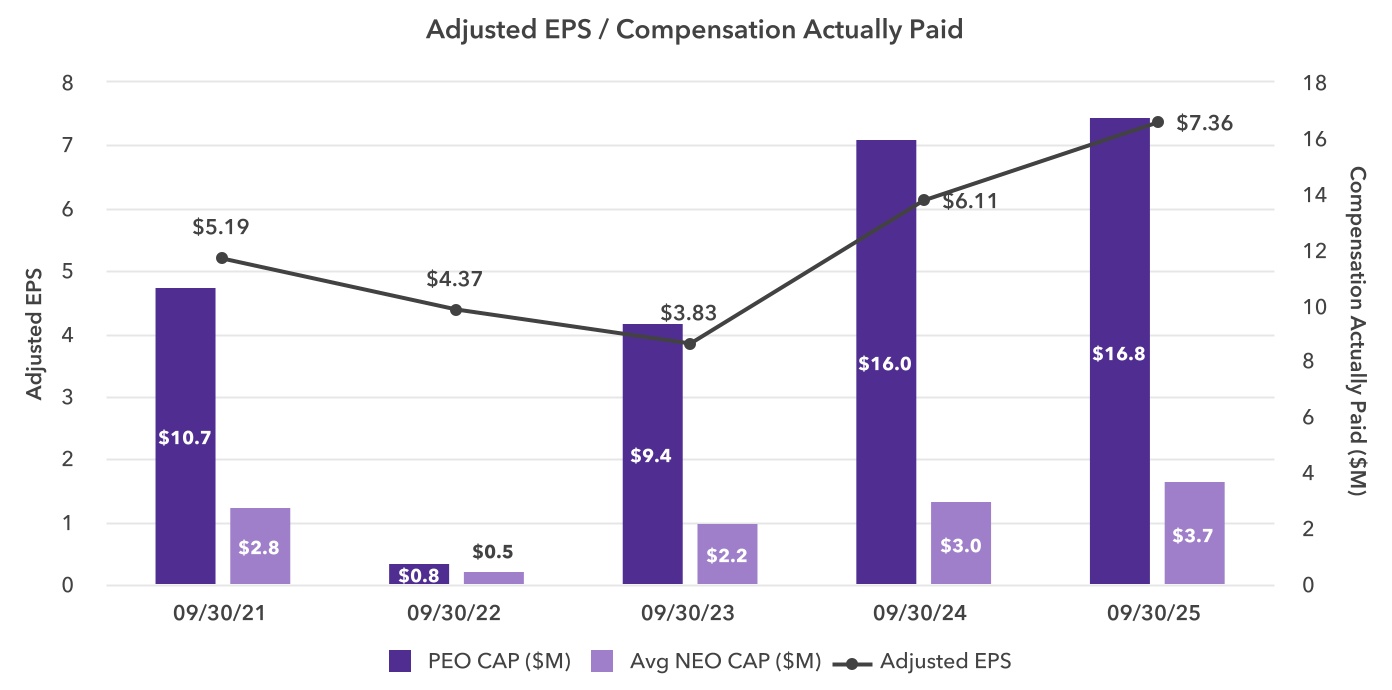
| $7.36 | | $366M |
Adjusted diluted earnings per share1 | | Free cash flow1 |
| | |
1.Adjusted earnings metrics and free cash flow are non-GAAP terms. A summary of our use of non-GAAP numbers as well as a description of how we calculate them, may be found in Item 7 of our Annual Report on Form 10-K for the year ended September 30, 2025, and filed with the SEC on November 20, 2025.
| | | | | | | | |
2 | MAXIMUS 2026 PROXY STATEMENT | |
Moving our Talent Forward
At Maximus, we want our employees to have a career, not just a job. This means it will take all of us, through tools, processes, technology, and a shared vision, to enable our talent to both redeploy internally and level-up for future skills. We are committed to Moving Our Talent Forward. Embarking on an organization-wide initiative of the same name, we are focused on planning and meeting our organization’s current and future strategic talent goals by empowering our most important success factor–our employees.
| | | | | | | | |
| | |
| Mobilizing our talent internally as the business needs | | Helping employees level-up for future skill needs |
| | |
To support mobilizing our talent internally, we created a Strategic Workforce Planning (SWP) function to advance an employee-centric approach to streamlining the redeployment of our workforce. They are dedicated to making certain that we have the right people with the right skills at the right time to meet the demands of our government clients to effectively serve and support citizens . This function oversees our “Beach” program, a virtual status designed to maintain continuity between assignments. This initiative is designed to safeguard income and benefits, provide stability during transitional periods, and support employees navigating change. It is also designed to facilitate seamless redeployment to new projects while offering structured opportunities for professional development and upskilling. We believe that the program strengthens talent readiness, accelerates business responsiveness, and reinforces our long-term capability strategy. Since its implementation, we have matched over 4,000 employees ending a project with open positions. preventing potential reductions in force. These efforts created value by avoiding severance, recruitment, and rehiring expenses, and created an atmosphere of increased employee security by taking steps to allow their careers to continue with us.
| | Artificial Intelligence (AI) is transforming how we work and redefining the types of roles and skills essential for future success. As an organization, we recognize this opportunity and are committed to equipping our employees to thrive in this rapidly changing landscape. We’ve committed to launch an internal AI initiative to provide learning paths tailored to the specific needs of our workforce. These programs are designed to upskill employees in two critical dimensions: •Technical proficiency in AI: Understanding the tools, technologies, and applications that will shape our operations. •Human-centric capabilities: Skills such as critical thinking, ethical judgment, problem framing, adaptability, and collaboration, which will become increasingly vital as AI becomes more prevalent. We are committed to offering our employees meaningful opportunities for growth. These custom AI learning paths will evolve in complexity based on organizational level, job type, and individual roles, and are designed to provide development that is relevant and impactful. Our goal is clear: to empower our people to lead in an AI-driven world and to provide that innovation enables the uniquely human capabilities needed for future success.
|
| | |
| | | | | | | | |
| MAXIMUS 2026 PROXY STATEMENT | 3 |
Our Values
We continue to build a culture that embodies our values of accountability, collaboration, compassion, customer focus, innovation, and respect. To support this effort, we look for ways to continuously embed these values into our organizational DNA, guiding our conduct and decision-making and reflecting our collective beliefs and ambitions. At Maximus, we share an authentic desire to do something meaningful to help others succeed. This is the Maximus culture and the bedrock of our brand identity and values. It’s who we are.
| | | | | | | | | | | | | | | | | |
| Respect | | Compassion | | Innovation |
| | | | | |
| Accountability | | Collaboration | | Customer Focus |
Strategy for Growth
Today’s rapidly changing world demands that governments have the capacity and flexibility to respond to the growing expectations of the people they serve. Maximus makes it easier for people to access public services more efficiently. As a leader in the ability to implement government customer priorities through use of outcomes-based operating models, we help advance technology modernization, tech-enabled customer experiences, and clinical health services that change lives.
The three pillars of our strategy are supported by significant and growing demand, the capabilities we bring to our goal of “moving people, technology, and government forward,” and our ability to deliver on customer priorities with differentiation and sustainable competitive advantage. We are embracing the relentless pace of technology and demonstrating the art of the possible to our government customers with AI, which we believe offers us a significant opportunity to transform service delivery in this era of rapid change.
| | | | | | | | | | | | | | |
| | | | |
Technology
Modernization | | Future
of Health | | Tech-Enabled Government Service Delivery |
| | | | |
•We modernize programs and legacy technology systems to be agile enough to meet the needs of a rapidly changing landscape. •As a mission-critical partner, we align solutions around the unique circumstances of each program. | | •We use innovative techniques and proven technologies and analytics to meet individuals on their own terms. •We automate complex processes and empower health professionals with timely, actionable data – enabling them to focus on individuals while responding to community needs at scale. | | •Our solutions provide efficient and tech-enabled access to critical benefits. •We deliver citizen services in an innovation ecosystem that drives measurable outcomes and unlocks the full potential of a customer’s mission through data-driven insights. |
| | | | | | | | |
4 | MAXIMUS 2026 PROXY STATEMENT | |
Board of Directors
The Nominating and Governance ("N&G") Committee works directly with the Chair to lead the Board in an annual self-evaluation process that assesses the performance of the Board as a whole, the committees of the Board, and the contributions of the individual directors. In fiscal year 2025, the N&G Committee recommended retaining the committee structure that was implemented on January 1, 2024.
| | | | | | | | | | | | | | | | | | | | |
| Name | Age | Director Since | Audit | Nominating & Governance | Compensation & Human Resources | Technology |
| | | | | | |
| Anne K. Altman | 66 | 2016 | | | l | |
| Bruce L. Caswell | 60 | 2018 | | | | |
| John J. Haley | 76 | 2020 | | l | | |
| Jan D. Madsen | 62 | 2020 | | | | l |
| Richard A. Montoni | 74 | 2006 | | | | |
| Gayathri Rajan | 58 | 2016 | | l | | l |
| Raymond B. Ruddy | 82 | 2004 | l | l | | |
| Michael J. Warren | 58 | 2019 | l | | l | l |
| | | | | | | | | | | | | | |
| Committee Chair | | l | Committee Member |
| | | | | | | | |
| MAXIMUS 2026 PROXY STATEMENT | 5 |
Board Composition
The N&G Committee has worked to provide that Maximus' Board reflects that of a strategic asset board that is defined by a variety of skills that will benefit the long-term strategy of the organization while at the same time representing the needs of our shareholders. We have wide array of stakeholders, with employees, customers, and stakeholders that represent a wide variety of viewpoints, and we are proud of our board composition and feel that it represents us well.
| | | | | | | | | | | | | | | | | | | | | | | | | | | | | | | | | | | | | | | | | | | | | | | | | | | | | | | | | | | | | | | | | | | | | | | | | | | | | | | | | | | |
| Director Tenure | | | Director Age |
| | | | | | | | | | | | | | | | | | | | | | | | | | | |
| l | l | l | l | l | l | l | l | | | l | l | l | l | l | l | l | l | | | l | l | l | l | l | l | l | l |
| 5 - 9 years | | | 50's | | | 60's |
| | | | | | | | | | | | | | | | | | | | | | | | | | | |
| | | | | | | | | | | | | | | | | | | | | | | | | | | |
| l | l | l | l | l | l | l | l | | | l | l | l | l | l | l | l | l | | | l | l | l | l | l | l | l | l |
| 10+ years | | | 70's | | | 80's |
| | | | | | | | | | | | | | | | | | | | | | | | | | | |
| | | | | | | | |
6 | MAXIMUS 2026 PROXY STATEMENT | |
Our Leadership
Our executive officers and their respective ages and positions as of the date of this proxy statement are as follows:
| | | | | | | | |
| Name | Age | Position |
| | |
| Bruce L. Caswell | 60 | Chief Executive Officer, President and Director |
| David W. Mutryn | 44 | Chief Financial Officer and Treasurer |
| Ilene R. Baylinson | 69 | General Manager, U.S. Services |
| Michelle F. Link | 51 | Chief Human Resources Officer |
| John T. Martinez | 53 | Chief Legal Officer and Corporate Secretary |
The following information sets forth biographical information for the past five years of the executive officers. Such information with respect to Bruce L. Caswell, our Chief Executive Officer and President, is set forth below in the “Proposal One - Election of Directors” section.
David W. Mutryn assumed the role of Chief Financial Officer in 2021. Mr. Mutryn joined Maximus in 2016 as Corporate Controller and transitioned to Senior Vice President of Finance in 2020. Prior to Maximus, Mr. Mutryn was Vice President of Finance at CSRA, Inc. and held numerous financial leadership positions at SRA International, Inc.
Ilene R. Baylinson has served as the General Manager of our U.S. Services Segment since 2020. She previously served as the General Manager of the U.S. Health Segment from 2015 to 2020. Ms. Baylinson joined Maximus in 1991.
Michelle F. Link joined Maximus in March 2020 as Chief Human Resources Officer. From 2018 to 2020 she served as the Executive Vice President of Human Resources for ADS, Inc. Before that she served as Chief Human Resources Officer for PRA Group from 2011 to 2018. She has also held senior Human Resources roles at BlueCross Blue Shield of Tennessee, AMERIGROUP (now Elevance Health), CIGNA, and Corning.
John T. Martinez joined Maximus in September 2023 as Chief Legal Officer and Corporate Secretary. Mr. Martinez previously served as Vice President and General Counsel of GE Aerospace from August 2021 to September 2023 where he was responsible for developing and executing GE Aerospace's legal strategy across the commercial aviation and defense sectors and led GE Aerospace's global legal, contracts, compliance, and government relations organizations. In the ten years prior, Mr. Martinez served in roles including senior leadership positions at Raytheon Intelligence & Space, the Director of National Intelligence, and the Central Intelligence Agency. Following the conclusion of our fiscal year 2025 and as disclosed in our Current Report on Form 8-K on December 18, 2025, Mr. Martinez announced his intention to resign effective as of February 15, 2026.
| | | | | | | | |
| MAXIMUS 2026 PROXY STATEMENT | 7 |
Corporate Governance
Board’s Role in Risk Oversight
The Board of Directors as a whole oversees risk management for us. Senior members of our management team regularly report to the Board on operational and financial risks relating to our projects, and about compliance with our policies and procedures and code of ethics.
| | | | | | | | | | | | | | | | | | | | | | | | | | | | | |
| Board of Directors | |
| | | | | | | | | |
| | | | | | | | | |
| Audit Committee | | Nominating and
Governance Committee | | | Compensation and Human Resources Committee | | Technology Committee | |
| | | | | | | | | |
| Oversees management of business and operational risks that could have a financial impact, such as those relating to internal controls and liquidity. | | Manages the risks associated with compliance matters, including receiving regular reports from our Chief Compliance Officer, governance issues, such as the independence and performance of the Board, and environmental and social issues. | | | Responsible for managing the risks relating to our executive compensation and succession plans and policies. | | Assists the Board with oversight of our information technology risks, strategic technology investments, and the quality and effectiveness of our cybersecurity policies and practices, including our use of AI. | |
| | | | | | | | | |
| | | | | | | | | |
| Enterprise Risk Management | |
| | |
Annually, we survey our key leaders to identify significant risks we face. Those risks are ranked based on likelihood of occurrence as well as potential impact and assigned a risk manager. Management engages risk managers to regularly update performance metrics and mitigation plans for risks identified in the assessment process. Key leaders oversee performance and mitigations and determine if action is necessary based on our tolerance for risk. The outcome of the process is reported to the Board. This process also informs our disclosure and discussion of risks in our SEC filings.
| | | | | | | | |
8 | MAXIMUS 2026 PROXY STATEMENT | |
Corporate Governance Guidelines
The Board of Directors has adopted Guidelines for Corporate Governance that set forth the practices of the Board with respect to the function of the Board, oversight of management, Board composition, selection of directors, operation of the Board and meetings, committees of the Board, director responsibilities, and tenure and evaluation of the Board and committees. The Guidelines for Corporate Governance are available on our Corporate Governance web page at investor.maximus.com/governance. The information contained on our website is not a part of this proxy statement and is not deemed incorporated by reference into this proxy statement or any other public filing made with the SEC.
Director Independence
Under our Guidelines for Corporate Governance and New York Stock Exchange (“NYSE”) rules, a director is not independent unless the Board affirmatively determines that he or she does not have a direct or indirect material relationship with us or any of our subsidiaries. Our Guidelines for Corporate Governance define independence in accordance with the independence definition in the current NYSE corporate governance rules for listed companies.
Our Guidelines for Corporate Governance require the Board to review the independence of all directors at least annually. In the event a director has a relationship with us that is relevant to his or her independence and is not addressed by the objective tests set forth in the NYSE independence definition, the Board will determine, considering all relevant facts and circumstances, whether such relationship is material.
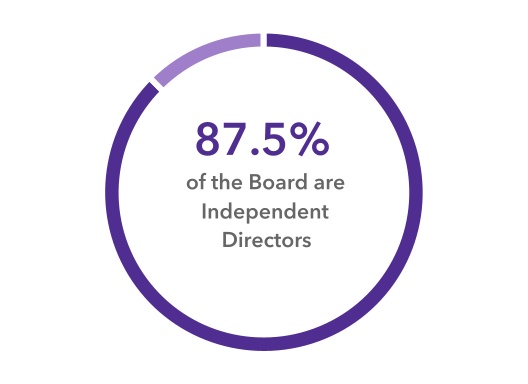
The Board of Directors in its business judgment has determined that the following directors are independent as defined by NYSE listing standards: Anne K. Altman, John J. Haley, Jan D. Madsen, Richard A. Montoni, Gayathri Rajan, Raymond B. Ruddy, and Michael J. Warren.
How Directors Are Elected
The Board of Directors currently consists of eight directors. All directors are elected annually for one-year terms, and the Board has nominated the eight director nominees for election at the Annual Meeting. If you sign and return your proxy card, the persons named as proxies in the proxy card will vote to elect those eight nominees unless you mark your proxy card otherwise. You may not vote for a greater number of nominees than eight. Each nominee has consented to being named in this proxy statement and to serve if elected. If for any reason a nominee should become unavailable for election prior to the Annual Meeting, the proxy holders may vote for the election of a substitute. We do not presently expect that any of the nominees will be unavailable.
Vote Required for the Election of Directors
Our by-laws provide for majority voting in director elections. The Board of Directors also has adopted a Director Resignation Policy. Under that policy, each director nominee has submitted a written contingent resignation which will become effective only if (i) the director fails to receive the required number of votes for re-election as set forth in our by-laws and (ii) the Board of Directors accepts the resignation. The affirmative vote of a majority of the total number of votes cast with respect to that director’s election is required to re-elect each nominee to our Board. Abstentions and broker non-votes will not be counted as votes cast and will have no effect on the outcome of this matter.
| | | | | | | | |
| MAXIMUS 2026 PROXY STATEMENT | 9 |
Director Nomination Process
Under the process we use for selecting new Board candidates, the Chief Executive Officer, the N&G Committee, or other Board members identify the need to add a new Board member with specific qualifications or to fill a vacancy on the Board. The Chair of the N&G Committee will initiate a search, working with staff support and seeking input from Board members and senior management, hiring a search firm, if necessary, and considering any candidates recommended by shareholders. The Chief Executive Officer and members of the N&G Committee interview prospective candidates. The N&G Committee recommends final candidates for approval by the full Board of Directors.
Shareholder Recommendations and Nominations of Director Candidates
The N&G Committee will consider qualified shareholder recommendations for candidates to serve on the Board of Directors and would evaluate any such candidate in the same manner described above. A shareholder may submit candidates for consideration by the N&G Committee if such shareholder gives timely written notice, in proper form, for each such recommended director nominee. To be timely for the 2027 Annual Meeting of Shareholders, the notice must be received within the time frame set forth in “Shareholder Proposals and Directors For Our 2027 Annual Meeting of Shareholders” below. To be in proper form, the notice must include each nominee’s written consent to be named as a nominee and to serve, if elected, and such other information as required under our by-laws. These requirements are more fully described in Article I, Section 6, of our by-laws.
Insider Trading Policy
We have adopted our Insider Trading Policy governing the purchase, sale, and/or other dispositions of our securities by our directors, officers, employees and other covered persons that we believe is reasonably designed to promote compliance with insider trading laws, rules and regulations, and the exchange listing standards applicable to us. A copy of our Insider Trading Policy is incorporated by reference as Exhibit 19.1 to our Annual Report on Form 10-K for the year ended September 30, 2025.
Code of Ethics
We have adopted a code of ethics that applies to all employees, including our principal executive officer, principal financial officer and principal accounting officer or controller, or persons performing similar functions. That code, our Standards of Business Conduct and Ethics, can be found posted on our Corporate Governance web page at investor.maximus.com/governance. The Board regularly reviews our code of ethics, and any amendment or waiver of our code of ethics required to be disclosed under the Securities Exchange Act of 1934 (the “Exchange Act”) will be reflected on our Corporate Governance web page.
| | | | | | | | |
10 | MAXIMUS 2026 PROXY STATEMENT | |
Director Attendance
Our Board expects that its members will prepare for, attend, and participate in all Board and applicable committee meetings. Our Board of Directors held eight meetings during fiscal year 2025. During our 2025 fiscal year, all of our directors attended at least 75% of the aggregate Board and applicable committee meetings.
We encourage members of the Board of Directors to attend our annual meetings. All of our directors attended our annual meeting in 2025.
Executive Sessions
Executive sessions where non-management directors meet on an informal basis are scheduled either at the beginning or at the end of each regularly scheduled Board meeting. John J. Haley, the independent, non-executive Chair of the Board, presides over the executive sessions.
Board Evaluations
As part of the Board’s ongoing commitment to continuous improvement, the N&G Committee leads the Board in an annual self-evaluation process that assesses the performance of the Board as a whole, the committees of the Board, and the individual directors. Based on results of the annual assessments, the Chair of the Board provides feedback to each respective Board member. In addition, an outside expert is engaged every five years to perform an in-depth, independent assessment. The most recent external assessment was completed in fiscal year 2022. Board members received feedback on their strengths and contributions, as well as opportunities for improvement. Feedback is also considered when designing education and certification road maps for each director.
| | | | | | | | | | | | | | | | | | | | | | | |
| | | | | | | |
| Nominating and Governance Committee leads the Board in an annual self-evaluation process that assesses the performance of: | |
| | | | | | | |
| | | | | | | |
| | | | | | | |
| The Board as a Whole | | The Committees of the Board | | The Individual Directors | |
| | | | | | | |
| | | | | | | |
| | | | | | | |
| Based on results of the annual assessments, the Chair of the Board provides feedback to each respective Board member. | |
| | | | | | | |
As a result of the Board evaluation process, the Board made several changes and enhancements to committee composition, overall Board focus, processes, information and resources as well as amplification of our positive Board culture. In fiscal year 2024, the Board adjusted committee assignments in accordance with Director skills and experiences, further aligned to our strategy and growth plans which have enhanced Board risk assessment, governance and oversight.
| | | | | | | | |
| MAXIMUS 2026 PROXY STATEMENT | 11 |
Stemming from the annual self-evaluation process, in fiscal year 2025, the Board initiated a two-day Board and senior management off-site session which examined our existing strategy, assessed historical implementation of, and performance against, our strategic metrics as well as reviewed changes to our future strategic direction based our capabilities, customer demand signals, and overall competitive landscape. The Directors also assessed allocation of Board meeting time, cadence, and presentation materials. Process improvements were implemented, including providing Directors with background reference materials for in-depth understanding of the presentation materials which have been streamlined highlighting important information while maintaining a thoroughness that allows Directors to better assess risk and perform their governance and oversight responsibilities. In addition, the Board has scheduled certain committee meetings to be held on a different cadence than the quarterly Board meetings. These changes have allowed greater time for discussion, debate, and detailed reviews of key risk areas and opportunities, focus on strategic trends, and the Board's engagement and interaction with senior management as well as emerging talent within the organization.
Lastly, consistent with our core values, the overall changes and enhancements made in fiscal years 2024 and 2025 further facilitated the Board's thoughtful discussion and debate in a collegial and collaborative environment that drives strategic priorities and facilitates stronger governance and oversight.
Director Education
The Board acknowledges the significance of continuous director education and is in regular pursuit of continuous learning to enhance governance and oversight responsibilities. The Board facilitates both internal and external speakers and presentations on relevant topics and encourages Directors to pursue their own independent education and continuous learning, including through external director education programs, presentations and professional articles. The Board also leverages formal Board and committee meetings to access regular presentations by subject-matter experts in a variety of areas relevant to our strategic priorities and that facilitates stronger oversight and governance for us. In fiscal year 2025 alone, the Board received numerous internal and external presentations by experts on topics including: enterprise risk management, ethics and compliance, political trends related to government contractors, emerging technology such as generative AI, machine learning, and cybersecurity risks, trends and best practices, human capital management, talent and succession planning, among others.
Independent Board Chair
Maximus has maintained separate Chief Executive Officer and Chair of the Board positions since before our initial public offering in 1997. John J. Haley currently serves as our independent, non-executive Chair of the Board. Under our Guidelines for Corporate Governance, the Board will periodically evaluate the separation of the CEO and Chair positions in light of our governance objectives and relevant circumstances. We believe that the separation of these roles at this time is appropriate and represents good corporate governance that promotes Board and director independence from the management team.
Mr. Haley brings experience to us from his prior roles as both board chair and CEO of a public company. Mr. Haley, together with Anne Altman in her capacity as Chair of the N&G Committee and Vice Chair, represent us in meetings with shareholders and lead the Board in consideration of input from shareholders and other stakeholders.
| | | | | | | | |
12 | MAXIMUS 2026 PROXY STATEMENT | |
Committees of the Board
The standing committees of the Board of Directors are the Audit Committee, the N&G Committee, the Compensation and Human Resources Committee ("C&HR Committee"), and the Technology Committee. Each committee operates under a written charter adopted by the Board. Committee charters, as amended and currently in effect, are available on our Corporate Governance web page at investor.maximus.com/governance/governance-documents.
| | | | | | | | | | | | | | |
| | | | |
| Audit Committee Jan D. Madsen (Chair) Raymond B. Ruddy Michael J. Warren Meetings in fiscal 2025: 5 | | | The Audit Committee assists the Board of Directors in fulfilling its responsibility to oversee management’s conduct of our financial reporting processes and the integrity and audits of our financial statements. The Audit Committee specifically reviews the financial reports and other financial information provided by us, our disclosure controls and procedures, internal accounting and financial controls, the internal audit function, the risk management function, the legal compliance and ethics programs, and the annual independent audit process. Each member of the Audit Committee is independent as defined by applicable NYSE listing standards and SEC regulations governing the qualifications of audit committee members. The Board of Directors has determined that all of the Audit Committee members are financially literate as defined by the NYSE listing standards and that Ms. Madsen, Mr. Ruddy, and Mr. Warren qualify as audit committee financial experts as defined by regulations of the SEC. For additional information regarding the Audit Committee, see “Report of the Audit Committee” below. |
| | | | |
| | | | | | | | |
| MAXIMUS 2026 PROXY STATEMENT | 13 |
| | | | | | | | | | | | | | |
| | | | |
| Nominating & Governance Committee Anne K. Altman (Chair) John J. Haley Gayathri Rajan Raymond B. Ruddy Meetings in fiscal 2025: 4 | | | The purpose of the N&G Committee is to oversee the lifecycle of the Board to include identifying, evaluating, and recommending candidates for membership on the Board of Directors, to establish and assure the effectiveness of the governance principles of the Board and for us, and to oversee the ongoing training and assessments/evaluations of our directors. The N&G Committee is responsible for assessing the appropriate mix of skills, qualifications, and characteristics for the effective functioning of the Board in light of our needs. The N&G Committee considers, at a minimum, the following qualifications in recommending to the Board potential new directors, or the continued service of existing directors: •personal characteristics, such as the highest personal and professional ethics, integrity and values, an inquiring and independent mind, with a respect for the views of others, ability to work well with others, and practical wisdom and mature judgment; •broad, policy-making level experience in business, government, academia, or science to understand business problems and evaluate and formulate solutions; •experience and expertise that is useful to us and complementary to the background and experience of other directors; •willingness and ability to devote the time necessary to carry out duties and responsibilities of directors and to be an active, objective, and constructive participant at meetings of the Board and its committees; •commitment to serve on the Board over a period of several years to develop knowledge about our principal operations; and •willingness to represent the best interests of all shareholders and objectively evaluate management performance. The N&G Committee has oversight of our governance initiatives. The N&G Committee also oversees and receives reports at least quarterly on (1) compliance with U.S. laws and our policies pertaining to political contributions, (2) political activities and contributions of the Maximus Political Action Committee, (3) significant lobbying priorities and related expenditures in the U.S. and (4) expenditures relating to our principal U.S. trade associations. |
| | | | |
| | | | | | | | |
14 | MAXIMUS 2026 PROXY STATEMENT | |
| | | | | | | | | | | | | | |
| | | | |
| Compensation & Human Resources Committee John J. Haley (Chair) Anne K. Altman Michael J. Warren Meetings in fiscal 2025: 5 | | | The C&HR Committee is responsible for reviewing, approving, and overseeing our compensation and executive benefit programs, evaluating their effectiveness in supporting our overall business objectives and facilitating an appropriate structure and process for management succession. The C&HR Committee also reviews, in conjunction with the CEO and the Chief Human Resources Officer (CHRO), activities impacting human resources such as global inclusion and belonging initiatives, the Global Employee Engagement Survey, and labor relations. Specifically, the C&HR Committee is responsible for: •evaluating the performance and setting the compensation of the Chief Executive Officer and approving the CEO’s recommendations for other members of senior management; •reviewing our compensation policies and practices; •overseeing executive succession plans; and •reviewing the risks associated with our incentive compensation programs. To assist in its efforts to meet the objectives outlined above, the C&HR Committee also retains an independent consulting firm to advise it on executive compensation programs. For additional information regarding the C&HR Committee, see “Compensation and Human Resources Committee Report” below. |
| | | | |
| | | | | | | | |
| MAXIMUS 2026 PROXY STATEMENT | 15 |
| | | | | | | | | | | | | | |
| | | | |
| Technology Committee Richard A. Montoni (Chair) Jan D. Madsen Gayathri Rajan Michael J. Warren Meetings in fiscal 2025: 5 | | | The Technology Committee assists the Board of Directors in fulfilling its responsibility to oversee our strategic information technology investments and our risk management efforts pertaining to cybersecurity, AI, and the protection of data assets. The Technology Committee meets regularly with our Chief Digital & Information Officer and our Chief Information Security Officer. Strategic technology investments include investments that are considered material expenditures and are important for the ongoing success of the business. These also include evaluation of our merger and acquisition strategy intended to supplement or supplant our technology portfolio. Risk management includes protecting our intellectual property and other data assets – in particular customer data – from theft or other compromise. This includes protection from external bad actors, as well as from unauthorized access on the part of employees, partners and customers. It also includes oversight of our use of AI to sort, organize, analyze, and generate data for business purposes, including the use of machine learning, generative AI, and other standard techniques. The comprehensive lifecycle utilization of AI, whether implemented directly by us or in collaboration with third parties, necessitates ongoing investment in governance and security resources to provide for our responsible use of AI and to safeguard against potential risks and vulnerabilities. With oversight from the Technology Committee, our AI Guiding Principles aim to ensure that our approach to AI is grounded in: •Human Oversight and Accountability •Ethical and Inclusive Design •Iterative Development These guiding principles help support our continued compliance with applicable laws and regulations, align with industry standards and best practices, and take societal and environmental well-being into consideration. |
| | | | |
| | | | | | | | |
16 | MAXIMUS 2026 PROXY STATEMENT | |
Shareholder Engagement and Responsiveness
Maximus is committed to engaging directly with our shareholders to understand their views on governance matters. Maximus, including members of our Board of Directors as appropriate, regularly meets with major shareholders on a wide range of topics including strategy, financial performance, capital allocation, corporate governance, and executive compensation. In addition, the full Board receives and reviews reports on investor feedback and emerging governance issues, allowing our directors to better understand shareholder priorities and perspectives.
We actively consider shareholder feedback and, as warranted, take action. During the last fiscal year, Maximus engaged with investors regarding, among other topics: the financial impact of actions by the U.S. federal government, a multitude of AI-based topics including Board oversight, opportunities for efficiency and cost-savings, and human capital implications, as well as capital allocation strategy, management succession planning, and Board refreshment and governance.
| | | | | | | | |
| MAXIMUS 2026 PROXY STATEMENT | 17 |
Director Compensation Table
The table below summarizes the compensation paid to our non-employee directors in fiscal year 2025.
| | | | | | | | | | | | | | |
Name | Fees Earned or Paid in Cash ($) | Stock Awards ($)(1) | Total ($) | |
| | | | |
Anne K. Altman(2) | 150,000 | | 210,000 | | 360,000 | | |
John J. Haley(3) | — | | 500,000 | | 500,000 | | |
Jan D. Madsen(4) | 105,000 | | 225,000 | | 330,000 | | |
Richard A. Montoni(5) | 320,000 | | — | | 320,000 | | |
Gayathri Rajan(6) | 150,000 | | 150,000 | | 300,000 | | |
Raymond B. Ruddy(7) | 335,000 | | — | | 335,000 | | |
Michael J. Warren(8) | 150,000 | | 150,000 | | 300,000 | | |
1.The amounts in this column reflect the aggregate grant date fair values, computed in accordance with FASB ASC Topic 718, of RSU awards made on March 11, 2025, under our 2021 Omnibus Incentive Plan. For each of the RSU awards, the grant date fair value is calculated using the closing price of our common stock on the grant date as if these awards were vested and issued on the grant date. The amounts shown disregard estimated forfeitures. For additional information regarding the assumptions used in determining the fair value of an award, please refer to Note 12 to the consolidated financial statements contained in our Annual Report on Form 10-K for the year ended September 30, 2025.
2.As of September 30, 2025, Ms. Altman held 3,085 unvested RSUs.
3.As of September 30, 2025, Mr. Haley held 7,346 unvested RSUs and an additional 22,873 deferred shares.
4.As of September 30, 2025, Ms. Madsen held 3,306 unvested RSUs and an additional 11,243 deferred shares.
5.As of September 30, 2025, Mr. Montoni held 0 unvested RSUs.
6.As of September 30, 2025, Ms. Rajan held 2,204 unvested RSUs.
7.As of September 30, 2025, Mr. Ruddy held 201,291 deferred shares.
8.As of September 30, 2025, Mr. Warren held 2,204 unvested RSUs and an additional 9,133 deferred shares.
Fees Payable to Non-Employee Directors
The director compensation for fiscal year 2025 as shown in the chart above was comprised of the below elements. With the assistance of Frederic W. Cook & Co., Inc. ("FW Cook"), the C&HR Committee’s compensation consultant, regularly reviews our non-employee director compensation and evaluates the competitiveness and reasonableness of the compensation program in light of general trends and practices. Based on its review, in fiscal year 2025 the C&HR Committee recommended no changes to the non-employee director compensation, determining it was competitive compared to our peer group.
Directors who are also Maximus employees do not receive additional compensation for their services as directors.
•An annual retainer of $300,000 payable in time-based restricted stock units (“RSUs”) or cash, with a minimum amount of $150,000 in RSUs unless a director holds more than seven times the annual retainer in Maximus equity.
| | | | | | | | |
18 | MAXIMUS 2026 PROXY STATEMENT | |
•Ms. Altman received an additional $20,000 retainer for her services as the Chair of the N&G Committee, and an additional $40,000 as Vice Chair of the Board.
•Mr. Haley received an additional $180,000 retainer for his services as Chair of the Board and a $20,000 retainer for his services as the Chair of the C&HR Committee.
•Ms. Madsen received an additional $30,000 retainer for her services as the Chair of the Audit Committee.
•Mr. Montoni received an additional $20,000 retainer for his services as Chair of the Technology Committee.
•Mr. Ruddy received an additional $35,000 retainer, which is a continuation of the additional retainer he previously received for his services as Vice Chair of the Board, which reflects his leadership role on the Board and recognizes the additional time that he continues to spend on Maximus matters over and above his normal director duties.
•RSU awards granted to our non-employee directors vest after one year; directors may elect to defer receipt of shares for their RSUs for a longer period up to termination of service on the Board of Directors.
We also permit our directors to participate in the medical and dental plans that we offer to our employees, although each director who elects to participate must pay the full cost of his or her own premiums in the plan. During fiscal year 2025, Mr. Montoni and Mr. Ruddy participated in portions of those plans.
In fiscal year 2026, the C&HR Committee approved a $15,000 increase to the annual retainer, increasing the portion to be paid in RSUs from $150,000 to $165,000.
Director Equity Ownership Requirements
Directors are required to hold equity of Maximus equal to at least five times their annual cash retainer. Furthermore, directors that opt to receive more than $150,000 of their annual retainer in cash are required to hold more than seven times their annual retainer in equity. For these purposes, “equity” consists of shares owned directly by the director, and any vested shares that would have been distributed to the director but for the director’s election to defer receipt of the shares for tax purposes. All of our directors met the ownership requirement as of the end of fiscal year 2025.
How To Communicate with Us
Our Board of Directors values input from a wide array of sources to inform its deliberations and decision-making. Since shareholders have a financial stake in our success and represent independent sources of information, the Board especially values shareholder questions and insights. The Board has therefore created a number of ways to obtain shareholder input including via participation at the annual meeting, use of our various reporting mechanisms including our hotline and audit functions, requests for individual director engagements, and use of the official communications mechanism described here.
Shareholders and other interested parties wishing to communicate with the Board of Directors, the non-employee directors, or any individual director (including any committee chair) may do so by sending a communication to the Board of Directors and/or a particular member of the Board of Directors, care of the Corporate Secretary at Maximus, 1600 Tysons Boulevard, McLean, Virginia 22102. Depending upon the nature of the communication and to whom it is directed, the Corporate Secretary will, as appropriate: (a) forward the communication to the appropriate director or directors; (b) forward the communication to the relevant department within Maximus; or (c) attempt to handle the matter directly (for example, a communication dealing with a share ownership matter).
| | | | | | | | |
| MAXIMUS 2026 PROXY STATEMENT | 19 |
Proposal One
Election of Directors
| | | | | | | | |
| | The Board of Directors recommends that the shareholders vote “FOR” the eight nominees set forth below. |
The Maximus Board of Directors takes seriously the opportunity that you, our shareholders, have to cast votes to elect or re-elect us each year.
When seeking to identify candidates to be considered for potential Board membership, our Board strives for a candidate pool with an appropriate mix of skills, qualifications and characteristics for the effective functioning of the Board in light of the needs of the Company. The Board and the N&G Committee assess the appropriate mix of skills, qualifications, and characteristics when looking for new directors and nominating current directors in conjunction with our needs as we continues to evolve.
In 2022, our Board of Directors spent a significant amount of time working to ensure that they are a strategic asset board – a board that has the critical skills, knowledge, and expertise to advise us on subjects specific to our operations and proactively contribute to our successful execution of strategic objectives. We revisited our traditional skills matrix and assessed which skills are needed most, both for today and for the upcoming three to five years.
The following skills are highlighted within the biographies of our current Board members, but are not all-inclusive of the experience and knowledge on which we rely on each individual:
•Additional Public Company Board, CEO/CFO or NEO
•Government Service Delivery
•Intelligent Modernization
•Financial Acumen
•Mergers & Acquisitions
•Cybersecurity & Data Privacy
We also developed, in conjunction with the N&G Committee, a competency matrix with appropriate proficiency assessments for Directors to better assess their skills relative to what would most benefit Maximus. This activity has been important to the Board and N&G Committee in their work to refresh the Board. The progression of a strategic asset board is anticipated to be a multi-year process as we carry out our strategic priorities.
We continue to believe that these skills and our Board’s representation of these skills and experiences position us for future success by aligning with our strategic direction.
| | | | | | | | |
| MAXIMUS 2026 PROXY STATEMENT | 21 |
Biographical Information of Director Nominees
The following presents biographical information about the eight directors nominated by the Board for election at the Annual Meeting. As part of the information below, we have included a brief description of the experience, qualifications, attributes, and skills that led to the conclusion that each director should serve on the Board. Information about the number of shares of common stock beneficially owned by each director, directly or indirectly, as of January 12, 2026, appears below under “Security Ownership - Security Ownership of Management.”
Nominees for Director (terms expiring in 2027)
| | | | | | | | |
| | Key Qualifications: Ms. Altman contributes to the Board's extensive leadership experience advising public sector clients in the information technology industry. Her expertise includes security, analytics, digital, commerce and cloud capabilities. She also provides valuable insights related to strong governance practices and enterprise risk management. •Government Service Delivery – at IBM (NYSE: IBM), served as General Manager, U.S. Federal and Government Industries ($4 billion business) and General Manager, Global Public Sector ($20 billion business). Responsible for strategy, solutions development and advisory services for U.S. Federal Government and global public sectors, including compliance with federal and international regulations. •Financial Acumen, Mergers & Acquisitions – throughout various IBM leadership roles, guided multiple strategic acquisitions ranging from $200 million - $2.6 billion, with a total of ~$5 billion in deal value across the healthcare industry, Watson analytics and the IBM Mainframe. •Intelligent Modernization – responsible for IBM’s initial AI implementations with Watson in healthcare and government. As a General Manager at IBM, she also oversaw the implementation of highly innovative capabilities in processor architecture, cryptography, virtualization and cloud-like workloads in the mainframe business and led IBM’s Smarter Cities initiative to help organizations, states and countries focus on transforming infrastructure, citizen-based services, healthcare, and education to improve economic vitality. •Cybersecurity & Data Privacy – acquired IT security expertise through various government-facing systems engineering roles and projects, which required a deep understanding of the complex data security landscape. •Governance - Chair or member of Nominating and Governance Committees, focused on discipline and finding best practices and processes for companies to implement. Career Snapshot Ms. Altman currently serves as the Co-Founder and Chief Executive Officer of Everyone Matters (since 2017), a social impact enterprise focused on citizen services. She is also an Advisor at Blue Delta Capital Partners (since 2024), a venture capital firm focused on the U.S. Federal government market. Previously, Ms. Altman served at IBM (1981-2016), most recently as the company’s General Manager for U.S. Federal and Government Industries. She also served as General Manager for IBM's Global Public Sector with responsibilities for national, regional and local governments, education, healthcare and life sciences. She began her tenure at IBM as a systems engineer and held several roles of increasing responsibility in areas pertaining to the public sector and technology. |
| |
Anne K. Altman Age: 66 Director Since: 2016 Vice Chair Since: 2021 Committees: •Nominating and Governance (Chair) •Compensation and Human Resources Education: B.S., Marketing, George Mason University Other Notable Positions: SPX Flow, Inc. (NYSE: SPXC), Director (2015-2022) Siemens Government Technologies, Inc., Chairman of the Board TechFlow, Inc., Board Member | |
| | | | | | | | |
22 | MAXIMUS 2026 PROXY STATEMENT | |
| | | | | | | | |
| | Key Qualifications: Mr. Caswell is a seasoned business leader with expertise in government policy, program operations, and technology solutions. As Chief Executive Officer and President of Maximus, he brings operational insight from a range of his prior leadership roles across our business segments and provides a critical bridge between the Board’s oversight of key risks and the management team’s execution of technology-focused growth strategies. •Intelligent Modernization – at IBM (NYSE: IBM), spearheaded federal technology modernization bids, guided an emerging technology team within IBM Software Group, and oversaw P&L for state, local and education technology solutions. As President & General Manager of multiple Maximus business segments, oversaw business process outsourcing and technology modernization projects that supported critical federal and state programs. •Government Service Delivery – began career in Federal consulting with Price Waterhouse where he contributed to nationwide transformation in the delivery of public assistance benefits leveraging financial services infrastructure. Led Federal Sales for IBM Business Consulting Services, developing a deep understanding of federal procurement processes, including contract compliance, pricing and bidding. Led Maximus business segments responsible for delivery of critical services supporting Medicaid, Medicare, the Affordable Care Act, and Veterans' Benefits. •Financial Acumen, Mergers & Acquisitions – as Chief Executive Officer and President of Maximus, has successfully managed our global revenue of more than $5 billion and overseen a disciplined capital allocation strategy. Guides a programmatic M&A team through identifying strategic capabilities and acquisition targets to strengthen long-term organic growth. Career Snapshot: Mr. Caswell was appointed Chief Executive Officer of Maximus in 2018 and has been with Maximus since 2004 in a variety of leadership roles including President, President of Health Services, President of Operations and President of Human Services. He previously worked at IBM Corporation for nine years, serving most recently as Vice President, State and Local Government & Education Industries for IBM Business Consulting Services. Mr. Caswell began his career at Price Waterhouse in the Office of Government Services. |
| |
Bruce L. Caswell Age: 60 Director Since: 2018 Education: Masters, Public Policy, John F. Kennedy School of Government at Harvard University B.A., Economics, Haverford College Other Notable Positions: Professional Services Council, Vice Chair Northern Virginia Technology Council, Immediate Past Chair Inova Health System, Board Member Greater Washington Partnerships, Board Member | |
| | | | | | | | |
| MAXIMUS 2026 PROXY STATEMENT | 23 |
| | | | | | | | |
| | Key Qualifications: Mr. Haley brings a deep understanding of strategic planning, risk management and human capital matters, acquired through his role as Chief Executive Officer and Chair of a global publicly-traded consulting firm focused on insurance solutions, human resources and employee benefits. •Mergers & Acquisitions – led strategic evaluation and execution of several key strategic transactions, which resulted in the creation of present-day global consulting firm Willis Towers Watson and numerous partnerships and transactions that resulted in growing the company to many times its original size. •Financial Acumen – as Chief Executive Officer of Willis Towers Watson, was responsible for overseeing its $9 billion of revenue and as President and CEO of Watson Wyatt Worldwide, led the company’s successful IPO in 2000. •Additional CEO/CFO, Public Board, NEO Experience – CEO of Willis Towers Watson for 23 years. Chairman of the Board for Hudson Highland, a publicly traded company. •Governance - leverages experience from Willis Towers Watson to enhance governance programs, particularly with respect to Board and NEO compensation structures, driving focus on shareholder return and best practices. Career Snapshot: Mr. Haley is the former Chief Executive Officer of Willis Towers Watson (2016-2021), an insurance broker and human resources and employee benefits consulting firm. From 2010 until 2016, Mr. Haley served as the Chief Executive Officer and Chair of the Board of Towers Watson & Co. Prior to that, he served as President and Chief Executive Officer of Watson Wyatt Worldwide from 1999 until its merger with Towers Perrin, Forster & Crosby in 2010. Mr. Haley joined Watson Wyatt in 1977. He is a Fellow of the Society of Actuaries. |
| |
John J. Haley Age: 76 Chair Since: 2021 Director Since: 2020 Committees: •Compensation and Human Resources (Chair) •Nominating and Governance Prior Tenure on Board of Directors: 2002 – 2019 Education: A.B., Mathematics, Rutgers University Other Notable Positions: Willis Towers Watson (NASDAQ: WTW), Director (2016-2021) | |
| | | | | | | | |
24 | MAXIMUS 2026 PROXY STATEMENT | |
| | | | | | | | |
| | Key Qualifications: Ms. Madsen is a Certified Public Accountant with over fifteen years of experience in global public company senior finance and operations roles. Ms. Madsen brings extensive expertise in finance, accounting, mergers and acquisitions, and operational management, developed through her senior leadership roles in higher education and international, publicly traded, technology-based, business services organizations. •Financial Acumen – as the former Chief Financial Officer of West Corporation, oversaw a $3 billion revenue business with a $5 billion market capitalization, operating in 28 countries. As a senior finance leader, has been responsible for global financial operations, internal audit, public reporting, treasury and capital markets transactions. •Intelligent Modernization – as Chief Financial Officer of the Financial Services Division of First Data, a company focused on developing technology platforms for financial institutions, gained experience in software and product development and innovation. As CFO of West Corporation, served Fortune 500 clients and government clients with technology-based solutions. As Executive Vice President (“EVP”) of Creighton University (“Creighton”), she has oversight over Creighton’s AI implementation plan, including governance, policy, tool selection and workforce planning and education. •Mergers & Acquisitions – led West Corporation’s $335 million acquisition of Nasdaq’s digital media businesses in 2018 and $5 billion take private transaction in 2017. Additionally, guided First Data’s $29 billion take private transaction in 2007. •Cybersecurity & Data Privacy – as EVP of Creighton, she oversees investments to enhance its cybersecurity and data privacy profile, and has implemented new policies, tools, infrastructure, and training. She also holds a CERT certificate in Cybersecurity Oversight, an NACD certification on Cyber-Risk Oversight, and recently completed a certification in AI Ethics and Board Oversight through the Diligent Institute. •Governance - Audit Committee Chair focused on best practices, compliance and risk analysis. Career Snapshot: Ms. Madsen currently serves as the Executive Vice President of Creighton University where she leads the institution’s operations, finance, information technology, enterprise risk management, human resources, communications and marketing, facilities, internal audit and continuous improvement initiatives. Previously, she was Chief Financial Officer of West Corporation (NASDAQ: WSTC) (2014-2018) and held a variety of senior finance and operational roles at First Data Corporation (formerly NYSE: FDC) (1994-2008), including segment Chief Financial Officer and Senior Vice President of Six Sigma Quality. She started her career with a global public accounting firm. |
| |
Jan D. Madsen Age: 62 Director Since: 2020 Committees: •Audit (Chair) •Technology Education: B.S.B.A., Accounting, University of Nebraska – Lincoln Other Notable Positions: Executive Vice President, Creighton University | |
| | | | | | | | |
| MAXIMUS 2026 PROXY STATEMENT | 25 |
| | | | | | | | |
| | Key Qualifications: Mr. Montoni brings deep insights into Maximus’ strategic advantages and corporate culture. As the Company’s former Chief Executive Officer and Chief Financial Officer, he was responsible for transforming Maximus into a focused, leading partner to governments across new geographies. Under his leadership, Maximus delivered significant shareholder value, and he continues to provide the Board with a critical perspective on profitable growth opportunities. •Additional CEO/CFO, Public Board, NEO Experience – CFO of Managed Storage International (2000 – 2001), CFO of CIBER (1996 – 2000). •Mergers & Acquisitions – during tenure as Chief Executive Officer of Maximus, led the international expansion strategy into the UK, Canada and Australia, which was successfully executed primarily through strategic M&A transactions. Oversaw strategic financial aspects, including target evaluation, due diligence and transaction execution maintaining alignment with long-term growth priorities. •Financial Acumen – expanded Maximus’ revenue from $700 million to over $2.4 billion between 2006 and 2017. Developed extensive financial leadership expertise through numerous Chief Financial Officer roles at Managed Storage International, CIBER and Maximus, complemented by nearly two decades of accounting and auditing experience at KPMG. •Government Service Delivery and Intelligent Modernization – throughout his tenure as both Chief Executive Officer and Chief Financial Officer of Maximus, directed complex business process outsourcing initiatives supporting critical services of Health and Human Services federal programs. Guided our strategic expansion into new service areas, leveraging new regulatory environment and streamlining operations by divesting non-core businesses. Recently completed a certification course in AI Ethics & Board Oversight. Career Snapshot: Mr. Montoni previously served as Senior Advisor to the Chief Executive Officer of Maximus (2018-2019), following his tenure as our Chief Executive Officer (2006-2018). He also held roles of President (2006-2014) and Chief Financial Officer and Treasurer (2002-2006). Prior to joining Maximus, Mr. Montoni served as Chief Financial Officer and Executive Vice President for Managed Storage International (2000-2001) and previously served as Chief Financial Officer and Executive Vice President for CIBER, Inc. (NYSE: CBR). Prior to that he was an audit partner with KPMG LLP. |
| |
Richard A. Montoni Age: 74 Director Since: 2006 Vice Chair (prior): 2018 - 2023 Committee: •Technology (Chair) Education: Masters, Accounting, Northeastern University B.S., Economics, Boston University | |
| | | | | | | | |
26 | MAXIMUS 2026 PROXY STATEMENT | |
| | | | | | | | |
| | Key Qualifications: Ms. Rajan is a proven technology leader with extensive experience in scaling innovative consumer products across the healthcare, advertising and payments industries. With nearly 20 years of experience leading product platforms at Google and other senior technology roles bring valuable expertise to the Board’s oversight of Maximus’ technology-driven growth strategy. •Intelligent Modernization – as the Global head of Product and Partnerships at Adyen, she is responsible for driving the company's ML/AI strategy and product portfolio spanning payments and financial products. Previously, as a senior product executive at Google, she drove pivotal product and technology innovations for Google Maps, Google Payments, and Android. •Cybersecurity & Data Privacy – developed and executed cybersecurity and data privacy oversight and protection strategies across multiple product leadership roles. •Mergers & Acquisitions – throughout her tenure at Google, supported the company’s programmatic M&A process, with a particular focus on due diligence processes. Career Snapshot: Ms. Rajan is the Global Head of Product and Partnerships at Adyen (OTCMKTS: ADYEY) (since 2023), a financial technology platform. Previously, she was the Chief Product Officer at DriveWealth (2022-2023), a fintech company offering investment and trading services. Ms. Rajan held various roles at Google (NASDAQ: GOOG) (2006-2022), including as Product VP and General Manager for Google Maps Platform. She also held engineering and product management roles at Air Products & Chemicals (NYSE: APD), The Vanguard Group, and Unilever (NYSE: UL). |
| |
Gayathri Rajan Age: 58 Director Since: 2016 Committees: •Nominating and Governance •Technology Education: MBA Stanford University MSc Computer Science, University of Pennsylvania B.A. and M. Eng, Chemical Engineering, Cambridge University Other Notable Positions: Shape Therapeutics, Inc., Board Member (2022-2024) DriveWealth, Chief Product Officer (2022-2023) | |
| | | | | | | | |
| MAXIMUS 2026 PROXY STATEMENT | 27 |
| | | | | | | | |
| | Key Qualifications: Mr. Ruddy's deep familiarity with Maximus’ operations and strategic evolution, as well as his extensive consulting and financial expertise, strengthens the Board’s insights into operations oversight and evolving risk management considerations in the government services industry. •Financial Acumen – gained his MBA through the Wharton School of Business and as a Partner and Associate National Director of Consulting with Touche Ross, an international accounting and consulting firm, where he advised on accounting, auditing and computer privacy issues. He also began his career at Maximus guiding the Controllership function. •Mergers & Acquisitions – as a senior executive at Maximus, led the strategic financial positioning of numerous significant transactions, including our IPO in 1997. •Government Service Delivery – during tenure as President of Maximus’ Consulting group, led state-facing programs focused on revenue maximization services with a focus on Medicaid and welfare programs. •Cybersecurity & Data Privacy – at Touche Ross, he addressed computer privacy and security matters, and as the former chair of Maximus’ Audit Committee he oversaw cybersecurity matters. Career Snapshot: Mr. Ruddy served in various leadership roles at Maximus for a nearly 17-year tenure (1985-2001), most recently serving as President of the Consulting Group (1989-2000). He also served as Chair of the Board (1985-2001) and later as Vice Chair (2005-2019). Prior to joining Maximus, Mr. Ruddy held senior roles at Touche Ross & Co., including Associate National Director of Consulting (1982-1984) and Director of Management Consulting (1978-1983) |
| |
Raymond B. Ruddy Age: 82 Director Since: 2004 Vice Chair (prior): 2005 – 2018 Committees: •Audit •Nominating and Governance Prior Tenure: 1985 – 2001 Education: MBA, Wharton School of Business of the University of Pennsylvania B.S., Economics, Holy Cross College | |
| | | | | | | | |
28 | MAXIMUS 2026 PROXY STATEMENT | |
| | | | | | | | |
| | Key Qualifications: Mr. Warren brings over two decades of global leadership in financial services, international business and government policy to the Board. His familiarity with government programs and expertise in value-creating operational investments, financial services and corporate strategy strengthen the Board’s oversight of Maximus’ key stakeholder relationships and growth initiatives. •Additional CEO/CFO, Public Board, NEO Experience, Financial Acumen – Managing Director of Albright Stonebridge Group (“ASG”), a global strategy and commercial diplomacy firm, since 2017, Managing Principal of ASG (2013-2017), and Principal of ASG (2009-2013). Chief Operating Officer and Chief Financial Officer of Stonebridge International (2004-2009). •Mergers & Acquisitions – at ASG, advised clients on strategic growth and capital allocation decisions, including mergers and acquisitions. Has guided numerous transactions and supported clients in navigating variable economic and geopolitical issues influencing global deal markets. •Financial Acumen – as Chief Operating Officer and Chief Financial Officer of Stonebridge International, has managed complex operations, business development initiatives, corporate finance and personnel portfolios. •Intelligent Modernization – leads ASG’s Global Innovation and Growth Group, advising clients on international expansion strategies. Additionally, began his career advising technology and financial institution sector companies as a strategic consultant at McKinsey & Company. •Government Services Delivery – provides valuable perspectives on the evolving government contracting, regulatory and public policy landscape, informed by senior advisory roles held within presidential administrations. •Governance – in addition to deep experience serving various Boards, both public and private, he has recently restructured the governance model of ASG. Career Snapshot: Mr. Warren was a founding member of the DGA Group ASG, (formerly Dentons Global Advisors) when it was launched in conjunction with ASG in 2021, and serves on the Board of Directors of DGA Group. Since March 2022, Mr. Warren has served as a Board member of Brookfield Business Corporation (NYSE: BBUC)), a Canadian corporation and paired entity with Brookfield Business Partners, a global business services and industrial company. Mr. Warren is a former Trustee of Yale University, where he chaired the University’s Audit Committee, and was a member of the Investment Committee of the Yale Corporation Endowment.
|
| |
Michael J. Warren Age: 58 Director Since: 2019 Committees: •Audit •Compensation and Human Resources •Technology Education: B.A., History, Yale University B.A., Philosophy, Politics and Economics, Balliol College, University of Oxford, Rhodes Scholar Other Notable Positions: Walker & Dunlop Inc (NYSE: WD), Director (2017-2024) Brookfield Property Partners (formerly NASDAQ: BPY), Director (2020-2021) District of Columbia Retirement Board, Board of Trustees (2006-2020) Overseas Private Investment Corporation (“OPIC”), Board Member (2009-2019) Commonfund, Board of Trustees Ripple Labs, Board Member | |
| | | | | | | | |
| MAXIMUS 2026 PROXY STATEMENT | 29 |
Proposal Two
Ratification of the Appointment of Independent Registered Public Accounting Firm
| | | | | | | | |
| | The Board of Directors recommends that the shareholders vote "FOR" the ratification of the appointment of KPMG LLP as our independent registered public accounting firm for the fiscal year ending September 30, 2026. |
Principal Public Accountant Fees and Services
Set forth below is a description of the fees billed by KPMG LLP ("KPMG"), our independent registered public accounting firm for the fiscal year ended September 30, 2025 and Ernst & Young LLP ("EY"), our independent registered public accounting firm for the fiscal year ended September 30, 2024.
Audit Fees
Fees billed for audit services totaled approximately $2,894,000 for fiscal year 2025 and $3,637,000 for fiscal year 2024. Those fees include fees associated with the annual audit, the reviews of our quarterly reports on Form 10-Q, Sarbanes-Oxley Act Section 404 attest services and statutory audits required internationally.
Audit-Related Fees
Fees billed for audit-related services primarily included services related to non-statutory financial reporting and totaled approximately $45,000 for fiscal year 2025 and $45,000 for fiscal year 2024.
Tax Fees
Fees billed for tax services, including tax advice and tax planning, totaled approximately $23,000 for fiscal year 2025 and approximately $106,000 for fiscal year 2024.
All Other Fees
There were no other fees billed to us by KPMG for fiscal year 2025. Fees billed for all other services rendered to us by EY, which included a subscription to an accounting research service, totaled approximately $7,000 for fiscal year 2024.
Change of Independent Registered Public Accounting Firm
As previously reported, on November 25, 2024, after the completion of a competitive selection process, the Audit Committee approved (i) the dismissal of EY, our then current independent registered public accounting firm, effective as of that date, and (ii) the engagement of KPMG to serve as our independent registered public accounting firm for the fiscal year ending September 30, 2025.
| | | | | | | | |
| MAXIMUS 2026 PROXY STATEMENT | 31 |
The audit report of EY on our consolidated financial statements as of and for the fiscal year ended September 30, 2024, did not contain an adverse opinion or disclaimer of opinion and were not qualified or modified as to uncertainty, audit scope or accounting principles.
During our fiscal year ended September 30, 2024, and the subsequent period through November 26, 2024, there were no disagreements (as defined in Item 304(a)(1)(iv) of Regulation S-K) between us and EY on any matter of accounting principles or practices, financial statement disclosure, or auditing scope or procedure, and there were no “reportable events” (as defined in Item 304(a)(1)(v) of Regulation S-K).
During the fiscal year ended September 30, 2024, as well as the subsequent period through November 26, 2024, neither we nor anyone on our behalf consulted KPMG regarding any of the matters referred to in Item 304(a)(2)(i) or (ii) of Regulation S-K.
Pre-Approval Policies and Procedures
The Audit Committee has adopted a policy that requires advance approval of all audit, audit-related, tax, and other services performed by the independent auditor. The policy provides for pre-approval by the Audit Committee of permitted services before the independent auditor is engaged to perform them. The Audit Committee has delegated to the Chair of the Audit Committee authority to approve permitted services. All audit, audit-related, tax, and other services performed by KPMG in fiscal year 2025 and EY in fiscal year 2024 and described above were pre-approved in accordance with our pre-approval policy.
One or more representatives of KPMG are expected to be present at the 2026 Annual Stockholder Meeting. They will have the opportunity to make a statement if they desire to do so and will be available to respond to appropriate questions from shareholders.
Report of the Audit Committee
The Audit Committee is composed of three directors, each of whom is independent within the meaning of the listing standards of the NYSE and SEC regulations. The Audit Committee operates under a written charter adopted by the Board of Directors. The Audit Committee reviews its charter at least annually and revises it as necessary to support compliance with current regulatory requirements.
Management is responsible for:
•establishing and maintaining our internal control over financial reporting;
•assessing the effectiveness of our internal control over financial reporting as of the end of each year; and
•the preparation, presentation, and integrity of our consolidated financial statements.
Our independent registered public accounting firm is responsible for:
•performing an independent audit of our consolidated financial statements and our internal control over financial reporting;
•expressing an opinion as to the conformity of our consolidated financial statements with U.S. generally accepted accounting principles; and
•expressing an opinion as to management’s assessment of the effectiveness of our internal control over financial reporting and the effectiveness of our internal control over financial reporting.
| | | | | | | | |
32 | MAXIMUS 2026 PROXY STATEMENT | |
The Audit Committee is responsible for:
•the appointment, compensation, retention, and oversight of the work of the independent registered public accounting firm engaged for the purpose of preparing or issuing an audit report or performing other audit, review, or attestation services for us; and
•overseeing and reviewing our accounting and financial reporting processes.
In this context, the Audit Committee has met and held discussions with management and KPMG, our independent registered public accounting firm for the fiscal year ended September 30, 2025. Management represented to the Audit Committee that our audited consolidated financial statements for the year ended September 30, 2025, were prepared in accordance with U.S. generally accepted accounting principles. The Audit Committee has reviewed and discussed those audited consolidated financial statements with management and KPMG, including the scope of the independent registered public accounting firm’s responsibilities, critical accounting policies and practices used, and significant financial reporting issues and judgments made in connection with the preparation of such financial statements.
The Audit Committee has discussed with KPMG the matters required to be discussed by the SEC and Public Company Accounting Oversight Board (“PCAOB”) Auditing Standard No. 1301 (Communications with Audit Committees). The Audit Committee has also received the written disclosures and the letter from KPMG relating to the independence of that firm as required by PCAOB Ethics and Independence Rule 3526 (Communications with Audit Committees Concerning Independence) and has discussed with KPMG the firm’s independence from us.
In addition, the Audit Committee has discussed with management its assessment of the effectiveness of internal control over financial reporting and has discussed with KPMG its opinion as to the effectiveness of our internal control over financial reporting and management's assessment thereof.
Based upon its discussions with management and KPMG and its review of the representations of management and the report of KPMG to the Audit Committee, the Audit Committee recommended to the Board of Directors that the audited consolidated financial statements be included in our Annual Report on Form 10-K for the year ended September 30, 2025 for filing with the SEC.
Audit Committee Members
Jan D. Madsen (Chair)
Raymond B. Ruddy
Michael J. Warren
Notwithstanding anything to the contrary set forth in any of our filings under the Securities Act of 1933, as amended (the “Securities Act”) or the Exchange Act that might incorporate future filings, including this proxy statement, in whole or in part, the Report of the Audit Committee shall not be deemed to be “Soliciting Material,” is not deemed “filed” with the SEC and shall not be incorporated by reference into any filings under the Securities Act or Exchange Act whether made before or after the date hereof and irrespective of any general incorporation language in such filing except to the extent that we specifically requests that the information be treated as soliciting material or specifically incorporates it by reference into a document filed under the Securities Act or the Exchange Act.
| | | | | | | | |
| MAXIMUS 2026 PROXY STATEMENT | 33 |
Executive Compensation Discussion and Analysis
We are proud to have a long history of shareholder support for our Executive Compensation Program along with its underlying philosophy as ascertained by our annual advisory vote for Say on Pay. In 2025, we received support of approximately 98.4% for our fiscal year 2024 compensation practices, which demonstrates strong support for our approach. As a result, we have only made minor changes to our overall program design for fiscal year 2025 and we continue to focus on paying for performance. This Compensation Discussion and Analysis (“CD&A”) discusses our compensation policies and determinations that apply to our named executive officers. When we refer to our named executive officers, or NEOs, we are referring to the following individuals whose fiscal year 2025 compensation is set forth below in the Summary Compensation Table and subsequent compensation tables.
| | | | | |
| Name | Position |
| |
| Bruce L. Caswell | Chief Executive Officer, President, and Director |
| David W. Mutryn | Chief Financial Officer and Treasurer |
John T. Martinez(1) | Chief Legal Officer and Secretary |
| Ilene R. Baylinson | General Manager, U.S. Services |
| Michelle F. Link | Chief Human Resources Officer |
1.Following the conclusion of our fiscal year 2025 and as disclosed in our Current Report on Form 8-K on December 18, 2025, Mr. Martinez announced his intention to resign effective as of February 15, 2026.
While the discussion in the CD&A is focused on our NEOs, many of our executive compensation programs apply broadly across our executive ranks.
Our executive compensation program is structured to support our long-term growth strategy.
| | | | | | | | |
34 | MAXIMUS 2026 PROXY STATEMENT | |
| | | | | |
| EXECUTIVE COMPENSATION DISCUSSION AND ANALYSIS |
Fiscal Year 2025 Business Highlights
| | | | | | | | |
| | |
$5.43B | | 3.9% |
| Total company revenue increased 2.4% to $5.43 billion, compared to $5.31 billion in fiscal year 2024. | | Organic revenue growth was 3.9%, enabled by U.S. Federal Services Segment growth. |
| | |
| | |
12.9% | | 20% |
| Adjusted EBITDA margin improved to 12.9%, compared to 11.6% for fiscal year 2024. | | Adjusted diluted earnings per share of $7.36 represents a 20% increase to earnings, compared to $6.11 for fiscal year 2024. |
| | |
Key Fiscal Year 2025 Compensation Actions
In determining the compensation of our executive officers, the C&HR Committee took into account the following:
•Our financial and operating performance, measured by attainment of specific objectives including a variety of organizational financial and non-financial measures
•The duties, responsibilities, and performance of each executive officer, including the achievement of identified goals for the year as they pertain to the business operations or functions for which the executive is personally responsible and accountable
•Total overall compensation levels, as well as the mix of salary, cash bonus incentives, and equity incentives
•Comparative industry market data to assess compensation competitiveness
•Internal pay equity considerations
•Adjustments to base salary and bonus targets to promote market competitiveness for our key executives.
•Adjustments to the Executive Bonus Plan (EBP) short-term incentive metrics: we removed the Inclusion metric from the EBP. The corresponding weight was proportionately redistributed across the remaining metrics
•Updated the adjusted EPS performance schedule, for performance stock units, to widen the minimum and maximum limits to 85% and 115% of target.
| | | | | | | | |
| MAXIMUS 2026 PROXY STATEMENT | 35 |
| | | | | |
| EXECUTIVE COMPENSATION DISCUSSION AND ANALYSIS | |
The primary elements of our total direct compensation program for the NEOs and a summary of the actions taken by the C&HR Committee during fiscal year 2025 are set forth below.
| | | | | | | | |
Compensation Component | Link to Business and Talent Strategies | Fiscal Year 2025 Compensation Actions |
| | |
| | |
Base Salary (Page 42) | •Competitive base salaries reflect each NEO’s skills, experience, and responsibilities to provide regular fixed income and help attract and retain executive talent. | •Mr. Caswell and the other NEOs received base pay increases in line with competitive market levels in fiscal year 2025. |
| | |
| | |
Executive Bonus Plan (“EBP”) Compensation (Page 43) | •Focus executives on achieving annual financial and non-financial results that are key indicators of annual financial and operational performance.
The EBP pool is funded based on the following financial metrics: •Adjusted Net Operating Income (54.1%) •Adjusted Net Operating Margin Percentage (16.2%) •Revenue (21.6%) •Employee Engagement (8.1%) Individual payouts are determined based on the achieved results against pre-established performance targets and the C&HR Committee’s assessment of the individual contribution of each NEO. | •Adjusted Net Operating Income achieved approximately 125% of target performance. •Adjusted Net Operating Margin Percentage was above outperform levels of performance. •Employee Engagement was above target levels of performance. •The formulaic EBP payouts for the CEO and other NEOs, based on the pre-set performance goals, were 242.2% of target. However, the total pool for EBP participants is capped at 220.0%. •As a result, the C&HR Committee approved overall EBP pool funding of 220.0% of target for fiscal year 2025. |
| | |
| | |
Long-Term Incentive Plan Compensation (Page 46) | •Fiscal year 2025 annual equity-based awards consist of RSUs and performance stock units ("PSUs"). •PSUs vest based on our performance against two pre-established metrics: adjusted diluted earnings per share ("EPS") and relative Total Shareholder Return ("TSR"). •RSUs and PSUs provide focus on our long-term financial objectives, stock price growth, and our talent retention objectives. | •RSUs vest for the NEOs over three years, in equal annual installments. •PSUs cliff-vest at the end of the three-year performance period subject to achieving pre-set adjusted EPS and relative TSR performance targets. •Adjusted EPS PSUs vest after three years but are divided into three equal tranches that each have a target goal for annual earnings per share. •TSR PSUs vest after three years based on our relative TSR performance evaluated against S&P 400 Value index. |
| | |
| | | | | | | | |
36 | MAXIMUS 2026 PROXY STATEMENT | |
| | | | | |
| EXECUTIVE COMPENSATION DISCUSSION AND ANALYSIS |
Fiscal Year 2025 Say-On-Pay Vote
At the 2025 Annual Meeting of Shareholders, approximately 98.4% of the votes cast were in favor of the advisory vote to approve executive compensation. The C&HR Committee will continue to regularly review, assess and, when appropriate, adjust our executive compensation program in response to shareholder feedback.
Independence Assessment of Compensation Consultant
The C&HR Committee retained FW Cook as its independent consulting firm, to advise it on executive compensation programs. The C&HR Committee reviewed the independence of FW Cook in light of SEC rules and NYSE listing standards and has concluded that its work for the C&HR Committee was independent and did not raise any conflicts of interest. The C&HR Committee assesses the performance of FW Cook annually and makes an informed decision to retain FW Cook each year.
Fiscal Year 2026 Compensation Program Changes
Our executive compensation program focuses our leadership team on key areas that drive the business forward and align with the long-term interests of our shareholders. The C&HR Committee regularly reviews and discusses our compensation program and incentive plan performance. The C&HR Committee considers many factors when electing to make changes to the program and for future incentive plans including market trends, input from its independent compensation consultant and shareholder feedback. For fiscal year 2026, the C&HR Committee is making the following changes to the current program:
•Providing modest overall increases to our NEO's base salaries to maintain market competitiveness. The C&HR Committee remains mindful of the market median of its proxy peers and overall market data when making these adjustments. For fiscal year 2026, no adjustment was made to the base salary of our CEO.
•Providing modest increases to bonus targets for our NEOs (other than the CEO) to further align our total compensation package to market, while keeping an appropriate mix of pay at risk.
•Updated short-term incentive metrics and rebalanced the overall metric weightings to align with strategic priorities.
We believe these changes will further align our executive compensation program with competitive market practice and sustain shareholder value.
| | | | | | | | |
| MAXIMUS 2026 PROXY STATEMENT | 37 |
| | | | | |
| EXECUTIVE COMPENSATION DISCUSSION AND ANALYSIS | |
How We Determine Executive Compensation
Our Executive Compensation Philosophy and Objectives
Maximus is committed to providing an executive compensation program that enables our organization to attract, develop, reward, motivate and retain top executive-level talent. Our executive team is responsible for driving our organization’s mission of Moving People, Technology, and Government Forward.
The guiding principles of our executive compensation program are:
•Performance-based and tied to individual and Company-wide achievement to motivate executives to attain our short and long-term financial and strategic objectives. Variable pay constitutes the majority of total compensation.
•Alignment with external talent markets we compete in, to support the attraction, motivation and retention of top talent while remaining competitive with Maximus's peer companies.
•Fair and equitable compensation allocated based on the expected contributions of an individual, along with their skills, abilities, competencies, and performance.
Our compensation program is designed to create commonality of interest between management and shareholders by tying a meaningful portion of realized compensation directly to changes in shareholder value (as evidenced by the information on page 46, our CEO has elected to have 100% of his equity compensation delivered through performance-based PSUs). We consider the financial efficiency of the overall executive compensation program from taxation, accounting, and cash flow perspectives. We also consider corporate governance best practices and input from our shareholders whether through Say-on-Pay proxy voting or investor outreach initiatives.
| | | | | | | | |
38 | MAXIMUS 2026 PROXY STATEMENT | |
| | | | | |
| EXECUTIVE COMPENSATION DISCUSSION AND ANALYSIS |
Executive Compensation Practices
The C&HR Committee reviews, on an ongoing basis, our executive compensation program to evaluate whether it supports our executive compensation philosophies and objectives and is aligned with shareholder interests. Our executive compensation practices include the following, each of which the C&HR Committee believes reinforces our executive compensation objectives:
| | | | | | | | | | | |
| | | |
| ✔ | Provide short-term and long-term incentive plans with performance targets aligned to business goals | ✘ | Do not allow directors or executives to engage in hedging or pledging of Maximus securities |
| | | |
| | | |
| ✔ | Maintain a C&HR Committee composed entirely of independent directors who are advised by an independent compensation consultant | ✘ | Do not encourage or reward executives for excessive, imprudent, inappropriate, or unnecessary risk-taking |
| | | |
| | | |
| ✔ | Require meaningful stock ownership for all senior leaders | ✘ | Do not backdate equity awards |
| | | |
| | | |
| ✔ | Require equity awards to have double trigger change in control provisions | ✘ | Do not provide excise tax gross-ups |
| | | |
| | | |
| ✔ | Complete an annual incentive compensation risk assessment | ✘ | Do not allow dividends or dividend equivalents on unearned performance-based awards |
| | | |
| | | |
| ✔ | Require cash and equity incentive awards for all executive officers to be subject to clawback and cancellation provisions including meeting SEC requirements | ✘ | Do not allow repricing of underwater stock options without shareholder approval |
| | | |
| | | |
| ✔ | Maintain strong shareholder and stakeholder engagement | ✘ | Do not provide excessive perquisites |
| | | |
| | | | | | | | |
| MAXIMUS 2026 PROXY STATEMENT | 39 |
| | | | | |
| EXECUTIVE COMPENSATION DISCUSSION AND ANALYSIS | |
Oversight Responsibilities for Executive Compensation
The table below summarizes the key oversight responsibilities for executive compensation.
| | | | | |
| |
Compensation and Human Resources Committee | •Establishes executive compensation philosophy •Approves incentive compensation programs and target performance expectations for the short-term and long-term incentive awards •Recommends and approves all compensation actions for the CEO and approves the CEO's recommendations for the other NEOs |
| |
| |
| Independent Board Members | •Assess performance of the CEO |
| |
| |
| Independent Committee Consultant | •Provides independent advice, research, and analytical services on a variety of subjects to the C&HR Committee, including compensation of executive officers, non-employee director compensation, annual compensation programs risk assessment, and executive compensation trends •Participates in C&HR Committee meetings as requested and communicates with the Chair of the C&HR Committee between meetings •In fiscal year 2025, FW Cook served as an independent compensation consultant to the C&HR Committee and reported solely to the C&HR Committee; FW Cook has not performed any other services for us nor has economic or other ties to us |
| |
| |
| CEO and Management | •Management, including the CEO, develops preliminary recommendations regarding compensation matters with respect to all NEOs, other than the CEO, and provides these recommendations to the C&HR Committee, which makes the final decisions, with input from FW Cook, as appropriate •Responsible for the administration of the compensation programs once the C&HR Committee decisions are finalized |
| |
Peer Group Selection and Market Data
The C&HR Committee uses comparative industry data to assist it in evaluating our executive compensation program. With the assistance of the independent compensation consultant, the C&HR Committee reviews elements of our executive compensation program against a group of peer companies that are similar in business operations, size, scope, and complexity through the use of public filings which is supplemented with broad-market survey data. Maximus may vary from the median in terms of pay mix and total compensation as we view market data as a reference rather than a determining factor in compensation decisions.
| | | | | | | | |
40 | MAXIMUS 2026 PROXY STATEMENT | |
| | | | | |
| EXECUTIVE COMPENSATION DISCUSSION AND ANALYSIS |
For purposes of fiscal year 2025 compensation, the C&HR Committee reviewed compensation practices for the following comparable companies based on analysis provided by FW Cook. Based on the criteria discussed above, the C&HR Committee added EPAM Systems and FTI Consulting to the peer group. We believe that these companies are closely aligned with Maximus in terms of business operations and maintain established peer relationships within the broader peer group.
| | | | | | | | |
| AMN Healthcare Services, Inc. | FTI Consulting, Inc. | Leidos Holdings, Inc. |
| Booz Allen Hamilton Holding Corp. | Gartner, Inc. | Parsons Corporation |
| CACI International | Genpact Limited | Science Applications International Corp. |
| Conduent, Inc. | ICF International | Tetra Tech, Inc. |
| EPAM Systems, Inc. | KBR, Inc. | WEX, Inc. |
The C&HR Committee believes that this peer group was appropriate as it represented a comparable group of public companies with similar business models and of similar revenue size. At the time the compensation peer group for fiscal 2025 was approved, we were at the 53rd percentile for revenue, 74th percentile in total employees, and 20th percentile for market capitalization compared to the new compensation peer group.
As there is limited data on positions other than the CEO and CFO in the peer group data, the C&HR Committee also reviews data from national survey sources, when it considers the market competitiveness of NEO compensation levels and/or market practices. The C&HR Committee does not review the specific companies included in these surveys and the data presented to the C&HR Committee is general and not specific to any particular subset of companies.
| | | | | | | | |
| MAXIMUS 2026 PROXY STATEMENT | 41 |
| | | | | |
| EXECUTIVE COMPENSATION DISCUSSION AND ANALYSIS | |
Fiscal Year 2025 Named Executive Officer Compensation
Fiscal Year 2025 Compensation Snapshot
Our fiscal year 2025 executive compensation program can be summarized as follows:
Fiscal Year 2025 Total Direct Compensation Elements
| | | | | | | | | | | | | | |
| Base Salary | Annual Cash Incentive (Bonus) | PSU | RSU |
| | | | |
| | | | |
| Who Receives | CEO & Other NEOs -------------------------------------------------------------------------------------------------------------u |
| | | | |
| | | | |
| When Granted | Annually ----------------------------------------------------------------------------------------------------------------------------u |
| | | | |
| | | | |
| Form of Delivery | Cash -----------------------------------------------------------u | Equity ------------------------------------------------------u |
| | | | |
| | | | |
| Type of Performance | Short-term emphasis (fixed) | Short-term emphasis (variable at-risk) | Long-term emphasis (variable at-risk) |
| | | | |
| | | | |
Performance Period | 1 year | 1 year | 3 years (cliff-vest) | 3 years (ratable annually) |
| | | | |
| | | | |
How Payout Determined | C&HR Committee determination | Pre-established formula. C&HR Committee maintains +/- 25% pool modifier (with the overall plan being capped at 220%) | Value of PSUs at vesting is tied to achieved performance results against pre-established metrics and our stock price performance | Ongoing service through each applicable vesting date |
| | | | |
| | | | |
Fiscal Year 2025 Performance Measures | Individual. Base salary adjustments to align key executives with the market and relative to their peers. | Adjusted Net Operating Income; Adjusted Operating Income Margin Percentage; Revenue; Employee Engagement | Adjusted Earnings per Share Growth; Relative TSR | Stock price |
| | | | |
Base Salary
Our base salary philosophy is to provide market competitive fixed income to our executive officers in amounts that attract and retain individuals with a broad, proven track record of performance. In general, we offer base salaries at or around the median of market practice among the peer group of comparable companies. Individual salaries can be above or below the median based on individual skills, experience, performance, tenure, and scope of responsibility of the incumbent, as well as the difficulty of replacing an incumbent and importance of the position to us. Salaries may exceed market medians for those whose skills are superior to typical executives with similar responsibilities, for those who hold positions that are broader in scope than their peers or who are uniquely important to us.
| | | | | | | | |
42 | MAXIMUS 2026 PROXY STATEMENT | |
| | | | | |
| EXECUTIVE COMPENSATION DISCUSSION AND ANALYSIS |
Adjustments to base salary are made based on (i) competitive practices among our peer group, as well as broader industry practices, (ii) our financial or individual performance in the prior year and expectations for the coming year, and (iii) qualitative assessments of the nature of the position, as well as the contribution, performance, and experience of the executive officer. In fiscal year 2025, the C&HR Committee adjusted the base salary for Mr. Caswell and approved the base salary recommendations for our NEOs to maintain market competitiveness.
| | | | | | | | | | | |
| Fiscal Year 2024
Base Salary | Increase
(%) | Fiscal Year 2025 Base
Salary |
| | | |
| Bruce L. Caswell | $900,000 | 11.1% | $1,000,000 |
| David W. Mutryn | $630,000 | 3.2% | $650,000 |
| John T. Martinez | $600,000 | 4.2% | $625,000 |
| Ilene R. Baylinson | $580,000 | 3.4% | $600,000 |
| Michelle F. Link | $450,000 | 5.6% | $475,000 |
Executive Bonus Plan
The C&HR Committee aims to set targets for the EBP (our annual cash incentive plan) within the range of the market median. As a result, annual cash compensation (base salary plus annual cash incentive) targets also generally approximate the market median.
Our short-term incentive plan is governed by the following considerations:
•Tying metrics and key indicators to our short-term strategic and financial objectives
•Establishing performance goals that are reasonably achievable with effort and viewed as fair, while at the same time, encouraging stretch performance
•Identifying metrics which are within line-of-sight and can be influenced by the executives participating in the plan and for which there is accountability
•Basing annual incentive payouts earned on overall Company, as well as individual, performance
The C&HR Committee determined the fiscal year 2025 annual cash incentive awards for the NEOs using the following framework:
| | | | | | | | | | | | | | | | | | | | | | | | | | |
| Base Salary | X | Annual Target Percentage | X | EBP Performance | X | Individual Performance | è | Earned Award |
| | | | | | | | |
| MAXIMUS 2026 PROXY STATEMENT | 43 |
| | | | | |
| EXECUTIVE COMPENSATION DISCUSSION AND ANALYSIS | |
The target annual cash incentive opportunity as a percent of annual base salary for each of our NEOs in fiscal year 2025 was as follows:
| | | | | | | | | | | |
| Fiscal Year 2024
Target Annual
Incentive as Percent
of Base Salary (%) | Year Over Year
Percentage Point Increase | Fiscal Year 2025
Target Annual
Incentive as
Percent of Base
Salary (%) |
| | | |
| Bruce L. Caswell | 150% | —% | 150% |
| David W. Mutryn | 100% | —% | 100% |
| John T. Martinez | 75% | 5% | 80% |
| Ilene R. Baylinson | 80% | —% | 80% |
| Michelle F. Link | 75% | 5% | 80% |
Our annual performance metrics are established with due consideration for the cyclical nature of our business and evolving government programs. This helps avoid inadvertently discouraging management from pursuing opportunities that involve start-up investments or losses that could deliver long-term financial benefits to us but might adversely affect near-term financial results and potential rewards. We set metric targets by building a model that aligns with our internal business plan. The metrics are designed with rigor and their achievement is not guaranteed. All performance metrics are adjusted to eliminate the effects of currency fluctuations from budget, goodwill, mergers and acquisitions, changes in accounting standards, legal settlements or recoveries, and any gains or losses from discontinued businesses as well as other factors deemed appropriate by the C&HR Committee. For our non-financial metrics, we use both historical internal data and external benchmark data to set goals.
The participants in our EBP, as recommended by the CEO and determined by the C&HR Committee, include our NEOs and approximately 20 other key executives (individuals that the CEO believes have the ability to directly deliver the results necessary to achieve the objectives). The metrics used in the EBP were Adjusted Net Operating Income, Adjusted Operating Income Margin Percentage, Revenue, and Employee Engagement. We chose the metrics for the following reasons:
•Adjusted Net Operating Income: demonstrates both our financial and operational success and is our most heavily weighted metric.
•Adjusted Operating Income Margin Percentage: demonstrates exceptional and efficient operational performance
•Revenue: a key indicator of demand for Maximus's services
•Employee Engagement: was chosen as the fiscal year 2025 strategic, non-financial goal as we believe it is essential to demonstrating that we are committed to maintaining and improving a strong relationship with our workforce. Our Engagement goal is tied to our global employee net promoter score (eNPS) as ascertained through our independently administered global employee engagement survey and more frequent quarterly survey pulse checks. The Employee Engagement goal is set in-line with high achievement external benchmarks, so that the goal is challenging, and achievement is not guaranteed. In support of this goal, we have launched an
| | | | | | | | |
44 | MAXIMUS 2026 PROXY STATEMENT | |
| | | | | |
| EXECUTIVE COMPENSATION DISCUSSION AND ANALYSIS |
employee career development function, rolled out our updated talent strategy to give employees greater insight into potential careers, continued the transition to a skills-based workforce, and continued to fund an employee assistance fund for employees experiencing hardships.
For fiscal year 2025, the goals for the metrics used to fund the bonus were as follows:
| | | | | | | | | | | | | | |
| Metric | Weight | 2024 Actual | 2025 Target | 2025 Actual |
| | | | |
Adjusted Net Operating Income | 54.1% | $506M | $461M | $577M |
| Adjusted Operating Income Margin | 16.2% | 11.0% | 10.4% | 12.3% |
| Revenue | 21.6% | $5.31B | $5.26B | $5.43B |
| Employee Engagement | 8.1% | 33 | 35 | 36 |
In aggregate, payout opportunities for achieving threshold, target, and outperform levels of achievement are 40%, 100%, and 220%. Each of the metrics in the EBP are subject to interpolation between points, and extrapolation for performance delivered in excess of the outperform goal with Non-Financial metrics capped at the Outperform level and the overall plan capped at 220%.
2025 targets were set above 2024 targets and were informed by updated forecasts, market insights, legislative developments, and anticipated business trends. Fiscal year 2024 results were boosted by a one-time initiative that supported state customers during a major Medicaid transition, significantly elevating performance in certain segments. By 2025, this initiative had concluded, and related activity returned to more typical levels. Additionally, unexpected legislative priorities in 2025 created new opportunities, driving stronger-than-expected engagement in federal programs. These shifts underscore the dynamic nature of our markets and the critical role of management in ensuring Maximus remains agile in meeting evolving customer needs and policy directions. The target performance goal, actual achievement, and resulting component payout achievement for each metric, are set forth below:
| | | | | | | | | | | | | | | | | | | | |
| Threshold | Target | Outperform | Actual | Payout Achievement | Component Payout |
| | | | | | |
| Adjusted Net Operating Income | $392M | $461M | $531M | $577M | 299.2% | 161.8% |
| Adjusted Operating Income Margin | 8.8% | 10.4% | 12.0% | 12.3% | 246.9% | 40.0% |
| Revenue | $4.73B | $5.23B | $5.78B | $5.43B | 140.3% | 30.3% |
| Engagement | 30 | 35 | 40 | 36 | 124.0% | 10.1% |
| Weighted Average Payout for Goals: 242.2% |
| Final Executive Bonus Pool Funding: 220.0% |
1.Non-financial metrics are capped at 220% payout achievement.
| | | | | | | | |
| MAXIMUS 2026 PROXY STATEMENT | 45 |
| | | | | |
| EXECUTIVE COMPENSATION DISCUSSION AND ANALYSIS | |
Determination of Fiscal Year 2025 Annual Cash Incentive Awards
Notwithstanding the calculated payout of 242.2%, consistent with the conditions of the EBP, the payout was 220%. Accordingly, although all NEOs surpassed performance expectations for the fiscal year 2025, the C&HR Committee determined not to award any additional increase to reflect outstanding individual performance.
| | | | | | | | | | | |
| Target Annual Cash Incentive Opportunity ($) | Annual Cash Incentive Paid ($) | % of Target |
| | | |
| Bruce L. Caswell | 1,500,000 | | 3,300,000 | | 220.0 |
| David W. Mutryn | 650,000 | | 1,430,000 | | 220.0 |
| John T. Martinez | 500,000 | | 1,100,000 | | 220.0 |
| Ilene R. Baylinson | 480,000 | | 840,000 | | 175.0 |
| Michelle F. Link | 380,000 | | 836,000 | | 220.0 |
Long-Term Incentive Program
Long-term incentive (“LTI”) opportunities are generally established so that, when combined with salary and target annual bonus, target total direct compensation (“TDC”) falls at the approximate median of market levels. Realized LTI and TDC will then vary from the median based on actual financial and stock price performance.
Our LTI program is forward-looking, so executives are generally granted consistent target awards annually. However, when relevant, we also consider Company and individual performance during the prior fiscal year, as well as retention objectives for each executive. We manage our plans carefully to avoid excessive levels of shareholder value transfer in relation to peer companies. Additionally, we believe that the aggregate LTI cost must be reasonable in comparison to our peer companies, and the cost implications of such plans must be supported by our Company’s annual and longer-term operating plans.
Each NEO has an annual long-term equity incentive target grant denoted in terms of a dollar value, which was allocated between PSUs and RSUs. Details on the types of equity awards granted are provided in the table below. We did not grant any options or similar LTI awards in 2025.
| | | | | | | | |
Equity Award | Weighting | Rationale and Key Features |
| | |
| | |
| PSUs | 100% CEO / 50% other NEOs | •Incentivize our executive officers to achieve specific measurable financial performance and shareholder return over a three-year performance cycle. •The PSUs are split evenly, on a value basis, between PSUs that are based on 3-year relative TSR performance (“TSR PSUs”) and PSUs that are based on annual adjusted EPS performance (“EPS PSUs”). •Earned shares vest and are issued at the end of the 3-year performance cycle and payouts can range from 0%-200%. |
| | |
| | |
| RSUs | 0% CEO / 50% other NEOs | •Align pay and company performance as reflected in our stock price. •Encourage retention of our executive officers' services and promote ownership by our executives in Maximus stock. •RSUs vest in one-third installments at the end of each of the first three fiscal years following grant. |
| | |
| | | | | | | | |
46 | MAXIMUS 2026 PROXY STATEMENT | |
| | | | | |
| EXECUTIVE COMPENSATION DISCUSSION AND ANALYSIS |
PSU Performance Metrics
The performance measures and weightings for the fiscal year 2025 PSU awards are as follows:
| | | | | | | | |
| Performance Measures | Weighting | Description |
| | |
| | |
| Relative TSR | 50% | •The TSR PSUs may be earned based on our TSR relative to the S&P 400 Value index, measured over a three-year performance period. •TSR PSUs require performance to be at the 50th percentile relative to the S&P 400 Value index comparator group for target vesting, and minimum performance to be at the 25th percentile relative to the comparator group for any vesting to occur. The maximum payout of 200% of target requires TSR performance to be at the 90th percentile or greater relative to the comparator group. |
| | |
| | |
| Adjusted EPS | 50% | •The EPS PSUs are separated into three tranches and may be earned based on fiscal year 2025, 2026, and 2027 performance, and then cliff vest at the end of a three-year vesting period to further align compensation outcomes with the long-term interests of our shareholders. •The initial target annual adjusted EPS is measured at a forecasted target with +15% being a maximum payout and -15% being zero payout. After the first year, target is set at a 4% increase over the prior year’s actual adjusted EPS. Each tranche will be earned based on the extent to which we achieve the applicable level of adjusted EPS growth over the immediately preceding fiscal year’s adjusted EPS result (i.e., each fiscal year’s actual result forms the baseline for the immediately following fiscal year’s performance measurement adjusted for the effects of changes in tax rate and weighted shares outstanding. The effects of acquisitions and other adjustments are applied to each respective period.). For threshold payout, the adjusted EPS growth must be at least 85% of the EPS target and maximum payout requires an increase of 15% or more over the EPS target. •“Annual EPS Growth” is defined as year over year growth of our Adjusted EPS. “Adjusted EPS” is defined as our fully diluted EPS, as adjusted for the positive or negative effect of: goodwill and intangible asset impairments; changes in the effective income tax rate; contributions to the Maximus Foundation or other tax-exempt organizations; the amortization of intangible assets; gains or losses on disposals of assets; changes in accounting standards; the portion of legal settlements or recoveries in excess of $3 million (for the avoidance of doubt, the first $3 million is not adjusted); merger, acquisition and divestiture expenses; gains, losses, or other charges related to divested or discontinued businesses; the portion of acquisitions and divestitures that have an accretive or dilutive impact in excess of $0.05 per share after any discrete adjustments detailed in prior bullets (for the avoidance of doubt, the first $0.05 per share is not adjusted); and the disclosed impact of a US Federal Government shutdown. |
| | |
| | | | | | | | |
| MAXIMUS 2026 PROXY STATEMENT | 47 |
| | | | | |
| EXECUTIVE COMPENSATION DISCUSSION AND ANALYSIS | |
Fiscal Year 2025 LTI NEO Awards
During fiscal year 2025, the C&HR Committee approved the grant of the following annual PSUs and RSUs.
| | | | | | | | | | | | | | |
| PSU | RSU |
| Award
(#) | Target Value ($)(1) | Award
(#) | Target Value ($)(1) |
| | | | |
| Bruce L. Caswell | 81,678 | 6,000,066 | | — | | — | |
| David W. Mutryn | 11,230 | 824,956 | | 11,231 | 825,029 | |
| John T. Martinez | 8,508 | 624,998 | | 8,508 | 624,998 | |
| Ilene R. Baylinson | 8,168 | 600,021 | | 8,168 | 600,021 | |
| Michelle F. Link | 6,126 | 450,016 | | 6,126 | 450,016 | |
1.Target Value is based on the fair market value of the stock price, $73.46, as of the grant date.
2023 Relative TSR Grant Vesting Achievement
Relative TSR PSUs with a three-year performance period were previously reported in our proxy statement for the 2024 annual meeting at fair value at the time of grant. The 2023 relative TSR PSU awards compared Maximus' relative TSR, relative to other companies in the S&P 400 Value index (companies in the index at the start of the performance period and that remained publicly traded at the conclusion of the performance period), and set the payout scale (% of target) as shown in the following table:
| | | | | |
| TSR Ranking | Target Shares Earned
(%) |
| |
| Below 25th percentile | Zero |
| 25th percentile | 50 |
| 50th percentile | 100 |
| 75th percentile or more | 150 |
| | | | | |
| MMS Ranking | Payout Percentage
(%) |
| |
| 62nd Percentile | 125 |
| | | | | | | | |
48 | MAXIMUS 2026 PROXY STATEMENT | |
| | | | | |
| EXECUTIVE COMPENSATION DISCUSSION AND ANALYSIS |
Vesting Achievement Under the Third Tranche of the Fiscal 2023-2025 PSU Award Cycle
The target adjusted EPS for fiscal year 2025 was $6.63 and the actual adjusted EPS for fiscal year 2025 was $7.18.
The following table shows the performance of the final tranche of the Fiscal 2023-2025 EPS PSUs and the degree of attainment of the goals and resulting outcome.
| | | | | | | | | | | | | | | | | | | | |
| Annual Adjusted EPS(1) Performance Range |
| Threshold | Target | Stretch | Maximum | Fiscal 2025 Actual | Earned PSUs (as % of Target) |
| | | | | | |
| Earned PSUs as a % of Target | 50% | 100% | 150% | 200% | | |
| Fiscal 2025 Adjusted EPS Growth | 2% | 5% | 7.5% | 10% or more | 13.6% | 200% |
1.Adjusted EPS, as used for the Fiscal 2023-2025 EPS PSUs, is a non-GAAP measure and is adjusted diluted EPS as shown in Item 7. Management's Discussion and Analysis of Financial Condition and Results of Operations ("Item 7") of our Annual Report on Form 10-K and then further adjusted exclude (i) any changes in the effective income tax rate, (ii) goodwill and intangible asset impairments (iii) changes in weighted average shares outstanding, (iv) contributions to the Maximus Foundation or other tax-exempt organizations, (v) merger and acquisition expenses, (vi) the portion of gains or losses on disposals of assets in excess of $1 million, (vii) changes in accounting standards, (viii) the portion of legal settlements or recoveries in excess of $3 million, (ix) the portion of gains or losses from discontinued businesses in excess of $1 million and (x) the portion of acquisitions that have an accretive or dilutive impact in the year the acquisition occurs or in the following year in excess of $0.05 per share to either year. Because of these adjustments to adjusted EPS, adjusted EPS as used for the Fiscal 2023-2025 EPS PSUs is not the same as adjusted diluted EPS reported in Item 7 of our Annual Report on Form 10-K.
The target number of EPS PSUs and actual number of earned EPS PSUs for the fiscal year 2023-2025 award cycle is summarized in the table below:
| | | | | | | | | | | | | | |
| Target Number of PSUs in Each Vesting Tranche | Earned PSUs During Each Year of the Three-Year Performance Period(1)(2) |
| | First Tranche (0%) | Second Tranche (200%) | Third Tranche
(200%) |
| | | | |
| Bruce L. Caswell | 11,879 | 0 | 23,758 | 23,758 |
| David W. Mutryn | 1,654 | 0 | 3,308 | 3,308 |
John T Martinez(3) | N/A | N/A | N/A | N/A |
| Ilene R. Baylinson | 944 | 0 | 1,888 | 1,888 |
| Michelle F. Link | 909 | 0 | 1,818 | 1,818 |
1.EPS PSUs are eligible for dividend equivalents, which are subject to the same vesting conditions as the associated equity awards, during the vesting period.
2.To the extent that actual EPS growth falls between any two of the values indicated in the table above, the number of earned EPS PSUs will be determined by the C&HR Committee based on an interpolation between the applicable values.
3.Mr. Martinez was not an NEO in fiscal year 2023 and did not receive a PSU award for the 2023-2025 award cycle.
| | | | | | | | |
| MAXIMUS 2026 PROXY STATEMENT | 49 |
| | | | | |
| EXECUTIVE COMPENSATION DISCUSSION AND ANALYSIS | |
Vesting Achievement Under the Second Tranche of the Fiscal 2024-2026 PSU Award Cycle
The target adjusted EPS for fiscal year 2025 was $6.57 and the actual adjusted EPS for fiscal year 2025 was $7.60.
The following table shows the performance of the first tranche of the Fiscal 2024-2026 EPS PSUs and the degree of attainment of the goals and resulting outcome. In the normal course, the earned PSUs will be subject to time-based vesting until September 30, 2026.
| | | | | | | | | | | | | | | | | | | | |
| Annual Adjusted EPS(1) Performance Range |
| Threshold | Target | Stretch | Maximum | Fiscal 2025 Actual | Earned PSUs (as % of Target) |
| | | | | | |
| Earned PSUs as a % of Target | 50% | 100% | 150% | 200% | | |
| Fiscal 2025 Adjusted EPS Target | 2% | 4% | 6% | 8% or more | 20.2% | 200% |
1.Adjusted EPS, as used for the Fiscal 2024-2026 EPS PSUs, is a non-GAAP measure and is adjusted EPS as shown in Item 7 of our Annual Report on Form 10-K and then further adjusted to exclude (i) changes in the effective income tax rate, (ii) contributions to the Maximus Foundation or other tax-exempt organizations, (iii) goodwill and intangible asset impairments, (iv) gains or losses on disposals of assets (v) changes in accounting standards, (vi) the portion of legal settlements or recoveries in excess of $3 million (for the avoidance of doubt, the first $3 million is not adjusted), (vii) gains, losses, or other charges related to divested or discontinued businesses, (viii) the portion of acquisitions and divestitures that have an accretive or dilutive impact in excess of $0.05 per share after any discrete adjustments detailed in this paragraph (for the avoidance of doubt, the first $0.05 per share is not adjusted), and (ix) the disclosed impact of a U.S. Federal Government shutdown. Because of these adjustments to adjusted EPS, adjusted EPS as used for the Fiscal 2024-2026 EPS PSUs is not the same as adjusted EPS reported in Item 7 of our Annual Report on Form 10-K.
The target number of EPS PSUs and actual number of earned EPS PSUs for the fiscal year 2024-2026 PSU award cycle is summarized in the table below:
| | | | | | | | | | | | | | |
| Target Number of PSUs in Each Vesting Tranche | Earned PSUs During Each Year of the Three-Year Performance Period(1)(2) |
| | First Tranche (200%) | Second Tranche (200%) | Third Tranche |
| | | | |
| Bruce L. Caswell | 11,201 | 22,402 | 22,402 | Fiscal 2026 Performance Period Has Not Completed |
| David W. Mutryn | 1,527 | 3,054 | 3,054 |
John T. Martinez(3) | 1,222 | 2,444 | 2,444 |
| Ilene R. Baylinson | 1,222 | 2,444 | 2,444 |
| Michelle F. Link | 815 | 1,630 | 1,630 |
1.EPS PSUs are eligible for dividend equivalents, which are subject to the same vesting conditions as the associated equity awards, during the vesting period.
2.To the extent that actual EPS growth falls between any two of the values indicated in the table above, the number of earned EPS PSUs will be determined by the C&HR Committee based on an interpolation between the applicable values.
3.In connection with Mr. Martinez’s voluntary resignation as our Chief Legal Officer effective as of February 15, 2026, the PSUs granted to Mr. Martinez will be forfeited in accordance with their terms.
| | | | | | | | |
50 | MAXIMUS 2026 PROXY STATEMENT | |
| | | | | |
| EXECUTIVE COMPENSATION DISCUSSION AND ANALYSIS |
Vesting Achievement Under the First Tranche of the Fiscal 2025-2027 PSU Award Cycle
The target adjusted EPS for fiscal year 2025 was $5.95 and the actual adjusted EPS for fiscal year 2025 was $7.61.
The following table shows the performance of the first tranche of the Fiscal 2025-2027 EPS PSUs and the degree of attainment of the goals and resulting outcome. In the normal course, the earned PSUs will be subject to time-based vesting until September 30, 2027.
| | | | | | | | | | | | | | | | | | | | |
| Annual Adjusted EPS(1) Performance Range | |
| Threshold | Target | Maximum | Fiscal 2025 Actual | Earned PSUs (as % of Target) | |
| | | | | | |
| Earned PSUs as a % of Target | 50% | 100% | 200% | | | |
| Fiscal 2025 Adjusted EPS Target | $5.06 | $5.95 | $6.84 | $7.61 | 200% | |
1.Adjusted EPS, as used for the Fiscal 2025-2027 EPS PSUs, is a non-GAAP measure and is adjusted EPS as shown in Item 7 of our Annual Report on Form 10-K and then further adjusted to exclude (i) changes in the effective income tax rate, (ii) contributions to the Maximus Foundation or other tax-exempt organizations, (iii) goodwill and intangible asset impairments, (iv) gains or losses on disposals of assets (v) changes in accounting standards, (vi) the portion of legal settlements or recoveries in excess of $3 million (for the avoidance of doubt, the first $3 million is not adjusted), (vii) gains, losses, or other charges related to divested or discontinued businesses, (viii) the portion of acquisitions and divestitures that have an accretive or dilutive impact in excess of $0.05 per share after any discrete adjustments detailed in this paragraph (for the avoidance of doubt, the first $0.05 per share is not adjusted), and (ix) the disclosed impact of a U.S. Federal Government shutdown.Because of these adjustments to adjusted EPS, adjusted EPS as used for the Fiscal 2025-2027 EPS PSUs is not the same as adjusted EPS reported in Item 7 of our Annual Report on Form 10-K.
The target number of EPS PSUs and actual number of earned EPS PSUs for the fiscal year 2025-2027 PSU award cycle is summarized in the table below:
| | | | | | | | | | | | | | |
| Target Number of PSUs in Each Vesting Tranche | Earned PSUs During Each Year of the Three-Year Performance Period(1)(2) |
| | First Tranche (200%) | Second Tranche | Third Tranche |
| | | | |
| Bruce L. Caswell | 13,613 | 27,226 | Fiscal 2026 Performance Period Has Not Commenced | Fiscal 2027 Performance Period Has Not Commenced |
| David W. Mutryn | 1,872 | 3,744 |
John T. Martinez(3) | 1,418 | 2,836 |
| Ilene R. Baylinson | 1,361 | 2,722 |
| Michelle F. Link | 1,021 | 2,042 |
1.EPS PSUs are eligible for dividend equivalents, which are subject to the same vesting conditions as the associated equity awards, during the vesting period.
2.To the extent that actual EPS growth falls between any two of the values indicated in the table above, the number of earned EPS PSUs will be determined by the C&HR Committee based on an interpolation between the applicable values.
3.In connection with Mr. Martinez’s voluntary resignation as our Chief Legal Officer effective as of February 15, 2026, the PSUs granted to Mr. Martinez will be forfeited in accordance with their terms.
| | | | | | | | |
| MAXIMUS 2026 PROXY STATEMENT | 51 |
| | | | | |
| EXECUTIVE COMPENSATION DISCUSSION AND ANALYSIS | |
Other Compensation and Governance Matters
Retirement and Deferred Compensation Plans
We provide additional compensation to our executive officers through various plans which are also available to some or all of our employees. Those plans include our 401(k) plan and our deferred compensation plan. We maintain the 401(k) plan for our employees, including our executives, because we wish to encourage employees to save some percentage of their cash compensation for their eventual retirement. The 401(k) plan permits employees to make such savings in a manner that is tax efficient. Maximus also maintains a non-tax-qualified deferred compensation plan that allows participants to save for the future on a tax-deferred basis. The plan is generally available to highly-compensated employees who desire to save more than permitted under the 401(k) plan. In fiscal year 2025, the C&HR Committee opted to allow executives to defer all or a portion of their RSUs and PSUs. If any executive chose a deferral in fiscal year 2025, it will be applied to their fiscal year 2026 granted award. See the Supplemental Discussion of Deferred Compensation Plan below.
Perquisites and Other Benefits
To promote our executives’ health and well-being, Maximus offers an annual healthcare screening for eligible executives and enhanced disability benefits. We also offer the opportunity for eligible executives’ access to paid financial planning services. Following the conclusion of our fiscal year 2024, the C&HR Committee determined it was in our best interests and in the best interests of our shareholders to authorize certain physical protection services for our Chief Executive Officer. The costs related to these personal security measures are reported in the “All Other Compensation” column in the 2025 Summary Compensation Table as required by SEC regulations.
Executive Stock Ownership
Maximus has adopted executive stock ownership guidelines to encourage the retention of our common shares and share equivalents delivered to executives through the compensation program. Retention of equity is critical to our ability to create commonality of interest between management and shareholders by tying the value of compensation already paid to future changes in shareholder value. Accumulation of equity therefore encourages a partnership-like environment where executives behave like owners rather than employees. The CEO must hold six times his base salary in fully owned shares, including vested stock awards that were elected to be deferred, and unvested time-based RSUs, but excluding unvested PSUs, while all other NEOs must hold two times their base salary. As of September 30, 2025, all NEOs had met their shareholding requirements.
Anti-Hedging and Anti-Pledging Policies
Our Insider Trading Policy prohibits directors, officers, and employees from selling short or purchasing financial instruments (including prepaid variable forward contracts, equity swaps, collars, and exchange funds), or otherwise engaging in transactions that hedge or offset, or are designed to hedge or offset, any decrease in the market value of Maximus securities, including the trading of those securities on margin. It also prohibits those parties from pledging Maximus securities (including incurring margin debt against those shares).
| | | | | | | | |
52 | MAXIMUS 2026 PROXY STATEMENT | |
| | | | | |
| EXECUTIVE COMPENSATION DISCUSSION AND ANALYSIS |
Compensation Recovery (“Clawback”) Policy
Under our Compensation Recovery Policy, effective as of September 13, 2021, the Board of Directors may, consistent with applicable law, cancel or require reimbursement of any incentive compensation (which includes bonuses, other short-term and long-term non-equity incentive compensation and time-based and performance-based equity-based incentive compensation) received by an executive officer, if and to the extent that (i) the amount of the bonus or other incentive compensation was calculated based upon the achievement of certain financial results that were subsequently the subject of a restatement, (ii) if the Board determines that incentive compensation was based on performance achievement that was calculated by us in a materially inaccurate manner, and (iii) the individual engaged in egregious conduct that is substantially detrimental to us (whether financially, reputationally or otherwise). In such cases, we may recover from the executive officer the amount by which the actual incentive payment or equity award for the relevant period exceeded the amount that the executive officer would have received based on the restated results, except in the case of egregious conduct where the board shall determine the amount of incentive compensation to recoup based on the following factors:
•the amount of incentive compensation received by the covered executive that exceeds the amount of incentive compensation that otherwise would have been received or granted had the covered executive’s egregious conduct substantially detrimental to us been known
•the relative fault or degree of involvement by the covered executive
•the relative impact of the covered executive’s conduct on us and the magnitude of any restatement, loss or variance from budget or plan; and/or any other facts and circumstances determined relevant by the Board, in its sole discretion
Additionally, to comply with the mandatory compensation recovery requirements of the SEC and the NYSE that became effective on October 1, 2023, we implemented the Policy Regarding Recovery of Executive Compensation, effective as of October 2, 2023. The additional policy requires us, in the event of an accounting restatement, to recover from current and former executives any incentive-based compensation received during the three years preceding the date we concluded, or reasonably should have concluded, an accounting restatement is required, that would not have been paid under the restated financial statements.
Severance Payments
The Company has severance guidelines for executive officers (other than the CEO) that apply in the event of a layoff or termination of employment for reasons other than cause (and not in connection with a change in control of the Company). The purpose of the guidelines is to have uniform standards that minimize the need for separately-negotiated arrangements and to provide for reasonable consideration in the event of an executive’s termination in exchange for a release of all claims against the Company.
The Company also maintains the Amended and Restated Maximus, Inc. Income Continuity Program ("Maximus Income Continuity Program") for executive officers that provides for severance payments and certain other benefits in the event of a change in control of the Company. The objective of that plan is to assure the Company that it will have the continued services and support of the executives notwithstanding the possibility, threat, or occurrence of a change in control. The income continuity program uses a “double trigger” approach such that cash-based payments to a participant under the plan are contingent on both a change in control of the Company as well as a qualifying termination of the participant’s employment. See Potential Payments upon Change in Control Involving Employment Termination below.
| | | | | | | | |
| MAXIMUS 2026 PROXY STATEMENT | 53 |
| | | | | |
| EXECUTIVE COMPENSATION DISCUSSION AND ANALYSIS | |
Risk Assessment of Compensation Programs
The C&HR Committee has reviewed with FW Cook the compensation and benefit programs for our executive officers and the potential effects of those programs on individual and group behavior and on our risk profile. The C&HR Committee has determined that those programs do not create incentives with respect to individual or group behavior that are likely to have a material adverse effect upon our risk profile or approach to risk management.
Additionally, our non-executive officer and management compensation policies and practices do not excessively incentivize or create a need for inappropriate risk-taking by its employees and therefore, it is not reasonably likely that current compensation policies and practices would have a material adverse effect on us.
Tax Considerations
Section 162(m) of the Code limits the deductibility of compensation paid to certain “covered employees” in excess of $1 million per year.
The C&HR Committee takes into consideration the potential deductibility of the compensation as one of the factors to be considered when establishing our executive compensation program. However, the C&HR Committee believes its primary responsibility is to provide a compensation program that attracts, retains, and rewards our executive officers critical to our success regardless of the deductibility of such compensation. Following the Tax Cuts and Jobs Act, the C&HR Committee continues to consider tax deductibility as a factor in determining executive compensation but does not structure its compensation arrangements solely around tax deductibility. The C&HR Committee will continue to monitor the effect of tax reform on our executive compensation program.
Compensation and Human Resources Committee Report
The Compensation and Human Resources Committee has reviewed the Compensation Discussion and Analysis included in this proxy statement and discussed it with our management. Based on that review and discussion, the Compensation and Human Resources Committee recommended that the Compensation Discussion and Analysis be included in our annual report on Form 10-K for the fiscal year ended September 30, 2025, and this proxy statement.
Compensation and Human Resources Committee
John J. Haley (Chair)
Anne K. Altman
Michael J. Warren
| | | | | | | | |
54 | MAXIMUS 2026 PROXY STATEMENT | |
| | | | | |
| EXECUTIVE COMPENSATION DISCUSSION AND ANALYSIS |
Annual Compensation of Executive Officers
Summary Compensation Table
In the tables and discussion below, we summarize the compensation earned during fiscal years 2023, 2024 and 2025 by our Chief Executive Officer, our Chief Financial Officer, and our other NEOs.
| | | | | | | | | | | | | | | | | | | | | | | | | | |
| Name and Principal Position | Fiscal Year | Salary
($) | Bonus
($) | Stock Awards ($)(1) | Non-Equity Incentive Plan Compensation ($)(2) | Change in Pension Value and Nonqualified Deferred Compensation Earnings
($) | All Other Compensation ($)(3) | Total ($) |
| | | | | | | | |
Bruce L. Caswell Chief Executive Officer and President | 2025 | 976,923 | | — | | 6,862,177 | | 3,300,000 | | — | | 71,568 | | 11,210,668 | |
| 2024 | 886,904 | | — | | 6,303,063 | | 2,970,000 | | — | | 20,947 | | 10,180,914 | |
| 2023 | 850,000 | | — | | 5,588,751 | | 892,500 | | — | | 18,689 | | 7,349,940 | |
David W. Mutryn Chief Financial Officer | 2025 | 645,385 | | — | | 1,768,518 | | 1,430,000 | | — | | 21,147 | | 3,865,050 | |
| 2024 | 616,539 | | — | | 1,609,474 | | 1,386,000 | | — | | 20,947 | | 3,632,960 | |
| 2023 | 551,731 | | — | | 1,241,956 | | 294,350 | | — | | 15,189 | | 2,103,226 | |
John T. Martinez(4) Chief Legal Officer | 2025 | 618,750 | | — | | 1,339,798 | | 1,100,000 | | — | | 57,167 | | 3,115,715 | |
| 2024 | 600,000 | | — | | 1,287,637 | | 990,000 | | — | | 43,203 | | 2,920,840 | |
Ilene R. Baylinson GM U.S. Services | 2025 | 593,348 | | — | | 1,286,256 | | 840,000 | | — | | 17,647 | | 2,737,251 | |
| 2024 | 566,539 | | — | | 1,287,637 | | 1,020,800 | | — | | 17,447 | | 2,892,423 | |
| 2023 | 530,000 | | — | | 841,741 | | 306,075 | | — | | 15,189 | | 1,693,005 | |
Michelle F. Link(4) Chief Human Resources Officer | 2025 | 469,231 | | — | | 964,692 | | 836,000 | | — | | 48,065 | | 2,317,988 | |
| 2024 | 443,269 | | — | | 858,480 | | 742,500 | | — | | 46,296 | | 2,090,545 | |
1.The amounts in this column reflect the aggregate grant date fair values, computed in accordance with FASB ASC Topic 718, of PSU and RSU awards granted during the applicable year. For each of the RSU and EPS PSU awards, the grant date fair value is calculated using the closing price of our common stock on the grant date as if the awards were vested and issued on the grant date. Each of the TSR PSU awards are calculated using a Monte Carlo simulation technique to return the fair value of the awards of $86.67 for awards granted in fiscal year 2023, $105.74 for awards granted in fiscal year 2024, and $94.57 for fiscal year 2025. The amounts shown disregard estimated forfeitures. There can be no assurance that these grant date fair values will ever be realized by the named executive officers. Assuming the highest level of the performance conditions is achieved, the value of the fiscal year 2025 PSU awards would be as follows: Mr. Caswell $12,000,132, Mr. Mutryn $1,649,912, Ms. Baylinson $1,249,995, Mr. Martinez $1,200,043, and Ms. Link $900,032.
2.The amounts in this column reflect annual cash incentive awards earned by our NEOs under the EBP.
3.The amounts in this column reflect our match for 401(k) of $14,000 and $3,647 for Executive Short and Long-term Disability for all of the NEOs (except $3,462 for Ms. Link), $3,500 for an annual physical for Mr. Mutryn, and Mr. Martinez, $36,020 for Mr. Martinez and $30,603 for Ms. Link for financial planning services, and $53,923 for physical security services for Mr. Caswell.
4.Mr. Martinez and Ms. Link were first designated as NEOs for 2024. Following the conclusion of our fiscal year 2025 and as disclosed in our Current Report on Form 8-K on December 18, 2025, Mr. Martinez announced his intention to resign effective as of February 15, 2026.
| | | | | | | | |
| MAXIMUS 2026 PROXY STATEMENT | 55 |
| | | | | |
| EXECUTIVE COMPENSATION DISCUSSION AND ANALYSIS | |
Supplemental Discussion of Compensation
As described below, we have entered into an employment agreement with Mr. Caswell. We have not entered into employment agreements with any of the other named executive officers. All compensation that we pay to our named executive officers is determined as described above in our “Compensation Discussion and Analysis” section.
Employment Agreement with Mr. Caswell
We and Mr. Caswell entered into a new employment agreement effective April 1, 2018, the date on which Mr. Caswell became Chief Executive Officer. The initial term of Mr. Caswell’s employment agreement was three years and automatically renews for successive one-year terms unless either party gives no less than three months’ prior notice of non-renewal. For fiscal year 2025, Mr. Caswell's annual base salary was $1,000,000 and he was eligible to receive a cash bonus under our EBP, with a target bonus of 150% of his base salary. For fiscal year 2025, his target equity award level was $6,000,000, and awards will continue to vest over their scheduled terms unless he is terminated for cause or resigns without good reason. If Mr. Caswell’s employment is terminated without cause, if Mr. Caswell terminates his employment for good reason, or if we elect not to renew the agreement, Mr. Caswell is entitled to receive a lump-sum severance payment equal to the greater of his base salary for the remainder of the renewal term, or two times the sum of (a) his base salary, plus (b) the lesser of his target bonus or the actual bonus paid to him in the year prior to the termination. In addition, Mr. Caswell will receive continued vesting of his equity awards in accordance with their terms and continuation of health and welfare benefits coverage for the greater of 12 months or the remainder of the term. If his employment terminates in connection with a change in control of our company, Mr. Caswell will be entitled to benefits under the Maximus Income Continuity Program in lieu of the severance under his employment agreement. Mr. Caswell is subject to confidentiality provisions and non-competition restrictions under the agreement for a period of one year following the termination of his employment.
CEO Pay Ratio
In accordance with Section 953(b) of the Dodd-Frank Act and Item 402(u) of Regulation S-K, we determined that there were no significant changes in our employee population or compensation arrangements that would materially affect our pay ratio disclosure for fiscal year 2025. The median employee originally identified for the 2025 CEO Pay Ratio calculation terminated employment during the year; therefore, consistent with SEC guidance, we substituted another employee with substantially similar compensation for purposes of this calculation. Based on this methodology, the ratio of the annual total compensation of Mr. Caswell to the median of the annual total compensation of our median employee was computed to be 247 to 1 for fiscal year 2025.
We identified the earned elements of this employee’s total compensation for fiscal year 2025 in accordance with the requirements of Item 402(u) of Regulation S-K resulting in annual total compensation for our median employee of $45,457. The ratio of the annual total compensation of Mr. Caswell as reported in the “Total” column of our 2025 Summary Compensation Table to the compensation of the median employee was then computed. We believe this is a reasonable estimate calculated in a manner consistent with Item 402(u) of Regulation S-K.
| | | | | | | | |
56 | MAXIMUS 2026 PROXY STATEMENT | |
| | | | | |
| EXECUTIVE COMPENSATION DISCUSSION AND ANALYSIS |
The information disclosed in this section was developed and is provided to comply with applicable SEC rules. The SEC rules for identifying the median employee and calculating the pay ratio permit companies to use various methodologies, exclusions, estimates and assumptions that reflect their employee populations and compensation practices. Accordingly, the pay ratio reported by other companies may not be comparable to the pay ratio reported above, as other companies have different employee populations and compensation practices and may use different methodologies, exclusions, estimates and assumptions in calculating their own pay ratios. Neither the C&HR Committee nor our management used the foregoing pay ratio measure in making compensation decisions.
| | | | | | | | |
| MAXIMUS 2026 PROXY STATEMENT | 57 |
| | | | | |
| EXECUTIVE COMPENSATION DISCUSSION AND ANALYSIS | |
Grants of Plan-Based Awards Table
The following table contains information concerning potential payouts under the EBP as well as actual grants of equity awards to each of the NEOs during the fiscal year ended September 30, 2025.
| | | | | | | | | | | | | | | | | | | | | | | | | | | | | | | | |
| Grant Date | | Estimated Future Payouts Under Non-Equity Incentive Plan Awards(1) | Estimated Future Payouts Under Equity Incentive Plan Awards | All Other Stock Awards: Number of Shares of Stock or Units (#) | Grant Date Fair Value of Equity Awards ($)(7) |
| Name | | Threshold ($)(2) | Target ($)(3) | Outperform ($)(4) | Threshold (#)(5) | Target (#) | Maximum (#)(6) |
| | | | | | | | | | |
| Bruce L. Caswell | | Cash | 600,000 | | 1,500,000 | | 3,300,000 | | | | | | |
| 11/25/2024 | PSU EPS | | | | 20,420 | 40,839 | 81,678 | | 3,000,033 | |
| 11/25/2024 | PSU TSR | | | | 20,420 | 40,839 | 81,678 | | 3,862,144 | |
| David W. Mutryn | | Cash | 260,000 | | 650,000 | | 1,430,000 | | | | | | |
| 11/25/2024 | RSU | | | | | | | 11,231 | 825,029 | |
| 11/25/2024 | PSU EPS | | | | 2,808 | 5,615 | 11,230 | | 412,478 | |
| 11/25/2024 | PSU TSR | | | | 2,808 | 5,615 | 11,230 | | 531,011 | |
| John T. Martinez | | Cash | 200,000 | | 500,000 | | 1,100,000 | | | | | | |
| 11/25/2024 | RSU | | | | | | | 8,508 | 624,998 | |
| 11/25/2024 | PSU EPS | | | | 2,127 | 4,254 | 8,508 | | 312,499 | |
| 11/25/2024 | PSU TSR | | | | 2,127 | 4,254 | 8,508 | | 402,301 | |
| Ilene R. Baylinson | | Cash | 192,000 | | 480,000 | | 1,056,000 | | | | | | |
| 11/25/2024 | RSU | | | | | | | 8,168 | 600,021 | |
| 11/25/2024 | PSU EPS | | | | 2,042 | 4,084 | 8,168 | | 300,011 | |
| 11/25/2024 | PSU TSR | | | | 2,042 | 4,084 | 8,168 | | 386,224 | |
| Michelle F. Link | | Cash | 152,000 | | 380,000 | | 836,000 | | | | | | |
| 11/25/2024 | RSU | | | | | | | 6,126 | 450,016 | |
| 11/25/2024 | PSU EPS | | | | 1,532 | 3,063 | 6,126 | | 225,008 | |
| 11/25/2024 | PSU TSR | | | | 1,532 | 3,063 | 6,126 | | 289,668 | |
1.These amounts reflect the potential range of payouts for threshold to outperform performance levels (there is no maximum amount that may be paid) under the 2025 EBP. Actual amounts paid for fiscal year 2025 performance are set forth in the Summary Compensation Table.
2.Threshold has been established at 40% of the executive’s target bonus; however, that amount does not constitute a lower limit and may be lower depending on Company and individual performance.
| | | | | | | | |
58 | MAXIMUS 2026 PROXY STATEMENT | |
| | | | | |
| EXECUTIVE COMPENSATION DISCUSSION AND ANALYSIS |
3.Each executive’s target bonus is set as a percent of base pay as follows: Mr. Caswell 150%, Mr. Mutryn 100%, Ms. Baylinson 80%, Mr. Martinez 80%, and Ms. Link 80%.
4.Outperform has been established at 220% of the executive’s target bonus; however, that amount does not constitute an upper limit and may be exceeded depending on Company and individual performance.
5.Threshold has been established at 50% of target number of shares for EPS PSUs and TSR PSUs.
6.Maximum has been established at 200% or the target number of shares for EPS PSUs and TSR PSUs.
7.The amounts in this column reflect the aggregate grant date fair values, computed in accordance with FASB ASC Topic 718, of equity awards made during the applicable fiscal year under our 2021 Omnibus Incentive Plan. For each of the RSU and EPS PSU awards, the grant date fair value is calculated using the closing price of our common stock on the grant date as if these awards were vested and issued on the grant date. For TSR PSUs awards, the grant date fair value is calculated using a Monte Carlo simulation. The amounts shown disregard estimated forfeitures. For additional information regarding the assumptions used in determining the fair value of an award, please refer to Note 12 to the consolidated financial statements contained in our Annual Report on Form 10-K for the fiscal year ended September 30, 2025.
Supplemental Discussion of Awards
Dividends are accrued on unvested RSUs and PSUs in the form of additional RSUs and PSUs. Those additional RSUs and PSUs vest over the same period and within the same parameters as the underlying awards on which they are paid. Once the RSUs and PSUs vest, they become shares of stock and are entitled to cash dividends and possess all other features of our common stock. RSU awards vest in equal installments over three years and PSU awards vest after three years and upon certification of performance by the C&HR Committee.
| | | | | | | | |
| MAXIMUS 2026 PROXY STATEMENT | 59 |
| | | | | |
| EXECUTIVE COMPENSATION DISCUSSION AND ANALYSIS | |
Outstanding Equity Awards at Fiscal Year-End Table
In the table below, we list information on the holdings of unvested stock awards as of September 30, 2025, for each of the NEOs. The NEOs did not have any outstanding stock options as of September 30, 2025.
| | | | | | | | | | | | | | | | | | | | | | | | | | | | | | | | |
| Name | Grant Date | Approval Date | Number of Shares or Units of Stock That Have Not Vested (#) | Market Value of Shares or Units of Stock That Have Not Vested ($)(1) | | Equity Incentive Plan Awards: Number of unearned Shares, Units or Other Rights That Have Not Vested | | Equity Incentive Plan Awards: Market or Payout Value of Unearned Shares, Units or Other Rights That Have Not Vested |
| | | | | | | | | | |
| Bruce L. Caswell | 11/20/2023 | 11/14/2023 | | | | | 57,504 | | (4) | | 5,254,125 | |
| 11/20/2023 | 11/14/2023 | | | | | 34,503 | | (5) | | 3,152,502 | |
| 11/25/2024 | 11/19/2024 | | | | | 55,116 | | (6) | | 5,035,976 | |
| 11/25/2024 | 11/19/2024 | | | | | 41,337 | | (7) | | 3,776,982 | |
| David W. Mutryn | 11/20/2023 | 11/14/2023 | 3,136 | (2) | 286,536 | | | | | |
| 11/20/2023 | 11/14/2023 | | | | | 7,841 | (4) | | 716,395 |
| 11/20/2023 | 11/14/2023 | | | | | 4,705 | (5) | | 429,878 |
| 11/25/2024 | 11/19/2024 | 7,578 | (3) | 692,402 | | | | | |
| 11/25/2024 | 11/19/2024 | | | | | 7,577 | (6) | | 692,340 |
| 11/25/2024 | 11/19/2024 | | | | | 5,684 | (7) | | 519,301 |
| John T. Martinez | 9/11/2023 | 5/16/2023 | 1,309 | | (2) | 119,603 | | | | | | |
| 11/20/2023 | 11/14/2023 | 2,508 | | (2) | 229,156 | | | | | | |
| 11/20/2023 | 11/14/2023 | | | | | 6,273 | | (4) | | 573,209 | |
| 11/20/2023 | 11/14/2023 | | | | | 3,764 | | (5) | | 343,940 | |
| 11/25/2024 | 11/19/2024 | 5,740 | | (3) | 524,464 | | | | | | |
| 11/25/2024 | 11/19/2024 | | | | | 5,741 | | (6) | | 524,573 | |
| 11/25/2024 | 11/19/2024 | | | | | 4,306 | | (7) | | 393,430 | |
| | | | | | | | |
60 | MAXIMUS 2026 PROXY STATEMENT | |
| | | | | |
| EXECUTIVE COMPENSATION DISCUSSION AND ANALYSIS |
| | | | | | | | | | | | | | | | | | | | | | | | | | | | | | | | |
| Name | Grant Date | Approval Date | Number of Shares or Units of Stock That Have Not Vested (#) | Market Value of Shares or Units of Stock That Have Not Vested ($)(1) | | Equity Incentive Plan Awards: Number of unearned Shares, Units or Other Rights That Have Not Vested | | Equity Incentive Plan Awards: Market or Payout Value of Unearned Shares, Units or Other Rights That Have Not Vested |
| | | | | | | | | | |
| Ilene R. Baylinson | 11/20/2023 | 11/14/2023 | 2,508 | (2) | 229,156 | | | | | |
| 11/20/2023 | 11/14/2023 | | | | | 6,273 | (4) | | 573,209 |
| 11/20/2023 | 11/14/2023 | | | | | 3,764 | (5) | | 343,940 |
| 11/25/2024 | 11/19/2024 | 5,511 | (3) | 503,540 | | | | | |
| 11/25/2024 | 11/19/2024 | | | | | 5,511 | (6) | | 503,579 |
| 11/25/2024 | 11/19/2024 | | | | | 4,134 | (7) | | 377,707 |
| Michelle F. Link | 11/20/2023 | 11/14/2023 | 1,673 | (2) | 152,862 | | | | | |
| 11/20/2023 | 11/14/2023 | | | | | 4,182 | (4) | | 382,079 |
| 11/20/2023 | 11/14/2023 | | | | | 2,510 | (5) | | 229,293 |
| 11/25/2024 | 11/19/2024 | 4,133 | (3) | 377,632 | | | | | |
| 11/25/2024 | 11/19/2024 | | | | | 4,134 | (6) | | 377,707 |
| 11/20/2023 | 11/19/2024 | | | | | 3,100 | (7) | | 283,281 |
1.The market value of the RSUs and PSUs is based on $91.37 the closing price of a share of our common stock as of September 30, 2025, the last trading day of our fiscal year as reported on the NYSE.
2.RSUs will vest on September 30, 2026, the third year after the year of grant, subject to continued employment.
3.One-half of the RSUs will vest on each of September 30, 2026, and September 30, 2027, the second, and third years, respectively, after the year of grant, subject to continued employment.
4.EPS PSUs will vest on September 30, 2026, according to the performance criteria and subject to continued employment. The settlement date and the determination of the total amount of shares earned under this award when the C&HR Committee determines the performance of the EPS PSUs no later than two and a half months following the vesting date.
5.The TSR PSUs will vest on September 30, 2026, according to the performance criteria and subject to continued employment. The settlement date and the determination of the total amount of shares earned under this award when the C&HR Committee determines the performance of the TSR PSUs no later than two and a half months following the vesting date.
6.The EPS PSUs will vest on September 30, 2027, according to the performance criteria and subject to continued employment. The settlement date and the determination of the total amount of shares earned under this award when the C&HR Committee determines the performance of the EPS PSUs no later than two and a half months following the vesting date.
7.The TSR PSUs will vest on September 30, 2027, according to the performance criteria and subject to continued employment. The settlement date and the determination of the total amount of shares earned under this award when the C&HR Committee determines the performance of the TSR PSUs no later than two and a half months following the vesting date.
| | | | | | | | |
| MAXIMUS 2026 PROXY STATEMENT | 61 |
| | | | | |
| EXECUTIVE COMPENSATION DISCUSSION AND ANALYSIS | |
Stock Vested Table
In the table below, we list information on the vesting of stock awards during the year ended September 30, 2025, for each of the named executive officers.
| | | | | | | | |
| Stock Awards Vested |
| Name | Number of Shares Acquired on Vesting (#) | Value Realized on Vesting(1) ($) |
| | |
| Bruce L. Caswell | 95,856 | | 8,758,363 |
| David W. Mutryn | 22,566 | | 2,061,855 |
| John T. Martinez | 6,690 | | 611,265 |
| Ilene R. Baylinson | 14,852 | | 1,357,027 |
| Michelle F. Link | 12,334 | | 1,126,958 |
1.The value realized on vesting is calculated as the number of shares acquired on vesting multiplied by the market value of the underlying shares on the vesting date.
Nonqualified Deferred Compensation Table
In the table below, we show the changes in the balance of the NEOs nonqualified deferred compensation plans during the year ended September 30, 2025.
| | | | | | | | | | | | | | | | | |
| Name | Executive Contributions in Last Fiscal Year ($)(1) | Registrant Contributions in Last Fiscal Year ($) | Aggregate Earnings in Last Fiscal Year ($)(2) | Aggregate Withdrawals/Distributions ($) | Aggregate Balance at Last Fiscal Year End ($)(3) |
| | | | | |
| Bruce L. Caswell | 839,808 | | — | | 1,721,214 | | — | | 11,040,254 | |
| David W. Mutryn | — | | — | | 399 | | — | | 2,143 | |
| John T. Martinez | — | | — | | — | | — | | — | |
| Ilene R. Baylinson | — | | — | | — | | — | | — | |
| Michelle F. Link | 22,202 | | — | | 8,219 | | — | | 67,224 | |
1.For Mr. Caswell, Mr. Mutryn, and Ms. Link the deferrals were made under the Maximus Deferred Compensation Plan. All amounts contributed by these individuals during 2025 have been included in the Summary Compensation Table.
2.None of these amounts are included in the Summary Compensation Table as compensation earned in 2025, since the Maximus Deferred Compensation Plan does not provide above-market or preferential earnings.
3.Includes the following amounts that were reported as compensation in the Summary Compensation Table for prior years; Mr. Caswell — $1,139,279; Mr. Mutryn — $0; and Ms. Link— $15,442.
| | | | | | | | |
62 | MAXIMUS 2026 PROXY STATEMENT | |
| | | | | |
| EXECUTIVE COMPENSATION DISCUSSION AND ANALYSIS |
Supplemental Discussion of Deferred Compensation Plan
The Maximus Deferred Compensation Plan is a non-tax-qualified, deferred compensation plan that we offer to certain highly-compensated employees including the NEOs. A participant may elect to defer receipt of up to 80% of salary, 100% of bonus payments, and any refunds of excess 401(k) Plan contributions. Participants may also defer receipt of all or a portion of their equity awards under the 2021 Omnibus Incentive Plan. Participants choose from investment alternatives which are used to measure the gains or losses that will be attributed to the participant’s deferral account over time. Equity awards are maintained as stock units and distributed only in the form of shares of our stock. The plan includes a discretionary 50% match by us on the first 1% of employee salary deferrals. As required by IRS regulations, deferral elections are made in a year prior to the year in which the compensation is earned. Elections for the distribution of deferrals may be made during employment as an in-service withdrawal, in a lump sum or installments upon termination of employment, or as a lump sum payment in the event of a change in control of our company. Distribution elections may be changed in accordance with IRS rules. We partially fund the plan through variable universal life insurance. Participants in the plan are our general creditors for payment of their deferral accounts.
Retirement Program for Key Executives
In fiscal year 2019, the C&HR Committee adopted a program pertaining to the treatment of equity awards upon the retirement of certain key executives. The participants in the program are the NEOs, our Segment General Managers, and select individuals approved by the C&HR Committee. An individual must be at least 55 years of age with 10 or more years of service with us or at least 60 years of age with five or more years of service to qualify. Provided an individual gives sufficient notice and enters into an enhanced non-competition agreement that extends for two years beyond the last vesting date of any equity awards, the individual's equity awards will continue to vest over their stated terms.
The following table shows the total pre-tax value of equity awards that would be subject to continued vesting and performance conditions had the person elected to retire under the terms of this program effective September 30, 2025. The value shown would be the amount realized over the remaining vesting period of the equity awards based on the value of our common stock as of September 30, 2025.
| | | | | | | | |
| Name | Years of Service | Continued Vesting of Equity Awards over Their Stated Terms ($) |
| | |
| Bruce L. Caswell | 20 | 17,219,585 | |
David W. Mutryn(1) | 9 | — | |
John T. Martinez(1) | 2 | — | |
| Ilene R. Baylinson | 34 | 2,531,131 | |
Michelle F. Link(1) | 5 | — | |
1.Mr. Mutryn, Mr. Martinez, and Ms. Link were not eligible for the program as of September 30, 2025.
| | | | | | | | |
| MAXIMUS 2026 PROXY STATEMENT | 63 |
| | | | | |
| EXECUTIVE COMPENSATION DISCUSSION AND ANALYSIS | |
Potential Payments upon Termination
The C&HR Committee has adopted severance guidelines that would apply to executive officers (other than the CEO) in the event of a layoff or termination of employment for reasons other than cause (and not in connection with a change in control of our company). The guidelines provide for the following benefits in exchange for a release by the executive of all claims against us:
•a severance amount equal to one times an executive’s annual base salary plus the lesser of his/her target bonus or previous year’s actual bonus
•the cash equivalent value of one year’s worth of executive-level outplacement services
•benefits continuation for one year
•unvested stock options and equity awards shall generally be forfeited; however, the C&HR Committee retains discretion to approve continued or accelerated vesting, with the expectation that such discretion shall be rarely exercised; and
•executives with written agreements or offer letters that address severance shall be entitled to whatever higher level of compensation and benefits might be set forth in those documents
Employment Agreement with Mr. Caswell
As described above, under Supplemental Discussion, Mr. Caswell's Employment Agreement provides for certain severance payments and benefits. If Mr. Caswell’s employment is terminated without cause, if Mr. Caswell terminates his employment for good reason, or if we elect not to renew his employment agreement, Mr. Caswell is entitled to receive (i) a lump-sum severance payment equal to the greater of his base salary for the remainder of the initial term (or renewal term), or two times the sum of (a) his base salary, plus (b) the lesser of his target bonus or the actual bonus paid to him in the year prior to the termination, (ii) continued vesting of his equity awards in accordance with their terms and (iii) continuation of health and welfare benefits coverage for the greater of 12 months or the remainder of the term. The foregoing severance payments and benefits are subject to Mr. Caswell’s execution and non-revocation of a release of claims against us.
| | | | | | | | | | | | | | | | | |
| Cash-Based | Equity-Based | |
| Name | Cash Severance ($) | Misc. Benefits ($)(1) | Total Cash-Based ($) | Stock-Based Awards ($)(2) | Total Pre-Tax Benefit ($) |
| | | | | |
Bruce L. Caswell(3) | 3,500,000 | | 95,102 | 3,595,102 | 17,219,585 | 20,814,687 |
| David W. Mutryn | 1,300,000 | | 96,441 | 1,396,441 | | 1,396,441 |
John T. Martinez(4) | 1,125,000 | | 115,575 | 1,240,576 | | 1,240,576 |
| Ilene R. Baylinson | 1,080,000 | | 84,053 | 1,164,053 | | 1,164,053 |
| Michelle F. Link | 855,000 | | 108,886 | 963,886 | | 963,886 |
1.The miscellaneous benefits amount includes an estimated $50,000 intended for outplacement services. It also includes 12 months’ worth of employee benefits which include medical, dental, life insurance, disability, and financial planning benefits made available to an executive (and his or her eligible dependents) prior to termination.
| | | | | | | | |
64 | MAXIMUS 2026 PROXY STATEMENT | |
| | | | | |
| EXECUTIVE COMPENSATION DISCUSSION AND ANALYSIS |
2.An executive may also be entitled to continued vesting of equity awards provided he or she has complied with the terms of the Retirement Program for Key Executives described above.
3.Mr. Caswell's entitlement to compensation upon termination of employment is governed by his Employment Agreement as described above in Supplemental Discussion of Compensation. His equity awards will continue to vest over their stated terms pursuant to that agreement.
4.Mr. Martinez will not be eligible to receive any severance payments or benefits or continued or accelerated vesting of his outstanding equity awards in connection with his voluntary resignation from the Company on February 15, 2026.
Potential Payments upon Change in Control Involving Employment Termination
The Maximus Income Continuity Program provides each executive officer participant with compensation, benefits, and rights if the following events occur:
We terminate the participant’s employment without “cause,” or a participant resigns for “good reason,” within 36 months following a “change in control” (as each of those terms is defined in the program); or the participant’s employment is terminated one year prior to a change in control at the request of a party involved in such change in control, or otherwise in connection with or in anticipation of a change in control.
This program is a “double-trigger” program meaning that there must be both a change in control and a termination of a participant’s employment for any benefits based on salary, bonus, or benefits to be payable under the program. The double trigger applies to such equity awards. The compensation, benefits, and rights to which a participant would be entitled include the following items:
•a lump sum cash payment equal to the sum of (i) any unpaid salary through the date of termination, (ii) any bonus earned but unpaid as of the date of termination for any previously completed year, (iii) reimbursement for any unreimbursed expenses incurred prior to the date of termination, and (iv) an amount equal to 200% (300% in the case of the Chief Executive Officer) of base salary and bonus (which is defined as the higher of the individual’s target bonus or the average of the actual bonuses paid over the previous three years)
•the vesting of any unvested stock options, RSUs, PSUs, or similar equity incentives that are outstanding on the date of termination (to the extent that such awards have not vested in connection with a change in control; see the description of terms applicable to RSU awards in the next section below)
•continued eligibility for employee benefits for a period of 24 months (36 months in the case of the Chief Executive Officer) following the date of termination
•a lump sum, payable within ten days following the date of termination, equal to $50,000, which is intended for outplacement and financial planning services
The program also provides for the continuation of indemnification and directors’ and officers’ liability insurance coverage as permitted by law and the potential reimbursement of the participant’s costs and expenses in connection with any legal proceedings relating to the program. We do not provide excise tax gross-ups.
The initial term of the program continued until December 31, 2009, with automatic one-year renewals commencing on December 31, 2009, and each December 31 thereafter, unless we notify participants no later than October 31 of a particular year that we will not extend the program. The program nevertheless will remain in effect for not less than three years following a change in control.
| | | | | | | | |
| MAXIMUS 2026 PROXY STATEMENT | 65 |
| | | | | |
| EXECUTIVE COMPENSATION DISCUSSION AND ANALYSIS | |
The total pre-tax benefit for each of the NEOs is reflected in the table below as if his or her employment had been terminated at the end of fiscal year 2025 following a change in control. Each amount includes an estimate for continued employee benefits and outplacement and financial planning services, as described above.
| | | | | | | | | | | | | | | | | |
| Cash-Based | Equity-Based | |
| Name | Cash Severance ($) | Misc. Benefits ($)(1) | Total Cash-Based ($) | Stock-Based Awards ($) | Total Pre-Tax Benefit ($) |
| | | | | |
Bruce L. Caswell(2) | 10,162,500 | | 185,305 | 10,347,805 | 17,219,585 | 27,567,390 |
| David W. Mutryn | 3,373,566 | | 142,883 | 3,516,449 | 3,336,852 | 6,853,301 |
| John T. Martinez | 3,340,000 | | 181,543 | 3,521,543 | 2,708,375 | 6,229,918 |
| Ilene R. Baylinson | 2,644,584 | | 118,107 | 2,762,691 | 2,531,131 | 5,293,822 |
| Michelle F. Link | 2,146,126 | | 168,112 | 2,314,238 | 1,802,854 | 4,117,092 |
1.The miscellaneous benefits amount includes $50,000 intended for outplacement and financial planning services, but which may be used for any purpose. It also includes 36 months’ worth of employee benefits in the case of the Chief Executive Officer and 24 months’ worth of employee benefits in the case of the other NEOs which include medical, dental, life insurance and disability benefits made available to an executive (and his or her eligible dependents) prior to a change in control.
2.Mr. Caswell's Employment Agreement incorporates the terms of the Maximus Income Continuity Program.
Other Potential Benefits upon Change in Control or Death or Disability of Participant
Under the terms and conditions applicable to stock-based awards granted to Maximus employees under the 2021 Omnibus Incentive Plan, unvested stock-based awards vest immediately upon (i) a Change in Control (as defined in our 2021 Omnibus Incentive Plan) of our company if the successor company does not assume, continue, or substitute such stock-based awards, or (ii) the death or disability of the participant if the participant was employed by us at the time of his or her death or disability.
The total pre-tax benefit for each of the NEOs is reflected in the table below as if there were a Change in Control of Maximus (not involving a termination of employment and assuming the successor company does not assume, continue or substitute such awards) or the death or disability of the executive at the end of fiscal year 2025.
| | | | | | | | |
66 | MAXIMUS 2026 PROXY STATEMENT | |
| | | | | |
| EXECUTIVE COMPENSATION DISCUSSION AND ANALYSIS |
| | | | | | | | | | | |
| Cash-Based | Equity-Based | |
| Name | Cash Severance ($) | Stock-Based Awards ($)(1) | Total Pre-Tax Benefit ($) |
| | | |
| Bruce L. Caswell | — | | 17,219,585 | 17,219,585 |
| David W. Mutryn | — | | 3,336,852 | 3,336,852 |
| John T. Martinez | — | | 2,708,375 | | 2,708,375 | |
| Ilene R. Baylinson | — | | 2,531,131 | 2,531,131 |
| Michelle F. Link | — | | 1,802,854 | 1,802,854 |
1.Note that the amounts in this column are included in the preceding table reflecting Potential Payments upon Change in Control Involving Employment Termination and are not in addition to those amounts.
Equity Compensation Plan Information
The following table sets forth as of September 30, 2025, information with respect to (a) number of securities to be issued upon exercise of outstanding options, warrants, and rights, (b) the weighted average exercise price of outstanding options, warrants, and rights and (c) the number of securities remaining available for future issuance under our 2021 Omnibus Incentive Plan. All shares under the 2021 Omnibus Incentive Plan may be issued in the form of restricted stock, performance shares, stock appreciation rights, stock units, or other stock-based awards.
| | | | | | | | | | | |
| Number of securities to be issued upon exercise of outstanding options, warrants and rights | Weighted average exercise price of outstanding options, warrants and rights | Number of securities remaining available for future issuance under equity compensation plans |
| | | |
Equity compensation plans/arrangements approved by the shareholders | 1,069,607 | — | 1,885,415 |
Equity compensation plans/arrangements not approved by the shareholders | — | — | — |
| Total | 1,069,607 | — | 1,885,415 |
Compensation Committee Interlocks and Insider Participation
In fiscal year 2025, the members of our C&HR Committee were John J. Haley (Chair), Anne K. Altman, and Michael J. Warren. All members of the C&HR Committee are independent directors, were independent directors and none were our employees or officers during fiscal year 2025. None of the C&HR Committee currently serves, or has served during the last completed fiscal year, on the compensation committee or board of directors of any other entity that has one or more executive officers serving as a member of our Board or C&HR Committee.
| | | | | | | | |
| MAXIMUS 2026 PROXY STATEMENT | 67 |
Pay Versus Performance
In accordance with Item 402(v) of Regulation S-K, we are providing the following information regarding the relationship between “compensation actually paid” to our CEO, or Principal Executive Officer ("PEO"), and our other named executive officers ("Non-PEO NEOs") and certain financial performance measures for the fiscal years ended on September 30, 2025, September 30, 2024, September 30, 2023, September 30, 2022, and September 30, 2021. The dollar amounts presented as compensation actually paid in the below tables do not reflect the actual amount of compensation earned by or paid to our PEO and Non-PEO NEOs during the applicable fiscal year. For further information on our pay-for-performance philosophy and how executive compensation aligns with our performance, refer to the above section entitled “Compensation Discussion & Analysis.”
| | | | | | | | | | | | | | | | | | | | | | | | | | |
| | | Avg. Summary Compensation Table Total for Non-PEO NEOs(1) ($) | Avg. Compensation Actually Paid to Non-PEO NEOs(1)(3) ($) | Value of Initial Fixed $100 Investment Based On: | | |
| Year | Summary Compensation Table Total for PEO(1) ($) | Compensation Actually Paid to PEO(1)(2) ($) | Total Shareholder Return (4) ($) | Peer Group Total Shareholder Return(4) ($) | Net Income
($, in millions) | Adjusted EPS (5) ($) |
| | | | | | | | |
| 2025 | 11,210,668 | | 16,784,938 | | 3,009,001 | | 3,727,891 | | 144 | | 151 | | 319.0 | | 7.36 | |
| 2024 | 10,180,914 | | 15,951,517 | | 3,004,577 | | 3,039,479 | | 144 | | 165 | | 306.9 | | 6.11 | |
| 2023 | 7,349,940 | | 9,425,799 | | 1,836,998 | | 2,177,700 | | 114 | | 132 | | 161.8 | | 3.83 | |
| 2022 | 6,286,385 | | 808,795 | | 1,525,980 | | 510,074 | | 87 | | 114 | | 203.8 | | 4.37 | |
| 2021 | 7,906,006 | | 10,682,785 | | 2,136,923 | | 2,779,404 | | 123 | | 135 | | 291.2 | | 5.19 | |
1.The PEO and non-PEO NEOs for each year were:
| | | | | | | | | | | | | | | | | |
| 2021 | 2022 | 2023 | 2024 | 2025 |
| | | | | |
| PEO | Bruce Caswell | Bruce Caswell | Bruce Caswell | Bruce Caswell | Bruce Caswell |
| NEO | Richard Nadeau | Richard Nadeau | David Mutryn | David Mutryn | David Mutryn |
| NEO | Ilene Baylinson | David Mutryn | Ilene Baylinson | Ilene Baylinson | John Martinez |
| NEO | Thomas Romeo | Teresa Weipert | Teresa Weipert | Teresa Weipert | Ilene Baylinson |
| NEO | David Francis | David Francis | David Francis | John Martinez | Michelle Link |
| NEO | Michelle Link | | | Michelle Link | |
| | | | | | | | |
68 | MAXIMUS 2026 PROXY STATEMENT | |
2.Compensation Actually Paid reflects the exclusions and inclusions of certain amounts for the PEO as set forth below:
| | | | | | | | |
| PEO | |
| Calculation of Compensation Actually Paid | 2025
($) | |
| | |
| SCT Total | 11,210,668 | | |
| - Grant Date Fair Value of Option Awards and Stock Awards Granted in Fiscal Year | (6,862,177) | | |
| + Fair Value at Fiscal Year-End of Outstanding and Unvested Option Awards and Stock Awards Granted in Fiscal Year | 11,130,533 | | |
| + Change in Fair Value of Outstanding and Unvested Option Awards and Stock Awards Granted in Prior Fiscal Years | 593,107 | | |
| + Fair Value at Vesting of Option Awards and Stock Awards Granted in Fiscal Year That Vested During Fiscal Year | — | | |
| + Change in Fair Value as of Vesting Date of Option Awards and Stock Awards Granted in Prior Fiscal Years For Which Applicable Vesting Conditions Were Satisfied During Fiscal Year | 712,807 | | |
| - Fair Value as of Prior Fiscal Year-End of Option Awards and Stock Awards Granted in Prior Fiscal Years That Failed to Meet Applicable Vesting Conditions During Fiscal Year | — | | |
| Compensation Actually Paid | 16,784,938 | | |
3.Compensation Actually Paid reflects the exclusions and inclusions of certain amounts for the non-PEO NEOs as set forth below.
| | | | | | | | |
| NEO | |
| Calculation of Compensation Actually Paid | 2025
($) | |
| | |
| SCT Total | 3,009,001 | | |
| - Grant Date Fair Value of Option Awards and Stock Awards Granted in Fiscal Year | (1,339,816) | | |
| + Fair Value at Fiscal Year-End of Outstanding and Unvested Option Awards and Stock Awards Granted in Fiscal Year | 1,682,700 | | |
| + Change in Fair Value of Outstanding and Unvested Option Awards and Stock Awards Granted in Prior Fiscal Years | 61,755 | | |
| + Fair Value at Vesting of Option Awards and Stock Awards Granted in Fiscal Year That Vested During Fiscal Year | 262,356 | | |
| + Change in Fair Value as of Vesting Date of Option Awards and Stock Awards Granted in Prior Fiscal Years For Which Applicable Vesting Conditions Were Satisfied During Fiscal Year | 51,895 | | |
| - Fair Value as of Prior Fiscal Year-End of Option Awards and Stock Awards Granted in Prior Fiscal Years That Failed to Meet Applicable Vesting Conditions During Fiscal Year | — | | |
| Compensation Actually Paid | 3,727,891 | | |
4.The Peer Group TSR represents the S&P 400 Commercial and Professional Services index, which was included in our stock performance graph in Item 5 of the Annual Report on Form 10-K for fiscal year 2025 based upon an investment of $100 as of September 30, 2020.
5.The Company selected measure is Adjusted EPS. Adjusted EPS is defined as diluted earnings per share excluding the effect of the amortization of intangible assets and divestiture-related charges. A GAAP to Non-GAAP reconciliation for fiscal year 2021, 2022, 2023, 2024, and 2025 is included in Item 7 of the Annual Report on Form 10-K.
| | | | | | | | |
| MAXIMUS 2026 PROXY STATEMENT | 69 |
Relationship Between Pay Versus Performance Measures and Compensation Actually Paid Descriptions
The charts below display the relationship between CAP to our PEO and the average of CAP to our other NEOs for our cumulative TSR, the Peer Group TSR, Net Income, and Adjusted EPS over the five-year period from fiscal years 2021 through 2025.
| | | | | | | | |
70 | MAXIMUS 2026 PROXY STATEMENT | |
| | | | | | | | |
| MAXIMUS 2026 PROXY STATEMENT | 71 |
Tabular List of Financial Performance Measures
The C&HR Committee believes in a holistic evaluation of our NEOs’ and our performance and uses a mix of performance measures throughout our annual short-term and long-term incentive compensation programs to align executive pay with our performance. As required by SEC rules, the performance measures identified as the most important used to link the “compensation actually paid” to our NEOs’ for fiscal year 2025 compensation to our performance are listed in the table below, each of which is described in more detail in the section entitled CD&A above.
| | |
| Financial Performance Measures |
|
Adjusted EPS Growth |
| Adjusted Net Operating Income |
| Revenue |
| Adjusted Net Operating Margin % |
Relative TSR |
| | | | | | | | |
72 | MAXIMUS 2026 PROXY STATEMENT | |
Certain Relationships and Related Person Transactions
Our Audit Committee is responsible for reviewing and approving related person transactions, as defined in applicable rules promulgated by the SEC. Officers and directors are required to bring any potential related person transaction to our legal counsel. In addition, our legal counsel conducts annual and quarterly surveys of the Board of Directors and senior management to help ensure we maintain a current list of potential related persons. Our legal counsel would present any actual or proposed transactions with related persons to the Audit Committee for its review and approval.
Ilene Baylinson is one of our named executive officers. Ms. Baylinson’s brothers, Peter Baylinson and Evan Baylinson, are long-time employees of Maximus whose employment with us predates Ms. Baylinson’s designation as a named executive officer. Peter Baylinson’s and Evan Baylinson’s total compensation in fiscal year 2025 was approximately $266,219 and $229,947, respectively. These compensation arrangements are consistent with those made available to other employees of Maximus with similar years of experience and positions with us. Peter Baylinson and Evan Baylinson each also participate in our benefit plans available to all other employees in similar positions.
| | | | | | | | |
| MAXIMUS 2026 PROXY STATEMENT | 73 |
Proposal Three
Advisory Vote to Approve the Compensation of the Named Executive Officers
| | | | | | | | |
| | The Board of Directors recommends that the shareholders vote “FOR” the approval, on an advisory basis, of the compensation of our named executive officers, as disclosed in the compensation discussion and analysis, the compensation tables and any related material contained in this proxy statement. |
We are requesting your advisory (non-binding) approval of the compensation of our named executive officers as disclosed in the Compensation Discussion and Analysis, the compensation tables, and any related material contained in this proxy statement. We are including this proposal as required under Section 14A of the Exchange Act. This proposal, commonly known as a “Say-on-Pay” proposal, gives shareholders the opportunity to vote on our executive pay program and policies through the following resolution:
“Resolved, that the shareholders approve, on an advisory basis, the compensation of our named executive officers, as disclosed in the Compensation Discussion and Analysis, the compensation tables and any related material contained in the proxy statement for this meeting.”
While the results of the vote are non-binding and advisory in nature, the Board and the C&HR Committee intend to carefully consider the results of this vote when making future executive compensation decisions for our named executive officers. The advisory vote on this proposal will not affect any compensation already paid or awarded to any named executive officer and will not overrule any decisions made by our Board or C&HR Committee.
Discussion
We believe that our compensation policies and procedures, which are reviewed and approved by the C&HR Committee, encourage a culture of pay for performance and are closely aligned with our long-term interests and the long-term interests of our shareholders. Maximus has been successful in attracting and retaining highly-qualified executives who helped us deliver record revenues in fiscal year 2025.
The C&HR Committee evaluates our compensation practices regularly to advance practices that are both responsible and properly aligned with the long-term interests of our owners. Those practices include:
•substantial emphasis on performance-based incentive compensation — 88% of the target compensation of Mr. Caswell and at least 73% of the target compensation of the other named executive officers is variable, at-risk compensation
•no guarantees of salary increases, bonuses, or equity awards
•modest executive benefits and perquisites
•no repricing of stock options without mandatory shareholder consent
| | | | | | | | |
| MAXIMUS 2026 PROXY STATEMENT | 75 |
•cash-based payments under the Maximus Income Continuity Program based on a double trigger (i.e., a change in control coupled with a termination of employment) and no tax gross-up
•equity ownership requirements for directors and executive officers
•anti-hedging and anti-pledging policies applicable to all directors, officers, and employees
•clawback policy applicable to executive officers for incentive payments and equity-based awards
•reasonable burn rate for equity awards
•overall compensation in line with that of comparable companies
We currently conduct the “Say-on-Pay” on an annual basis. We expect the next such “Say-on-Pay” vote will be held at the 2027 Annual Meeting of Shareholders. The number of shares voted “for” the proposal must exceed the number of shares voted “against” the proposal, voted in person or by proxy at the Annual Meeting, for adoption of Proposal Three. If you sign and return your proxy card, the proxy holders will vote “for” Proposal Three unless you mark your proxy card otherwise.
| | | | | | | | |
76 | MAXIMUS 2026 PROXY STATEMENT | |
Our Shareholders – Security Ownership
The following tables show the number of shares of our common stock beneficially owned as of January 12, 2026 (unless otherwise indicated), by (i) the only persons known by us to own more than five percent of our outstanding shares of common stock, (ii) our directors and director nominees, (iii) the named executive officers and (iv) all of our current directors and executive officers as a group. Unless set forth in the tables below, the address of each beneficial owner is c/o Maximus, 1600 Tysons Boulevard, McLean, Virginia 22102.
The number of shares shown in the table below as beneficially owned by each holder is based upon the rules of the SEC. Under SEC rules, beneficial ownership includes any shares over which a person has sole or shared voting or investment power, as well as shares which the person has the right to acquire within 60 days by exercising any stock option or other right and shares underlying restricted stock units that will vest within 60 days. Accordingly, this table includes shares that each person has the right to acquire on or before March 13, 2026. Unless otherwise indicated, to the best of our knowledge, each person has sole investment and voting power (or shares that power with his or her spouse) over the shares listed in the table. By including in the table shares that he or she might be deemed beneficially to own under SEC rules, a holder does not admit beneficial ownership of those shares for any other purpose.
To compute the percentage ownership of any shareholder or group of shareholders in the following tables, the total number of shares deemed outstanding consists of 54,548,576 shares that were outstanding on January 12, 2026 rather than the percentages set forth in the shareholders’ filings with the SEC.
| | | | | | | | |
| MAXIMUS 2026 PROXY STATEMENT | 77 |
| | | | | |
| OUR SHAREHOLDERS - SECURITY OWNERSHIP | |
Security Ownership of Certain Beneficial Owners
The following table shows the number of shares of our common stock beneficially owned by the only persons known by us to own more than five percent of our outstanding shares of common stock as of January 12, 2026 (unless otherwise indicated):
| | | | | | | | |
| Name and Address of Beneficial Owner | Amount and Nature of Beneficial Ownership | Percent of Class |
| | |
FMR, LLC(1) 245 Summer St. Boston, Massachusetts 02210 | 8,488,656 | 15.6% |
BlackRock, Inc.(2) 50 Hudson Yards New York, New York 10001 | 7,429,468 | 13.6% |
The Vanguard Group(3) 100 Vanguard Boulevard Malvern, Pennsylvania 19355 | 6,441,654 | 11.8% |
1.According to a Schedule 13G/A filed with the SEC on May 12, 2025, FMR LLC reported that it had sole voting power with respect to 7,178,182 shares of common stock and sole dispositive power with respect to 8,488,656 shares of common stock.
2.According to a Schedule 13G/A filed with the SEC on February 5, 2025, BlackRock, Inc. reported that through certain business units (collectively, the "Reporting Business Units") of BlackRock, Inc. and its subsidiaries and affiliates, it had sole voting power with respect to 7,330,893 shares of common stock and sole dispositive power with respect to 7,429,468 shares of common stock.
3.According to a Schedule 13G/A filed with the SEC on April 30, 2025, The Vanguard Group reported that it had shared voting power with respect to 71,673 shares of common stock, sole dispositive power over 6,298,000 shares of common stock, and shared dispositive power over 143,654 shares of common stock.
| | | | | | | | |
78 | MAXIMUS 2026 PROXY STATEMENT | |
| | | | | |
| OUR SHAREHOLDERS - SECURITY OWNERSHIP |
Security Ownership of Management
The following table shows the number of shares of our common stock beneficially owned by our directors and director nominees, the named executive officers and all of our current directors and executive officers as a group as of January 12, 2026 (unless otherwise indicated).
| | | | | | | | |
| Directors and Director Nominees | Amount and Nature of Beneficial Ownership(1) | Percent of Class |
| | |
| Anne K. Altman | 32,066 | * |
| Bruce L. Caswell | 324,838 | * |
| John J. Haley | 143,867 | * |
| Jan D. Madsen | 18,258 | * |
| Richard A. Montoni | 55,500 | * |
| Gayathri Rajan | 14,395 | * |
| Raymond B. Ruddy | 315,940 | * |
| Michael J. Warren | 15,525 | * |
| Named Executive Officers (except Directors) | | |
| | |
| Ilene R. Baylinson | 9,934 | * |
| David W. Mutryn | 18,026 | * |
John T. Martinez | 5,642 | * |
Michelle F. Link | 7,703 | * |
| All directors and executive officers as a group (13 persons) | 962,593 | 1.8% |
*Percentage is less than 1% of all outstanding shares of common stock.
1.Certain non-employee directors have elected to defer receipt of RSUs for tax purposes over periods varying from one year until termination of their Board service. Therefore, the amounts also include the following deferred/unvested RSUs that will vest within 60 days or could vest within 60 days in the event a non-employee director’s service on the Board of Directors terminated: Altman 3,096, Haley 30,323, Madsen 14,600, Ruddy 201,985, Rajan 2,211, and Warren 11,376 and all directors and executive officers as a group 263,591.
| | | | | | | | |
| MAXIMUS 2026 PROXY STATEMENT | 79 |
Delinquent Section 16(a) Reports
Our directors, our executive officers and anyone owning beneficially more than ten percent of our equity securities are required under Section 16(a) of the Exchange Act, to file with the SEC reports of their ownership and changes of their ownership of our securities. They must also furnish copies of the reports to us. Based solely on our review of the reports furnished to us and any written representations that no other reports were required, we believe that during our 2025 fiscal year, our directors, executive officers, and ten percent beneficial owners timely filed all applicable Section 16(a) reports.
| | | | | | | | |
80 | MAXIMUS 2026 PROXY STATEMENT | |
General Information About Voting
This year’s Annual Meeting will be a completely virtual meeting conducted via live webcast. If you were a shareholder as of the record date, you will be able to participate in the Annual Meeting online and submit your questions during the meeting by visiting virtualshareholdermeeting.com/MMS2026. You will also be able to vote your shares electronically at the Annual Meeting. To participate in the Annual Meeting, you will need the 16-digit control number included on your proxy card or the instructions that accompanied your proxy materials.
The meeting webcast will begin at 11:00 a.m. Eastern Time on March 10, 2026. Online access will begin at 10:45 a.m. Eastern Time, and we encourage you to access the meeting prior to the start time. We will also make the Annual Meeting accessible to anyone who is interested by visiting the same link at virtualshareholdermeeting.com/MMS2026. Non-shareholder guests will not be permitted to vote or submit questions at the Annual Meeting.
Submitting Questions at the Annual Meeting
You can submit questions electronically at the Annual Meeting during the webcast. During the live Q&A session of the meeting, members of our executive leadership team and our Chair of the Board will answer questions as they come in, as time permits. To facilitate a meeting that is conducted in a manner that is fair to all shareholders, the Chair (or such other person designated by our Board) may exercise broad discretion in recognizing shareholders who wish to participate, the order in which questions are asked and the amount of time devoted to any one question. However, we reserve the right to edit or reject questions we deem profane or otherwise inappropriate. Detailed guidelines for submitting written questions during the meeting are available at virtualshareholdermeeting.com/MMS2026.
We will have technicians ready to assist you with any technical difficulties you may have accessing the virtual meeting. If you encounter any difficulties accessing the virtual meeting or during the meeting time, please call:
+1 844-986-0822 (US)
+1 303-562-9302 (International)
Who can vote. You will be entitled to vote your shares of Maximus common stock at the Annual Meeting if you were a shareholder of record at the close of business on January 12, 2026. As of that date, 54,548,576 shares of common stock were outstanding and entitled to vote at the Annual Meeting. You are entitled to one vote on each item voted on at the meeting for each share of common stock that you held on January 12, 2026.
How to vote your shares. You may vote your shares either by voting online at the Annual Meeting or by voting by proxy. If you choose to vote by proxy, you may vote your shares in any of the following ways:
•By Internet. You may vote online by accessing proxyvote.com and following the on-screen instructions. Have your Notice or proxy card available when you vote. You may vote online 24 hours a day. If you vote online, you do not need to return a proxy card.
•By Telephone. You may vote by calling toll free 1-800-690-6903 and following the instructions. You will need the control number included on the Notice or on your proxy card, as applicable. Have your Notice or proxy card available when you vote. If you vote by telephone, you do not need to return a proxy card.
| | | | | | | | |
| MAXIMUS 2026 PROXY STATEMENT | 81 |
| | | | | |
| GENERAL INFORMATION ABOUT VOTING | |
•By Mail. If you requested printed copies of the proxy materials, you will receive a proxy card, and you may vote by signing, dating, and mailing the proxy card in the envelope provided.
•At the Annual Meeting. If you are a shareholder of record, you may vote online at the Annual Meeting. You will need the 16-digit control number included on your proxy card or the instructions that accompanied your proxy materials.
Online and telephone voting are available through 11:59 p.m. Eastern Time on March 9, 2026.
If you vote by proxy, the named proxies (David Mutryn and Dominic A. Corley) will vote your shares as you have instructed. If you are a shareholder of record and you sign and return a proxy card without giving specific voting instructions, the proxies will vote your shares on each proposal as recommended by the Board of Directors contained in this proxy statement. If you are a beneficial owner of shares held in street name and do not provide the broker, bank or other nominee that holds your shares with specific voting instructions, it could result in a “broker non-vote.” For more information, see “Abstentions and broker non-votes” below.
Quorum. A quorum of shareholders is required in order to transact business at the Annual Meeting. A majority of the outstanding shares of common stock entitled to vote must be present at the meeting, either in person or by proxy, to constitute a quorum. Abstentions and broker non-votes are counted in determining whether a quorum is present at the meeting.
Number of votes required. The number of votes required to approve each of the proposals scheduled to be presented at the Annual Meeting is as follows:
| | | | | | | | |
| Proposal | Required Vote |
| |
| 1 | Election of Directors | For each nominee, a majority of the votes cast are “for” such nominee. |
| 2 | Ratification of the Audit Committee’s selection of independent registered public accounting firm | The number of votes cast “for” the proposal must exceed the number of votes cast “against” the proposal. |
| 3 | Advisory vote to approve named executive officer compensation | The number of votes cast “for” the proposal must exceed the number of votes cast “against” the proposal. |
Shares held through a bank, broker, or other nominee. If you hold your shares in “street name” through a bank, broker or other nominee, such bank, broker, or nominee will vote those shares in accordance with your instructions. To instruct your bank, broker, or nominee how to vote, you should follow the information provided to you by such entity. Without instructions from you, a bank, broker, or nominee will be permitted to exercise its own voting discretion with respect to so-called “routine matters” but will not be permitted to exercise voting discretion with respect to non-routine matters, as described below. We urge you to provide your bank, broker, or nominee with appropriate voting instructions so that all your shares may be voted at the meeting.
| | | | | | | | |
82 | MAXIMUS 2026 PROXY STATEMENT | |
| | | | | |
| GENERAL INFORMATION ABOUT VOTING |
Abstentions and broker non-votes. A broker non-vote occurs when a broker cannot vote a customer’s shares registered in the broker’s name because the customer did not send the broker instructions on how to vote on the matter. If the broker does not have instructions and is barred by law or applicable rules from exercising its discretionary voting authority on a particular matter, then the shares will not be voted on the matter, resulting in a “broker non-vote.” Brokers have discretionary voting authority on Proposal Two, but not on Proposals One and Three. Therefore, there may be broker non-votes on Proposals One and Three. Abstentions and broker non-votes will not count as votes cast with respect to the proposals listed above. Therefore, abstentions and broker non-votes, if any, will have no effect on the outcome of these matters at the Annual Meeting.
Discretionary voting by proxies on other matters. Aside from the proposals listed above, we do not know of any other proposal that may be presented at the 2026 Annual Meeting of Shareholders. However, if another matter is properly presented at the meeting, the persons named as proxies (David Mutryn and Dominic A. Corley) will exercise their discretion in voting on the matter.
How you may revoke your proxy. You may revoke your proxy at any time before the named proxies exercise it at the Annual Meeting by substituting a subsequent vote using any of the methods described in “How to vote your shares” above or by timely delivering a written notice of revocation to the Corporate Secretary that is dated later than the date of your proxy.
Expenses of solicitation. We will bear all costs of soliciting proxies. We will request that brokers, custodians, and fiduciaries forward proxy soliciting material to the beneficial owners of stock held in their names, for which we will reimburse their out-of-pocket expenses. In addition to solicitations by mail, our directors, officers, and regular employees, without additional remuneration, may solicit proxies by telephone and/or personal interviews.
Shareholders sharing the same surname and address. In some cases, shareholders holding their shares in a brokerage or bank account who share the same surname and address and have not given contrary instructions are receiving only one copy of the Notice. This practice is designed to reduce duplicate mailings and save printing and postage costs as well as natural resources. If you would like to have additional copies of our annual report, proxy statement or Notice mailed to you, please write us at our corporate headquarters, 1600 Tysons Boulevard, McLean, Virginia 22102, Attn: Vice President of Investor Relations, email: IR@maximus.com. If you want to receive separate copies of the proxy statement, annual report to shareholders or Notice in the future, or if you are receiving multiple copies and would like to receive only one copy per household, you should contact your bank, broker, or other nominee record holder.
| | | | | | | | |
| MAXIMUS 2026 PROXY STATEMENT | 83 |
Shareholder Proposals and Director Nominations For Our 2027 Annual Meeting of Shareholders
Generally, our by-laws require a shareholder who wishes to bring business before or propose director nominations at an annual meeting of shareholders to give written notice to the Chair of the Board, the Chief Executive Officer, or the Corporate Secretary not earlier than the close of business on November 10, 2026, the one hundred twentieth (120th) day prior to the first anniversary of the preceding year’s annual meeting, and not later than December 10, 2026, the close of business on the ninetieth (90th) day prior to, the first anniversary of the preceding year’s annual meeting. However, in the event that the date of the annual meeting is more than thirty (30) days before or more than sixty (60) days after such anniversary date, notice by the Shareholder must be so delivered not earlier than the close of business on the one hundred twentieth (120th) day prior to the date of such annual meeting and not later than the close of business on the later of the ninetieth (90th) day prior to the date of such annual meeting or, if the first public announcement of the date of such annual meeting is less than one hundred (100) days prior to the date of such annual meeting, the tenth (10th) day following the day on which public announcement of the date of such meeting is first made by us. A shareholder notice of business to be brought before an annual meeting or of director nominations at an annual meeting must contain the information specified in our by-laws.
In addition, if we do not receive your proposal for presentation at the 2027 Annual Meeting of Shareholders within the timeframe stated above, then the named proxies will be permitted to use their discretionary voting authority for such proposal, without having advised shareholders of the proposal in the proxy statement for the 2027 Annual Meeting of Shareholders.
Any proposal you intend to present at the 2027 Annual Meeting of Shareholders in accordance with Rule 14a-8 under the Exchange Act must be received by Maximus at our principal office at 1600 Tysons Boulevard, McLean, Virginia 22102, Attention: Corporate Secretary, not later than September 24, 2026 if you wish to have it included in the proxy statement and form of proxy for that meeting.
| | | | | | | | |
84 | MAXIMUS 2026 PROXY STATEMENT | |
Other Materials
Our 2025 Annual Report, which includes our Annual Report on Form 10-K for the fiscal year ended September 30, 2025, as filed with the SEC on November 20, 2025, is being made available to you on the Internet along with this proxy statement on or about January 22, 2026.
Upon written request, we will provide any recipient of this proxy statement, free of charge, one copy of our complete Annual Report on Form 10-K for the fiscal year ended September 30, 2025. If the person making the request was not a shareholder of record on January 12, 2026, then the request must include a good faith representation that the requestor was a beneficial owner of our common stock as of the close of business on such date. Requests should be directed to the Vice President of Investor Relations, Maximus, 1600 Tysons Boulevard, McLean, Virginia 22102.
By Order of the Board of Directors,
/s/ John T. Martinez
John T. Martinez
Chief Legal Officer and Corporate Secretary
January 22, 2026
| | | | | | | | |
| MAXIMUS 2026 PROXY STATEMENT | 85 |