UNITED STATES
SECURITIES AND EXCHANGE COMMISSION
WASHINGTON, D.C. 20549
FORM
(Mark One)
OR
For
the fiscal year ended
OR
OR
Commission
file number:
(Exact name of Registrant as specified in its charter)
Not applicable
(Translation of Registrant’s name into English)
(Jurisdiction of incorporation or organization)
Sariyer/Istanbul,
(Address of principal executive offices)
Sariyer/Istanbul,
(Name, Telephone, Email and/or Facsimile number and Address of Company Contact Person)
Securities registered or to be registered pursuant to Section 12(b) of the Act:
| Title of each class | Trading Symbol(s) | Name of each exchange on which registered | ||
Securities registered or to be registered pursuant to Section 12(g) of the Act: None
Securities for which there is a reporting obligation pursuant to Section 15(d) of the Act: None
Indicate the number of outstanding shares of each of the issuer’s classes of capital or common stock as of the close of the period covered by the annual report:
As
of December 31, 2025, the registrant had
Indicate
by check mark if the registrant is a well-known seasoned issuer, as defined in Rule 405 of the Securities Act. Yes ☐
If
this report is an annual or transition report, indicate by check mark if the registrant is not required to file reports pursuant to Section
13 or 15(d) of the Securities Exchange Act of 1934. Yes ☐
Indicate
by check mark whether the registrant: (1) has filed all reports required to be filed by Section 13 or 15(d) of the Securities Exchange
Act of 1934 during the preceding 12 months (or for such shorter period that the registrant was required to file such reports), and (2)
has been subject to such filing requirements for the past 90 days.
Indicate
by check mark whether the registrant has submitted electronically every Interactive Data File required to be submitted pursuant to Rule
405 of Regulation S-T (§232.405 of this chapter) during the preceding 12 months (or for such shorter period that the registrant
was required to submit such files).
Indicate by check mark whether the registrant is a large accelerated filer, an accelerated filer, a non-accelerated filer, or an emerging growth company. See the definitions of “large accelerated filer,” “accelerated filer,” and “emerging growth company” in Rule 12b-2 of the Exchange Act.
| Large accelerated filer | ☐ | Accelerated filer | ☐ | ☒ | |
| Emerging growth company |
If
an emerging growth company that prepares its financial statements in accordance with U.S. GAAP, indicate by check mark if the registrant
has elected not to use the extended transition period for complying with any new or revised financial accounting standards provided pursuant
to Section 13(a) of the Exchange Act.
Indicate
by check mark whether the registrant has filed a report on and attestation to its management’s assessment of the effectiveness
of its internal control over financial reporting over Section 404(b) of the Sarbanes-Oxley Act (15 U.S.C. 7262(b)) by the registered
public accounting firm that prepared or issued its audit report.
If
securities are registered pursuant to Section 12(b) of the Act, indicate by check mark whether the financial statements of the registrant
included in the filing reflect the correction of an error to previously issued financial statements.
Indicate by check mark whether any of those error corrections are restatements that required a recovery analysis of incentive-based compensation received by any of the registrant’s executive officers during the relevant recovery period pursuant to §240.10D-1(b). ☐
Indicate by check mark which basis of accounting the registrant has used to prepare the financial statements included in this filing:
| ☒ | International Financial Reporting Standards as issued by the International Accounting Standards Board ☐ | Other ☐ |
If “Other” has been checked in response to the previous question, indicate by check mark which financial statement item the registrant has elected to follow. Item 17 ☐ Item 18 ☐
If
this is an annual report, indicate by check mark whether the registrant is a shell company (as defined in Rule 12b-2 of the Exchange
Act). Yes ☐ No
i
INTRODUCTION
All references to (i) “we,” “us,” our,” “Marti,” and the “Company” refer to Marti Technologies, Inc., an exempted company incorporated with limited liability under the laws of the Cayman Islands, and its subsidiaries, effective upon the closing of the Business Combination (as defined herein) and (ii) “Marti Delaware” refer to Marti Technologies I Inc., a Delaware corporation and wholly owned subsidiary of the Company (formerly known as Marti Technologies Inc.), and its subsidiaries.
EXCHANGE RATES
In this annual report on Form 20-F (“Annual Report”), unless otherwise specified or the context otherwise requires:
| ● | “$,” “US$,” “USD” and “U.S. dollar” each refer to the United States dollar; and |
| ● | “₺,” “TL” and “lira” each refer to the Turkish lira. |
Certain amounts described herein have been expressed in U.S. dollars for convenience, and when expressed in U.S. dollars in the future, such amounts may be different from those set forth herein due to intervening exchange rate fluctuations. The Company and Marti Delaware use USD as their functional currency. If the legal records are kept in a currency other than the functional currency, the consolidated financial statements are initially translated into the functional currency and then translated into USD. For the companies in Türkiye that book legal records in TL, currency translation from TL to the presentation currency USD is made under the framework described below:
| ● | Assets and liabilities are translated using the Central Bank of the Republic of Türkiye (“TCMB”) U.S. dollar buying rate prevailing at the balance sheet date: |
| ○ | December 31, 2025: 1 U.S. dollar = TL 42.8623; |
| ○ | December 31, 2024: 1 U.S. dollar = TL 35.2233; and |
| ○ | December 31, 2023: 1 U.S. dollar = TL 29.4382. |
| ● | Income and expenses are translated from TL to USD using the TCMB U.S. dollar average buying rates: |
| ○ | 2025: 1 U.S. dollar = TL 39.4382; |
| ○ | 2024: 1 U.S. dollar = TL 32.7825; and |
| ○ | 2023: 1 U.S. dollar = TL 23.7464. |
ii
PRESENTATION OF FINANCIAL INFORMATION
Unless indicated otherwise, financial data presented in this Annual Report has been taken from the audited financial statements of Marti. Unless otherwise indicated, financial information of Marti has been prepared in accordance with U.S. GAAP.
MARKET AND INDUSTRY DATA
This Annual Report contains estimates, projections, and other information concerning our industry and business, as well as data regarding market research, estimates, and forecasts prepared by our management. Information that is based on estimates, forecasts, projections, market research, or similar methodologies is inherently subject to uncertainties, and actual events or circumstances may differ materially from events and circumstances that are assumed in this information. The industry in which we operate is subject to a high degree of uncertainty and risk due to a variety of factors, including those described in Item 3.D “Key Information–Risk Factors.” Unless otherwise expressly stated, we obtained industry, business, market, and other data from reports, research surveys, studies, and similar data prepared by market research firms and other third parties, industry and general publications, government data, and similar sources. In some cases, we do not expressly refer to the sources from which this data is derived. In that regard, when we refer to one or more sources of this type of data in any paragraph, you should assume that other data of this type appearing in the same paragraph is derived from sources that we paid for, sponsored, or conducted, unless otherwise expressly stated or the context otherwise requires. While we have compiled, extracted, and reproduced industry data from these sources, we have not independently verified the data. Forecasts and other forward-looking information with respect to industry, business, market, and other data are subject to the same qualifications and additional uncertainties regarding the other forward-looking statements in this Annual Report. See the section entitled “Cautionary Note Regarding Forward-Looking Statements” for more information.
TRADEMARKS AND TRADE NAMES
We own or have rights to various trademarks, service marks and trade names that we use in connection with the operation of our business. This Annual Report also contains trademarks, service marks and trade names of third parties, which are the property of their respective owners. The use or display of third parties’ trademarks, service marks, trade names or products in this Annual Report is not intended to create, and does not imply, a relationship with us, or an endorsement or sponsorship by or of us. Solely for convenience, the trademarks, service marks and trade names referred to in this Annual Report may appear with the ®, TM or SM symbols, but such references are not intended to indicate, in any way, that we will not assert, to the fullest extent under applicable law, our rights or the right of the applicable licensor to these trademarks, service marks and trade names.
iii
CAUTIONARY NOTE REGARDING FORWARD-LOOKING STATEMENTS
This Annual Report and the information incorporated by reference herein include certain “forward-looking statements” within the meaning of Section 27A of the Securities Act of 1933, as amended (the “Securities Act”), and Section 21E of the Securities Exchange Act of 1934, as amended (the “Exchange Act”). These forward-looking statements can generally be identified by the use of forward-looking terminology, including the terms “believes,” “estimates,” “anticipates,” “expects,” “seeks,” “projects,” “intends,” “plans,” “may,” “will” or “should” or, in each case, their negative or other variations or comparable terminology.
These forward-looking statements include all matters that are not historical facts. They appear in a number of places throughout this Annual Report and include statements regarding our intentions, beliefs or current expectations concerning, among other things, results of operations, financial condition, liquidity, prospects, growth, strategies, future market conditions or economic performance and developments in the capital and credit markets and expected future financial performance, the markets in which we operate, as well as any information concerning possible or assumed future results of our operations.
The forward-looking statements contained in this Annual Report are based on our current expectations and beliefs concerning future developments. There can be no assurance that future developments affecting us will be those that we have anticipated. Such forward-looking statements involve a number of risks, uncertainties (some of which are beyond our control) or other assumptions that may cause actual results or performance to be materially different from those expressed or implied by the forward-looking statements. Should one or more of these risks or uncertainties materialize, or should any of the assumptions prove incorrect, actual results may vary in material respects from those projected in forward-looking statements herein.
Many factors could cause actual results or performance to be materially different from those expressed or implied by the forward-looking statements in this Annual Report, including without limitation: (i) our ability to implement business plans, forecasts, and other expectations, and identify opportunities, (ii) the risk that we may not be able to effectively manage our growth, including our design, research, development, and maintenance capabilities, (iii) the risk of downturns in the highly competitive tech-enabled mobility services industry, (iv) our ability to build our brand and consumers’ recognition, acceptance, and adoption of our brand, (v) the impact of geopolitical tensions and international conflicts, including the military conflict occurring in the Middle East, on the global economy, inflation, energy and commodity prices and our business, (vi) volatility in the price of our securities due to a variety of factors, including without limitation changes in the competitive and highly regulated industries in which we operating or plan to operate, variations in competitors’ performance and success and changes in laws and regulations affecting our business, (vii) the outcome of any legal proceedings that may be instituted against us or our directors or officers, (viii) technological changes and risks associated with doing business in an emerging market, (ix) risks relating to our dependence on and use of certain intellectual property and technology, (x) our ability to maintain the listing of our securities on the NYSE American Stock Exchange (the “NYSE American”) (xi) our ability to grow and make profitable our business, including our ride-hailing, delivery and two-wheeled electric vehicle businesses, and (xii) other factors discussed under Item 3.D “Key Information–Risk Factors” in this Annual Report, which section is incorporated herein by reference.
The foregoing list of factors is not exhaustive. Should one or more of these risks or uncertainties materialize, or should any of our assumptions prove incorrect, actual results may vary in material respects from those projected in the forward-looking statements herein. You are cautioned not to place undue reliance on these forward-looking statements, which speak only as of the date of this Annual Report. We undertake no obligation, except as required by law, to revise publicly any forward-looking statement to reflect circumstances or events after the date of this Annual Report or to reflect the occurrence of unanticipated events. You should, however, review the factors and risks described in the reports we file from time to time with the Securities and Exchange Commission (the “SEC”) after the date of this Annual Report.
iv
SUMMARY OF RISK FACTORS
Investing in our securities entails a high degree of risk as more fully described under “Risk Factors.” You should carefully consider such risks before deciding to invest in our securities. These risks include, but are not limited to, the following:
| ● | We have a limited operating history and operate in a new and rapidly evolving industry, which makes it difficult to evaluate our future prospects, forecast financial results and assess the risks and challenges we may face. |
| ● | Our business depends on our ability to attract, retain and engage drivers, riders, and consumers and to maintain effective pricing strategies in response to market competition or other factors. Failure to do so could materially harm our business, financial condition, and results of operations. |
| ● | If we are unable to efficiently grow, manage, and compete in our ride-hailing, delivery, and two-wheeled electric vehicle services, including as we expand into new services and geographic markets, our business, financial condition, and results of operations could be materially and adversely affected. |
| ● | Our ride-hailing and delivery services may not be scaled successfully or as planned and may subject us to increased liability. |
| ● | We may acquire other businesses, which could require significant management attention, disrupt our business, dilute shareholder value, and adversely affect our operating results. |
| ● | Our operating results depend on our ability to obtain vehicles and related components that meet our quality specifications in sufficient quantities and on commercially reasonable terms, and on the stability of international supply chains, third-party partners, and related regulatory frameworks. |
| ● | We have previously experienced, and may continue to experience, delays in launching and ramping up the production of our products and features, or we may be unable to control our manufacturing costs or the quality of the supplies that we require. |
| ● | Poor weather adversely affects the use of certain of our services, which causes seasonality in our business and could negatively impact our financial performance from period to period. |
| ● | If our mobile applications, vehicles, or other services have defects, the reputation and brand of our services and products could suffer, which could negatively impact the use of our services and products and our operating results and financial condition. |
| ● | Illegal, improper, or inappropriate activity of drivers, riders, and consumers could expose us to liability, regulatory scrutiny, and reputational harm, any of which could adversely affect our business, financial condition, and results of operations. |
| ● | Our business is subject to significant insurance and liability risks, and increases in claims, changes in insurance market conditions or regulatory requirements, or insufficient coverage could materially adversely affect our business, financial condition and results of operations. |
| ● | Our growth and performance metrics and estimates, including the key metrics included in this Annual Report, are subject to inherent challenges in measurement, and real or perceived inaccuracies in those metrics may harm our reputation and negatively affect our business. |
| ● | The loss of one or more of our key personnel, or our failure to attract and retain other highly qualified personnel in the future, could harm our business. |
v
| ● | Our business is subject to a wide range of laws and regulations, many of which are evolving, and failure to comply with such laws and regulations could adversely affect our business, financial condition, and results of operations. |
| ● | Government regulation of the internet and consumer privacy is evolving and negative changes could substantially harm our business and operating results. |
| ● | Action by governmental authorities to restrict access to our services and products in their localities could substantially harm our business and financial results. |
| ● | We are regularly subject to claims, lawsuits, government investigations, and other proceedings that may adversely affect our business, financial condition, and results of operations. |
| ● | Geopolitical tensions and regional conflicts may adversely affect the Turkish economy and our business. |
| ● | We are subject to certain anti-corruption laws, trade sanctions laws and regulations, and anti-money laundering laws and regulations, and we could face criminal liability and other serious consequences for violations, which could harm our business. |
| ● | We collect, store, process and use personal information and other consumer data, which subjects us to government regulation and other legal obligations related to privacy, information security, and data protection, and our actual or perceived failure to comply with such obligations could harm our business. |
| ● | Our consumer growth and engagement on mobile devices depend upon effective operation with mobile operating systems, networks, and standards that we do not control. |
| ● | AI and Algorithmic Decision-Making in our operations may introduce additional risks in a complex regulatory environment and could adversely affect our business, financial condition, and results of operations. |
| ● | Our operations in Türkiye expose us to political and economic instability, high inflation, macroeconomic volatility, foreign exchange fluctuations, and the risks associated with operating in an emerging market. |
| ● | Our business is subject to interruptions, delays, or failures resulting from geopolitical instability, war, earthquakes, other natural catastrophic events, terrorism, public health crises, and other unexpected events. |
| ● | We have incurred operating losses in the past and may not be able to achieve or maintain profitability in the future. |
| ● | We may need additional capital, and we cannot be certain that additional financing will be available. |
| ● | We have debts and may incur additional debts in the future. Our debt repayment obligations may limit our available resources and the terms of debt instruments may limit our flexibility in operating our business. |
| ● | The impact of economic conditions, including the resulting effect on discretionary consumer spending, may harm our business and operating results. |
| ● | Because we are incorporated under the laws of the Cayman Islands, investors may face difficulties in protecting their interests, and their ability to assert rights through the U.S. federal courts may be limited. |
| ● | We qualify as an “emerging growth company” and a smaller reporting company, and the reduced disclosure requirements applicable to “emerging growth companies” and smaller reporting companies may make our securities less attractive to investors. |
| ● | If securities or industry analysts do not publish enough research or publish inaccurate or unfavorable research about our business, the price and trading volume of our securities could decline. |
vi
PART I
ITEM 1. IDENTITY OF DIRECTORS, SENIOR MANAGEMENT AND ADVISERS
Not applicable.
ITEM 2. OFFER STATISTICS AND EXPECTED TIMETABLE
Not applicable.
ITEM 3. KEY INFORMATION
A. [Reserved]
B. Capitalization and Indebtedness
Not applicable.
C. Reasons for the Offer and Use of Proceeds
Not applicable.
D. Risk Factors
Our business faces significant risks and uncertainties. You should carefully consider all of the information set forth in this Annual Report and in the other documents we file with or furnish to the SEC, including the following risk factors, before deciding to invest in or to maintain an investment in our securities. Our business, financial condition or results of operations could be materially and adversely affected by any of these risks, any of which could have an adverse effect on the trading price of our securities. Additional risks not presently known to us or that we currently deem immaterial may also impair our business, financial condition and results of operations.
Risks Related to Our Business and Industry
We have a limited operating history and operate in a new and rapidly evolving industry, which makes it difficult to evaluate our future prospects, forecast financial results and assess the risks and challenges we may face.
We were founded in 2018 and have rapidly expanded our services, launching our two-wheeled electric vehicles operations in 2019, car-hailing and motorcycle-hailing operations in October 2022, taxi-hailing in February 2024, and delivery services in October 2025. Because our business model and markets are relatively new and continue to evolve, our historical results may not be reliable indicators of future performance, and our assumptions and forecasts may prove inaccurate.
We have encountered in the past, and will encounter in the future, risks and uncertainties frequently experienced by growing companies with limited operating histories in rapidly changing industries. Our success depends, in part, on our ability to:
| ● | evaluate our future prospects and the risks and challenges we may encounter and make effective operating decisions; |
| ● | forecast our revenue and budget for and manage our expenses; |
| ● | attract and retain drivers, riders, and consumers in a cost-effective manner; |
| ● | comply with existing and new or modified national and local laws and regulations applicable to our business; |
| ● | scale and manage our software platform, assets, and operations; |
| ● | maintain and enhance the value of our reputation and brand; |
1
| ● | effectively manage our growth and successfully expand our geographic reach in markets in which we currently operate as well as new markets; |
| ● | hire, integrate and retain qualified personnel; |
| ● | successfully develop and adapt new features, services, and products to respond to evolving consumer demographics, tastes and preferences; |
| ● | plan and manage capital expenditures and supply chain relationships; |
| ● | develop, manufacture, source, deploy, maintain, and ensure utilization of our assets; and |
| ● | anticipate and respond to macroeconomic and market changes, particularly economic conditions that adversely affect discretionary consumer spending and demand for our services and products. |
If shared mobility and delivery service adoption slows due to safety, affordability, public health concerns, incidents on our or competitors’ platforms, or other factors, the markets in which we operate may grow more slowly than expected or fail to reach anticipated potential. We may also periodically reassess market performance and discontinue operations in certain markets.
If we fail to successfully address these risks, our business, financial condition, and results of operations could be adversely affected.
Our business depends on our ability to attract, retain and engage drivers, riders, and consumers and to maintain effective pricing strategies in response to market competition or other factors. Failure to do so could materially harm our business, financial condition, and results of operations.
The size, growth, and engagement of our driver, rider, and consumer bases are critical to the success of our platform. Our financial performance has been, and will continue to be, significantly determined by our ability to cost-effectively acquire, retain, and increase the engagement and usage frequency of drivers, riders, and consumers. If drivers, riders, and consumers do not perceive our services and products to be useful, reliable, trustworthy, affordable, and easy to use, we may not be able to attract or retain drivers, riders, and consumers, or maintain or increase the frequency of their use of our services and products. Our driver, rider and consumer engagement patterns have varied over time and may continue to fluctuate, particularly as we introduce new products and services and/or expand into new markets, and engagement can be difficult to measure accurately.
Any number of factors could negatively affect driver, rider, and consumer acquisition, retention, and engagement, including, among others:
| ● | increased use of competing platforms or alternative transportation or delivery solutions; |
| ● | restrictions by local governments and municipalities on our ability to operate in various jurisdictions at the level at which we desire to operate, or at all; |
| ● | adverse legislative, regulatory, or litigation-driven changes to our services, products, or business model; |
| ● | failure to introduce new features, services, or products that drivers, riders, and consumers find engaging, or the launch of new or modified offerings that are not favorably received; |
| ● | technical or other issues that prevent rapid and reliable delivery of services and products otherwise affect the consumer experience; |
| ● | difficulty installing, updating, or otherwise accessing our applications as a result of actions by us or third parties that we rely on to deliver our services and distribute our products; |
| ● | changes in driver, rider, and consumer preferences or behavior, including decreases in the frequency of use of our services and products; |
| ● | negative driver, rider, and consumer sentiment about the quality, affordability, or usefulness of our services and products or concerns related to privacy, safety, security or other factors; |
2
| ● | unfavorable public perception, adverse media coverage, or negative publicity involving us or others in our industry, even if factually incorrect or based on isolated incidents; |
| ● | technical or other issues that prevent rapid and reliable delivery of services and products otherwise affect the consumer experience; |
| ● | adoption of terms, policies or procedures related to areas such as consumer data that are perceived negatively by our drivers, riders, consumers, or the general public; |
| ● | government actions in response to potential future pandemics, such as travel bans, travel restrictions, and shelter-in-place orders; |
| ● | prioritization of long-term initiatives over near-term driver, rider, and consumer growth and engagement; or |
| ● | failure to provide adequate consumer service. |
Our future success depends significantly on our ability to acquire or retain drivers, riders, and consumers and achieve sustainable growth. If drivers choose to stop using our platform, we may experience a shortage of available drivers, resulting in longer waiting times for our services and decreased rider and consumer satisfaction. Similarly, if attracting riders and consumers becomes more challenging, existing drivers may also opt for other platforms, necessitating potential changes to our business model, including increased incentives, reduced profits, and higher marketing expenses. Conversely, if we choose to decrease incentives to improve our financial performance, we may experience further declines in driver numbers and increased dissatisfaction among them. Driver attrition may also require us to repeat onboarding processes such as driver education, background checks, and approvals, which may be time-consuming and increasingly complex if regulators require enhanced screening procedures. These operational burdens could decrease the value of our business and have a material adverse effect on our business, results of operations, and prospects.
Our pricing strategy is also central to our ability to attract and retain drivers, riders, and consumers. We regularly analyze data to determine pricing intended to balance driver supply and consumer demand, and to support long-term profitability. One of the risks of increasing subscription package prices is that consumers may downsize their packages and/or drivers may provide their services only on certain days. Another risk of changing prices is that rider and consumer demand is sensitive to price increases, particularly given the recent impact of inflation on consumer spending habits. If we raise prices too much or too often, rider and consumer demand may decrease. Additionally, factors such as operating costs, legal and regulatory requirements or constraints, geographic expansion, and the ability of our competitors to offer more attractive pricing to either their consumers or service providers may require us to reduce prices, increase incentives, or increase marketing expenditures, which could adversely affect our profitability.
Certain of our competitors offer, or may in the future offer, lower-priced or a broader range of products and services, or may attract drivers, riders, and consumers more efficiently through aggressive marketing strategies. As we expand geographically, local economic conditions and regulations may limit our ability to compete effectively on pricing. We may launch new pricing initiatives, subscription packages, or loyalty programs—including our Marti Shareholder Loyalty Program launched in March 2026, which offers long-term retail shareholders discounts on our services—, or modify existing pricing methodologies, and these efforts may not succeed. In addition, pricing errors, inaccurate demand forecasts, or technological issues could result in underpricing or overpricing our services and products. As we continue to launch new services and develop existing asset-intensive products, factors such as retention of drivers, riders, and consumers, asset maintenance, debt service, depreciation, asset life, battery swaps, supply chain efficiency, and asset replacement may affect our pricing methodologies.
If we are unable to maintain or grow our driver, rider, and consumer base, sustain engagement, or implement effective pricing strategies, our platform may become less attractive, and our business, financial condition, results of operations, and prospects could be materially adversely affected.
3
Our only significant asset is ownership of Marti Delaware and its affiliates, and such ownership may not be sufficient to pay dividends, make distributions or obtain loans to enable us to pay any dividends on our Ordinary Shares or satisfy other financial obligations.
We are a holding company and do not directly own any operating assets other than our ownership of interests in Marti Delaware. We depend on Marti Delaware for distributions, loans, and other payments to generate the funds necessary to meet our financial obligations, including our expenses as a publicly traded company, and to pay any dividends. The earnings from, or other available assets of, Marti Delaware may not be sufficient to make distributions or pay dividends, pay expenses or satisfy our other financial obligations.
We rely on third-party mobile application marketplaces to distribute our mobile application, and any adverse change in our relationship with, or the policies of, such marketplaces could materially adversely affect our business.
Substantially all of our revenue is generated through our mobile application, which is distributed primarily through the Apple App Store, Google Play Store, and Huawei AppGallery. We depend on these third-party marketplaces to make our platform available to consumers, process certain in-app transactions, and maintain reliable access to our services. If any of these marketplaces were to remove our application, suspend our developer account, delay updates, restrict functionality, or impose unfavorable terms, our ability to attract and retain consumers could be materially harmed.
The operators of these marketplaces have broad discretion to change their policies, terms of service, technical requirements, and fee structures. They may modify commission rates, impose additional service or payment processing fees, restrict pricing flexibility, mandate the use of proprietary billing systems, or limit our ability to communicate directly with consumers regarding alternative payment options. Any increase in fees or restrictions on payment methods could increase our operating costs and reduce margins.
In addition, these marketplace operators control the ranking, visibility, and discoverability of mobile applications within their storefronts. Changes to algorithms governing search results, featured placements, or consumer reviews may reduce consumer downloads and engagement. We may be required to increase marketing expenditures to maintain consumer acquisition levels.
We also rely on the continued technical performance and availability of these marketplaces. Past service interruptions, payment processing disruptions, or technical issues have affected digital storefronts. If such disruptions occur for a prolonged period, our ability to generate revenue may be adversely affected. Furthermore, changes to privacy frameworks, advertising identifiers, or consumer tracking policies implemented by marketplace operators could impair our ability to conduct targeted marketing campaigns efficiently.
Although alternative application distribution channels, including the Microsoft and Samsung app stores, exist, they currently represent a significantly smaller share of mobile device users in our markets. As a result, our business model is substantially dependent on continued access to the Apple App Store, Google Play Store, and Huawei AppGallery. Any deterioration in our relationship with these operators, any material policy change, or any prolonged unavailability of these platforms could materially adversely affect our business, financial condition, and results of operations.
If we are unable to efficiently grow, manage, and compete in our ride-hailing, delivery, and two-wheeled electric vehicle services, including as we expand into new services and geographic markets, our business, financial condition, and results of operations could be materially and adversely affected.
Our business model depends on our ability to successfully operate and scale a multi-service mobility platform that includes ride-hailing, delivery, and two-wheeled electric vehicles. Although certain major cities in Türkiye have adopted these services, new markets may not accept, or existing markets may not continue to accept, our offerings. Even where adoption occurs, we may not achieve sustainable unit economics, sufficient marketplace liquidity, or operational efficiency.
Our platform relies on maintaining a balanced marketplace among drivers, riders, consumers, and two-wheeled electric vehicle fleet. Our ride-hailing and delivery services depend on attracting, retaining, and incentivizing a sufficient number of qualified drivers to meet consumer demand in a cost-efficient manner. Increased competition, regulatory developments, labor market conditions, inflationary pressures, fuel prices, vehicle maintenance costs, insurance expenses, changes to commission structures, subscription package pricing, or incentive programs could adversely affect driver earnings and participation. If we fail to maintain adequate supply relative to demand, service reliability, wait times, delivery times, and consumer experience may suffer, which could harm our brand and financial performance.
4
Our delivery services introduce additional operational complexity and risks. Delivery requires effective dispatch, routing, order accuracy, package integrity, and compliance with applicable health, safety, and consumer protection requirements. Failure to ensure timely and accurate deliveries, prevent fraud, safeguard consumer property, or comply with consumer protection, e-commerce, tax, and distance sales regulations could result in refunds, chargebacks, penalties, litigation, regulatory scrutiny, or reputational harm. Delivery services may also expose us to product liability or other claims related to damaged goods or lost items.
Our two-wheeled electric vehicle operations are asset-intensive and subject to supply chain risks. We rely on a limited number of external suppliers for vehicles and key components and depend on a stable and cost-effective supply of parts that meet our specifications. Disruptions resulting from foreign exchange volatility, tariffs, geopolitical developments, force majeure events, supplier insolvency, or other factors beyond our control could impair our ability to procure vehicles or components on acceptable terms or at all. We have incurred, and may continue to incur, significant capital expenditures related to fleet procurement, warehousing, charging infrastructure, maintenance, depreciation, and operations. Substantial increases in asset prices or operating costs could reduce our margins. These risks have been heightened by the military conflict involving Iran that commenced in February 2026, which has disrupted shipping through the Strait of Hormuz, contributing to significant increases in global energy and commodity prices, and increasing geopolitical uncertainty in Türkiye, which shares a border with Iran. Prolonged conflict or further escalation could continue to increase our energy and procurement costs, disrupt our supply of vehicles or components, and subject our operations to broader macroeconomic instability. Our two-wheeled electric vehicles or their components may experience defects or quality issues. Failure to detect and remediate such issues could result in service interruptions, personal injury or product liability claims, regulatory investigations, litigation, and reputational damage.
As we expand into new service categories or geographic markets, including additional delivery verticals or financial services, we may encounter unfamiliar regulatory regimes and compliance obligations. We may become subject to new or evolving laws relating to transportation, delivery services, labor classification, taxation, consumer protection, data privacy, and e-commerce. Compliance costs may increase, and regulatory authorities may impose restrictions on pricing, commissions, data usage, or operational models, which could reduce our flexibility and profitability.
Public perception of safety, reliability, and service quality is critical across all of our offerings. Negative publicity relating to accidents, traffic incidents, courier misconduct, package loss, data privacy breaches, or other events, whether occurring on our platform or involving competitors, could materially harm our reputation and reduce demand.
The markets in which we operate are highly competitive and rapidly evolving. We compete and expect to compete with other ride-hailing platforms, shared two-wheeled electric vehicle operators, local courier and delivery networks, logistics providers, traditional transportation services, and emerging autonomous vehicle and autonomous delivery technologies. Many of our competitors may have greater financial, technical, marketing, or operational resources, stronger international brand recognition, larger consumer bases, or greater economies of scale. Competitors may adopt more aggressive pricing, commission, or incentive strategies or develop services that achieve greater market acceptance. Increased competition may require us to reduce prices, increase incentives, or invest more heavily in technology and marketing, which could adversely affect our margins and financial results.
If we are unable to efficiently manage the operational, regulatory, competitive, and capital-intensive aspects of our ride-hailing, delivery, and two-wheeled electric vehicle businesses, or if these services fail to achieve sufficient scale or profitability, our business, financial condition, and results of operations could be materially and adversely affected.
Adverse market developments affecting financial institutions could adversely affect our access to cash and cash equivalents.
We maintain the majority of our cash and cash equivalents in accounts with major U.S. and multinational financial institutions, and our deposits at certain of these institutions exceed insured limits. Market conditions can impact the viability of these institutions. In the event of a failure of any financial institution where we maintain our cash and cash equivalents, we cannot guarantee timely access to uninsured funds, or access to them at all. Any inability or delay in accessing these funds could adversely affect our business and financial position.
5
Our crypto asset treasury strategy exposes us to market volatility, regulatory uncertainty, and other risks that could adversely affect our financial condition and results of operations.
As part of our treasury strategy, we have announced our intention to allocate a portion of our assets to crypto assets. Crypto assets are highly volatile and subject to significant price fluctuations, which may be driven by market sentiment, macroeconomic factors, regulatory developments, technological changes, and other factors beyond our control. As a result, the value of any crypto assets we hold may decline significantly, and we may incur impairment charges or realized losses.
In addition, the regulatory framework governing crypto assets in Türkiye, the United States, and other jurisdictions is evolving and remains uncertain. Changes in laws, regulations, or government policies, or increased regulatory scrutiny, could restrict our ability to hold, use, or transact in crypto assets, or could impose additional compliance, reporting, or tax obligations.
Crypto assets may also present operational and security risks, including risks related to custody, loss or theft of private keys, cybersecurity incidents, and reliance on third-party service providers. Furthermore, crypto asset markets may experience reduced liquidity, market disruptions, or failures of exchanges or other market participants, which could impair our ability to liquidate positions at desired times or prices.
If our crypto asset treasury strategy is unsuccessful or if we experience significant losses, operational issues, or regulatory challenges related to crypto assets, our business, financial condition, and results of operations could be materially and adversely affected.
Our ride-hailing and delivery services may not be scaled successfully or as planned and may subject us to increased liability.
We launched our ride-hailing service in October 2022, offering car-hailing and motorcycle-hailing, and expanded it to include additional mobility offerings, including taxi-hailing-related services in February 2024. In October 2024, we introduced subscription packages within our platform that provide consumers with access to certain features and benefits across our service offerings. In October 2025, we also introduced delivery services on our platform. Our ability to generate meaningful revenue from subscription packages remains uncertain and may not develop as expected.
Unlike traditional commission-based models, our monetization strategy primarily relies on subscription packages. This model may reduce driver participation, particularly if they are unwilling to pay upfront fees without predictable trip volume. Any reduction in the number or quality of drivers on our platform could adversely affect service levels, rider and consumer experience, platform growth, and revenue generation.
Our ability to scale these services depends on numerous factors, many of which are outside our control, including our ability to attract and retain drivers and couriers, maintain competitive pricing, respond to competitive commission or incentive structures, ensure platform reliability and safety, and manage fraud and abuse. Increased competition, changes in market dynamics, or failure of our subscription model to gain acceptance could result in reduced market share and operating losses.
In addition, our ride-hailing and delivery services subject us to heightened regulatory scrutiny and potential liability. We may face claims, investigations, or enforcement actions relating to traffic accidents, personal injury, goods handling, worker classification, consumer protection, and data privacy. Adverse regulatory developments or unfavorable legal determinations could result in fines, penalties, litigation costs, operational restrictions, or reputational harm.
If we are unable to successfully scale our ride-hailing and delivery services or generate meaningful revenue from our subscription packages, or if associated risks materialize, our business, financial condition, and results of operations could be materially and adversely affected.
We may acquire other businesses, which could require significant management attention, disrupt our business, dilute shareholder value, and adversely affect our operating results.
As part of our business strategy, we may purchase the stock or assets of other entities. We continue to evaluate a wide array of potential strategic transactions, including the acquisition of businesses, new technologies, services, and other assets, and strategic investments that complement our business.
6
Acquisitions involve numerous risks which could harm our business and negatively affect our financial condition and results of operations. There is intense competition for suitable acquisition targets, which could increase acquisition costs and adversely affect our ability to consummate deals on favorable or acceptable terms. There is no assurance that the time and resources invested in pursuing a particular acquisition will result in a completed transaction, or that any completed transaction will ultimately be successful. Furthermore, if we complete acquisitions, we may not ultimately strengthen our competitive position or achieve our goals, and our ability to bring to market successful services and products could be limited. In addition, acquisitions we complete may not translate into successful business opportunities, and we may not realize the anticipated benefits or synergies of any such transaction. If we fail to successfully integrate our past or future acquisitions, or the technologies associated with such acquisitions, our revenue and operating results could be adversely affected. Each integration process requires significant time and resources, and we might not be able to manage the process successfully. We might not successfully evaluate or utilize the acquired technology or other assets or accurately forecast the financial impact of an acquisition transaction, including accounting charges. We may also encounter difficulties in retaining key employees or business partners of an acquired company. There may be transaction-related lawsuits or claims, or adverse market reactions to an acquisition. We may not determine the appropriate purchase price of acquired companies, which may lead to the potential impairment of intangible assets and goodwill acquired in the acquisitions. Additionally, we may have to pay cash, incur debt, or issue equity securities to pay for any such acquisition, each of which could affect our financial condition or the value of our capital stock, result in dilution to our shareholders, increase our fixed obligations, or require us to comply with covenants or other restrictions that would hinder our ability to manage our operations. Future acquisitions may also involve other risks, such as assuming unidentified liabilities for which we, as a successor, may be responsible. The direct costs of these acquisitions, as well as the resources required to evaluate, negotiate, integrate, and promote these acquisitions, may divert significant time and resources from the general operation of our business and require significant attention from management, all of which could disrupt the functioning of our business and adversely affect our operating results.
We may need additional capital, and we cannot be certain that additional financing will be available.
Historically, we have funded our operations and capital expenditures primarily through sales of our preferred stock, debt financing, and cash generated from our operations. To support our growing business, we must have sufficient capital to continue making significant investments in our services and products. Although we currently anticipate that our available funds and cash flow from operations will be sufficient to meet our cash needs for the foreseeable future, especially if we continue to successfully grow revenue from our subscription packages, we may require additional equity or debt financing, including the issuance of securities. If we raise additional funds through the issuance of equity, equity-linked, or debt securities, those securities may have rights, preferences or privileges senior to the rights of our Ordinary Shares, and our shareholders may experience dilution.
We evaluate financing opportunities periodically, and our ability to obtain financing will depend, among other factors, on our development efforts, business plans, operating performance, and the condition of the capital markets at the time we seek financing. Additionally, the continuing impact of global economic headwinds may affect our access to capital and make additional financing more difficult to obtain or available only on less favorable terms. We cannot assure you that additional financing will be available to us on favorable terms when required, or at all. If we are unable to obtain adequate financing, or financing on terms satisfactory to us when needed, our ability to support our business growth and respond to business challenges could be significantly limited, and our business, financial condition, and results of operations could be adversely affected.
We have previously experienced, and may continue to experience, delays in launching and ramping up the production of our products and features, or we may be unable to control our manufacturing costs or the quality of the supplies that we require.
We have previously experienced, and may in the future experience, launch and production delays for new products and features. In addition, we may introduce in the future new or unique manufacturing processes and design features for our existing and new products. There is no guarantee that we will be able to successfully and timely introduce and scale such processes or features.
In particular, our future business operations partly depend on increasing the production of our fleet of two-wheeled electric vehicles or obtaining certain supply components, such as IoT units, electric motors or batteries. In order to be successful, we will need to implement, maintain and ramp up efficient and cost-effective manufacturing capabilities, processes and supply chains and achieve the design tolerances, high quality and output rates we have planned for expanding the production capacity in Türkiye through collaborations with local business partners. Bottlenecks and other unexpected challenges such as those we experienced in the past may arise during production ramps, and we must address them promptly while continuing to improve manufacturing processes and reduce costs. If we are not successful in achieving these goals, we could face delays in establishing and/or sustaining our growth plans or be unable to meet our related cost and profitability targets.
7
Any delay or other complication in ramping up the production of our current products or the development, manufacture, launch, and production ramp of our future products, features, and services, or in doing so cost-effectively and with high quality, may harm our brand, business, prospects, financial condition, and results of operations.
Poor weather adversely affects the use of certain of our services, which causes seasonality in our business and could negatively impact our financial performance from period to period.
We offer ride-hailing, delivery, and two-wheeled electric vehicle operations in a variety of markets in Türkiye, some of which can have cold and long winters or significant periods of rain or other precipitation, which can negatively impact demand for our services. In particular, motorcycle-hailing, motorcycle-delivery, and two-wheeled electric vehicle services are especially vulnerable to adverse weather conditions due to their open-air nature, making them less viable during heavy rain, snow, or extreme temperatures. Similarly, poor weather can reduce overall mobility demand, discouraging consumers from using car-hailing and taxi-hailing services. As a result, poor weather conditions in a particular market can have a material effect on our results of operations in that market and can cause our results to vary significantly from quarter to quarter. Because all of our revenue is currently generated from markets in the Northern Hemisphere, poor weather conditions are more likely to negatively impact our overall business in the first and fourth quarters of the calendar year. However, from time to time we may re-evaluate the markets in which we operate and the performance of services, and may in the future discontinue or scale down operations in certain markets and/or at certain times as a result of such evaluations. Any entrance into markets with different weather patterns would introduce additional seasonality. Other seasonal trends may develop or existing seasonal trends may become more extreme, as a result of climate change or otherwise, which would contribute to fluctuations in our operating results. The seasonality of our business could also create cash flow management risks if we do not adequately anticipate and plan for periods of decreased activity, which could negatively impact our ability to execute on our strategy, which in turn could harm our business, financial condition, and results of operations.
Our operating results depend on our ability to obtain vehicles and related components that meet our quality specifications in sufficient quantities and on commercially reasonable terms, and on the stability of international supply chains, third-party partners, and related regulatory frameworks.
Our operating results depend on our ability to obtain vehicles and related components that meet our design, safety and quality specifications in sufficient quantities and on commercially reasonable terms. We contract with a limited number of external suppliers to manufacture vehicles based on our design inputs, and we expect to continue to rely on third parties for the production of our current and future vehicles and mobility-related products.
Because we obtain vehicles and certain components from single or limited sources, we are subject to significant supply, pricing, and concentration risks. Many vehicles and components, including those that are available from multiple sources, are or could become at times subject to delivery failures, industry-wide shortages, quality issues or significant pricing fluctuations. The prices and availability of our vehicles, components, and related products could fluctuate depending on factors beyond our control, including market and economic conditions, changes to import or export regulations, tariffs, duties, taxes, and demand dynamics.
Changes in business conditions, force majeure, any public health crises, governmental or regulatory changes, and other factors beyond our control have affected, and could continue to affect, our suppliers’ ability to deliver products on a timely basis. While we have entered into agreements for the supply of our vehicles and other components, there can be no assurance that we will be able to extend or renew these agreements on commercially reasonable terms, or at all, and that our suppliers will have sufficient capacity or financial resources to fulfill our orders. In addition, the vehicles and components we receive may not meet our quality specifications or may contain defects.
As we expand our product and service offerings, including the potential introduction of new vehicle types, technologies, or mobility solutions, our supply chain, manufacturing and regulatory risks may increase. The introduction of new or technologically advanced products may require additional suppliers, specialized components or new manufacturing processes, which could expose us to additional operational, regulatory or cost risks.
New or changing tariffs, duties and taxes applicable to the import or export of vehicles, equipment or parts could negatively affect our cost structure and logistics planning. Customs authorities may also challenge our import classifications or valuations, which could result in additional duties, penalties and interest.
8
Any sustained supply disruption, material cost increase, quality failure, regulatory action or inability to secure sufficient quantities of vehicles or components could materially adversely affect our business, financial condition and results of operations.
Our business is subject to significant insurance and liability risks, and increases in claims, changes in insurance market conditions or regulatory requirements, or insufficient coverage could materially adversely affect our business, financial condition and results of operations.
In the future, our ride-hailing operations may increasingly rely on insurance coverage maintained by drivers and, in certain cases, by our Company. We currently do not request or verify drivers’ insurance documentation during the registration process. However, as the number of our drivers grows, the ride-hailing market expands in Türkiye, and/or new laws or regulations applicable to our services are introduced, alongside an increase in incidents, third-party insurance companies may alter their policy coverages and premiums for ride-hailing drivers, including our drivers.
Drivers may seek that we facilitate, subsidize or directly provide insurance coverage, including installment payment arrangements, which could increase our operating expenses and working capital requirements. If third-party insurers deny coverage, delay payments or become insolvent, drivers may seek compensation from us directly, potentially resulting in litigation, reputational harm or driver attrition.
We rely on a limited number of third-party insurance providers for various policies, including, but not limited to, general liability, automobile liability, workers’ compensation, property, cyber liability, directors’ and officers’ liability, and an excess umbrella policy. These policies are intended to mitigate risks arising from our operations, including vehicle-related incidents and regulatory requirements. However, insurance may not be available on commercially reasonable terms in the future, coverage limits may be insufficient, deductibles may increase, or insurers may decline to renew policies. Premiums may rise in response to our claims history, sector-wide developments or regulatory changes.
Certain losses may be excluded from insurance coverage including, but not limited to, losses caused by intentional act, pollution, terrorism, war, civil unrest, contamination or similar events. For new or evolving services and products, we may be unable to obtain adequate insurance coverage or may elect not to do so due to cost considerations.
Due to the nature of our business, we may be subject to significant liability based on traffic accidents, injuries, or other incidents involving our vehicles, consumers or drivers. If one or more claims exceeds our coverage limits, or if coverage is unavailable, we would bear the excess costs. In addition, adverse judicial decisions or regulatory developments could establish precedents requiring us to assume greater responsibility for driver-related insurance or damages, increasing our exposure.
We also do not maintain insurance coverage for certain risks, including loss or damage to our two-wheeled electric vehicles due to theft or vandalism. Although historical vehicle losses have been less than 1% of revenues, any material increase in such losses could adversely affect our financial condition and results of operations.
If insurance becomes unavailable, prohibitively expensive or insufficient to cover our risks, or if the frequency or severity of claims exceeds our expectations and historic averages, our business, financial condition and results of operations could be materially adversely affected.
Illegal, improper, or inappropriate activity of drivers, riders, and consumers could expose us to liability, regulatory scrutiny, and reputational harm, any of which could adversely affect our business, financial condition, and results of operations.
Our success depends on driver, rider, and consumer activity and overall experience of trips. As such, illegal, improper, or otherwise inappropriate activities by drivers and consumers, including the activities of individuals who may have previously engaged with, but are not then receiving or providing services offered through our software platform, including using our vehicles, or individuals who are intentionally impersonating drivers, riders or consumers could adversely affect our brand, business, financial condition, and results of operations. Such conduct may include, among other things, assault, harassment, theft, violent assault, rape, kidnapping, or terrorist attacks before, during, or after a trip on our platform reckless driving or riding, traffic violations, improper parking of two-wheeled electric vehicles, consumer account sharing, unauthorized use of credit cards, debit cards, or bank accounts, fraud, identity theft, the transportation or delivery of illegal, restricted, or controlled substances or other prohibited items, and other misconduct. We may be subject to civil claims, criminal investigations, fines, penalties, or other enforcement actions in connection with such activities, even if we are not directly involved in or aware of the underlying conduct.
9
These types of behaviors could lead to accidents or injuries, negative publicity for us, and damage to our brand and reputation. Repeated inappropriate driver, rider, and consumer behavior or perceived systemic failures could significantly impact our relationship with municipalities and regulatory authorities. Municipalities and government authorities may impose additional requirements, limit the number of drivers or vehicles permitted to operate, restrict or suspend our services, or revoke licenses or permits necessary for our operations. Further, any negative publicity related to the foregoing, whether such incident occurred on our platform, on our competitors’ platforms, or on any ride-hailing, delivery or ride-hailing platform, could adversely affect our reputation and brand or public perception of the ride-hailing, delivery, and ride-hailing industries as a whole, which could negatively affect demand for platforms like ours, and potentially lead to increased regulatory or litigation exposure.
To protect against such risks, we have implemented various programs to anticipate, identify, and address risk of these activities, such as background checks of drivers, in-app driver and vehicle verification, live location sharing, GPS tracking of trips, panic button, implementing in-house security systems, IoT unit-equipped vehicles and effective use of Closed-Circuit Televisions (“CCTVs”) to reduce theft and vandalism, in-app messaging to outline local regulations to consumers, and credit card pre-authorization to confirm consumer identity and minimize payment fraud. These measures may not adequately address or prevent all illegal, improper, or otherwise inappropriate activity by these parties from occurring in connection with our services and products. Furthermore, if these measures are too restrictive and inadvertently prevent qualified drivers and consumers from using our services and products, or if we are unable to implement and communicate them fairly and transparently or are perceived to have failed to do so, the growth and retention of the number of drivers, riders, and consumers on our platform and their utilization of our platform could be negatively impacted.
Any of the foregoing risks could subject us to significant liability, increased insurance costs, regulatory restrictions, litigation expenses, or reputational damage, any of which could materially and adversely affect our business, financial condition, and results of operations.
Exposure to product liability claims arising from alleged defects, malfunctions or safety incidents involving our two-wheeled electric vehicles could adversely affect our business, financial condition, and results of operations.
We are subject to product liability exposure arising from our operations. Consumers or third parties may allege that our two-wheeled electric vehicles malfunctioned or were otherwise defective during the course of their trips. Product liability claims may arise from, among other allegations, defective design, defective manufacture, failure to warn of known risks, inadequate maintenance, component failures or improper use.
Our two-wheeled electric vehicles utilize lithium-ion battery cells, which, under certain circumstances, can rapidly release the energy they contain by venting smoke and flames in a manner that can cause burns and other injuries or ignite nearby materials, as well as other lithium-ion cells. Although we have rarely experienced such events and we implement safety protocols in connection with battery selection, vehicle design, inspection, maintenance and consumer education, we cannot guarantee that battery-related incidents or other vehicle malfunctions will not occur.
We have implemented operational and educational initiatives intended to promote consumer safety and responsible usage, including structured safety training programs and enhanced communication of safety guidance. However, these measures may not eliminate the risk of accidents, injuries or alleged product defects. In addition, evolving regulatory standards or heightened public scrutiny relating to two-wheeled electric vehicle safety could increase our exposure to claims or litigation.
We maintain general liability insurance covering bodily injury and property damage arising from two-wheeled electric vehicle-related incidents. However, insurance coverage may be insufficient to cover all potential claims, may be subject to exclusions or deductibles, and insurers may contest coverage. Product liability claims, whether or not meritorious, could result in significant defense costs, reputational harm, reduced consumer confidence, decreased vehicle usage and increased insurance premiums. Any of these outcomes could adversely affect our business, financial condition and results of operations.
10
Our growth and performance metrics and estimates, including the key metrics included in this Annual Report, are subject to inherent challenges in measurement, and real or perceived inaccuracies in those metrics may harm our reputation and negatively affect our business.
We regularly review and may adjust our processes for calculating our metrics used to evaluate our growth, measure our performance, and make strategic decisions. These metrics are calculated using internal company data and have not been evaluated by a third party. Our metrics may differ from estimates published by third parties or from similarly titled metrics of our competitors due to differences in methodology or the assumptions on which we rely, and we may make material adjustments to our processes for calculating our metrics in order to enhance accuracy, as better information becomes available or for other reasons, which may result in changes to our metrics. Similarly, we may at times present claims and metrics about the emissions, or other sustainability, benefits of our services and products. The methodologies for determining these benefits are complex and continuously evolving, and there is not currently a single accepted industry standard for these calculations. The estimates and forecasts we disclose relating to the size and expected growth of our addressable markets may prove to be inaccurate. Even if the markets in which we compete meet the size estimates and growth we have forecasted, our business could fail to grow at similar rates, if at all. If investors or analysts do not consider our metrics to be accurate representations of our business, or if we discover material inaccuracies in our metrics, then our business, financial condition, and results of operations could be adversely affected.
We rely on third-party service providers, including payment processors and operational partners, and if we cannot manage these relationships or related regulatory and operational risks, our business, financial condition, and results of operations could be adversely affected.
We rely on a limited number of third-party service providers that currently support, or may support in the future, critical aspects of our services. These include payment processors that facilitate transactions on our platform, as well as operational partners providing services such as battery swaps, repair and maintenance of our two-wheeled electric vehicles, driver onboarding, mapping and navigation solutions, and certain delivery-related logistics support.
If any of these third-party service providers, whether currently working with us or potentially engaged in the future, terminates its relationship with us, declines to renew its agreement with us on mutually agreeable terms, fails to perform as expected, or experiences service disruptions, outages, cybersecurity incidents, financial distress, or regulatory issues, our operations could be disrupted. We may not be able to secure suitable replacements on comparable terms or in a timely manner, and any transition to an alternative provider may also require significant time from our employees and necessitate the use of other limited resources. A prolonged disruption could impair our ability to provide reliable services to drivers, riders, and consumers, which could reduce demand for our platform and harm our reputation.
We rely on third-party payment processors to facilitate substantially all payments made by riders, drivers, and consumers on our platform. If we lose the ability to accept credit cards, debit cards, or other electronic payments, our platform could become less convenient and attractive. Payment processors are subject to operating rules set by payment networks and financial institutions, as well as evolving laws and regulations, including those relating to anti-money laundering, money transmission, privacy, data protection, and information security. New rules and regulations related to payment networks and systems have recently been implemented in Türkiye and, although adapted from EU regulations, the absence of established practice rules and court decisions related to these new rules and regulations in Türkiye creates significant legal uncertainty. If we or our service providers fail to comply with applicable rules and regulations, we may be subject to civil or criminal penalties, fines, higher transaction fees, loss of payment processing privileges, or other enforcement actions.
If we expand into new services or jurisdictions, introduce new payment methods or financial features, we may become subject to additional regulatory regimes. If we are deemed to be a money transmitter or financial service provider in any jurisdiction and are not in compliance with applicable requirements, we may be subject to regulatory scrutiny, fines, penalties, asset forfeiture, or mandated changes to our business practices.
In addition, we are required to pay interchange, processing, and other transaction fees imposed by payment processors, networks, and financial institutions. These fees may increase over time or be restructured in ways that adversely affect our margins. Payment networks may also adopt or reinterpret operating rules in a manner that limits our ability to offer certain services or imposes additional compliance burdens.
More broadly, our dependence on third-party operational partners, whether currently working with us or potentially engaged in the future, subjects us to risks beyond our direct control, including:
| ● | limited day-to-day oversight over service quality and performance; |
| ● | failure of service providers to meet agreed standards, quantities, timelines, or regulatory requirements; |
11
| ● | unilateral termination or unfavorable modification of commercial terms; and |
| ● | disputes that may result in costly and time-consuming litigation or arbitration. |
If we fail to establish and maintain satisfactory relationships with our current and potential third-party service providers, including payment processors and operational partners supporting our ride-hailing, micromobility, and delivery services, our ability to scale efficiently, maintain service reliability, and protect our brand could be impaired, and our business, financial condition, and results of operations could be adversely affected.
The markets in which we operate, including ride-hailing, delivery, and two-wheeled electric vehicles, are highly competitive, and competition represents an ongoing threat to the growth and success of our business.
The ride-hailing, delivery, and two-wheeled electric vehicle markets are intensely competitive, rapidly evolving, and characterized by low switching costs for riders, drivers, and consumers, as well as relatively low barriers to entry in certain segments. We compete with local and global ride-hailing, taxi-hailing, delivery, and mobility platforms, traditional taxi operators, vehicle ownership, public transportation, and other transportation and logistics alternatives. We may also face competition from new modalities and technologies, including autonomous vehicles and integrated mobility platforms.
Our current and potential competitors may have one or more significant advantages over us, either globally or in particular geographic markets, including:
| ● | longer operating histories and greater experience within one or more industries; |
| ● | significantly greater financial, technical, marketing, research and development, manufacturing, and other resources; |
| ● | stronger brand recognition regionally or worldwide; |
| ● | a larger driver, rider, and consumer base; |
| ● | economies of scale and the ability to integrate or leverage synergies or compatibilities with other business units, brands, services or products; |
| ● | the capacity to leverage their marketing expenditures across a broader portfolio of services or products; |
| ● | more substantial intellectual property of their own from which they can develop mobile applications and which may predate our intellectual property; |
| ● | greater platform-specific focus, experience, and expertise; and |
| ● | lower operating or capital costs; and |
| ● | broader geographic presence and distribution capabilities. |
In particular, well-capitalized competitors may pursue aggressive pricing strategies, offer significant driver incentives, consumer promotions and discounts, or make substantial marketing and technology investments in Türkiye. Such actions could reduce our market share, increase our consumer acquisition and retention costs, and negatively impact our revenue, margins, and profitability.
Given the minimal switching costs for platform consumers and service providers, competitors may attract riders, drivers, or consumers away from our platform. Increased competition may also result in consolidation transactions among competitors that provide them with scale, pricing advantages, or enhanced technological capabilities.
To remain competitive, we may lower subscription package prices, fares, service fees, or commission rates, or increase incentives and promotions. These actions may reduce our margins and may not result in sustained driver, rider or consumer growth or improved profitability. Additionally, regulatory developments affecting pricing models, commissions, or incentive structures could limit our flexibility to compete effectively.
If we are unable to compete successfully across ride-hailing, delivery, and two-wheeled electric vehicle, our revenue growth may slow, our margins may decline, and our business, financial condition, results of operations, and prospects could be materially adversely affected.
12
If our mobile applications, vehicles, or other services have defects, the reputation and brand of our services and products could suffer, which could negatively impact the use of our services and products and our operating results and financial condition.
We believe that establishing and maintaining our brand is critical to attracting engagement with our services and products. Increasing awareness of our brand and recognition of our services and products is particularly important in connection with increasing our consumer base. Our ability to promote our brand and increase recognition of our platform and services depends on our ability to provide high-quality services and products. If consumers do not perceive our services and products as safe and of otherwise high quality (including our mobile applications, vehicles, services and maintenance and repair practices) or if we introduce new services and products that are not favorably received by them, then we may not succeed in building brand recognition and brand loyalty in the marketplace. If our mobile applications or vehicles have physical or other defects, have usability issues, or are subject to acts of vandalism, we might face negative consumer reviews, significant litigation or regulatory challenges, including personal injury or products and services liability claims, decreased usage of our platform and services, and damage our brand.
There can be no assurance that we will be able to detect and fix all defects or vandalism in our services and products. In addition, globalizing and extending our brand and recognition of our services and products is costly and involves extensive management time to execute successfully, particularly as we expand our efforts to increase awareness of our brand, services, and products among a wider range of consumers. If we fail to increase and maintain brand awareness and consumer recognition of our services and products, our potential revenue could be limited, our costs could increase, and our business, financial condition, results of operations, and prospects could be materially adversely affected.
Any failure to offer high-quality consumer support may harm our relationships with consumers and could adversely affect our reputation, brand, business, financial condition, and results of operations.
Our ability to attract and retain drivers, riders, and consumers depends in part on the ease and reliability of our services and products, including our ability to provide high-quality support. Drivers, riders, and consumers on our platform depend on our support organization to resolve any issues relating to our services or products, such as retrieving a lost item left in a vehicle, reporting a safety incident, being overcharged for a trip, discovering a damaged vehicle or having difficulty locating a two wheeled electric vehicle. Our ability to provide effective and timely support largely depends on our ability to attract and retain service providers who are qualified to support consumers and sufficiently knowledgeable regarding our services and products. As we expand our geographic reach, we will face challenges related to providing quality support services at scale. Any failure to provide efficient consumer support, or a market perception that we do not maintain high-quality support, could adversely affect our reputation, brand, business, financial condition, and results of operations.
Our business is subject to interruptions, delays, or failures resulting from geopolitical instability, war, earthquakes, other natural catastrophic events, terrorism, public health crises, and other unexpected events.
Our services and operations, and the operations of our third-party service providers, are vulnerable to damage or disruption from earthquakes, severe weather events, fires, power outages, telecommunications failures, cyber or human errors, acts of war or terrorism, geopolitical instability, and other catastrophic events. Public health crises, including pandemics, as well as political or economic instability, may reduce demand for mobility services, disrupt supply chains, impact driver or consumer activity, or impair the broader economy.
A significant portion of Türkiye’s population and most of its economic resources are located in first-degree earthquake risk zones (i.e., the highest level of risk of damage from earthquakes), and a number of our properties and business operations in Türkiye are located in such zones. Türkiye has experienced a large number of earthquakes in recent years, some of which were severe and caused widespread destruction, loss of life, displacement, and disruption to economic activity and supply chains. Future earthquakes or other natural disasters could disrupt transportation networks, damage infrastructure, affect our workforce, and negatively impact economic activity in the regions where we operate. Such events could also disrupt our operations or those of our partners and service providers.
For example, the February 6, 2023 earthquakes in Türkiye disrupted economic activity in certain regions, and the COVID-19 pandemic led to temporary declines in demand for our services. More recently, the military conflict involving Iran that commenced in February 2026 has disrupted global shipping routes, including through the Strait of Hormuz, and has increased the risk of broader regional instability that could directly affect our operations in Türkiye. Similar events in the future, including acts of war, armed conflict, terrorism, civil unrest, or heightened geopolitical tensions, could adversely affect consumer demand, driver supply, fuel and energy availability, the continuity of our charging and fleet operations, consumer confidence and spending, or the availability and performance of critical technologies, including GPS and telecommunications infrastructure.
13
Any prolonged service disruption affecting our platform, third-party infrastructure, or critical systems, whether due to natural disasters, public health crises, war, terrorism, civil unrest, geopolitical instability, or related governmental or military responses, could result in reduced revenue, increased costs, reputational harm, regulatory scrutiny, operational limitations, interruptions to satellite-based or telecommunications systems, broader economic volatility, and losses that may not be fully covered by insurance.
The occurrence of any of these events could have a material adverse effect on our business, financial condition, and results of operations.
The loss of one or more of our key personnel, or our failure to attract and retain other highly qualified personnel in the future, could harm our business.
Our success and ability to grow our business depend on the talents and efforts of highly skilled individuals. We devote significant resources to identifying, recruiting, hiring, integrating, training, developing, motivating, and retaining such highly skilled personnel. We may not be successful in attracting and retaining qualified personnel to fulfill our current or future needs. Also, all of our employees, including our management team, work for us on an at-will basis, and there is no assurance that any such employee will remain with us. Our competitors may be successful in recruiting and hiring members of our management team or other key employees, and it may be difficult for us to find suitable replacements on a timely basis, on competitive terms, or at all. If we are unable to attract and retain the necessary personnel, particularly in critical areas of our business, we may not achieve our strategic goals.
We currently depend on the continued services and performance of our key personnel, including our executive team, business development team, product managers, engineers, and others. People with these skills are in high demand in Türkiye, where our headquarters are located and we will continue to face increased competition for talent. To attract and retain top talent, we have had to offer, and we believe we will need to continue to offer, competitive compensation and benefits packages. Job candidates and existing personnel often consider the value of the equity awards they receive in connection with their employment. If the perceived value of our equity awards declines or we are unable to provide competitive compensation packages, it may adversely affect our ability to attract and retain highly qualified personnel, and we may experience increased attrition. Certain employees may receive significant proceeds from sales of our equity in the public markets, which may reduce their motivation to continue to work for us. We may need to invest significant amounts of cash and equity to attract and retain new employees and expend significant time and resources to identify, recruit, train, and integrate such employees, and we may never realize returns on these investments. If we are unable to effectively manage our hiring needs or successfully integrate new hires, our efficiency, ability to meet forecasts and employee morale, productivity, and retention could suffer, which could adversely affect our business, financial condition, and results of operations.
The impact of economic conditions, including the resulting effect on discretionary consumer spending, may harm our business and operating results.
Our performance is subject to economic conditions and their impact on levels of discretionary consumer spending. Some of the factors that affect discretionary consumer spending include general economic conditions, unemployment, consumer debt, reductions in net worth, residential real estate and mortgage markets, taxation, energy prices, interest rates, consumer confidence, and other macroeconomic factors. Consumer preferences tend to shift to lower-cost alternatives during recessionary periods and other periods when disposable income is adversely affected. In such circumstances, consumers may not choose to use our services and products to get around, seeking alternative low-cost options. An economic downturn resulting in a prolonged recessionary period may have a further adverse effect on our revenue.
14
Our company culture has contributed to our success and if we cannot maintain this culture as we grow, our business could be harmed.
We believe that our company culture has been critical to our success. We may face a number of challenges that may affect our ability to sustain our corporate culture, including:
| ● | failure to identify, attract, reward, and retain people in leadership positions in our organization who will share and further our culture, values, and mission; |
| ● | the increasing size and geographic diversity of our workforce; |
| ● | inability to achieve adherence to our internal policies and core values; |
| ● | competitive pressures to move in directions that may divert us from our mission, vision, and values; |
| ● | the continued challenges of a rapidly evolving industry; |
| ● | the increasing need to develop expertise in new areas of business that affect us; |
| ● | negative perception of our treatment of employees or our response to employee sentiment related to political or social causes or actions of management; and |
| ● | the integration of new personnel and businesses from acquisitions. |
From time to time, we may engage in workforce reductions in order to better align our operations with our strategic priorities, manage our cost structure, or in connection with acquisitions. These actions may adversely affect our ability to attract and retain personnel and maintain our culture. If we are not able to maintain our culture, our business, financial condition, and results of operations could be adversely affected.
We are subject to risks associated with doing business in an emerging market.
We operate in Türkiye and derive substantially all of our revenue from activities in Türkiye. As a result, our business, results of operations, financial condition and prospects are significantly affected by the overall level of economic activity and political stability in Türkiye. Although Türkiye has undertaken political and economic reforms in recent years, it continues to be considered by international investors to be an emerging market. Emerging markets such as Türkiye are more likely than developed markets to be perceived negatively by investors because of external events, and financial turmoil in any emerging market (or global markets generally) could disrupt the business environment in Türkiye. Moreover, financial turmoil in one or more emerging market tends to adversely affect prices for securities in other emerging market countries as investors move their money to countries that are perceived to be more stable and economically developed. An increase in the perceived risks associated with investing in emerging economies could dampen capital flows to Türkiye and adversely affect the Turkish economy. For example, the military conflict involving Iran that commenced in February 2026 has contributed to increased volatility in Turkish financial markets and may heighten the perceived risks associated with investing in Türkiye and other emerging markets in the region. Political developments in Türkiye, including events that have contributed to significant volatility in the Turkish equity markets, may further increase the perceived risks of investing in Türkiye. Investors’ interest in Türkiye could be negatively affected by events in other emerging markets or the global economy in general, which could adversely affect the value of our business and could have a material adverse effect on our business, results of operations, and prospects.
Our business would be adversely affected if drivers were classified as employees, workers, or quasi-employees in the future.
The classification of drivers is not currently being challenged in Türkiye by legislators or by government agencies. However, our global peers face numerous legal proceedings, including putative class and collective class action lawsuits in different countries, claiming that drivers should be treated as company employees (or as workers or quasi-employees where those statuses exist), rather than as independent contractors. We believe drivers are independent contractors since they can choose the platform they work on regardless of any performance criteria and switch between platforms without any penalties. They can also choose the time and location to provide their services. However, we might not successfully uphold the classification of drivers in certain jurisdictions, which may also lead to arbitration demands against us that assert similar classification claims. Changes to laws and regulations governing the definition or classification of independent contractors could require the classification of drivers as employees (or workers or quasi-employees where those statuses exist).
Such reclassification of drivers could lead the group of drivers to become represented by labor unions. If the number of unionized drivers were to become significant, collective bargaining agreement terms may deviate significantly from our business model and we may be required to change it. In addition, a labor dispute involving drivers may harm our reputation, disrupt our operations, reduce our future net revenues, and increase the resolution costs of labor disputes.
15
Furthermore, due to the competition for attracting and onboarding drivers, which might be intense, we may not employ adequate drivers currently using our platform to meet the consumer demand. Even if we manage to retain drivers initially, drivers might change their platform easily, slowing down our long-term growth. Additionally, any such reclassification would require us to fundamentally change our business model, consequently having an adverse effect on our business, results of operations, financial position, and cash flows.
In addition to the risks of incurring significant additional expenses for compensating drivers, including expenses related to wages (including minimum wage, overtime, and meal and rest period requirements), employee benefits, social security contributions, taxes (direct and indirect), and potential penalties, the expenses tied to defending, settling, or resolving ongoing and future legal disputes (including arbitration demands) may be significant for our business which could adversely affect the value of our business and could have a material adverse effect on our business, results of operations, and prospects.
Climate change, sustainability initiatives, and evolving environmental regulations risks may adversely affect our operations, costs, and reputation.
Our operations may be subject to climate-related physical risks, including extreme weather events, natural disasters, heatwaves, flooding, and other severe climate conditions that could disrupt our ability to operate, damage infrastructure, reduce consumer and driver activity, or result in temporary shutdowns. Given the nature of the motorcycle-hailing, motorcycle-delivery, and two-wheeled electric vehicle businesses, which are conducted primarily outdoors and depend on road accessibility and favorable weather conditions, we may be particularly vulnerable to such disruptions.
In addition, increasing regulatory, investor, and public focus on climate change and sustainability may result in new or more stringent environmental laws, regulations, and standards. As Türkiye continues to promote domestically produced electric vehicles and lower-carbon transportation solutions, regulators may mandate or incentivize a transition from fossil-fuel-powered vehicles to electric vehicles for mobility and delivery services. Such measures could include emissions standards, vehicle restrictions, licensing conditions, carbon-related taxes, or additional fees imposed on drivers using internal combustion engine vehicles.
Any required or accelerated transition to electric vehicles could increase costs for drivers and fleet operators, which may reduce driver supply, slow platform growth, or lead drivers to seek financial support or incentives from us. If we are unable to facilitate or adapt to such a transition in a cost-effective manner, our operations, growth prospects, and competitive position could be adversely affected.
Furthermore, failure to meet evolving environmental expectations or sustainability standards, whether regulatory or market-driven, could result in reputational harm, reduced consumer demand, or diminished investor confidence. Any of the foregoing could have a material adverse effect on our business, results of operations, financial condition, and prospects.
We have announced our sustainability targets which may require substantial effort, resources, and management time to achieve. However, unforeseen circumstances, some beyond our control, could necessitate adjustments to our planned timelines for fulfilling these commitments.
Our sustainability targets include achieving net-zero Scope 1 and 2 emissions and net-zero inbound logistics operations by 2030 (Scope 3). Achieving the targets may require significant investment of effort, resources, and management time. However, factors such as epidemics, changing regulations and policies, technological advancements (e.g., battery storage and charging stations), accessibility to electric vehicles (“EVs”) by drivers, and the convenience and costs of EV charging stations may present unforeseen challenges beyond our control.
Additionally, as we expand into new business sectors and geographies, such as ride-hailing, delivery services, and financial services, we may need to adjust our calculation methods or operational scopes included in these sustainability calculations.
Failure to comply with climate-related regulations, meet our announced sustainability targets within the agreed timeframe, or achieve them at all could negatively impact our reputation and have a material adverse effect on our business, results of operations, and prospects.
16
Our ability to continue as a going concern depends on our capacity to secure sufficient funding to finance our operations due to our history of recurring losses and anticipated expenditures.
Our audited financial statements for the fiscal years ended December 31, 2025, 2024 and 2023 were prepared assuming that we will continue as a going concern. The going concern basis of the presentation assumes that we will continue in operation for the foreseeable future, will be able to realize our assets, and satisfy our liabilities in the normal course of business. These audited financial statements do not include any adjustments to reflect the possible future effects on the recoverability and classification of assets or amounts and classification of liabilities that may result from our inability to continue as a going concern. Our ability to continue as a going concern is subject, in part, to our ability to continue raising additional capital through equity offerings or debt financings. However, we may not be able to secure additional financing in a timely manner or on favorable terms, if at all, and may not receive any milestone payments. If we cannot continue as a going concern, we may have to liquidate our assets and may receive less than the value at which those assets are carried on our financial statements, and it is likely that our shareholders may lose some or all of their investment in us. If we seek additional financing to fund our business activities in the future and there is substantial doubt about our ability to continue as a going concern, investors or other financing sources may be unwilling to provide additional funding on commercially reasonable terms or at all, which could materially and adversely affect our business, financial condition, and results of operations.
We have debts and may incur additional debts in the future. Our debt repayment obligations may limit our available resources and the terms of debt instruments may limit our flexibility in operating our business.
As of December 31, 2025, we had approximately $85.8 million total convertible notes outstanding. We may incur additional debts, secure existing or future debts, or refinance existing debts in the future.
We may need to incur additional debt to fund our growing operations, and the terms of such financing may not be favorable. To the extent that convertible notes are not converted into Ordinary Shares, a substantial portion of our cash flow, cash on hand, and capital raised may be used to pay the principal and interest on our indebtedness. These payments would reduce funds available for working capital, capital expenditures, and other corporate purposes, which may in turn limit our ability to implement our business strategy, pursue expansion plans, or respond to business opportunities as they arise. Conversely, to the extent that convertible notes are converted into Ordinary Shares, existing shareholders would experience dilution. See “—Convertible notes issued and outstanding, or that we may issue in the future, may have a material adverse effect on our financial results, result in dilution to our shareholders, and create downward pressure on the price of our Ordinary Shares” for more information.
Our debt obligations may also increase our vulnerability to downturns in our business, in the industries in which we operate, or in the broader economy, and may limit our flexibility in planning or reacting to changes. Our business might not generate sufficient cash flow from operations, and future financing may not be available in sufficient amounts or on favorable terms to enable us to make timely debt payments or fund our operations.
Future debt agreements could include covenants or other restrictions that limit our ability to take certain actions, such as incurring additional debt and encumbrances, carrying out corporate reorganizations, selling assets, paying dividends or making other acquisitions or divestitures. If we breach any such future covenants, we could be held in default, which could accelerate repayment obligations. A default could require immediate repayment of all or part of our debt, trigger cross-defaults under other debt agreements, allow lenders to foreclose on pledged assets, or prevent us from refinancing on favorable terms or at all, any of which could have a material adverse effect on our business, financial condition, and results of operations.
17
Any actual or perceived security or privacy breach could interrupt our operations and adversely affect our reputation, brand, business, financial condition, and results of operations.
Our business involves the collection, storage, processing, and transmission of consumers’ personal data and other sensitive data. An increasing number of organizations, including large online and offline merchants and businesses, other Internet companies, financial institutions, and government institutions, have disclosed breaches of their information security systems and other information security incidents, some of which have involved sophisticated and highly targeted attacks. Because techniques used to obtain unauthorized access to or to sabotage information systems change frequently and may not be known until launched, we may be unable to anticipate or prevent these attacks. For example, in February 2022 an unknown actor claimed that they were able to access and obtain consumer data from our servers. After notifying Türkiye’s Personal Data Protection Authority (Kişisel Verileri Koruma Kurumu) (“TDPA”), we conducted an internal investigation into the matter and have not been able to verify the actor’s claim nor do we believe the actor obtained any consumer data. Unauthorized parties may in the future gain access to our systems or facilities through various means, including gaining unauthorized access into our systems or facilities or those of our service providers, partners or consumers on our platform, or attempting to fraudulently induce our employees, service providers, partners, consumers or others into disclosing consumer names, passwords, payment card information or other sensitive information, which may in turn be used to access our information technology systems, or attempting to fraudulently induce employees, partners or others into manipulating payment information, resulting in the fraudulent transfer of funds to criminal actors. In addition, consumers on our platform could have vulnerabilities on their own mobile devices that are entirely unrelated to our systems and platform but could mistakenly attribute their own vulnerabilities to us. Further, breaches experienced by other companies may also be leveraged against us. For example, credential stuffing attacks are becoming increasingly common and sophisticated actors can mask their attacks, making them increasingly difficult to identify and prevent. Certain efforts may be state-sponsored or supported by significant financial and technological resources, making them even more difficult to detect.
Although we use systems and processes that are designed to protect consumers’ data, prevent data loss and prevent other security breaches, these security measures cannot guarantee security. Our information technology and infrastructure may be vulnerable to cyberattacks or security breaches, and third parties may be able to access our consumers’ personal information and limited payment card data that are accessible through those systems. Employee error, malfeasance or other errors in the storage, use or transmission of personal information could result in an actual or perceived privacy or security breach or other security incident. Although we have policies restricting access to the personal information we store, we may be subject to accusations in the future of employees violating these policies.
Any actual or perceived breach of privacy or security could interrupt our operations, result in our platform being unavailable, result in loss or improper disclosure of data, result in fraudulent transfer of funds, harm our reputation and brand, damage our relationships with third-party partners, result in significant legal, regulatory, and financial exposure and lead to loss of consumer confidence in, or decreased use of, our platform, any of which could adversely affect our business, financial condition, and results of operations. Any breach of privacy or security impacting any entities with which we share or disclose data (including, for example, third-party technology providers) could have similar effects. Further, any cyberattacks, or security and privacy breaches directed at our competitors could reduce confidence in the industries in which we operate as a whole and, as a result, reduce confidence in us.
Additionally, defending against claims or litigation based on any security breach or incident, regardless of their merit, could be costly and divert management’s attention.
Our insurance coverage might not be adequate for data handling or data security liabilities actually incurred, and we cannot assure you that insurance will continue to be available to us on commercially reasonable terms, or at all, or that any insurer will not deny coverage as to any future claim. The successful assertion of one or more large claims against us that exceed available insurance coverage, or the occurrence of changes in our insurance policies, including premium increases or the imposition of large deductible or co-insurance requirements, could have an adverse effect on our reputation, brand, business, financial condition, and results of operations.
Convertible notes issued and outstanding, or that we may issue in the future, may have a material adverse effect on our financial results, result in dilution to our shareholders, and create downward pressure on the price of our Ordinary Shares.
As of December 31, 2025, the total amount of convertible notes outstanding, which includes additional investment amounts from current and new subscribers, accrued interest, and incentive shares reduced from the convertible note liabilities, was approximately $85.8 million. Of this amount, approximately $81.5 million was in-the-money at an exercise price of $1.65. In addition, we may issue additional convertible notes or other convertible securities in the future as part of our financing activities.
The sale of the convertible notes may affect our earnings per share figures, as accounting procedures may require that the number of Ordinary Shares into which the convertible notes are convertible be included in the calculation of earnings per share. If Ordinary Shares are issued to holders of the convertible notes upon conversion, there will be dilution to our stockholders’ equity, and the market price of our Ordinary Shares may decrease due to the additional selling pressure in the market. Any downward pressure on the price of Ordinary Shares caused by the sale, or potential sale, of shares issuable upon conversion of the convertible notes could also encourage short sales by third parties, creating additional selling pressure on our share price.
18
Risks Related to Our Intellectual Property and Technology
Our consumer growth and engagement on mobile devices depend upon effective operation with mobile operating systems, networks, and standards that we do not control.
Our revenue is generated from the use of our mobile application, which we refer to as the “Marti App”. There is no guarantee that popular mobile devices or application stores will continue to feature our mobile application, or that mobile device users will continue to use our services and products rather than competing services and products. We are dependent on the interoperability of the Marti App with popular mobile operating systems, networks, and standards that we do not control, such as the Android and iOS operating systems. Any changes, bugs, or technical issues in such systems, or changes in our relationships with mobile operating system partners, handset manufacturers, or mobile carriers, or in their terms of service or policies that degrade our products’ and services’ functionality, availability, reduce or eliminate our ability to distribute our services and products, give preferential treatment to competitive services and products, or charge fees related to the distribution of our services and products, could adversely affect the usage of the Marti App on mobile devices and revenue. Additionally, in order to deliver a high-quality mobile application, it is important that our services and products work well with a range of mobile technologies, systems, networks, and standards that we do not control, and that we have good relationships with handset manufacturers and mobile carriers. We may not be successful in maintaining or developing relationships with key participants in the mobile ecosystem or in developing services and products that operate effectively with these technologies, systems, networks, or standards. In the event that it is more difficult for our consumers to access and use the Marti App on their mobile devices, or if our consumers choose not to access or use the Marti App on their mobile devices or use mobile products that do not offer access to the Marti App, our consumer growth and consumer engagement could be harmed. From time to time, we may also take actions regarding the distribution of our services and products or the operation of our business based on what we believe to be in our long-term best interests. Such actions may adversely affect our consumers and our relationships with the operators of mobile operating systems, handset manufacturers, mobile carriers, or other business partners, and there is no assurance that these actions will result in any benefits in the short or long term. In the event that our consumers are adversely affected by these actions or if our relationships with such third parties deteriorate, our consumer growth and engagement could be adversely affected and our business could be harmed.
Our business could be adversely impacted by changes in consumers’ Internet and mobile device accessibility and unfavorable changes, in or our failure to comply with, existing or future laws governing the Internet and mobile devices.
Our business depends on consumers’ access to our platform via a mobile device and the Internet. We may operate in jurisdictions that provide limited Internet connectivity, particularly as we expand into more remote areas in the markets in which we operate. Internet access and access to a mobile device are frequently provided by companies with significant market power that could take actions that degrade, disrupt, or increase the cost of consumers’ ability to access our platform. In addition, the Internet’s infrastructure that we and consumers of our software platform rely on in any particular geographic area may be unable to support the demands placed upon it. Any such failure in Internet or mobile device accessibility, even for a short period of time, could adversely affect our results of operations.
Moreover, we are subject to a number of laws and regulations specifically governing the internet and mobile devices that are constantly evolving, including the legal principles and regulations that govern the use of the internet. Existing and future laws and regulations, or changes thereto, may impede the growth and availability of the Internet and online products and services, require us to change our business practices, or raise compliance costs or other costs of doing business. These laws and regulations, which continue to evolve, cover taxation, privacy and data protection, pricing, copyrights, distribution, mobile and other communications, advertising practices, consumer protections, the provision of online payment services, unencumbered Internet access to our offering, and the characteristics and quality of online products and services, among other things. Any failure, or perceived failure, by us to comply with any of these laws or regulations could result in damage to our reputation and brand a loss of business and proceedings or actions against us by governmental entities or others, which could adversely impact our results of operations.
We may be subject to intellectual property rights claims and other litigation that are expensive to defend, or may be unable to adequately protect our intellectual property, either of which could materially adversely affect our business.
Companies in the technology industry, like ours, often own a significant number of copyrights, trademarks, patents, domain names, and trade secrets and frequently engage in litigation based on allegations of infringement, misappropriation or other violations of intellectual property or other rights. As we face increasing competition and gain greater visibility, the likelihood of intellectual property rights claims against us could increase. Defending such claims can be time-consuming and expensive, regardless of their merits, and may divert management’s attention and resources.
19
In addition, we use open source software in our website, mobile applications and backend applications, and expect to continue doing so in the future. From time to time, we may face claims from companies that incorporate open source software into their products, claiming ownership of, or demanding release of, the source code, the open source software and/or derivative works that were developed using such software, or otherwise seeking to enforce the terms of the applicable open source license, including by altering the terms on which we license our software to others.
We also rely, and expect to continue to rely, on a combination of contractual protections with our employees, consultants and other third parties, as well as trademark, copyright and trade secret laws, to protect our proprietary rights. However, these measures may not be sufficient to prevent unauthorized use or infringement. Third parties may challenge our intellectual property rights, our applications for registration may not be approved, or others may claim priority over our intellectual property. If we are found to have infringed or otherwise violated the intellectual property rights of third parties, we may be required to pay substantial damages, enter into licensing arrangements that may not be available on commercially reasonable terms or at all, or modify, suspend or discontinue certain technologies, services or operations.
If we are unable to adequately protect our intellectual property or defend against such claims, the value of our brand and other intangible assets may be diminished and competitors may be able to more effectively replicate our services or business model, which could adversely affect our business, financial condition and results of operations.
Significant disruptions to our technology systems and platform, third-party infrastructure, or satellite navigation systems could impair our services, harm our reputation, and adversely affect our business.
Our reputation and ability to attract and retain consumers and grow our business depends on our ability to operate our platform with high levels of reliability, scalability, security, and performance. Our services rely on complex information technology systems and mobile applications that support ride-hailing, delivery, and two-wheeled electric vehicle operations. Failures in our software, hardware, networks, or internal information technology systems could impair the availability, speed, or functionality of our mobile applications and platform services, which could harm our reputation and reduce consumer engagement.
Our platform also depends on third-party service providers, including cloud infrastructure providers that host our data and support our application programming interfaces. Any damage to or failure of our systems or those of our third-party providers’ hosting facilities, including hardware failures, service outages, or unsuccessful or delayed data transfers, could interrupt or degrade our services and lead our consumers and potential consumers to perceive our platform is unreliable.
Our services and products depend on GPS and other Global Navigation Satellite Systems (“GNSS”) to determine and display the locations of drivers, riders, consumers, and our two-wheeled electric vehicles and to support core platform functionality. These satellite systems and their ground infrastructure are complex electronic systems operated by the U.S. government and maintained by the U.S. Department of Defense. They may experience mechanical or electronic failures, degradation, sabotage, or disruption due to the hostile space environment. Some satellites currently in operation have exceeded their originally designed lifespan, and repairing or replacing damaged satellites may take significant time. In addition, system modernization updates or changes in U.S. government policy affecting GPS availability could impair the functionality or accessibility of these systems.
If access to GPS or other GNSS services were lost or degraded, we may be unable to accurately determine or display the locations of drivers, riders, consumers, and our two-wheeled electric vehicles. This could impair our ability to match riders or consumers with drivers, calculate trip distances and pricing, display nearby vehicles in our application, or enable our operations teams to locate and retrieve two-wheeled electric vehicles, which could reduce demand for our services and increase the risk of vehicle theft or loss.
Our systems and those of third-party service providers upon which we rely may also experience disruptions or degradation due to hardware or software defects, distributed denial-of-service and other cyberattacks, computer viruses, ransomware, malware, fraud, human error, or intentional acts such as break-ins, sabotage, theft, or vandalism, including by insiders. Interruptions may also arise from external events such as earthquakes, floods, fires, natural disasters, power outages, telecommunications failures, military or political conflicts, wars, or terrorist attacks. Some of our systems are not fully redundant, our disaster recovery plans may not address all scenarios, and our business interruption insurance may be insufficient to cover all resulting losses.
20
Disruptions affecting the availability, speed, or functionality of our services and products could result in lost revenue, reduced consumer activity, reputational harm, and the loss of consumers. In addition, if such disruptions cause harm or losses to consumers, we may choose to make voluntary payments to affected consumers or could face claims seeking monetary or contractual remedies. Addressing these disruptions and responding to related claims may be time-consuming, costly, and could require significant management attention.
Any disruption affecting our technology systems, third-party infrastructure, or satellite navigation systems, including system failures, cloud service outages, cyberattacks, natural disasters, geopolitical events, or the loss or degradation of GPS or other GNSS services, could impair our ability to deliver our services, reduce consumer demand, increase operational costs, and materially and adversely affect our business, financial condition, and results of operations.
Computer malware, viruses, hacking, phishing attacks, and spamming could harm our business and results of operations.
The prevalence of computer malware, viruses, hacking, and phishing attacks has increased in our industry and may occur on our systems or on the systems of our third-party service providers in the future. Though it is difficult to determine what, if any, harm may directly result from any specific interruption or attack, any failure to maintain performance, reliability, security, integrity, and availability of our services, products, and technical infrastructure could adversely affect our reputation and our ability to retain existing consumers and attract new consumers. We have been targeted by phishing attempts in the past and may be further targeted in the future. In addition, we may experience other cybersecurity incidents, including unauthorized access, data breaches, distributed denial-of-service attacks, ransomware attacks, or other malicious activities, which could result in the loss, misuse, or disclosure of sensitive information, business interruptions, regulatory investigations, or potential legal liability.
Risks Related to Legal Matters and Regulations
Action by governmental authorities to restrict access to our services and products in their localities could substantially harm our business and financial results.
The ride-hailing, delivery, and two-wheeled electric vehicle industries are relatively nascent, rapidly evolving, and subject to increasing regulatory scrutiny. Government authorities at the national and municipal levels have in the past, and may in the future, impose restrictions on, limit access to, or suspend our services and products in certain localities, either temporarily or permanently.
In particular, certain district municipalities in Istanbul, the city that accounts for a significant portion of our two-wheeled electric vehicle trips, have expressed and may continue to express concerns regarding two-wheeled electric vehicle usage in public areas and may request or require operators to reduce fleet sizes, relocate vehicles, or install designated parking infrastructure. Similar regulatory oversight can apply to ride-hailing and delivery operations, including requirements for permits, fleet limits, or operational restrictions in congested areas. Compliance with such requirements could result in additional capital expenditures and operational constraints. As of the date of this Annual Report, we have not received any formal written notices from district municipalities; however, we continue to monitor ongoing discussions and regulatory developments at the municipal level.
The Istanbul Metropolitan Municipality has adopted regulations that include designated parking zones, speed limitations in certain areas, and recurring consumer education requirements. In addition, the Ministry of Transportation and Infrastructure, together with the Ministry of Environment, Urbanization and Climate Change and the Ministry of Interior, has adopted regulations requiring shared e-scooter operators to implement software-based geofencing to restrict access to designated zones, transmit real-time location data to a centralized government platform, and comply with speed limitations enforced through automated controls. Non-compliance may result in administrative fines and potential suspension of operating permits. Similar measures could extend to other services and fleet types if regulators deem it necessary for safety or traffic management.
To continue operating in the cities in which we operate, we must comply with evolving laws and regulations, including permitting requirements, safety-related obligations, fleet caps, and parking zone rules. From time to time, we need to participate in competitive tender or licensing processes to obtain or renew operating permits. Failure to secure or renew such permits could result in suspension or termination of operations in affected markets.
Government authorities may also restrict or block access to our services if they determine that we are not in compliance with applicable laws, present public safety concerns, or for other policy reasons. If access to our services or products is restricted, in whole or in part, or if additional operational limitations are imposed, our ability to retain and grow our consumer base, expand into new markets, and increase engagement could be adversely affected. Any such restrictions, or our inability to compete effectively in markets where access is limited, could materially and adversely affect our business, financial condition, and results of operations.
21
Our business is subject to a wide range of laws and regulations, many of which are evolving, and failure to comply with such laws and regulations could adversely affect our business, financial condition, and results of operations.
We are subject to several laws in Türkiye, including the Highway Traffic Code, the Regulation on Electric Scooters, the Regulation on Highway Traffic, the Code on Protection of Competition, the Code on Environment, the Code on Personal Data Protection, the Code on Protection of Consumers, the Code on Intellectual Property Rights, the Code on Industrial Property Rights, and the Law on Municipal Revenues, and regulations and standards governing issues such as ridesharing, product liability, personal injury, text messaging, subscription services, intellectual property, consumer protection, taxation, privacy, data security, competition, terms of service, mobile application accessibility, and vehicle sharing are often complex, constantly evolving and subject to varying interpretations, in many cases due to their lack of specificity. As a result, their application in practice may change or develop over time through judicial decisions or as new guidance or interpretations are provided by regulatory and governing bodies. Regulatory changes at the national or local level could result in severe restrictions to ride-hailing, delivery, two-wheeled electric vehicle or shared mobility services and products, including outright bans of certain services or products, revocation of one or more of our operating licenses, reductions in the number of our vehicles allowed in certain cities and/or districts, and additional requirements to obtain and/or renew an operating license, any of which could have a material adverse effect on our business, results of operations, and financial condition.
The ride-hailing, delivery, and two-wheeled electric vehicle sharing industries and our business model are relatively nascent and rapidly evolving, particularly in the markets in which we operate. Under Türkiye’s current regulatory framework, we are subject to a multi-tiered license process that requires us to procure a national license from the Ministry of Transportation and Infrastructure and city-level licenses in each city in which we operate or propose to operate for our two-wheeled electric vehicle services. Additionally, we must pay a per-vehicle daily occupancy fee to each district in which we operate our two-wheeled electric vehicles. New laws and regulations and changes to existing laws and regulations continue to be adopted, implemented, and interpreted in response to the industry and related technologies, and we could be subject to intense and even conflicting regulatory pressure from national, regional, and local regulatory authorities. As we expand our business into new markets or introduce new services and products into existing or new markets, regulatory bodies or courts may claim that we or consumers on our platform are subject to additional requirements, that we are prohibited from conducting business in certain jurisdictions, or that consumers on our platform are prohibited from using the platform, either generally or with respect to certain services and products. Adverse changes in laws or regulations at all levels of government or bans on or material limitations to our services or products could adversely affect our business, financial condition, and results of operations.
Certain jurisdictions and governmental entities require us to obtain permits, pay fees or penalties, or comply with certain other requirements to provide ride-hailing, delivery, and/or two-wheeled electric vehicle sharing services and products. These jurisdictions and governmental entities may reject our applications for permits or deny renewals, delay our ability to operate, increase their fees or charge new types of fees, any of which could adversely affect our business, financial condition, and results of operations. Additionally, many of the permits that we have received are for set periods of time and require renewal every one to two years. If governmental authorities were to revoke any permit that we had previously been granted or deny the renewal of any of our permits, consumers of our certain services and associated revenues could decrease.
Regulatory bodies may enact new laws or promulgate new regulations that are adverse to our business, or they may view matters or interpret laws and regulations differently than they have in the past or in a manner adverse to our business. Such regulatory scrutiny or action may create different or conflicting obligations on us across different jurisdictions.
Our success, or perceived success, and increased visibility may also prompt some businesses that view our business model negatively to raise their concerns to local policymakers and regulators. These businesses and their trade association groups or other organizations may take actions and employ significant resources to shape the legal and regulatory regimes in jurisdictions where we may have, or seek to have, a market presence in an effort to change such legal and regulatory regimes in ways intended to adversely affect or impede our business and the ability of consumers to utilize our platform.
Any of the foregoing risks could harm our business, financial condition, and results of operations.
22
Government regulation of the internet and consumer privacy is evolving and negative changes could substantially harm our business and operating results.
We are subject to various business regulations and laws, including those specifically governing the internet and consumer privacy, including the processing and storage of personal information. Existing and future regulations and laws could impede the growth of the internet or other online services. These regulations and laws may involve taxation, tariffs, data protection, content, copyrights, distribution, electronic contracts and other communications, consumer protection and the characteristics and quality of services, any of which may substantially harm our business, financial condition, and results of operations.
As substantially all of our operations are located in Türkiye, we are particularly exposed to the evolving regulatory framework applicable to internet platforms and digital services in Türkiye. The legal framework governing areas such as e-commerce, online content, and digital platforms remains relatively new and continues to develop, and judicial and regulatory interpretations may be inconsistent or subject to change.
Any failure or perceived failure by us to comply with our posted privacy policies, our privacy-related obligations to consumers or other third parties, or any other legal obligations or regulatory requirements relating to privacy, data protection or information security may result in governmental investigations or enforcement actions, litigation, claims or public statements against us by consumer advocacy groups or others and could result in significant liability, cause our consumers to lose trust in us, and otherwise materially and adversely affect our reputation and business. Furthermore, the costs of compliance with, and other burdens imposed by, the laws, regulations, and policies that are applicable to the businesses of our consumers may limit the adoption and use of, and reduce the overall demand for, our platform. Additionally, if third parties we work with violate applicable laws, regulations, or agreements, such violations may put our consumers’ data at risk, could result in governmental investigations or enforcement actions, fines, litigation, claims, or public statements against us by consumer advocacy groups or others and could result in significant liability, cause our consumers to lose trust in us and otherwise materially and adversely affect our reputation and business. Further, public scrutiny of, or complaints about, technology companies or their data handling or data protection practices, even if unrelated to our business, industry or operations, may lead to increased scrutiny of technology companies, including us, and may cause government agencies to enact additional regulatory requirements, or to modify their enforcement or investigation activities, which may increase our costs and risks.
Additionally, certain actions of our consumers that are deemed to be a misuse of or unauthorized disclosure of another consumer’s personal data could negatively affect our reputation and brand and impose liability on us. The safeguards we have in place may not be sufficient to avoid liability on our part or avoid harm to our reputation and brand, especially if such misuse or unauthorized disclosure of personal data was high profile, which could adversely affect our ability to expand our consumer base, and our business and financial results.
Our business could be adversely affected if laws or regulations are adopted, interpreted, or implemented in a manner that is inconsistent with our current business practices and that require changes to these practices, the design of our features, websites, mobile applications, or our privacy policies. Furthermore, our business could be harmed by any significant change to applicable laws, regulations or industry practices or the requirements of platform providers regarding the use or disclosure of data our consumers choose to share with us, age verification, underage consumers or the manner in which the express or implied consent of consumers for such use and disclosure is obtained. Such changes may require us to modify our websites and mobile applications features and advertising practices, possibly in a material manner, and may limit our ability to use the data that our consumers share with us as well as our ability to monetize our products and services. In addition, any failure by us to comply with such regulations could result in our incurrence of material liabilities.
23
We collect, store, process and use personal information and other consumer data, which subjects us to government regulation and other legal obligations related to privacy, information security, and data protection, and our actual or perceived failure to comply with such obligations could harm our business.
We collect, store, process and use personal information and other consumer data. Such information may include, among other things, identifiers (such as name, date of birth and contact details), government-issued identification information (where required), driver-related information (such as driver’s license details), trip-related information (including pickup and drop-off locations, timestamps and ride history), device and usage data (such as device type, device ID and usage patterns), transaction records, and location data. We may also process limited payment-related information through third-party payment service providers. Due to the volume and types of personal information and data we manage and the nature of our services, products, and applications, the security features of our platform and information systems are critical. If our security measures or applications are breached, disrupted or fail, unauthorized persons may be able to obtain access to consumer data. If we or our third-party service providers or business partners were to experience a breach, disruption or failure of systems compromising our consumers’ data or the media suggested that our security measures or those of our third-party service providers were insufficient, our brand and reputation could be adversely affected, use of our services and products could decrease, and we could be exposed to a risk of loss, litigation, and regulatory proceedings. Depending on the nature of the information compromised, in the event of a data breach, disruption or other unauthorized access to our consumer data, we may also have obligations to notify the relevant governmental bodies and consumers about the incident and we may need to provide some form of remedy for the individuals affected by the incident. A growing number of legislative and regulatory bodies have adopted consumer notification requirements in the event of unauthorized access to or acquisition of certain types of personal data. Such breach notification laws continue to evolve and may be inconsistent from one jurisdiction to another. Complying with these obligations could cause us to incur substantial costs and could increase negative publicity surrounding any incident that compromises consumer data. Our consumers may also accidentally disclose or lose control of their passwords, creating the perception that our systems or those of our third-party service providers are not secure against third-party access. Additionally, if third parties we work with, such as vendors, business partners, service providers, or developers, violate applicable laws, agreements, or our policies, or experience security breaches that affect our consumer information, such violations or breaches may also put our consumers’ information at risk and could in turn have an adverse effect on our business.
Our services and products have and could continue to subject us to additional laws and regulations, and any actual or perceived failure by us to comply with such laws and regulations or manage the increased costs associated with such laws or regulations could adversely affect our business, financial condition, or results of operations.
Laws and regulations are continuously evolving, and compliance is costly, often requiring changes to our business practices and significant management time and effort. It is not always clear how existing laws apply to our new business models. We strive to comply with all applicable laws, but the scope and interpretation of the laws that are or may be applicable to us is often uncertain and may conflict across jurisdictions. As we enter new businesses or introduce new lines of business, we may be subjected to ambiguous or broad laws and regulations, which could adversely affect our operational costs.
For example, On February 3, 2023, the Istanbul Otomobilciler Esnaf Odası, an association of taxi owners, filed a lawsuit against us before the Istanbul 14th Commercial Court regarding our ride-hailing and e-moped services, claiming that these services create unfair competition. The plaintiff also requested that the court prevent third parties from accessing these services through our website or mobile application.
In response, the court issued an order on March 6, 2023, blocking access to the ride-hailing service. We appealed this decision, and the injunction was lifted on June 20, 2023.
On July 19, 2024, following expert reports and hearings, the court ruled in favor of the plaintiff regarding our ride-hailing service, but dismissed claims related to our motorcycle-hailing service. The court also issued an order blocking access to our ride-hailing application, but clarified that order did not affect our other activities. We filed objections to the ruling on October 1, 2024, except for the part related to motorcycle-hailing.
The 14th Civil Chamber of the Istanbul Regional Court of Justice overturned the decision, stating that the expert reports were insufficient and that the court had failed to properly consider the defendant’s defenses. The case was sent back to the first instance court for retrial.
The case resumed before the Istanbul 14th Commercial Court on November 27, 2024. Additionally, a lawsuit filed by the Antalya Chamber of Drivers was combined with the existing case, as both were related. At the second hearing of the retrial, held on March 21, 2025, the Istanbul 14th Commercial Court appointed a new expert committee and requested a new report, which was subsequently submitted. In a subsequent hearing held on December 19, 2025, the court ordered the preparation of an additional expert report, as the existing report failed to address all the questions posed, and adjourned the proceedings until June 24, 2026.
24
We are regularly subject to claims, lawsuits, government investigations, and other proceedings that may adversely affect our business, financial condition, and results of operations.
We are regularly subject to claims, lawsuits, arbitration proceedings, government investigations, and other legal and regulatory proceedings in the ordinary course of business, including those involving personal injury, property damage, worker classification, labor and employment, commercial disputes, competition, consumer complaints, compliance with regulatory requirements, and other matters, and we may become subject to additional types of claims, lawsuits, government investigations, and legal or regulatory proceedings as our business grows and as we deploy new services and products, including proceedings related to our acquisitions, securities issuances, or business practices.
For example, we have previously been investigated, and may be investigated in the future, by the Turkish Competition Authority (the “TCA”) to determine whether we hold a dominant position in the markets we serve and, if so, whether we have abused such a dominant position. If the TCA finds that we have abused a dominant position, we may be subject to an administrative fine up to 10% of the annual net revenue we earned in the fiscal year preceding the TCA’s final decision, as well as fines related to the procedural aspects of the TCA’s investigation. Depending on the nature of these matters, we may be subject to monetary damage awards, fines, penalties, or injunctive orders. Furthermore, the outcome of such investigations could materially adversely affect our business, results of operations, and financial condition.
The results of any such claims, lawsuits, arbitration proceedings, government investigations, or other legal or regulatory proceedings cannot be predicted with certainty. Any claims against us, whether meritorious or not, could be time-consuming, result in costly litigation, be harmful to our reputation, require significant management attention, and divert significant resources. Determining reserves for our pending litigation is a complex, fact-intensive process requiring significant subjective judgment and speculation. It is possible that a resolution of one or more such proceedings could result in substantial damages, settlement costs, fines, and penalties. These proceedings could also result in harm to our reputation and brand, sanctions, consent decrees, injunctions, or other orders requiring a change in our business practices. Furthermore, under certain circumstances, we have contractual and other legal obligations to indemnify and to incur legal expenses on behalf of our business and commercial partners and current and former directors and officers.
A determination in, or settlement of, any legal proceeding, whether we are party to such legal proceeding or not, that involves our industry, could harm our business, financial condition, and results of operations. The costs associated with an adverse outcome in that litigation, or in defending, settling, or resolving those proceedings, may be material to our business.
We have faced, and are likely to continue to face, lawsuits from local governmental entities, municipalities, and private citizens related to the conduct of our business.
We have been, and may continue to be, subject to litigation and other actions brought by governmental entities, municipalities, and private citizens alleging a variety of causes of actions, among other things, failure to operate with proper local permits, public nuisance and trespass related to the placements of our two-wheeled electric vehicles on public property, interfering with others’ use and enjoyment of, and access to, public and private property, and personal injuries and property damages caused by drivers and consumers. Defending these matters has and could continue to significantly increase our operating expenses. In addition, if we are determined to have violated applicable laws or regulations, or we settle or compromise these disputes, we may be required to change our operations or services in certain markets or globally, to change material components of our business strategy, to cease operations in one or more markets, and/or to pay substantial damages or fines. In the event that we are required to take one or more such actions, our business, prospects, operating results, and financial condition could be materially adversely affected. In addition, any litigation or claims, valid or not, could result in substantial costs, negative publicity, and diversion of resources and management attention.
We are subject to various existing and future environmental health and safety laws and regulations that could result in increased compliance costs or additional operating costs and restrictions. Failure to comply with such laws and regulations may result in substantial fines or other limitations that could adversely impact our financial results or operations.
We and our operations, as well as our contractors, suppliers, and consumers are subject to various domestic and international environmental laws and regulations, including laws related to the generation, storage, transportation, and disposal of hazardous substances and waste as well as electronic waste and hardware, whether hazardous or not. We or others in our supply chain may be required to obtain permits and comply with procedures that impose various restrictions on operations that could have adverse effects on our operations. If key permits and approvals cannot be obtained on acceptable terms, or if other operational requirements cannot be met in a manner satisfactory for our operations or on a timeline that meets our commercial obligations, it may adversely impact our business.
25
Environmental and health and safety laws and regulations can be complex and may be subject to change, such as through new regulations enacted at the supranational, national, sub-national, and/or local level or new or modified regulations that may be implemented under existing law. The nature and extent of any changes in these laws, rules, regulations, and permits may be unpredictable and may have material effects on our business. Future legislation and regulations or changes in existing legislation and regulations, or interpretations thereof, including those relating to electronic waste, could cause additional expenditures, restrictions, and delays in connection with our operations as well as other future projects, the extent of which cannot be predicted.
Further, we rely on third parties to ensure compliance with certain environmental laws, including those related to the disposal of waste, such as electronic waste, to include end-of-life disposal or recycling. Any failure to properly handle or dispose of waste, regardless of whether such failure is ours or that of our contractors, may result in liability under environmental laws, including, but not limited to administrative fines and suspension of activity. The costs of liability with respect to contamination could have a material adverse effect on our business, financial condition, or results of operations. Additionally, we may not be able to secure contracts with third parties and contractors to continue their key supply chain and disposal services for our business, which may result in increased costs for compliance with environmental laws and regulations.
Separately, our Company and our operations are subject to an increasing number of laws and regulations regarding Environmental, Social and Governance (“ESG”) matters. We may also be subject to various supply chain requirements in the future regarding, among other things, conflict minerals and labor practices. We may be required to incur substantial costs to comply with these requirements, and the failure to comply may result in substantial fines or other penalties that may adversely impact our business, financial condition, or results of operations.
Because we are incorporated under the laws of the Cayman Islands, investors may face difficulties in protecting their interests, and their ability to assert rights through the U.S. federal courts may be limited.
We are an exempted company limited by shares incorporated under the laws of the Cayman Islands. As a result, it may be difficult for investors to effect service of process within the United States upon our directors or officers, or enforce judgments obtained in the United States courts against our directors or officers.
Our corporate affairs will be governed by our Amended and Restated Memorandum and Articles of Association (“Articles of Association”), the Companies Act (As Revised) of the Cayman Islands (“the Companies Act”) and the common law of the Cayman Islands. The rights of shareholders to take action against the directors, actions by minority shareholders and the fiduciary responsibilities of our directors to the Company under Cayman Islands law are to a large extent governed by the common law of the Cayman Islands. The common law of the Cayman Islands is derived in part from comparatively limited judicial precedent in the Cayman Islands as well as from English common law, the decisions of whose courts are of persuasive authority, but are not binding on a court in the Cayman Islands. The rights of our shareholders and the fiduciary responsibilities of our directors under Cayman Islands law are different from what they would be under statutes or judicial precedent in some jurisdictions in the United States. In particular, the Cayman Islands has a different body of securities laws compared to the United States, and certain states, such as Delaware, may have more fully developed and judicially interpreted bodies of corporate law. In addition, Cayman Islands companies may not have standing to initiate a shareholders derivative action in a federal court of the United States.
We have been advised by Stuarts Humphries, our Cayman Islands legal counsel, that the courts of the Cayman Islands are unlikely (1) to recognize or enforce against us judgments of courts of the United States predicated upon the civil liability provisions of the federal securities laws of the United States or any state; and (2) in original actions brought in the Cayman Islands, to impose liabilities against us predicated upon the civil liability provisions of the federal securities laws of the United States or any state, so far as the liabilities imposed by those provisions are penal in nature. In those circumstances, although there is no statutory enforcement in the Cayman Islands of judgments obtained in the United States, the courts of the Cayman Islands will recognize and enforce a foreign money judgment of a foreign court of competent jurisdiction without retrial on the merits based on the principle that a judgment of a competent foreign court imposes upon the judgment debtor an obligation to pay the sum for which judgment has been given provided certain conditions are met. For a foreign judgment to be enforced in the Cayman Islands, such judgment must be final and conclusive and for a liquidated sum, and must not be in respect of taxes or a fine or penalty, inconsistent with a Cayman Islands judgment in respect of the same matter, impeachable on the grounds of fraud or obtained in a manner, or be of a kind the enforcement of which is, contrary to natural justice or the public policy of the Cayman Islands (awards of punitive or multiple damages may well be held to be contrary to public policy). A Cayman Islands Court may stay enforcement proceedings if concurrent proceedings are being brought elsewhere.
26
As a result of all of the above, public shareholders may have more difficulty protecting their interests in the face of actions taken by our management, members of our board of directors (the “Board”) or controlling shareholders than they would as public shareholders of a United States company.
The Economic Substance Legislation of the Cayman Islands may impact us.
The Cayman Islands enacted the International Tax Co-operation (Economic Substance) Act (As Revised)(the “Cayman Economic Substance Act”), in January 2019. We are required to comply with the Cayman Economic Substance Act and related regulations and guidelines. As a Cayman Islands exempted company, our compliance obligations include filing annual notifications, in which must state whether we are carrying out any relevant activities and if so, whether we have satisfied the economic substance tests as required under the Cayman Economic Substance Act and the filing of an annual return with the Department of International Tax Co-Operation. We may need to allocate additional resources and make changes to our operations to comply with all requirements under the Cayman Economic Substance Act. Failure to satisfy these requirements may subject us to penalties under the Cayman Economic Substance Act.
The Financial Action Task Force’s and European Commission’s monitoring of the Cayman Islands could impact us.
In February 2021, the Cayman Islands was added to the Financial Action Task Force (“FATF”) list of jurisdictions whose anti-money laundering/counter-terrorist and proliferation financing practices are under increased monitoring, commonly referred to as the “FATF grey list”. When the FATF places a jurisdiction under increased monitoring, it means the country has committed to swiftly resolving the identified strategic deficiencies within agreed timeframes and is subject to increased monitoring during that timeframe. It is unclear what ramifications, if any, the designation will have for us.
In June 2023, the FATF confirmed that the Cayman Islands had satisfied all FATF recommended actions, recognizing that the jurisdiction has a robust and effective anti-money laundering/counter-terrorist financing regime. In October 2023, the Cayman Islands was removed from the FATF grey list after demonstrating that all remaining recommended actions were addressed, but we have no assurance that the Cayman Islands, just like any other jurisdiction, will not be added back to the FATF grey list in the future.
On March 13, 2022, the European Commission (“EC”) updated its list of ‘high-risk third countries’ (the “EU AML List”) identified as having strategic deficiencies in their anti-money laundering/counter-terrorist financing regimes. The EC noted it was committed to greater alignment with the FATF listing process and the addition of the Cayman Islands to the EU AML List was a direct result of the inclusion of the Cayman Islands on the FATF grey list in February 2021. Following the removal from the FATF grey list, in January 2024, the Cayman Islands was removed from the EU AML List, but we have no assurance that the Cayman Islands, just like any other jurisdiction, will not be added back to the EU AML List.
AI and Algorithmic Decision-Making in our operations may introduce additional risks in a complex regulatory environment and could adversely affect our business, financial condition, and results of operations.
AI integration into our platform creates risks related to algorithmic transparency, fairness, data integrity, and evolving regulations. AI-powered pricing and automated decision-making optimize efficiency but may also lead to biased outcomes, pricing concerns, and regulatory challenges.
Our AI models rely on large datasets, and flaws in data quality or training could result in discriminatory outcomes, unfair treatment, or unpredictable pricing. Perceived biases or exploitative pricing could harm our reputation or create legal challenges.
Furthermore, AI-related intellectual property disputes, cybersecurity risks, and liability for algorithmic decisions present additional challenges. Unclear ownership of AI-generated outputs and potential adversarial manipulation of our systems could lead to service disruptions, regulatory penalties, or financial losses. The rapid developments in AI may require us to make necessary investments and allocate resources minimize unintended or harmful impacts.
27
Our operations depend on international supply chains, third-party partners, and regulatory frameworks, and disruptions to these arrangements could adversely affect our business, financial condition, results of operations, and prospects.
Our platform includes ride-hailing, delivery, two-wheeled electric vehicle, and other services that we may introduce in the future. The operation and expansion of these services may depend on international suppliers, components, materials, technology, and third-party service providers located both within and outside of Türkiye. As a result, supply chain disruptions, foreign currency exchange rate fluctuations, and changes to international trade agreements, tariffs, import and excise duties, taxes, or other governmental rules and regulations could increase our procurement, logistics, and shipping costs and adversely affect our margins. The extent to which our margins could decrease in response to such developments is uncertain. In addition, if we expand our operations into new jurisdictions, we may be exposed to risks associated with operating in markets with unstable governments, corruption, changes in laws and regulations, trade restrictions, or other uncertainties, any of which could harm our business, financial condition, results of operations, and prospects.
Risks Related to Türkiye
Our principal executive offices and other operations and facilities are located in Türkiye and, therefore, our prospects, business, financial condition, and results of operations may be adversely affected by political, economic, and inflationary risks in Türkiye.
Substantially all of our revenue is derived from our operations in Türkiye, and our principal executive offices and most of our personnel, infrastructure, suppliers, and operations are located in Türkiye. As a result, our business, financial condition, and results of operations are significantly influenced by economic, political, and regulatory developments in Türkiye.
Türkiye has experienced periods of economic and political volatility in recent years, including high inflation, fluctuations in currency exchange rates, and shifts in economic and monetary policy. Political developments, elections, changes in government policies, or declining investor confidence in Türkiye’s economic management could contribute to financial market volatility and economic uncertainty. For example, in March 2025, the arrest of a prominent opposition political figure triggered significant volatility in the Turkish equity markets and raised concerns among international investors regarding the rule of law and political stability in Türkiye. In addition, Türkiye’s relationships with other countries and international organizations may periodically experience tensions that could affect economic conditions, foreign investment flows, or trade relationships.
Geopolitical developments in the region may further increase uncertainty. The military conflict involving Iran that commenced in February 2026 has further heightened geopolitical risks given Türkiye’s shared border with Iran and its dependence on regional energy supplies and trade routes. Such developments have contributed to volatility in global energy and commodity prices, which may further exacerbate inflationary pressures in Türkiye.
Türkiye has also experienced significant inflation and macroeconomic volatility in recent years, including elevated inflation and depreciation of the Turkish lira against the U.S. dollar throughout 2025, which have increased the cost of imported goods and services, reduced consumer purchasing power, and may continue to increase our operating expenses, including labor, technology infrastructure, and other operational costs.
In response to inflationary conditions, the Central Bank of the Republic of Türkiye has implemented monetary tightening measures, including maintaining relatively high interest rates. While these measures are intended to reduce inflation over time, they may also slow economic growth, reduce consumer spending, and increase borrowing costs across the economy, including the cost of any future debt financing we may seek to obtain.
Any deterioration in Türkiye’s economic or political environment, continued inflationary pressures, or adverse geopolitical developments could reduce consumer demand for our services, increase our operating costs, and adversely affect our business, financial condition, and results of operations.
28
Foreign exchange rate fluctuations could adversely affect the Turkish macroeconomic environment, reduce investment activity, and significantly impact our results of operation and financial position in future periods, particularly if hedging tools are not available on commercially reasonable terms.
The Turkish Lira has experienced significant volatility and depreciation against major currencies, including the U.S. dollar, in recent years. Although the majority of our revenues and expenses are denominated in Turkish Lira, we maintain certain assets and liabilities denominated in foreign currencies.
Fluctuations in exchange rates may affect our financial results, the valuation of our assets and liabilities, and the translation of our financial statements into U.S. dollars. In addition, significant depreciation of the Turkish Lira may contribute to inflationary pressures and economic instability, reduce overall investment activity, and negatively affect consumer spending and demand for our services.
Because our operating subsidiary is incorporated in Türkiye and is subject to Turkish accounting rules, any dividends we may declare must be calculated and declared in Turkish Lira. Depreciation of the Turkish Lira against the U.S. dollar could result in fewer U.S. dollars being obtained upon conversion of Turkish Lira at the time dividend payments are made.
We do not currently undertake any currency hedging to manage our exposure in Türkiye to changes in foreign exchange rates. Consequently, any sudden and significant fluctuations in foreign exchange rates could have an adverse effect on our financial condition, revenue, and results of operations.
Geopolitical tensions and regional conflicts may adversely affect the Turkish economy and our business.
Türkiye is located in a region that has experienced ongoing geopolitical tensions and armed conflicts. Regional developments, including conflicts in the Middle East, the ongoing war between Russia and Ukraine, and other geopolitical disputes, have contributed to volatility in global energy markets, supply chains, and financial markets.
Recent developments in the Middle East, including the Israel–Gaza conflict and the recent escalation of tensions between Israel and Iran, including military actions, retaliatory measures, and heightened cyber and security risks, as well as the involvement of the United States, the European Union, and other regional or international actors, have significantly increased geopolitical uncertainty across the region and may continue to evolve rapidly. The conflict involving Iran has disrupted shipping through the Strait of Hormuz, contributing to sharp increases in global energy and commodity prices, and heightened instability along Türkiye’s border with Iran.
Any further escalation of these conflicts or expansion into a broader regional confrontation could negatively affect the Turkish economy through, among other factors, increased energy prices, inflationary pressures, financial market volatility, reduced tourism activity, disruptions to trade routes, and logistics networks, cyber-related disruptions, refugee inflows, or decreased foreign investment.
In addition, such geopolitical developments may negatively impact consumer confidence and discretionary spending, which could reduce demand for our services, and could also disrupt our operations, including through impacts on fuel availability and pricing, driver supply, and the reliability of critical infrastructure.
If geopolitical tensions escalate further or regional conflicts expand, our business, financial condition, and results of operations could be materially and adversely affected.
29
We are subject to certain anti-corruption laws, trade sanctions laws and regulations, and anti-money laundering laws and regulations, and we could face criminal liability and other serious consequences for violations, which could harm our business.
Our activities may be subject to applicable anti-corruption laws, including the U.S. Foreign Corrupt Practices Act of 1977 (the “FCPA”), as amended, anti-corruption laws in Türkiye, and other state and national anti-bribery and anti-money laundering laws that may apply to our business activities. Anti-corruption laws are interpreted broadly and generally prohibit companies and their employees from authorizing, promising, offering, or providing, directly or indirectly, corrupt payments of anything of value to private persons or public officials to obtain or retain business or an improper business advantage. Under the FCPA and other anti-corruption laws, we also can be held liable for the corrupt activities of our agents, intermediaries, and other partners, even if we do not explicitly authorize such activities. As part of our business, we or our third-party service providers may need to obtain permits, licenses, patent registrations, and other regulatory approvals outside the United States, and we may engage third party service providers to assist us with sales activities. As a U.S. issuer, we also are subject to the FCPA’s accounting provisions, which require us to make and keep complete and accurate books and records, and to maintain a system of adequate internal accounting controls. We also may be subject to certain economic and trade sanctions regulations (such as those administered by the U.S. Treasury Department’s Office of Foreign Assets Control (“OFAC”)) or applicable anti-money laundering and anti-terrorist financing laws and regulations. To the extent applicable, these laws and regulations generally prohibit transactions with certain countries or regions or certain persons or entities, and compliance with these laws could impact our business. Although we have policies and controls in place to promote compliance with these laws and regulations, we cannot assure you that these policies and controls will always prevent illegal or improper acts by employees, agents, third party service providers, or business partners. Violations of the laws and regulations described above may result in substantial civil and criminal fines and penalties, imprisonment for individuals involved, the loss of export or import privileges, debarment, tax reassessments, breach of contract and fraud litigation, reputational harm, investigation costs, and other consequences, any of which could have a material adverse effect on our business, financial condition, and results of operations.
Risks Related to Our Financial Results
We have incurred operating losses in the past and may not be able to achieve or maintain profitability in the future.
We have incurred net losses since our inception, and we may not be able to achieve or maintain profitability in the future as we continue to invest in to develop and launch new services, products, and software platform features, expand into existing and new markets, broaden marketing channels and operations, hire additional employees, and continue to invest in the acquisition and retention of drivers, riders, and consumers through subsidies and loyalty programs, including our Marti Shareholder Loyalty Program launched in March 2026. These efforts may be more costly than we expect and may not result in increased revenue or growth sufficient to offset these expenses.
Furthermore, our services and products require significant capital investments and recurring costs, including debt payments, maintenance, depreciation, and asset replacement. If we are unable to maintain sufficient utilization of such assets, or if our services or products are not successful, our investments may not generate sufficient returns. As a public company, we also expect share-based compensation to remain a significant expense in future periods.
Given our limited operating history and evolving business model, our revenue and operating results may fluctuate and may not be indicative of future performance. Our growth will depend on multiple factors, including demand for our services, competition, regulatory developments, and broader market conditions. If revenue does not grow sufficiently to offset expenses, or if expenses increase unexpectedly or we incur impairment or other charges, we may not achieve or maintain profitability, which could adversely affect our business, financial condition, and results of operations.
We are exposed to fluctuations in currency exchange rates.
We conduct a significant portion of our business in currencies other than the U.S. dollar but report our financial results in U.S. dollars. As a result, we face exposure to fluctuations in currency exchange rates. As exchange rates vary, revenue, cost of revenue, exclusive of depreciation and amortization, operating expenses, other income and expense, and assets and liabilities, when translated, may also vary materially and thus affect our overall financial results.
We are subject to complex and evolving tax and customs laws, and audits, investigations, or changes in tax laws, rates, or interpretations in multiple jurisdictions could materially increase our tax liabilities and adversely affect our results of operations.
We are subject to income, indirect, import, withholding, and other taxes in the United States, Türkiye, the Cayman Islands, and other jurisdictions in which we currently operate or may operate in the future. Tax laws, regulations, and administrative practices in these jurisdictions are complex and subject to change, potentially with retroactive effect. Our effective tax rate may fluctuate due to:
| ● | changes in the mix of earnings and losses between jurisdictions; |
| ● | changes in statutory tax rates; |
30
| ● | new tax legislation or regulatory guidance; |
| ● | changes in administrative interpretations or enforcement priorities; and |
| ● | tax audits, assessments, or disputes. |
Tax laws in many jurisdictions are evolving rapidly. For example, in October 2021, the Organization for Economic Co-operation and Development (“OECD”) issued model rules for a new global minimum tax framework, commonly referred to as “Pillar Two,” which included the introduction of a 15% global minimum tax effective beginning January 1, 2024. To date, approximately 140 countries have tentatively signed a framework agreeing in principle to this initiative. On January 5, 2026, the OECD released a “side-by-side” package (the “SbS Package”) that generally establishes an exemption for U.S. multinationals from the 15% global minimum tax. However, the implementation of the SbS Package depends on domestic legislation and regulation in OECD member countries and is subject to subsequent review. Details around the proposals are still uncertain as the OECD and local jurisdictions continue to issue the technical guidance. Our effective tax rate and cash tax payments could increase in future years as a result of these changes.
The U.S. enacted the Inflation Reduction Act of 2022 (“IRA”) in August 2022, which, among other provisions, created a new corporate alternative minimum tax (“CAMT”) of at least 15% for certain large corporations that have at least an average of $1 billion in adjusted financial statement income over a consecutive three-year period, and became effective in tax years beginning after December 31, 2022. The IRA also includes a 1% excise tax on new corporate stock repurchases that became effective in 2023. We do not expect to meet the CAMT threshold in the near term nor expect the IRA to have a material impact on our financial statements. In addition, the One Big Beautiful Bill Act (“OBBBA”), enacted on July 4, 2025, significantly changed the U.S. tax landscape by implementing revisions to key business tax provisions, including through the expansion of rules related to deductibility of executive compensation, the reinstatement of bonus depreciation deductions for acquisitions of qualified property, the restoration of EBITDA-based business interest expense limitation and the implementation of changes relating to the computation of certain taxes in respect of non-U.S. activities. The long-term effects of the changes brought about by OBBBA on the results of operations and cash flows remain uncertain and could be material. In addition, it is possible that the U.S. Congress could advance other tax legislation proposals in the future that could have a material impact on our financial statements.
In Türkiye, corporate income tax rates, withholding tax rules, loss carryforward limitations, import tax classifications, and other tax provisions have changed in recent years and may change again, possibly with retroactive effect. Turkish tax authorities may initiate audits of our current or prior fiscal years as a result of third-party complaints, industry-wide investigations, internal risk assessments, or commercial relationships with companies under audit. If the Turkish Revenue Administration disagrees with our tax positions and we do not prevail, we could incur additional tax liabilities, including interest and penalties.
We have also been subject to investigations by the Turkish customs authorities relating to the importation and classification of scooters and e-bikes. In connection with these reviews, we voluntarily amended certain import tax product codes and incurred additional import tax charges and fines. Although certain amounts were paid, settled, restructured, or fell within the scope of applicable amnesty regulations, future audits or investigations could result in additional assessments, fines, interest, penalties, or the loss of certain tax advantages.
As we continue to evolve our services and revenue model, including monetizing our services through subscription packages or other fee structures, and as we introduce or integrate new technologies such as connected vehicle platforms, or potentially autonomous vehicle technologies in the future, we may become subject to new or increased tax and compliance obligations. These may include VAT, corporate income tax, withholding taxes, digital services taxes, platform-based levies, data-related taxes, transaction-based taxes, or sector-specific mobility or technology taxes. Tax authorities may challenge our characterization of revenues, the tax treatment of subscription package revenues or driver earnings, the allocation of income among jurisdictions, or the classification of technology-enabled services, which could result in additional liabilities.
We establish tax provisions based on our interpretation of applicable tax laws and our assessment of probable outcomes. However, the outcome of tax audits, investigations, and disputes is inherently uncertain. Changes in relevant tax laws and tax rates, treaties, regulations, administrative practices and principles, judicial decisions, and interpretations thereof, in each case possibly with retroactive effect, could materially increase our tax liabilities and adversely affect our after-tax profitability and financial results.
31
Risks Related to Being a Public Company
We qualify as an “emerging growth company” and a smaller reporting company, and the reduced disclosure requirements applicable to “emerging growth companies” and smaller reporting companies may make our securities less attractive to investors.
We qualify as an “emerging growth company,” as defined in Section 2(a)(19) of the Securities Act. For as long as we continue to be an emerging growth company, we may choose to take advantage of certain exemptions and relief from various reporting requirements that are applicable to other public companies, including, but not limited to: (i) not being required to comply with the auditor attestation requirements of Section 404 of the Sarbanes-Oxley Act (“Section 404”); (ii) reduced disclosure obligations regarding executive compensation in our periodic reports and proxy statements; and (iii) exemptions from the requirements of holding nonbinding advisory votes on executive compensation and shareholder approval of any golden parachute payments not previously approved. We will remain an emerging growth company until the last day of the fiscal year ending after the fifth anniversary of the initial public offering, though it may cease to be an emerging growth company earlier if (1) we have more than $1.235 billion in annual gross revenue, (2) we qualify as a “large accelerated filer” as defined in Rule 12b-2 under the Exchange Act, or (3) we issue, in any three-year period, more than $1.0 billion in non-convertible debt securities held by non-affiliates. We currently intend to take advantage of each of the reduced reporting requirements and exemptions described above when available. As a result, our securityholders may not have access to certain information they may deem important.
Further, the Jumpstart Our Business Startups Act of 2012 (the “JOBS Act”) exempts emerging growth companies from being required to comply with new or revised financial accounting standards until private companies are required to comply with the new or revised financial accounting standards. The JOBS Act provides that a company can elect to opt out of the extended transition period and comply with the requirements that apply to non-emerging growth companies but any such election to opt out is irrevocable. We have elected, and expect to continue to elect, not to opt out of such extended transition period, which means that when a standard is issued or revised and it has different application dates for public or private companies, we, as an emerging growth company, can adopt the new or revised standard at the time private companies adopt the new or revised standard. This may make comparison of our financial statements with another public company, which is neither an emerging growth company nor a company that has opted out of using the extended transition period, difficult because of the potential differences in accounting standards used.
Additionally, we qualify as a “smaller reporting company” as defined in Item 10(f)(1) of Regulation S-K under the Securities Act. Smaller reporting companies may take advantage of certain reduced disclosure obligations when available, including, among other things, providing only two years of audited financial statements in their periodic reports (other than annual reports on Form 20-F). We will remain a smaller reporting company until the last day of the fiscal year in which we fail to meet the following criteria: (i) the market value of our Ordinary Shares held by non-affiliates does not exceed $250 million as of the end of that fiscal year’s second fiscal quarter; or (ii) our annual revenues do not exceed $100 million during such completed fiscal year and the market value of our Ordinary Shares held by non-affiliates does not exceed $700 million as of the end of that fiscal year’s second fiscal quarter. To the extent we take advantage of such reduced disclosure obligations, comparison of our financial statements with other public companies will be difficult or impossible.
It is difficult to predict whether investors will find our securities less attractive as a result of our taking advantage of these exemptions and relief granted to emerging growth companies and smaller reporting companies. If some investors find our securities less attractive as a result, the trading prices of our securities may be lower than they otherwise would be, there may be a less active trading market for our securities and the market price of our securities may be more volatile.
When we lose our “smaller reporting company” and “emerging growth company” status, we will no longer be able to take advantage of certain exemptions from reporting, and we will also be required to comply with the auditor attestation requirements of Section 404. We will incur additional expenses in connection with such compliance and our management will need to devote additional time and effort to implement and comply with such requirements.
The requirements of being a public company may strain our resources, divert our management’s attention and affect our ability to attract and retain qualified board members.
We are subject to the reporting requirements of the Exchange Act, the Sarbanes-Oxley Act, the Dodd-Frank Wall Street Reform and Consumer Protection Act, the NYSE American listing requirements, and other applicable securities rules and regulations. As such, we have incurred additional legal, accounting, and other expenses following completion of the Business Combination. These expenses may increase to a greater extent if we no longer qualify as an “emerging growth company,” as defined in Section 2(a) of the Securities Act. The Exchange Act requires, among other things, that we file annual and current reports with respect to our business and operating results. The Sarbanes-Oxley Act requires, among other things, that we maintain effective disclosure controls and procedures and internal control over financial reporting. We may need to hire more employees or engage outside consultants to comply with these requirements, which will increase our costs and expenses.
Changing laws, regulations, and standards relating to corporate governance and public disclosure are creating uncertainty for public companies, increasing legal and financial compliance costs and making some activities more time-consuming. These laws, regulations, and standards are subject to varying interpretations, in many cases due to their lack of specificity, and, as a result, their application in practice may evolve over time as new guidance is provided by regulatory and governing bodies. This could result in continuing uncertainty regarding compliance matters and higher costs necessitated by ongoing revisions to disclosure and governance practices.
32
Our management team has limited experience managing a publicly traded company, interacting with securities analysts and public company investors and complying with the increasingly complex laws pertaining to public companies. The need to establish and maintain the corporate infrastructure required of a public company may divert the management’s attention from implementing our growth strategy. Furthermore, maintaining directors’ and officers’ liability insurance and other public-company governance requirements may continue to require significant time and expense, and the same or similar coverage may become more costly or more difficult to obtain in the future. These factors could also make it more difficult for us to attract and retain qualified members of the Board, particularly to serve on our audit committee and qualified executive officers.
As a public company, our disclosures and filings continue to make our business, financial condition and operations more visible to investors, competitors and other third parties. This increased visibility may expose us to threatened or actual litigation, regulatory inquiries, and other claims. If such claims are successful, our business and operating results could be adversely affected, and even if resolved in our favor, the time, expense and attention required to address them could cause an adverse effect on our business, financial condition, results of operations, prospects and reputation.
If we fail to remediate the identified material weaknesses and implement appropriate and effective internal control over financial reporting and disclosure controls and procedures, we may suffer harm to our reputation and investor confidence levels.
As a public company, we have significant requirements for enhanced financial reporting and internal controls over financial reporting in a manner that meets the standards required by Section 404.
The process of designing and implementing effective internal controls is a continuous effort that requires us to anticipate and react to changes in our business and the economic and regulatory environments and to expend significant resources to maintain a system of internal controls that is adequate to satisfy our reporting obligations as a public company. If we are unable to establish or maintain appropriate internal financial reporting controls and procedures, it could cause us to fail to meet our reporting obligations on a timely basis, result in material misstatements in our consolidated financial statements, and harm our operating results. In addition, we are required, pursuant to Section 404, to furnish a report by our management on, among other things, the effectiveness of our internal control over financial reporting in the annual report on Form 20-F. Internal control over financial reporting is a process designed to provide reasonable assurance regarding the reliability of financial reporting and the preparation of financial statements. This assessment must include disclosure of any material weaknesses identified by our management in our internal control over financial reporting. The rules governing the standards that must be met for our management to assess our internal control over financial reporting are complex and require significant documentation, testing, and possible remediation. Testing and maintaining internal controls may divert our management’s attention from other matters that are important to our business. If we are no longer an “emerging growth company” or a “smaller reporting company,” our auditors will be required to issue an attestation report on the effectiveness of our internal controls on an annual basis.
In connection with the implementation of the necessary procedures and practices related to internal control over financial reporting, we may identify deficiencies that we may not be able to remediate in time to meet the deadline imposed by the Sarbanes-Oxley Act for compliance with the requirements of Section 404. In addition, we may encounter problems or delays in completing the remediation of any deficiencies identified by our independent registered public accounting firm or management. Our testing, or the subsequent testing (if required) by our independent registered public accounting firm, may reveal deficiencies in our internal control over financial reporting that are deemed to be material weaknesses. A material weakness is a deficiency, or combination of deficiencies, in internal control over financial reporting, such that there is a reasonable possibility that a material misstatement of the entity’s financial statements will not be prevented or detected on a timely basis. Any material weaknesses could result in a material misstatement of our annual or quarterly consolidated financial statements or disclosures that may not be prevented or detected. The existence of any material weakness would require management to devote significant time and incur significant expense to remediate any such material weakness, and our management may not be able to remediate any such material weakness in a timely manner.
33
If we fail to implement the requirements of Section 404 in the required timeframe once we are no longer an emerging growth company or a smaller reporting company, we may be subject to sanctions or investigations by regulatory authorities, including the SEC and the NYSE American. Furthermore, if we are unable to conclude that our internal controls over financial reporting are effective, we could lose investor confidence in the accuracy and completeness of our financial reports, the market price of our securities could decline, and we could be subject to sanctions or investigations by regulatory authorities. Failure to implement or maintain effective internal control over financial reporting and disclosure controls and procedures required of public companies could also restrict our future access to the capital markets.
In connection with the preparation of our financial statements for the year ended December 31, 2025, our management team determined that material weaknesses existed in our internal control over financial reporting due to (i) inadequate design and implementation of processes and controls, (ii) lack of sufficient accounting and financial reporting personnel with requisite knowledge and experience in the application of GAAP and (iii) insufficient risk assessment to identify all risks of material misstatements. We have concluded that these material weaknesses arose because, as a former private company, we did not have the necessary processes, systems, personnel, and related internal controls in place.
During the year ended December 31, 2025, we initiated and continued to implement the following remediation measures: (i) hiring key finance and technical GAAP accounting personnel, (ii) ongoing evaluation of the need for additional accounting and financial reporting resources, (iii) engaging third-party specialists, when necessary, to assist management in evaluating technical accounting matters and strengthening our internal control environment; and (iv) enhancing our risk assessment processes and control documentation to better identify and address risks of material misstatement.
Although we believe these actions will remediate the material weaknesses, there can be no assurance that the material weaknesses will be remediated on a timely basis or at all, or that additional material weaknesses will not be identified in the future. If we are unable to remediate the material weaknesses, our ability to record, process, and report financial information accurately, and to prepare financial statements within the time periods specified by the rules and forms of the SEC, could be adversely affected which, in turn, may adversely affect our reputation and business and the market price of our securities.
We qualify as a foreign private issuer within the meaning of the rules under the Exchange Act, and as such we are exempted from certain provisions applicable to U.S. domestic public companies.
Because we qualify as a foreign private issuer under the Exchange Act, we are exempted from certain provisions of the securities rules and regulations in the United States that are applicable to U.S. domestic issuers, including: (i) the rules under the Exchange Act requiring the filing of quarterly reports on Form 10-Q and current reports on Form 8-K with the SEC; (ii) the sections of the Exchange Act regulating the solicitation of proxies, consents, or authorizations in respect of a security registered under the Exchange Act; (iii) the sections of the Exchange Act requiring insiders to file public reports of their share ownership and trading activities and liability for insiders who profit from trades made in a short period of time; and (iv) the selective disclosure rules by issuers of material nonpublic information under Regulation FD.
We are required to file an annual report on Form 20-F within four months of the end of each fiscal year. Press releases relating to financial results and material events will also be furnished to the SEC on Form 6-K. However, the information we are required to file with or furnish to the SEC will be less extensive and less timely compared to that required to be filed with the SEC by U.S. domestic issuers. Accordingly, if you hold Ordinary Shares, you may receive less or different information about us that you would receive about a U.S. domestic public company.
The determination of foreign private issuer status is made annually on the last business day of an issuer’s most recently completed second fiscal quarter and, accordingly, the next determination will be made with respect to us on June 30, 2026.
In the future, we could lose our status as a foreign private issuer under current SEC rules and regulations if more than 50% of our outstanding voting securities become directly or indirectly held of record by U.S. holders and any one of the following is true: (i) the majority of our directors or executive officers are U.S. citizens or residents; (ii) more than 50% of our assets are located in the United States; or (iii) our business is administered principally in the United States. If we lose our status as a foreign private issuer in the future, we will no longer be exempt from the rules described above and, among other things, will be required to file periodic reports and annual and quarterly financial statements as if we were a company incorporated in the United States. If this were to happen, we would likely incur substantial costs to fulfill these additional regulatory requirements, including costs related to the preparation of financial statements and members of our management would likely have to divert time and resources from other responsibilities to ensuring these additional regulatory requirements are fulfilled.
34
As an exempted company limited by shares incorporated in the Cayman Islands, we are permitted to adopt certain home country practices in relation to corporate governance matters that differ significantly from the NYSE American corporate governance listing standards applicable to domestic U.S. companies; these practices may afford less protection to shareholders than they would enjoy if we complied fully with the NYSE American corporate governance listing standards.
We are a foreign private issuer as such term is defined in Rule 405 under the Securities Act and an exempted company limited by shares incorporated in the Cayman Islands, and are listed on the NYSE American. The NYSE American market rules permit a foreign private issuer like us to follow the corporate governance practices of their home country. Certain corporate governance practices in the Cayman Islands, which is our home country, may differ significantly from the NYSE American corporate governance listing standards applicable to domestic U.S. companies.
We have the option to rely on available exemptions under the listing rules that allow us to follow our home country practice, including, among other things, the ability to opt out of the requirement to have: (i) a majority of the board of directors consist of independent directors; (ii) a compensation committee consisting entirely of independent directors; (iii) a nominating committee consisting entirely of independent directors; or (iv) regularly scheduled executive sessions with only independent directors each year.
We rely on some of the exemptions afforded to foreign private issuers and follow certain home country corporate governance practices. As a result, you may not be provided with the benefits of certain corporate governance requirements of the NYSE American applicable to U.S. domestic public companies.
An active, liquid trading market for our securities may not be sustained.
There can be no assurance that we will be able to maintain an active trading market for our Ordinary Shares on the NYSE American or any other exchange in the future. If an active market for our securities is not maintained, or if we fail to satisfy the continued listing standards of the NYSE American for any reason, including a low selling price of our Ordinary Shares, and our securities are delisted, it may be difficult for our securityholders to sell their securities without depressing the market price for the securities or at all. An inactive trading market may also impair our ability to raise capital by selling shares, attract and motivate employees through equity incentive awards and acquire other companies, products, or technologies by using shares as consideration.
If securities or industry analysts do not publish enough research or publish inaccurate or unfavorable research about our business, the price and trading volume of our securities could decline.
The trading market for our securities depends in part on the research and reports that securities or industry analysts publish about us or our business. We will not control these analysts, and the analysts who publish information about us may have relatively little experience with us or our industry, which could affect their ability to accurately forecast our results and could make it more likely that we fail to meet their estimates. If few securities or industry analysts cover us, the trading price for our securities would be negatively impacted. If one or more of the analysts who covers us downgrades our securities, publishes incorrect or unfavorable research about us, ceases coverage of us, or fails to publish reports on us regularly, demand for and visibility of our securities could decrease, which could cause the price or trading volumes of our securities to decline.
We may be subject to securities class action litigation, which could adversely affect our business and operating results.
Companies with publicly traded securities, particularly those that experience market price volatility, are sometimes subject to securities class actions or other shareholder claims. We may be the target of this type of litigation and claims in the future.
Legal proceedings can be time-consuming, costly, and disruptive to our operations. Even if claims are without merit, defending ourselves against them may require significant management attention and result in substantial legal fees, settlements, or judgments. Litigation outcomes are uncertain, and an adverse result could materially adversely affect our business, financial condition, results of operations, or cash flows.
35
Sales of a substantial number of our securities in the public market by shareholders could cause the price of our Ordinary Shares to fall.
Certain of our shareholders can sell, including upon the conversion of all convertible notes and including such notes pursuant to the Callaway Commitment Agreement (as defined herein), the Subscription Agreements to the 2028 Convertible Notes (as defined herein), Subscription Agreements to the April 2029 Convertible Notes, and Subscription Agreements to the October 2029 Convertible Notes. A decrease in the price of our Ordinary Shares could impair our ability to raise capital through the sale of additional equity securities. We are unable to predict the effect that such sales may have on the prevailing market price of our Ordinary Shares.
Certain shareholders and investors acquired or may acquire our securities at prices or conversion prices below the current market price of our Ordinary Shares may experience a positive investment return. Future investors in the Company may not experience a similar investment return.
Certain of our shareholders and investors acquired or may acquire our securities at prices or conversion prices below the current market price of our Ordinary Shares may experience a positive investment return. These investors may realize significant profits if they sell or convert and sell their securities. Investors who purchase our Ordinary Shares in the open market may not experience a similar rate of return on the securities they purchase due to differences in the purchase prices and the current trading price. In addition, certain affiliates of Galata Acquisition Sponsor, LLC (“Sponsor”) may remain incentivized to sell their securities even if our share price is below the trading price of Galata’s ordinary shares prior to the Business Combination due to their lower acquisition cost. Sales or the potential for sales by these holders could adversely affect the market price of our securities.
We cannot guarantee that our Board will not authorize share repurchases in the future or that such purchases will enhance long-term shareholder value.
In January 2024, our Board authorized a share repurchase program with a maximum purchase price of $6.00 per share. The share repurchase program expired on April 9, 2026, and no further repurchases may be made under the programs.
Our Board may authorize a new shareholder repurchase program in the future and we cannot guarantee that any potential repurchase program would enhance long-term shareholder value. If the market price of our Class A ordinary shares exceeds the maximum purchase price authorized by our Board under any such program, we may be unable to repurchase shares under such program, which could limit or eliminate any benefits of such program to our shareholders. Conversely, the market price of our Class A ordinary shares may decline below the prices at which we repurchase shares under any potential program, which could reduce or eliminate the expected benefits of such program. In addition, share repurchases could increase the volatility of the trading price of our Class A ordinary shares and reduce our available cash, which could limit our ability to fund working capital needs, capital expenditures, strategic investments, or other growth opportunities.
ITEM 4. INFORMATION ON THE COMPANY
A. History and Development of the Company
Marti Technologies, Inc. (formerly known as Galata Acquisition Corp.) is an exempted company limited by shares, incorporated under the laws of the Cayman Islands on February 26, 2021.
On July 10, 2023, we consummated a business combination pursuant to the Business Combination Agreement, dated as of July 29, 2022, as amended on April 28, 2023, by and among us, Galata Merger Sub Inc., a Delaware corporation and direct, wholly owned subsidiary of the Company (“Merger Sub”) and Marti Delaware. The Business Combination Agreement provided that the parties thereto enter into the “Business Combination” pursuant to which, among other things, (i) Merger Sub merged with and into Marti Delaware (the “Merger”) with Marti Delaware surviving the Merger as a wholly owned subsidiary, and (ii) as a result of the Merger, as of the end of the day immediately preceding the closing, we became a U.S. corporation for U.S. federal income tax purposes by reason of Section 7874(b) of the U.S. Internal Revenue Code of 1986, as amended (the “Code”), in a transaction intended to qualify as a “reorganization” within the meaning of Section 368(a) of the Code, pursuant to U.S. Treasury Regulations issued pursuant to the Code.
36
Our registered office is Stuarts Corporate Services Ltd., P.O. Box 2510, Kensington House, 69 Dr Roy’s Drive, George Town, Grand Cayman KY1-1104, and our principal executive office is Buyukdere Cd. No:237, Maslak, 34485, Sariyer/Istanbul, Türkiye. Our phone number is + 0 (850) 308 34 19. Our website address is www.marti.tech. The information accessible on our website does not form a part of, and is not incorporated by reference in, this Annual Report. We have included our website address in this Annual Report solely for informational purposes. The SEC maintains a website at www.sec.gov where you may access reports and other information that we file with or furnish to the SEC. Our agent for service of process in the United States is Cogency Global Inc., 122 East 42nd Street, 18th Floor New York, NY 10168.
For a discussion of our principal capital expenditures and divestitures, refer to Item 4. “Information on the Company – Property, Plants and Equipment” and Item 5. “Operating and Financial Review and Prospects – Liquidity and Capital Resources” in this Annual Report.
B. Business Overview
Our Company
Marti is Türkiye’s leading urban mobility platform, addressing the country’s transportation needs through a technology-enabled, integrated mobility super app. Our platform is designed to provide convenient, reliable, and cost-effective solutions for urban transportation, supporting millions of consumers across Türkiye.
We deliver our services through three service offerings: ride-hailing, delivery, and two-wheeled electric vehicles services. Our ride-hailing service matches riders with car, motorcycle, and taxi drivers through an integrated platform. Our delivery service enables same-hour package delivery by leveraging our existing driver network and consumer base. Our two-wheeled electric vehicle offering provides shared access to a Company-owned and operated fleet of e-mopeds, e-bikes, and e-scooters, with each modality tailored to different trip distances, consumer preferences, and price points. We continuously evaluate and introduce new services to expand our platform capabilities and position Marti as a comprehensive solution for all urban mobility needs.
Marti is the leading urban mobility app in Türkiye across both iOS and Android, as measured by total downloads within the urban mobility, ride-hailing and sharing, taxi-hailing and sharing categories of both stores for intra-city transportation.
We launched our ride-hailing operations in October 2022 with car and motorcycle services, and expanded to include taxi-hailing in February 2024. Since launch, our ride-hailing services have scaled rapidly, facilitating millions of trips. As of December 31, 2025, our ride-hailing service operates in 20 cities across Türkiye, including Adana, Ankara, Antalya, Aydın, Bursa, Denizli, Eskişehir, Gaziantep, İstanbul, İzmir, Kayseri, Kocaeli, Konya, Manisa, Mersin, Muğla, Sakarya, Samsun, Tekirdağ, and Yalova.
As of December 31, 2025, our ride-hailing service has served approximately 3.38 million all-time unique ride-hailing riders and includes approximately 450 thousand all-time registered ride-hailing drivers, of which 316 thousand are located in Istanbul. This compares to approximately 20 thousand taxis serving the city, enabling us to offer significantly greater availability and coverage.
Complementing our ride-hailing service, Marti operates Türkiye’s largest fleet of two-wheeled electric vehicles, including e-scooters, e-bikes, and e-mopeds. These vehicles are available to consumers on a flexible, pay per-trip basis. As of December 31, 2025, our fleet consisted of more than 23 thousand vehicles across Istanbul, Izmir, and Antalya. Our proprietary software and IoT infrastructure support a seamless consumer experience while enabling efficient fleet deployment and management.
In October 2025, we launched our same-hour delivery service as a pilot in İstanbul, allowing consumers to send packages through the Marti app using motorcycle and car drivers.
As of December 31, 2025, Marti has facilitated more than 160 million all-time trips for over 7.3 million all-time unique platform consumers. We define an all-time unique platform consumer as a paying consumer who has completed at least one trip through our ride-hailing, delivery, or two-wheeled electric vehicle services on our platform.
37
We provide environmentally sustainable transportation services designed to reduce urban congestion and emissions. Our ride-hailing service encourages shared trips, while our rentable services are delivered exclusively through fully electric two-wheeled vehicles. In 2024, our operations helped to avoid approximately 462 tons of CO2 emissions, equivalent to the CO2 sequestration of approximately 21,000 mature trees.
We intend to expand our existing urban mobility services, introduce additional shared and/or electric transportation solutions, and leverage our scale and growing consumer base to offer adjacent, tech-enabled services beyond transportation.
We believe our strategy for sustainable growth positions us to become an integral component of urban transportation ecosystems, supporting more efficient, environmentally responsible mobility while enhancing the daily lives of our consumers.
Market Overview
We operate in Türkiye’s shared mobility market, a segment of the country’s $55-$65 billion consumer mobility market. Demand for mobility solutions in Türkiye remains strong, driven by factors such as limited public transportation options in certain areas, relatively low taxi penetration, persistent traffic congestion, and the high cost of private vehicle ownership. According to McKinsey & Company’s Turkish Consumer Mobility Market Assessment (2021), the size of the shared mobility market in Türkiye was estimated at $10-$15 billion in 2021, of which car rental and car sharing accounted for approximately $1-$3 billion, and taxis (both licensed and unlicensed) comprised the remaining $9-$12 billion.
Marti is currently the largest ride-hailing operator in Türkiye and the category creator for shared e-scooters, e-bikes, and e-mopeds –establishing the country’s two-wheeled electric vehicle segment within shared mobility. Prior to our launch, these forms of shared transportation were not available to Turkish consumers. Our strategy is to expand market share by competing not only with traditional shared mobility providers, but also by capturing demand from consumers of public transit and private vehicles who increasingly seek more convenient, accessible, and cost-effective services. We believe our platform’s reliability, operational efficiency, and strong brand recognition continue to drive consumer adoption and broaden participation in the shared mobility ecosystem.
The consumer mobility and shared mobility markets in Türkiye are projected to grow to at least $65 billion and $16 billion, respectively, by 2030, according to McKinsey & Company. As of December 31, 2025, our revenue represents less than 1% of the shared mobility market, underscoring what we believe is a significant opportunity for expansion. Supported by our scalable platform, growing ecosystem of drivers and consumers, and established market leadership, we believe we are well-positioned to accelerate growth and capture a meaningful additional share of Türkiye’s evolving urban transportation landscape.
Our Services
Marti offers tech-enabled urban transportation and delivery services to consumers across Türkiye through three service offerings in the country’s major metropolitan areas: ride-hailing, deliveries, and two-wheeled electric vehicles. Our ride-hailing service matches riders with car, motorcycle, and taxi drivers. Our delivery service leverages cars and motorcycles to provide fast, reliable, and on-demand delivery across the market we serve. Our two-wheeled electric vehicle service offers shared mobility through a Company-owned and operated fleet of e-mopeds, e-bikes, and e-scooters, with each transportation modality serving different distances, comfort levels, and price points. We are continuously exploring new service offerings to expand our consumer base and establish ourselves as the preferred solution for all mobility needs.
In October 2024, we introduced subscription packages within our platform that provide consumers with access to certain features and benefits across our services. These subscription packages offer consumers a bundle of advantages on the platform, including priority access to certain services, as well as free and discounted trips for ride-hailing and two-wheeled electric vehicle services and discounts on delivery orders.
Ride-Hailing
Our ride-hailing service offers car-hailing, motorcycle-hailing, and taxi-hailing options through our platform. The service connects riders with available drivers and provides real-time trip matching and route optimization designed to facilitate convenient urban transportation.
In January 2025, we launched a dynamic pricing model designed to improve service efficiency and enhance consumer and driver satisfaction in our ride-hailing service by enabling real-time fare adjustments based on supply and demand, improving marketplace efficiency and reducing consumer wait times.
38
Car-Hailing
Our car-hailing service was introduced in October 2022, marking the launch of our first four-wheeled transportation offering. Our car-hailing service matches riders with car drivers. Riders and drivers agree on the price of the trip.
Motorcycle-Hailing
Our motorcycle-hailing service was introduced in October 2022, which matches riders with motorcycle drivers. Riders and drivers agree on the price of the trip.
Taxi-Hailing
Our taxi-hailing service was introduced in February 2024, which matches riders with licensed taxi drivers.
Two-Wheeled Electric Vehicles
E-Scooters
We have operated eight different generations of e-scooters since launching our services in 2019, highlighting our continuous efforts to improve consumer experience, vehicle durability, and operational efficiency. Our e-scooter fleet consists of vehicles that were locally assembled using components procured from international suppliers.
Our current generation of e-scooters began deployment in November 2021 and has already achieved a useful life of more than 3 years. Based on our operational experience and continued engineering improvements, we expect the useful lives of our e-scooters to continue to increase over time.
Across our current modalities, e-scooters have the lowest trip duration, trip distance, and price level, making them particularly suitable for short, urban trips and first and last-mile transportation.
E-Bikes
We are currently operating our second generation of e-bikes, which was deployed in December 2021. Our e-bike fleet consists of vehicles that were locally assembled using components procured from international suppliers.
E-bikes usually serve a slightly longer trip duration and trip distance compared to e-scooters and have a higher price level. E-bikes are designed to provide consumers with increased comfort and stability while maintaining the flexibility and convenience associated with two-wheeled electric vehicle services.
E-Mopeds
We are currently operating our second-generation of e-mopeds, which was fully deployed in November 2023. These vehicles were designed with enhanced durability, improved safety features, and upgraded consumer experience. Our e-moped fleet consists of vehicles that were locally assembled using components procured from international suppliers.
E-mopeds are currently used for longer trips in terms of duration and distance compared to both e-scooters and e-bikes.
Deliveries
In October 2025, we launched our same-hour delivery service as a pilot in İstanbul, enabling consumers to send packages through the Marti app using motorcycle and car deliveries. Our delivery service leverages our existing network of registered car and motorcycle drivers and is designed to provide fast, reliable, and seamless delivery while utilizing the same technology and operational backbone of our platform.
39
Our Applications, Technology and Offerings
We believe we are redefining urban mobility in Türkiye through our integrated ride-hailing, delivery, and two-wheeled electric vehicle solutions, all powered by our proprietary technology platform. Developed in-house and supported by select third-party providers, our platform is designed with a scalable, modular, and secure architecture that enables seamless integration across our services and supports efficient expansion as we grow.
Our AI-driven matching algorithm efficiently connects consumers with available drivers, reducing wait times and optimizing trip availability. Dynamic surge pricing adjusts fares in real time based on traffic and demand, providing fair pricing. Similarly, our real-time rebalancing system optimizes two-wheeled electric vehicle fleet distribution by relocating underutilized vehicles to high-demand areas, increasing accessibility and maximizing usage.
Safety and security are core priorities of our platform. We employ real-time license plate verification and driver identity authentication, including “selfie” verification, to help ensure that only authorized drivers operate within our network. Consumers benefit from features such as live trip tracking, location sharing with trusted contacts, and in-app emergency assistance. In January 2025, we further strengthened our commitment to safety with the launch of our Safety Academy, an initiative focused on promoting responsible usage and enhancing awareness of safe mobility practices.
Our application delivers a unified and seamless consumer experience by integrating ride-hailing, delivery, and two-wheeled electric vehicle services within a single platform. Key features include real-time tracking of trips and deliveries, automated fare calculation, and a range of payment options, including credit and debit cards, as well as a closed-loop wallet system with peer-to-peer transfer functionality.
To maintain fleet health and reliability, we utilize predictive maintenance tools and damage-prediction algorithms to identify potential mechanical issues early, minimizing service disruptions. While self-diagnostics capabilities are currently focused on our two-wheeled electric vehicle fleet, our maintenance systems help ensure ride-hailing vehicles remain in top condition.
By harnessing real-time analytics and advanced technology, we aim to continuously optimize urban mobility to provide a fast, reliable, and user-friendly experience for consumers, riders, and drivers.
Competitive Strengths
We believe the following competitive advantages differentiate our business:
Attractive Market Demographics
Türkiye is the most populous country in Europe with a population of approximately 86 million as of December 31, 2025. Türkiye’s population grew at a rate of 0.4% CAGR between 2021 and 2025, with 72% of its population below the age of 50, as of December 31, 2025. We believe these demographic factors contribute to Türkiye’s high demand for ride-hailing, delivery, and mobility services, which, in turn, creates an attractive growth environment for our business.
40
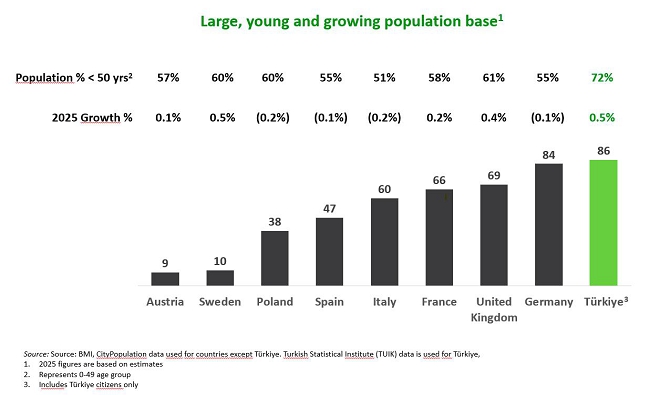
Ride-hailing, delivery, and two-wheeled electric vehicle services thrive in densely populated urban areas. Türkiye has 24 cities with a population greater than one million people, which is more than twice as many cities with a population greater than one million people than any other country in Europe. Our ride-hailing service operates in Istanbul, the most populous city in Europe, as well as Ankara, Antalya, and İzmir, and was expanded to 16 additional cities in 2025, Adana, Aydın, Bursa, Denizli, Eskişehir, Gaziantep, Kayseri, Kocaeli, Konya, Manisa, Mersin, Muğla, Sakarya, Samsun, Tekirdağ, and Yalova. These cities represent a broad section of Türkiye’s major urban areas and expand the reach of our platform to a significantly larger population. These cities, with populations greater than European capitals such as Rome and Paris, present significant opportunities for growth as we continue to enhance urban mobility solutions across the country. Furthermore, our two-wheeled electric vehicle service operates in Istanbul, İzmir, and Antalya, providing sustainable and convenient transportation alternatives. In addition, we have initiated our delivery service as a pilot in Istanbul in October 2025.
Market Position
Number one urban mobility and ride-hailing app in Türkiye across iOS and Android, as measured by the total number of downloads among all apps in the urban mobility and ride/taxi-hailing/sharing category of both the iOS and Android stores which serve within city rather than between city transportation. As of December 31, 2025, we had 26% of the app downloads among the five largest ride-hailing and sharing, taxi-hailing and sharing, and two-wheeled electric vehicle operators in Türkiye according to Sensor Tower. The rest of the market is highly fragmented. As of December 31, 2025, we serve 20 cities with our ride-hailing service, 3 cities with our two-wheeled electric vehicle service, and exclusively in Istanbul with our pilot delivery service across Türkiye. These cities collectively represent approximately 80% of Türkiye’s Gross Domestic Product in 2023. In 2026, we expect to continue investing in organic growth in the cities in which we currently operate, launch our services in new cities, optimize dynamic pricing, and increase the take rate of our platform services.
In 2025, we expanded our ride-hailing operations while continuing to streamline our two-wheeled electric vehicle operations to prioritize cities and vehicle generations based on profitability. We will continue to focus on operational efficiency in our two-wheeled electric vehicle business in 2026 and will evaluate the opportunity to expand our fleet no earlier than the summer of 2027.
41
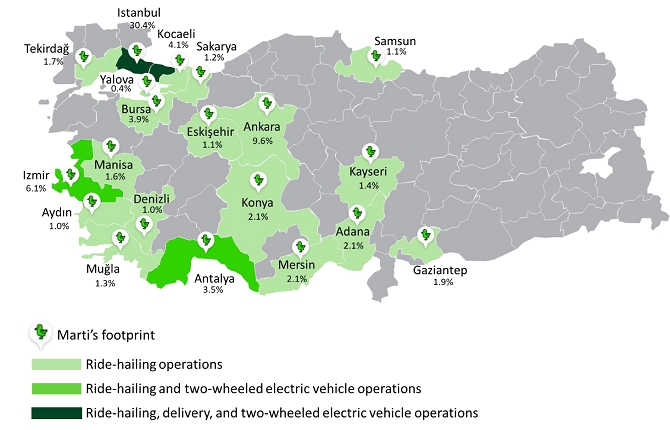
| (1) | As of December 31, 2025 |
Strong Consumer Retention Reinforced by Scale Across Multiple Services and Modalities
In addition to the benefits of economies of scale on our operating costs, each of our ride-hailing, delivery, and two-wheeled electric vehicle services benefit from network economies that strengthen as our platform grows. As the number of consumers, riders, drivers, and vehicles on our platform increases, service availability, marketplace efficiency, and reliability improve across all of our services and modalities.
In our ride-hailing service, the increase in drivers and riders on the platform increases trip opportunities for drivers while improving pickup times and availability for riders. It also increases the likelihood that a rider can locate a nearby vehicle, which improves utilization and encourages repeat usage. In our delivery service, a growing base of drivers and consumers increases order density and geographic coverage, enabling faster and more reliable deliveries. In addition, many of the drivers who fulfill delivery requests also participate in our ride-hailing service. This shared driver supply across services improves driver utilization and marketplace efficiency across our platform while increasing earning opportunities for drivers. As these networks scale, each added consumer, rider, driver, and vehicle incrementally enhances the value of the platform for all participants.
70% of our e-bike, 85% of our e-moped, 35% of our car-hailing, and 82% of our motorcycle-hailing consumers used these services after previously being introduced to Marti by using another Marti service, over their lifetime on the platform. Our existing services serve as highly effective consumer acquisition channel for our new services. Furthermore, 57% of our e-bike, 73% of our e-moped, 15% of our car-hailing, and 72% of our motorcycle-hailing consumers subsequently used other Marti services after their first e-bike, e-moped, car-hailing, and motorcycle-hailing trips, respectively. We believe this behavior demonstrates strong consumer preference for integrated, multi-service platform.
Multi-service consumers also generate greater economic value for our platform. Trips per consumer are 4.4 times higher and revenue per consumer is 3.6 times higher for multi-service consumers compared to consumers who use only a single service. We believe these dynamics reinforce our strategy of investing in the balanced growth of our ride-hailing, delivery, and two-wheeled electric services within a unified platform.
42
Vertically Integrated Platform and Operations
We operate a technology platform that connects consumers, riders, drivers, and vehicles to facilitate mobility and delivery services across Türkiye. Our platform currently supports multiple service categories, including ride-hailing, delivery, and two-wheeled electric vehicles.
Unlike global operators that rely extensively on third-party providers for vehicle operations or fleet management, we perform several core operational functions in-house. These functions include platform development, fleet operations for our two-wheeled electric vehicles, and operational support for ride-hailing and delivery services.
Our technology platform consists of internally developed mobile applications used by consumers, riders, drivers, and operational teams. These applications support trip and order matching, routing, dispatching, pricing, fleet monitoring, and operational coordination. Maintaining these applications internally allows us to respond to operational requirements and regulatory developments in our markets and to deploy updates to consumers, riders, and drivers efficiently.
For our two-wheeled electric vehicle services, we conduct key operational activities through in-house teams, including battery charging, repair and maintenance, and fleet rebalancing. We operate charging infrastructure in each city where our two wheeled electric vehicles are deployed and utilize a swappable battery system. Under this system, operations teams replace depleted batteries in deployed vehicles with fully charged batteries from our charging stations, allowing vehicles to remain available for consumers with limited downtime. We also take an active role in two-wheeled electric vehicle design, parts procurement, and vehicle assembly. This approach allows us to adapt vehicle specifications to local operating conditions, including terrain, climate, and rider usage patterns.
Our delivery services leverage the same technology platform and driver network that supports our ride-hailing operations. Our platform enables real-time delivery order and driver matching. By utilizing shared technology infrastructure and operational resources across ride-hailing and delivery services, we seek to improve platform efficiency and service availability.
We believe that certain structural factors in Türkiye, including comparatively lower labor costs and a large urban population, support the economics of in-house operational models in mobility and fleet management.
Constructive Regulatory Framework Across Our Platform
Our experience introducing and scaling two-wheeled electric vehicles in Türkiye demonstrates our ability to operate within, and contribute to, evolving regulatory environments. As the largest two-wheeled electric vehicle operator in Türkiye, we played a significant role in the development of this category alongside other market participants.
Shortly after we began operations in 2019, e-scooters were first introduced to the Turkish transportation code in 2020 as a new legal mode of transport. Subsequently, a framework governing the rights and requirements of e-scooter operators was established in 2021. This framework has three important characteristics:
| ● | Growth Oriented: E-scooters can operate in a fully dockless model, meaning that they can be picked up and dropped off anywhere, thereby maximizing demand and consumer convenience. |
| ● | Multi-Tiered Licensing Process: Operators first secure a national license from the Ministry of Transportation and Infrastructure, followed by city level licenses in each city where they would like to operate, followed by the payment of a per vehicle daily occupancy fee to each district in which they then operate. This multi-tiered licensing process ensures that operators are held to a high standard. This process also requires us to maintain dedicated teams to manage regulatory compliance across the national, city, and district levels in each market in which we operate. |
| ● | Focus on Domestic Growth: Operators are currently required to hold their servers, containing all vehicle, consumer, and operational data, in Türkiye. In addition, operators are required to source at least 30% of their fleet from TSE-certified domestic manufacturers in Türkiye by July 2026. These two distinct requirements help ensure that consumer data is protected and available to comply with applicable regulatory requirements, while also promoting the development of local operators who best understand the needs of local consumers. |
In contrast, e-bikes and e-mopeds were already recognized under existing transportation laws prior to our launch of these services, and therefore did not require new regulatory frameworks.
43
In this context, our experience pioneering the regulatory framework for e-scooters in Türkiye is a key competitive strength. We are leveraging our experience navigating and shaping a complex, multi-tiered regulatory environment, to support the development of thoughtful, locally appropriate frameworks for other modes of shared mobility including ride-hailing.
Platform Sustainability and Environmental, Social and Governance Initiatives
We integrate environmental, social, and governance considerations into our operational and strategic decision-making.
We released our 2024 Sustainability Report, reaffirming our commitment to strategy, “Move Forward. Together.”, which is centered around three key pillars: Smarter Mobility, Cleaner Cities, and Safer Trips.
In 2024, our efforts led to the avoidance of approximately 462 tons of CO₂ emissions, equivalent to the annual carbon absorption of approximately 21,000 mature trees. Further, our e-mopeds and e-bikes generate significantly lower lifecycle emissions, around 39% and 33% less, respectively, compared to the average trip in Türkiye. Our e-scooters emit approximately 18% less CO2 than alternative modes of urban transportation in Türkiye. We also achieved a 98.7% recycling rate, processing 96.6 tons of materials, including mixed metals, rubber, paper/cardboard, batteries, plastics, electronics waste, mixed packaging, and iron. These accomplishments underscore our dedication to integrating sustainability into our operations and strategy, reflecting strong environmental, social, and governance fundamentals.
Our operational practices also focus on extending the useful life of fleet components. We repaired and reused approximately 95% of our damaged batteries, approximately 84% of our damaged IoT, and approximately 52% of our damaged motors, as of December 31, 2024, substantially reducing our environmental footprint. In line with our circular economy commitment, we achieved a 0% landfill rate in 2024, continuing our practice of reusing, repairing, and recycling all components of our two-wheeled electric vehicle fleet through specialized recycling partners.
From a social perspective, as of December 31, 2025, 32% of our workforce was in the 15 – 24 year age group which has the highest unemployment rate in Türkiye. We also serve all segments of the population, including lower income neighborhoods, rather than just affluent neighborhoods or tourist centers. For example, we serve cities with our ride-hailing service covering approximately 65% of the country’s population and with our two-wheeled electric vehicle service covering 27% of the country’s population, reaching a diverse set of consumers.
From a governance perspective, women served in 15% and men served in 85% of our management roles, as of December 31, 2025, which includes C-level and department heads. We also offer competitive compensation packages, including an employee share ownership plan, to promote employee satisfaction and performance.
Growth Strategies
We intend to build upon our market leadership by expanding and enhancing our integrated, multi-service mobility platform through the following strategies:
Scaling Platform Usage in Existing Cities
As of December 31, 2025, we operate across 20 cities in Türkiye, representing approximately 80% of national GDP, although not all of our services are available in every city. We intend to deepen our presence in these markets by increasing platform utilization across our integrated, multi-service offerings. We believe these cities present a significant opportunity to drive incremental growth through higher engagement, increased usage frequency, and greater cross-service adoption among riders, drivers and consumers.
We are focused on increasing marketplace density and liquidity by increasing the availability of drivers and two-wheeled electric vehicles, while continuing to enhance reliability and reduce wait times. Higher marketplace density improves matching efficiency and increases the likelihood that a consumer who opens our app will successfully complete a request, whether for mobility or delivery services. In parallel, we deploy targeted incentives, pricing strategies, and loyalty programs designed to stimulate demand, improve conversion rates, and encourage repeat usage across our platform. In March 2026, we launched the Marti Shareholder Loyalty Program, which offers long-term retail shareholders special discounts on Marti subscriptions, rentals, trips, and deliveries, aiming to reward these shareholders while reinforcing our commitment to sustainable growth, stakeholder alignment, and responsible value creation, as well as driving incremental platform engagement and repeat usage.
44
We also continue to optimize the mix and allocation of our service modalities within existing cities to better align with local demand patterns. By leveraging data-driven insights, we dynamically allocate driver and fleet resources toward higher-performing areas and use cases, which we believe enhances utilization and supports improved unit economics. At the same time, we are investing in product and technology enhancements to streamline the consumer experience, improve onboarding, and enable more efficient interactions across our services.
In 2026, we intend to continue investing in the growth of our operations while maintaining a strong focus on efficiency. We plan to evaluate opportunities for fleet expansion no earlier than the summer of 2027, subject to alignment with our long-term financial and strategic goals.
Launch of Operations in New Cities and Countries
Türkiye’s large and growing urban population, with an urbanization rate of 93% in 2025, which includes numerous underpenetrated cities where demand for mobility and delivery services is rising. Our operational and technological playbook has been built for scalability, enabling us to enter new markets efficiently. We continue to evaluate potential opportunities in Türkiye’s neighboring countries, where similar demand patterns and regulatory environments may support expansion.
Dynamic Pricing Capabilities
We are enhancing the efficiency of our platform through dynamic pricing capabilities that match supply with demand in real time. By leveraging demand-supply forecasting and real-time fare adjustments, we aim to balance driver availability, optimize match rates, and increase revenue per trip. These capabilities are also intended to improve the consumer experience by reducing wait times during peak periods and supporting driver earnings.
Increasing Our Take Rate
We are focused on increasing our take rate in a sustainable and consumer-friendly manner to strengthen platform-level economics. We have introduced subscription packages and continue to explore additional subscription alternatives tailored to different consumer segments and usage patterns. These monetization initiatives are designed to support long-term health of our ecosystem while enabling continued reinvestment into service improvement, consumer experience, and driver engagement.
Diversification of Service Offerings by Launching New Services
We continue to evaluate opportunities to introduce new services on our platform that leverage our technology infrastructure, driver network, and consumer base.
Potential new services may include additional mobility modalities, expanded delivery or financial services, and other complementary platform features designed to increase consumer engagement and driver utilization. New service introductions are typically piloted in selected markets before broader deployment and are subject to regulatory approvals, operational feasibility, and other considerations.
Enhancing Platform-Level Efficiency and Operational Excellence
We are committed to improving platform-level efficiency to support sustainable scaling, better unit economics, and long-term profitability. Key initiatives include:
| ● | Ongoing investments in technology, data analytics, and operations to reduce wait times, increase trip conversion rates, and optimize supply-demand matching. |
| ● | Active reallocation of fleet and driver resources to higher-performing areas and service modalities, with a continued focus in 2026 on improving the operational efficiency throughout our services. |
| ● | Application and onboarding enhancements, such as streamlined flows, improved navigation, and consumer experience upgrades, aiming higher conversion rates, increased active consumers, and better ratings. |
| ● | Targeted measures to enhance driver and vehicle utilization, reduce friction in the ecosystem, and support cost-effective growth while maintaining service quality. |
45
These efforts are designed to strengthen our marketplace dynamics, lower per-trip costs over time, and enable reinvestment in growth initiatives. As with our other strategies, these operational improvements involve risks and uncertainties, including execution challenges, competitive pressures, and macroeconomic factors in Türkiye, as described elsewhere in this Annual Report.
Consumers
Our platform offers ride-hailing, delivery, and mobility services that together address a broad range of transportation and delivery needs. Consumers use our services for point-to-point daily commutes, on-demand travel, delivery of goods, late-night and safety-conscious travel, medical and emergency transport, standalone commute, first and last mile connections to public transport, and leisure trips. By providing multiple services on a single platform, we aim to create a seamless, convenient experience for all consumer segments.
We have a predominantly young consumer base. Out of our more than 7.3 million all-time platform consumers, as of December 31, 2025, approximately 59% are between 16 and 30 years of age, approximately 31% are between 31 and 45 years of age, approximately 9% are between 46 and 60 years of age, and less than 1% are older than 60. We also started actively collecting gender information during the second quarter of 2021. Based on available information, as of December 31, 2025, approximately 78% of our consumers are identified as male, 21% as female, and approximately 1% of consumers did not wish to specify gender information.
Brand, Marketing and Sales
The awareness, recognition, and positive perception of our brands are key contributors to our success. As a leading multi-service mobility platform in Türkiye, we have established strong brand recognition across ride-hailing and two-wheeled electric vehicle services, and we are leveraging this brand foundation as we expand into new offerings, including delivery services. We believe our brands have become synonymous with ride-hailing and two-wheeled electric vehicle services in Türkiye, rather than being seen as just individual brands within these markets.
Our platform and services are central to our marketing and consumer acquisition strategy. We focus on driving consumer engagement across our multi-service platform, with marketing efforts aimed at consumer activation, retention, and increasing adoption of newer services. Our campaigns are primarily data-driven and targeted, utilizing insights from our in-house analytics capabilities to optimize performance and efficiency.
We collaborate with third parties and establish strategic partnerships to expand our reach, support the growth of our service offerings, and provide additional value to our consumers.
Additionally, we actively use social media and digital channels to share and promote our values, services, updates and campaigns, news, consumer and public safety information, mass campaigns, and other content relevant to our consumers.
Competition
The shared mobility and delivery industries in Türkiye are relatively nascent and increasingly competitive, and we believe there is significant market demand in the country due to a lack of efficient public transportation options, limited taxi penetration, heavy traffic, dense populations, and high costs of private car ownership. We believe these structural characteristics support long-term demand for technology-enabled mobility and delivery solutions. We directly compete with companies that offer similar technology-enabled services across ride-hailing and delivery, including car-hailing, motorcycle-hailing, taxi-hailing, e-scooters, e-bikes, e-mopeds, and deliveries.
In these markets, we face competition from companies that may have longer operating histories in their respective service categories, greater brand recognition in specific offerings, or more substantial financial, technical, or marketing resources, as well as from potential future entrants. In addition, certain competitors operate multi-service platforms that span several of our service categories, which may intensify competition across our ecosystem. Competition may also vary by service type, and our delivery offering, which is at an earlier stage of development, may face competitors with more established positions in that category.
We believe that our ability to compete effectively is driven by the strength and scalability of our integrated multi-service platform, which brings together ride-hailing, delivery, and two-wheeled electric vehicle services within a single consumer interface. This platform approach enables us to benefit from shared network effects, optimize supply and demand across services, and drive higher utilization of our assets and driver base. Our vertically integrated model allows us to manage key elements of our operations, including fleet, pricing, consumer experience, and technology development, which we believe enhances service quality, operational efficiency, and unit economics over time.
46
In addition, we believe our growing and engaged consumer base, combined with increasing brand recognition in Türkiye, supports repeat usage across our services and facilitates cross-selling opportunities as we expand our services and offerings. Our ability to leverage data-driven insights, local market expertise, and continuous product innovation enables us to adapt to evolving consumer preferences and competitive dynamics. While we operate in highly competitive and rapidly evolving markets, we believe operational capabilities of our platform and focus on efficiency position us to compete effectively. For a discussion of additional competitive advantages that differentiate our business, see the section titled “Competitive Strengths.”
For a discussion of risks relating to competition, see the section titled “Risk Factors — Risks Related to Our Business and Industry —The markets in which we operate, including ride-hailing, delivery, and two-wheeled electric vehicle, are highly competitive, and competition represents an ongoing threat to the growth and success of our business.”
Intellectual Property
Our intellectual property rights are valuable to our business. We have confidentiality procedures to protect our intellectual property rights, including but not limited to, non-disclosure agreements, intellectual property assignment agreements, and employee non-disclosures. We have an ongoing trademark registration program pursuant to which we register our brand name and logos in Türkiye and will expand to other countries to the extent we determine appropriate.
As of December 31, 2025, we held 14 registered trademarks in Türkiye. In addition, we have registered domain names for websites that we use in our business, such as www.marti.tech and other variations. We also control our intellectual property through specific terms of use on our mobile application and website.
We intend to pursue additional intellectual property protection to the extent we believe it would be beneficial and cost-effective for our business. Despite our efforts to protect our intellectual property rights, they may not be respected in the future or may be invalidated, circumvented, or challenged. See “Risk Factors —Risks Related to Our Intellectual Property and Technology — We may be subject to intellectual property rights claims and other litigation that are expensive to defend, or may be unable to adequately protect our intellectual property, either of which could materially adversely affect our business.” and “Risk Factors —Risks Related to Legal Matters and Regulations—Our business is subject to a wide range of laws and regulations, many of which are evolving, and failure to comply with such laws and regulations could adversely affect our business, financial condition, and results of operations.”
Government Regulation
We are subject to various laws and regulations as a result of our business operations. Some of these laws and regulations govern the rules directly related to our business such as labor and employment, service payments, vehicle defects, personal injury, consumer protection, data protection, intellectual property, competition, insurance, environmental health and safety, taxation, advertising, promotional materials, and licensing.
E-scooters were first introduced to the Turkish legislation system by the Regulation on Electric Scooters published in Official Gazette numbered 31454, dated April 14, 2021 (the “Regulation”) as a new legal mode of transport. Following the Regulation, the Act on Highway Traffic Law numbered 2918 and Regulation on Highway Traffic was published in Official Gazette numbered 23053, which embodied the rules regarding e-scooters. Subsequently, a framework governing the rights and requirements of e-scooter operators was established in 2021. Under the Regulation, we are required to obtain permits for our e-scooters to enable tracking of the number of e-scooters deployed in a relevant municipal area. Such permits are issued by the Metropolitan Municipality Transportation Coordination Center (“UKOME”) in the metropolitan cities and by the Provincial Traffic Commissions in the other municipalities to the companies who operate e-scooters.
47
We are also subject to a number of laws and regulations specifically governing the Internet and mobile devices that are constantly evolving, including the laws and regulations concerning information technologies. For example, we are subject to Personal Data Protection Act numbered 6698 in respect of storing, sharing, use, transfer, disclosure, and protection of certain types of data due to the personal information and data we collect from our consumers. The Turkish Personal Data Protection Authority, which is a public legal entity, has been established to carry out duties conferred on it under the Act No. 6698 and follows the latest developments in the legislation and practices, including making evaluations and recommendations and conducting research and investigations regarding implementation and breaches of Act No. 6698. We are also subject to the Electronic Communication Act numbered 5809, which governs the Internet law specifically related to the electronic communication market. Information Technologies and Communication Authority regulates and monitors the market for compliance with the Electronic Communication Act No. 5809. The Information Technologies and Communication Authority also (i) has the authority to grant licenses to operate in the electronic communication sector (ii) supervises whether the operators procure the services in accordance with the Electronic Communication Act No. 5809, (iii) imposes fines and penalties for noncompliance with the Electronic Communication Act No. 5809 and (iv) makes/amends the regulations in respect of electronic communication market.
For a discussion of risks relating to regulation, see the section titled “Risk Factors — Risks Related to Legal Matters and Regulations — Action by governmental authorities to restrict access to our services and products in their localities could substantially harm our business and financial results.” and “— Our business is subject to a wide range of laws and regulations, many of which are evolving, and failure to comply with such laws and regulations could adversely affect our business, financial condition, and results of operations.”
Seasonality
We experience seasonality in differing levels across our services and geographic markets. Typically, the second and third quarters of our fiscal year experience increased usage due to favorable weather conditions in the markets that we operate. Unexpected weather events, including those driven by climate change or other factors, can have a material impact on our business.
Seasonality affects our services differently. Ride-hailing services exhibit varying degrees of seasonality depending on the type of vehicle used. While car-hailing and taxi-hailing services experience relatively stable demand throughout the year, motorcycle-hailing is more affected by cold and extreme weather conditions due to its open-air nature. Usage of motorcycle-hailing services tends to decline in winter months and during periods of heavy rain or adverse weather, whereas car-hailing and taxi-hailing remain more resilient, as consumers continue to require transportation regardless of external conditions.
Two-wheeled electric vehicle operations are more sensitive to seasonal and weather conditions, with higher demand during warmer months and lower demand during colder or extreme weather conditions.
Our delivery service, currently operating as a pilot using both car and motorcycle drivers, may also be affected by adverse weather, which can reduce driver availability, delay deliveries, and impact overall service levels.
As a fully integrated platform, we actively manage seasonal fluctuations through service diversification, geographic expansion, and operational adjustments, including vehicle rebalancing and resource allocation across services and regions, to maintain service continuity and optimize efficiency during periods of unfavorable weather.
Legal Proceedings
We are subject to various legal proceedings and claims that arise in the ordinary course of our business.
On February 3, 2023, the Istanbul Otomobilciler Esnaf Odası, an association of taxi owners, filed a lawsuit against us before the Istanbul 14th Commercial Court regarding our ride-hailing and e-moped services, claiming that these services create unfair competition. The plaintiff also requested that the court prevent third parties from accessing these services through our website or mobile application.
In response, the court issued an order on March 6, 2023, blocking access to the ride-hailing service. We appealed this decision, and the injunction was lifted on June 20, 2023.
On July 19, 2024, following expert reports and hearings, the court ruled in favor of the plaintiff regarding our ride-hailing service, but dismissed claims related to our motorcycle-hailing service. The court also issued an order blocking access to our ride-hailing application, but clarified that order did not affect our other activities. We filed objections to the ruling on October 1, 2024, except for the part related to motorcycle-hailing.
The 14th Civil Chamber of the Istanbul Regional Court of Justice overturned the decision, stating that the expert reports were insufficient and that the court had failed to properly consider the defendant’s defenses. The case was sent back to the first instance court for retrial.
The case resumed before the Istanbul 14th Commercial Court on November 27, 2024. Additionally, a lawsuit filed by the Antalya Chamber of Drivers was combined with the existing case, as both were related. At the second hearing of the retrial, held on March 21, 2025, the Istanbul 14th Commercial Court appointed a new expert committee and requested a new report, which was subsequently submitted. In a subsequent hearing held on December 19, 2025, the court ordered the preparation of an additional expert report, as the existing report failed to address all the questions posed, and adjourned the proceedings until June 24, 2026.
48
C. Organizational Structure
The following table sets forth all of our significant subsidiaries.
Name of Subsidiary |
Country
of Incorporation or Residence |
Proportion
of ownership interest |
Proportion
of voting power held | |||
| Marti Technologies I Inc. (formerly Marti Technologies Inc.) | Delaware | 100% (direct) | 100% (direct) | |||
| Marti İleri Teknoloji A.Ş. | Türkiye | 100% (indirect) | 100% (direct) |
D. Property, Plants and Equipment
Our Facilities
We are headquartered in Istanbul, Türkiye, and conduct operations in 20 different cities across the country. Our operations are supported by seven warehouses and a principal office, which together have a total area of 14,818 square meters. We continue to invest in our current and potential locations as necessary to grow our ride-hailing, delivery, and two-wheeled electric vehicle services and believe that our properties, including the principal properties described above, are well-maintained, adequate, and suitable for their current requirements and for our operations in the foreseeable future.
ITEM 4A. UNRESOLVED STAFF COMMENTS
None.
ITEM 5. OPERATING AND FINANCIAL REVIEW AND PROSPECTS
The following discussion and analysis provides information which our management believes is relevant to an assessment and understanding of our consolidated results of operations and financial condition. The discussion should be read together with our financial statements and the related notes that are included elsewhere in this Annual Report. This discussion may contain forward-looking statements based upon current expectations that involve risks and uncertainties. Our actual results may differ materially from those anticipated in these forward-looking statements, including those set forth under “Cautionary Note Regarding Forward-Looking Statements” as a result of various factors, including those set forth under “Risk Factors” or in other parts of this Annual Report.
For the impact of foreign currency fluctuations on our Company, please refer to “Item 11. Quantitative and Qualitative Disclosures about Market Risk-Foreign Currency Risk.”
A. Operating Results
Overview
Marti offers tech-enabled transportation services to consumers across Türkiye through three service offerings: ride-hailing, delivery, and two-wheeled electric vehicles. The availability of each service varies by city. Our ride-hailing service matches riders with car, motorcycle, and taxi drivers. Our delivery service enables fast, same-hour package deliveries through our driver network, with digital tracking available within the Marti super app. Our two-wheeled electric vehicle service offers shared mobility through a Company-owned and operated fleet of e-mopeds, e-bikes and e-scooters, with each transportation modality serving different distances, comfort levels, and price points.
The Company operates and reports as a single operating and reportable segment. Prior to December 31, 2024, the Company reported two separate operating segments: (i) Two-wheeled Electric Vehicle and (ii) Ride-hailing.
49
On October 1, 2024, the Company launched a unified subscription-based platform that provides consumers access to its ride-hailing and two-wheeled electric vehicle services through a single application with delivery services added in October 2025. As a result of this strategic integration and corresponding change in how the Chief Operating Decision Maker (“CODM”), Marti CEO Oğuz Alper Öktem evaluates the Company’s performance and allocates resources, the Company determined that its operations are more appropriately presented as a single operating and reportable segment. This updated reporting structure aligns with how the Company manages its business and strategic objectives.
The key measure of performance used by the CODM for our single reportable segment is loss before income tax expense.
See Note 3.4 to the Audited Consolidated Financial Statements of the Company for more information.
Key Factors Affecting Operating Results
We believe operating results and growth trajectory are influenced by a number of factors, including the scale and efficiency of our platform, supply and demand dynamics across our services, regulatory developments and government relations, competition, seasonality, and broader macroeconomic conditions. Some of these factors present significant opportunities for us, impact our growth trajectory, profitability, and operational performance, but also pose risks and challenges, including those discussed below and in the section of this Annual Report titled “Risk Factors”.
Network density and supply-demand balance
Our ability to efficiently match supply and demand across our platform, through driver availability in ride-hailing and delivery services and fleet availability in our two-wheeled electric vehicle services, is a key determinant of growth and profitability. Increasing network density, alongside effective management of supply-demand balance, enhances utilization rates, reduces wait times, and improves overall service reliability. Driver acquisition, retention, and engagement, as well as fleet expansion and utilization, directly impact consumer experience, service levels, and platform level revenue generation.
Consumer demand and adoption
Growth in active consumers and usage frequency across our services depends on consumer perception of affordability, reliability, and safety. Sustained adoption is driven by our ability to deliver consistent service quality and a seamless consumer experience across our platform. Changes in consumer preferences, service performance, or brand perception may impact demand levels and usage patterns.
Regulatory framework and government relations
Our operations are subject to evolving national and local regulations in Türkiye, particularly with respect to licensing and operational requirements for our two-wheeled electric vehicle services. Regulatory developments may affect our ability to expand into new markets, increase or decrease the number of fleet and licensed drivers, or maintain existing operations, and may also impact our cost structure. We engage with regulatory authorities at the national, city, and district levels to monitor regulatory developments, maintain compliance with applicable laws, and advocate for policies that support the urban mobility needs of our consumers.
Competition
We operate in a highly competitive and rapidly evolving industry. Competitive dynamics may impact pricing, incentives, and consumer and driver acquisition costs, which in turn affect our margins and growth. For more information, see “Item 4. Information on the Company—Business Overview—Competition.”
Seasonality of the business
Usage of our services is influenced by seasonal trends and weather conditions, with higher demand typically observed during the second and third quarters. Adverse weather conditions may reduce usage and impact revenue. See “Item 4B. Information on the Company—Business Overview—Seasonality” for more information on the seasonality of our business.
Macroeconomic and geopolitical factors
Our operating results are also sensitive to macroeconomic and geopolitical factors, including inflation, currency fluctuations, interest rates, labor market dynamics, and consumer spending patterns. In 2025, Türkiye continued to experience elevated inflation and significant depreciation of the Turkish lira against the U.S. dollar. These factors have affected, and may continue to affect, both consumer demand and driver supply, as well as our overall cost base. Additionally, economic or political instability in Türkiye or globally could result in lower discretionary travel, supply chain interruptions, or changes in investor sentiment. The military conflict involving Iran that commenced in February 2026 has contributed to sharp increases in global energy and commodity prices, disrupted shipping through the Strait of Hormuz, and heightened geopolitical uncertainty in Türkiye, which shares a border with Iran. Prolonged conflict or further escalation could exacerbate inflationary pressures, increase our operating costs, and reduce consumer spending on our services. We continue to monitor macroeconomic and geopolitical conditions and seek to adjust our business model to preserve financial resilience and operational continuity.
50
Components of Results of Operations
Revenue
Our platform revenue is generated from subscription packages that provide platform consumers with various benefits across our ride-hailing, delivery, and two-wheeled electric vehicle services. These subscription packages offer consumers a bundle of advantages on the Company’s platform, such as priority access to certain services, as well as free and discounted trips for ride-hailing and two-wheeled electric vehicle usage and discounts on delivery orders.
Our two-wheeled electric vehicles revenue is primarily generated from the fees paid by our consumers to rent our vehicles less promotions, discounts, and refunds.
We also generate two-wheeled electric vehicles revenue from reservations, where we charge a minute-based fee for reserving a vehicle until start of the trip, and subscription package offerings. For the years ended December 31, 2025, 2024, and 2023, reservation revenues constituted less than 1.0% of our total revenues.
Cost of Revenues
Cost of revenues primarily consists of depreciation and amortization expense, salaries of operational and logistics staff, rental vehicles’ maintenance and repair expense, operating lease expense, and data cost expense.
Gross Profit
Gross profit represents revenue less cost of revenues.
General and Administrative
General and administrative expenses represent costs incurred by us for executive and management overhead and administrative and back-office support functions. These costs primarily consist of salaries, benefits, travel, bonuses, and share-based compensation, consulting, communication, network and cloud, email, and IT services expenses, professional service providers, off-site storage and logistics, certain insurance coverage, and an allocation of office rent and utilities related to our general and administrative divisions. General and administrative costs are expensed as incurred.
Selling and Marketing
Selling and marketing expenses primarily consist of advertising expenses and services marketing costs. Selling and marketing costs are recognized as they are incurred.
Other Income (Expense), Net
Other income (expense), net primarily consists of provisional expenses and other non-operational income.
Financial Income (Expense), Net
Financial income (expense), net primarily consists of interest expense on financial liabilities and foreign exchange gains and losses.
Provision for Income Taxes
We account for income taxes using the asset and liability method. Under this method, deferred income tax assets and liabilities are recorded based on the estimated future tax effects of differences between the financial statement and income tax basis of existing assets and liabilities. These differences are measured using the enacted statutory tax rates that are expected to apply to taxable income for the years in which differences are expected to reverse. We recognize the effect on deferred income taxes of a change in tax rates in the period that includes the enactment date.
51
We record a valuation allowance to reduce its deferred tax assets to the net amount that we believe is more likely than not to be realized. Management considers all available evidence, both positive and negative, including historical levels of income, expectations, and risks associated with estimates of future taxable income and ongoing tax planning strategies in assessing the need for a valuation allowance.
Under the provisions of ASC 740-10, Income Taxes, we evaluate uncertain tax positions by reviewing against applicable tax law for all positions taken by us with respect to tax years for which the statute of limitations is still open. ASC 740-10 provides that a tax benefit from an uncertain tax position may be recognized when it is more likely than not that the position will be sustained upon examination, including resolutions of any related appeals or litigation processes, based on the technical merits. We recognize interest and penalties related to the liability for unrecognized tax benefits, if any, as a component of the income tax expense line in the accompanying consolidated statement of operations and comprehensive loss.
Operating Results
The following table sets forth our results of operations for the periods presented. The period-to-period comparisons of financial results is not necessarily indicative of future results.
| Year Ended December 31, | ||||||||||||
| (in thousands) | 2025 | 2024 | 2023 | |||||||||
| Revenue | $ | 39,241 | $ | 18,660 | $ | 20,030 | ||||||
| Cost of revenues | $ | (15,253 | ) | $ | (21,549 | ) | $ | (24,085 | ) | |||
| Research and development expenses | $ | (3,007 | ) | $ | (1,963 | ) | $ | (1,955 | ) | |||
| General and administrative expenses(1) | $ | (28,051 | ) | $ | (49,249 | ) | $ | (15,130 | ) | |||
| Selling and marketing expenses | $ | (12,954 | ) | $ | (9,348 | ) | $ | (7,348 | ) | |||
| Other income | $ | 891 | $ | 1,194 | $ | 658 | ||||||
| Other expenses | $ | (9,399 | ) | $ | (3,056 | ) | $ | (2,774 | ) | |||
| Loss from operations | $ | (28,532 | ) | $ | (65,310 | ) | $ | (30,603 | ) | |||
| Fair value gain on derivative liabilities | $ | 1,381 | $ | -- | $ | -- | ||||||
| Financial income | $ | 1,351 | $ | 1,408 | $ | 3,561 | ||||||
| Financial expense | $ | (15,646 | ) | $ | (9,980 | ) | $ | (6,773 | ) | |||
| Loss before income tax expense | $ | (41,446 | ) | $ | (73,881 | ) | $ | (33,815 | ) | |||
| Income tax expense | $ | -- | $ | -- | $ | -- | ||||||
| Net loss | $ | (41,446 | ) | $ | (73,881 | ) | $ | (33,815 | ) | |||
| (1) | 2025 general and administrative expenses include share-based compensation expense of $(11.3) million. In the absence of share-based compensation expense, 2025 general and administrative expenses were $(16.8) million. |
| Year Ended December 31, | ||||||||||||
| (in thousands) | 2025 | 2024 | 2023 | |||||||||
| Gross Profit (in thousands) | $ | 23,988 | $ | (2,889 | ) | $ | (4,055 | ) | ||||
| Gross Profit Margin (%) | 61.1 | % | (15.5 | )% | (20.2 | )% | ||||||
Year Ended December 31, 2025 Compared to Year Ended December 31, 2024
Revenue
Our revenue increased by $20.6 million, or 110.3%, from $18.7 million during the year ended December 31, 2024 to $39.2 million during the year ended December 31, 2025, primarily attributable to the launch of subscription packages that provide platform consumers with various benefits across our ride-hailing, delivery, and two-wheeled electric vehicle services, which began in October 2024.
Total trips including ride-hailing, delivery, and two-wheeled electric vehicle services, increased by 19.13 million, or 60.3%, from 31.71 million during the year ended December 31, 2024 to 50.84 million during the year ended December 31, 2025, primarily attributable to the growth of ride-hailing trips.
Total unique platform consumers including ride-hailing, delivery, and two-wheeled electric vehicle services, increased by 0.94 million, or 44.3%, from 2.13 million during the year ended December 31, 2024 to 3.08 million the year ended December 31, 2025, primarily attributable to the growth of ride-hailing riders.
52
Trips per unique platform consumer increased by 1.7, or 11.1%, from 14.9 during the year ended December 31, 2024 to 16.5 during the year ended December 31, 2025, as a result of platform level efficiency, increased availability, and consumer awareness of service offerings across cities driving higher utilization.
We outperformed our quarterly operational targets for all-time unique ride-hailing riders and all-time registered ride-hailing drivers throughout 2025. The number of all-time unique ride-hailing riders increased by 1.72 million, or 103.5%, from 1.66 million during the year ended December 31, 2024 to 3.38 million during the year ended December 31, 2025. The number of all-time registered ride-hailing drivers increased by 188 thousand, or 71.7%, from 262 thousand as of December 31, 2024 to 450 thousand as of December 31, 2025.
Cost of Revenues
Our cost of revenues decreased by $6.3 million, or 29.2%, from $21.5 million during the year ended December 31, 2024, to $15.3 million during the year ended December 31, 2025, primarily attributable to operational efficiencies achieved across our multi-service platform and AI-enabled cost reduction initiatives implemented during the year. These initiatives included the gradual decommissioning of our two-wheeled electric vehicle fleet introduced in 2021 and a reduction in number of service vans and motorcycles used in our operations, which reduced depreciation and amortization expense as well as rental vehicle maintenance and repair expenses.
Our depreciation and amortization expenses decreased by $5.1 million, or 62.2%, from $8.2 million during the year ended December 31, 2024, to $3.1 million for the year ended December 31, 2025, primarily attributable to fully depreciated vehicles, remaining in use. Our rental vehicle maintenance and repair expenses decreased by $1.5 million, or 57.9%, from $2.6 million during the year ended December 31, 2024, to $1.1 million during the year ended December 31, 2025.
Gross Profit
Our gross profit increased by $26.9 million from $(2.9) million during the year ended December 31, 2024 to $24.0 million during the year ended December 31, 2025. The increase was primarily driven by the growth in revenue, including the introduction of subscription packages beginning in October 2024, combined with a reduction in cost of revenues resulting from operational efficiencies achieved across our multi-service platform and AI-enabled cost reduction initiatives implemented during the year. As a result, our gross profit margin improved significantly from (15.5)% during the year ended December 31, 2024 to 61.1% during the year ended December 31, 2025.
Research and Development
Our research and development expenses increased by $1.0 million, or 53.2%, from $2.0 million during the year ended December 31, 2024 to $3.0 million during the year ended December 31, 2025, primarily attributable to the increased size of our team focusing on new platform redesign and software development.
General and Administrative
Our general and administrative expenses decreased by $21.2 million, or 43.0%, from $49.2 million during the year ended December 31, 2024 to $28.1 million during the year ended December 31, 2025, primarily attributable to decreased share-based compensation expense in personnel expenses. In the absence of share-based compensation expense, our general and administrative expenses increased by $4.7 million, or 38.7%, from $12.1 million during the year ended December 31, 2024 to $16.8 million during the year ended December 31, 2025, primarily attributable to the increased size of our team and consulting and legal expense related to public company requirements.
Our personnel expenses decreased by $23.3 million, or 53.7%, from $43.4 million during the year ended December 31, 2024 to $20.1 million during the year ended December 31, 2025, primarily attributable to decreased share-based compensation expense. In the absence of share-based compensation expense, our personnel expenses increased by $2.5 million, or 40.5%, from $6.3 million during the year ended December 31, 2024 to $8.8 million during the year ended December 31, 2025, driven by the increased size of our team. Our consulting and legal expense increased by $1.1 million, or 33.9%, from $3.1 million during the year ended December 31, 2024 to $4.2 million during the year ended December 31, 2025, primarily attributable to increased filing and reporting requirements of being a public company.
53
Selling and Marketing
Our selling and marketing expenses increased by $3.6 million, or 38.6%, from $9.3 million during the year ended December 31, 2024, to $13.0 million during the year ended December 31, 2025, primarily attributable to increased social media expenses related to consumer and driver acquisition and retention, as well as higher advertising consulting expenses. Social media expenses increased by $3.7 million, or 141.2%, from $2.7 million during the year ended December 31, 2024 to $6.4 million during the year ended December 31, 2025. This produced a 1.72 million, or 103.5% increase in all-time unique ride-hailing riders and a 188 thousand, or 71.7% increase in all-time registered ride-hailing drivers in 2025. Advertising consulting expenses increased by $1.6 million, or 49.6%, from $3.3 million during the year ended December 31, 2024, to $4.9 million during the year ended December 31, 2025, primarily attributable to increasing indoor and outdoor marketing and promotion activities for our platform.
Other Income (Expense), Net
Our other income (expense), net, increased by $6.6 million, or 357.0%, from $1.9 million expense during the year ended December 31, 2024, to $8.5 million expense during the year ended December 31, 2025, primarily attributable to an increase in fine subsidies of platform consumers.
Financial Income (Expense), Net
Our financial income (expense), net, increased by $5.7 million, or 66.8%, from $8.6 million expense during the year ended December 31, 2024, to $14.3 million expense during the year ended December 31, 2025, primarily attributable to increasing interest expense on financial liabilities. Interest expense on financial liabilities increased by $5.7 million, or 56.8%, from $10.0 million during the year ended December 31, 2024 to $15.6 million during the year ended December 31, 2025.
Year Ended December 31, 2024 Compared to Year Ended December 31, 2023
Revenue
Our revenue decreased by $1.4 million, or 6.8%, from $20.0 million during the year ended December 31, 2023 to $18.7 million during the year ended December 31, 2024, primarily attributable to a decreased number of two-wheeled electric vehicles on the field. The number of average daily two-wheeled electric vehicles deployed decreased from 34.6 thousand to 32.6, or by 5.7%, during the year ended December 31, 2024.
Total trips increased by 9.78 million, or 44.6%, from 21.93 million during the year ended December 31, 2023 to 31.71 million during the year ended December 31, 2024, primarily attributable to the growth of ride-hailing trips. As we were not monetizing platform services prior to October 2024, the revenue impact began in the fourth quarter with the introduction of subscription packages.
We outperformed our operational targets for all-time unique ride-hailing riders and all-time registered ride-hailing drivers throughout 2024. The number of all-time unique ride-hailing riders increased by 1.16 million, or 233.5%, from 0.50 million during the year ended December 31, 2023 to 1.66 million during the year ended December 31, 2024. The number of all-time registered ride-hailing drivers increased by 156 thousand, or 145.9%, from 107 thousand as of December 31, 2023 to 262 thousand as of December 31, 2024.
Cost of Revenues
Our cost of revenues decreased by $2.5 million, or 10.5%, from $24.1 million during the year ended December 31, 2023, to $21.5 million during the year ended December 31, 2024, primarily attributable to the decreased depreciation and amortization expenses and operating lease expenses. Our cost of revenues excluding depreciation and amortization expenses decreased by $1.4 million, or 9.3%, from $14.8 million during the year ended December 31, 2023, to $13.4 million during the year ended December 31, 2024.
Our depreciation and amortization expenses decreased by $1.2 million, or 12.5%, from $9.3 million during the year ended December 31, 2023, to $8.2 million for the year ended December 31, 2024, primarily attributable to fully depreciated vehicles in 2024, despite remaining in use. Our operating lease expense decreased by $0.8 million, or 35.1%, from $2.2 million during the year ended December 31, 2023, to $1.4 million for the year ended December 31, 2024, as a result of ceasing operations in three cities in 2024. We also reduced our number of service vans and motorcycles for field operations in fiscal year 2024.
Gross Profit
Our gross profit increased by $1.2 million from $(4.1) million during the year ended December 31, 2023 to $(2.9) million during the year ended December 31, 2024. While revenue was $1.4 million lower, due to our profitability enhancing measures, including increasing the lifetime of our vehicles beyond the anticipated depreciation schedule, ceasing operations in lower performing cities, reallocating vehicles to higher performing cities, and reducing the number of service vans and motorcycles for field operations, our gross profit increased.
54
Research and Development
Our research and developments expense was unchanged at $2.0 million during the year ended December 31, 2023 and 2024.
General and Administrative
Our general and administrative expense increased by $34.1 million, or 225.5%, from $15.1 million during the year ended December 31, 2023, to $49.2 million during the year ended December 31, 2024. Share-based compensation expense increased general and administrative expenses by $35.2 million. Other general and administrative expenses, excluding personnel expenses decreased by $1.1 million, or 15.1%, from $6.9 million during the year ended December 31, 2023, to $5.8 million during the year ended December 31, 2024 attributable to decrease in consulting and legal expense driven primarily by team efficiencies and streamlining public company costs in our second year as a public company.
Selling and Marketing
Our selling and marketing expense increased by $2.0 million, or 27.2%, from $7.3 million during the year ended December 31, 2023, to $9.3 million during the year ended December 31, 2024, primarily attributable to consumer and driver acquisition and retention expenses, and advertising consulting expenses. Consumer and driver acquisition and retention expenses increased by $1.2 million, or 229.9%, from $0.5 million during the year ended December 31, 2023 to $1.8 million during the year ended December 31, 2024. This produced a 1.16 million, or 233.5% increase in all-time unique ride-hailing riders and a 156 thousand, or 145.9% increase in all-time registered ride-hailing drivers in 2024. Advertising consulting expense increased by $0.8 million, or 31.4%, from $2.5 million during the year ended December 31, 2023, to $3.3 million during the year ended December 31, 2024 primarily attributable to increasing indoor and outdoor marketing and promotion activities for our ride-hailing service.
Other Income (Expense), Net
Other income (expense), net, decreased by $0.3 million, or 12.0%, from $2.1 million expense during the year ended December 31, 2023, to $1.9 million expense during the year ended December 31, 2024, primarily attributable to a decrease in lawsuit provision liability of $0.7 million.
Financial Income (Expense), Net
Financial income (expense), net, increased by $5.4 million, or 166.9%, from $3.2 million expense during the year ended December 31, 2023, to $8.6 million expense during the year ended December 31, 2024, primarily attributable to increasing interest expense on financial liabilities and decreasing foreign exchange gain, net. Financial interest expense related to financial liabilities increased by $3.2 million, or 48.0%, from $6.7 million during the year ended December 31, 2023 to $10.0 million during the year ended December 31, 2024. Foreign exchange gain, net decreased by $2.3 million, or 85.5%, from $2.7 million during the year ended December 31, 2023 to $0.4 million during the year ended December 31, 2024.
55
Key Metrics and Non-GAAP Financial Measures
Our management reviews the following key business metrics and non-GAAP financial measures, including Adjusted EBITDA and pre-depreciation contribution per transaction, to evaluate its business, measure its performance, identify trends affecting our business, formulate business plans, and make strategic decisions. We believe that, in addition to conventional measures prepared in accordance with GAAP, certain investors and analysts use this information to evaluate the Company’s core operating and financial performance and its financial position. We believe these non-GAAP measures are useful to investors in evaluating our performance by providing an additional tool for investors to use in comparing our financial performance over multiple periods. Nevertheless, our use of Adjusted EBITDA and pre-depreciation contribution per trip has limitations as an analytical tool, and you should not consider these measures in isolation or as a substitute for analysis of our financial results as reported under GAAP. Other companies may calculate similarly titled non-GAAP financial measures differently than us, thereby limiting the usefulness of these non-GAAP financial measures as a comparative tool. Because of these and other limitations, you should consider our non-GAAP measures only as supplemental to other GAAP-based financial performance measures, including net loss and gross profit per trip.
| Year Ended December 31, | ||||||||||||
| (in thousands, except as otherwise noted) | 2025 | 2024 | 2023 | |||||||||
| Operating Metrics (Periodic): | ||||||||||||
| Trips (in millions) | 50.84 | 31.71 | 21.93 | |||||||||
| Unique Platform Consumers (in millions) | 3.08 | 2.13 | 1.81 | |||||||||
| Trips per Unique Platform Consumer | 16.5 | 14.9 | 12.1 | |||||||||
| Revenue per Trip | $ | 0.77 | $ | 0.59 | $ | 0.91 | ||||||
| Gross Profit per Trip | $ | 0.47 | $ | (0.09 | ) | $ | (0.18 | ) | ||||
| Fleet Depreciation (in thousands) | $ | 3,084 | $ | 8,153 | $ | 9,322 | ||||||
| Two-wheeled Electric Vehicle | ||||||||||||
| Average Daily Two-wheeled Electric Vehicles Deployed (in thousands) | 23 | 33 | 35 | |||||||||
| Operating Metrics (Cumulative): | ||||||||||||
| All-time Trips (in millions) | 160.2 | 109.4 | 77.7 | |||||||||
| All-time Unique Platform Consumers (in millions) | 7.4 | 5.9 | 4.9 | |||||||||
| Ride-hailing | ||||||||||||
| All-time Unique Ride-hailing Riders (in thousands) | 3,384 | 1,663 | 499 | |||||||||
| All-time Registered Ride-hailing Drivers (in thousands) | 450 | 262 | 107 | |||||||||
| Non-GAAP Financial Measures | ||||||||||||
| Adjusted EBITDA (in thousands)(1) | $ | (12,104 | ) | $ | (19,274 | ) | $ | (17,692 | ) | |||
| Pre-Depreciation Contribution per Trip(1) | $ | 0.53 | $ | 0.17 | $ | 0.24 | ||||||
| (1) | Adjusted EBITDA and Pre-Depreciation Contribution per Trip include ride-hailing, delivery, and two-wheeled electric vehicle services. |
Operating Metrics
| ● | Trips: This metric reflects the total number of trips that have taken place on our application during the relevant time period. We believe this is an important metric for management as it reflects the size of our business, including the scale of our ride-hailing and delivery services, as well as two-wheeled electric vehicle fleet available for use, as measured by the average daily two-wheeled electric vehicles deployed. It is a similarly important metric for investors as it reflects total demand for our three services in light of our current ride-hailing and delivery drivers, as well as two-wheeled electric vehicle fleet availability. |
| ● | Unique Platform Consumers: This metric reflects the total number of unique consumers who have completed at least one trip during the relevant time period using any of our ride-hailing, delivery, or two-wheeled electric vehicle services, as measured by average daily vehicles deployed. Unique Platform Consumers are counted only once upon completing their first trips. We believe this is an important metric both for management and investors as it reflects the total demand for our services. |
| ● | Trips Per Unique Platform Consumer: The numerator of this metric is our total trips, and the denominator is the total unique platform consumers, both measured over a specific time period. We believe this is an important metric for management as it reflects both the penetration and utilization of our services. |
56
| ● | Revenue per Trip: The numerator of this metric is our revenue, and the denominator is the number of trips completed by our ride-hailing, delivery, and two-wheeled electric vehicle services, both during a specific time period. Our revenue is calculated as the gross revenue received from subscription packages, and two-wheeled electric vehicle trips, less value added tax, promotional discounts, coupons, and refunds. We believe this is an important metric for management as it reflects our pricing policies across all services, including subscription packages, and two-wheeled electric vehicle starting fare and minute-based pricing model. The metric enables management to adjust pricing policy for our services as may be necessary, including to adjust subscription package fees, initiate new packages, incentivize shorter or longer trip durations for two-wheeled electric vehicle services, to achieve a specific revenue per trip. This is an important metric for investors because it enables them to assess the appropriateness of our pricing policy in light of our consolidated cost structure. |
| ● | Gross Profit per Trip: The numerator of this metric is our gross profit during a given time period, calculated as our pre-depreciation contribution (please see the metric below for the calculation), less depreciation during the period. Depreciation reflects the decline in the book value of the two-wheeled electric vehicle fleet and does not include disposals or any other changes in book value. Gross profit is divided by the total number of trips completed by our ride-hailing, delivery, and two-wheeled electric vehicle services during the period to reflect the gross profit per trip. We believe this is an important metric for management as it enables us to assess the per trip unit profitability of our services, including all revenue earned and all costs incurred to deliver those services, excluding fixed costs. This also makes it an important metric for investors, as it enables them to evaluate the operating health of our platform and understand at what scale of activity we can achieve sufficient gross profit to cover our fixed costs. |
| ● | Fleet Depreciation: This metric reflects the amount of the decline in the book value of our two-wheeled electric and intangible assets related to operations over a given time period, and does not include disposals or any other changes in book value. We believe this is an important metric for management as it reflects how much we would have to spend in order to maintain the remaining useful life of our two-wheeled electric vehicles fleet at the start of the given time period in light of the amount of depreciation incurred during the given time period. This is also an important metric for investors as it reflects how much cash we would need to produce to maintain two-wheeled electric operations, either organically from operations or externally through funding, in order to maintain the remaining useful life of our two-wheeled electric vehicles fleet at the start of the given time period. |
| ● | Average Daily Two-wheeled Electric Vehicles Deployed: This metric includes a vehicle that is available for rent, in use, or reserved for future use by a consumer during at least one instance during the day as a deployed vehicle. The metric looks at the total number of such deployed vehicles across each day of the year and takes the average of these daily figures as the average daily vehicles deployed. We believe this is an important metric for management as it increases in line with the total size of our fleet, while also reflecting the share of this fleet that is available for rent, in use, or reserved for future use on a daily basis. This metric excludes vehicles that are offline due to repair, maintenance or having run out of battery on the field. As such, this metric also reflects the operating efficiency of our repair and maintenance and battery swapping teams in making our fleet available for rent by consumers. As these available vehicles represent vehicles that impact revenue for our business, it is an important metric for investors. |
| ● | All-time Trips: This metric reflects the total number of trips that have taken place on our application since launch. We believe this is an important metric for management as it reflects the size of our business, including the scale of our ride-hailing and delivery services, as well as two-wheeled electric vehicle fleet available for use, as measured by the average daily two-wheeled electric vehicles deployed. It is a similarly important metric for investors as it reflects total demand for our three services since inception in light of our ride-hailing and delivery drivers, as well as two-wheeled electric vehicle fleet availability. |
| ● | All-time Unique Platform Consumers: This metric reflects the total number of unique consumers who have completed at least one trip since launch using any of our ride-hailing, delivery, or two-wheeled electric vehicle services, as measured by average daily vehicles deployed. Unique Platform Consumers are counted only once upon completing their first trips since launch. We believe this is an important metric both for management and investors as it reflects the total demand for our services since launch. |
| ● | All-time Unique Ride-hailing Riders: This metric reflects the total number of unique ride-hailing riders who have completed at least one trip using our car-hailing, motorcycle-hailing, or taxi-hailing services since we launched our ride-hailing service in October 2022. Unique Ride-hailing Riders are counted only once upon completing their first trips. We believe this is an important metric both for management and investors as it reflects the total demand for our ride-hailing services. |
| ● | All-time Registered Ride-hailing Drivers: This metric reflects the total number of registered ride-hailing drivers who have been onboarded for at least one of our car-hailing, motorcycle-hailing, or taxi-hailing services since we launched our ride-hailing service in October 2022. Registered Ride-hailing Drivers are counted only once upon completing the onboarding process. We believe this is an important metric for management as it reflects the scale of our available drivers available for riders to use. It is a similarly important metric for investors as it reflects the total supply for our ride-hailing service in light of our driver availability. |
57
Non-GAAP Financial Measures and Reconciliations of Non-GAAP Financial Measures
Adjusted EBITDA: Adjusted EBITDA is calculated by adding depreciation, amortization, taxes, financial expenses (net of financial income) and one-time charges and non-cash adjustments, to net income (loss). The one-time charges and non-cash adjustments are mainly comprised of customs tax provision expenses resulting from the one-time amendment of customs duties and lawsuit provision expense which Marti did not consider the provision to be reflective of its normal cash operations.
Adjustments for customs tax provision expenses are not normal, recurring expenses because they result from a one-time amendment of our customs duties to reflect e-scooters imported in finished vehicle form under a single customs duty product code rather than as separate parts with their corresponding different customs duty product codes. While the then-applicable customs law did not specify in which form e-scooters had to be imported historically this law has now been revised to reflect the fact that e-scooters must be imported in finished vehicle form. We will therefore perform all of our imports as finished vehicles moving forward, and do not expect to perform any future amendments or incur the resulting customs tax provision expenses in the future. The one-time nature of the customs tax provision expense is further supported by the fact that it is exclusively related to the e-scooters imported.
The following table presents a reconciliation of Adjusted EBITDA to Net loss, which is the most directly comparable GAAP measure, for the periods indicated:
| Year Ended December 31, | ||||||||||||
| (in thousands) | 2025 | 2024 | 2023 | |||||||||
| Net loss | $ | (41,446 | ) | $ | (73,881 | ) | $ | (33,815 | ) | |||
| Depreciation and amortization | $ | 3,587 | $ | 8,691 | $ | 10,045 | ||||||
| Financial income | $ | (1,351 | ) | $ | (1,408 | ) | $ | (3,561 | ) | |||
| Financial expense | $ | 15,646 | $ | 9,980 | $ | 6,773 | ||||||
| Customs tax provision expense | $ | -- | $ | -- | $ | 32 | ||||||
| Lawsuit provision expense | $ | 179 | $ | 184 | $ | 846 | ||||||
| Share-based compensation expense | $ | 11,280 | $ | 37,161 | $ | 1,989 | ||||||
| Adjusted EBITDA | $ | (12,104 | ) | $ | (19,274 | ) | $ | (17,692 | ) | |||
Pre-Depreciation Contribution per Trip: Pre-depreciation contribution per trip is calculated by adding depreciation per trip to gross profit per trip. The numerator of this metric is our pre-depreciation contribution, which is calculated as our net revenue (please see the metric above for the calculation of our net revenue) less all variable costs, excluding depreciation and amortization, necessary to provide a trip for our services, during a given time period. Our variable costs include the field operations team, the operations service vans and motorcycles, the fuel consumed by field operations service vans and motorcycles, the repair and maintenance team, spare parts, charging station rent, electricity costs, consumer service call center costs, operations control center costs, occupancy fees paid to municipalities, data costs for servers and the internet connectivity of our vehicles, payment processing costs, invoice costs, and other operating costs. Pre-depreciation contribution is divided by the total number of trips completed by our ride-hailing, delivery, and two-wheeled electric service vehicles during a given time period in order to reflect the pre-depreciation contribution per trip. We believe this is an important metric for management as it lets us assess the efficiency of our platform services, distinct from the performance of our two-wheeled electric vehicle team in increasing the useful life of our vehicles off of the field as reflected by depreciation. This makes it an important metric for investors to track our operating efficiency and unit economics.
The following table presents a reconciliation of pre-depreciation contribution per trip to gross profit per trip in our services, which is the most directly comparable GAAP measure, for the periods indicated:
| Year Ended December 31, | ||||||||||||
| 2025 | 2024 | 2023 | ||||||||||
| Gross Profit per Trip | $ | 0.47 | $ | (0.09 | ) | $ | (0.18 | ) | ||||
| Depreciation per Trip | $ | (0.06 | ) | $ | (0.26 | ) | $ | (0.43 | ) | |||
| Pre-Depreciation Contribution per Trip | $ | 0.53 | $ | 0.17 | $ | 0.24 | ||||||
58
B. Liquidity and Capital Resources
Our principal sources of liquidity have historically consisted of cash generated from operations, capital increases, and various forms of debt financing. Marti had $7.8 million in cash and cash equivalents as of December 31, 2025.
We incurred net losses and negative cash flows from operations since our inception. Our ability to fund working capital, make capital expenditures, and service our debt will depend on our ability to generate cash from operating activities, which is subject to our future operating success especially following the monetization of our subscription packages, and obtain financing on reasonable terms, which is subject to factors beyond our control, including general economic, political, and financial market conditions.
Until we can generate sufficient revenue to cover operating expenses, working capital and capital expenditures, we expect to fund cash needs primarily through a combination of equity and debt financing. If we raise funds by issuing equity securities, dilution to our then-existing shareholders may result. Any equity securities issued may also provide for rights, preferences or privileges senior to those of holders of our ordinary shares. If we raise funds by issuing debt securities, such debt securities may have rights, preferences or privileges senior to those of our preferred shareholders and holders of our ordinary shares.
The terms of our debt securities or borrowings could impose significant restrictions on our operations and our ability to undertake certain fundraising activities. The capital markets have in the past, and may in the future, experience periods of volatility and upheaval that could impact the availability and cost of equity and debt financing.
Sales of a substantial number of shares of our Ordinary Shares in the public market by securityholders, or the perception that those sales might occur, could depress the market price of our Ordinary Shares and could impair our ability to raise capital through the sale of additional equity securities. We are unable to predict the effect that such sales may have on the prevailing market price of our Ordinary Shares.
We have concluded that we have adequate resources and liquidity to meet our cash flow requirements for the next twelve months, and we believe that it is reasonable to apply the going concern basis as the underlying assumption for our consolidated financial statements. This assessment includes knowledge of our subsequent financial position, the estimated economic outlook and identified risks and uncertainties in relation thereto. Furthermore, the review of our strategic plan and budget, including expected developments in liquidity were considered.
In the future, we may enter into arrangements to acquire or invest in complementary businesses, products, and technologies. We may be required to seek additional equity or debt financing to consummate such transactions. In the event that we require additional financing, we may not be able to raise such financing on acceptable terms or at all. If we are unable to raise additional capital or generate cash flows necessary to expand our operations and invest in continued innovation, we may not be able to compete successfully, which would harm our business, results of operations, and financial condition.
Cash Flows
The following table presents a summary of our consolidated cash flows provided by (used in) operating, investing, and financing activities for the periods indicated:
| Year Ended December 31, | ||||||||||||
| (in thousands) | 2025 | 2024 | 2023 | |||||||||
| Net cash used in operating activities | $ | (14,781 | ) | $ | (25,077 | ) | $ | (14,866 | ) | |||
| Net cash used in investing activities | $ | (542 | ) | $ | (1,039 | ) | $ | (4,820 | ) | |||
| Net cash generated from financing activities | $ | 17,980 | $ | 11,841 | $ | 28,612 | ||||||
Operating Activities
Our net cash used by operating activities decreased by $10.3 million, from $25.1 million during the year ended December 31, 2024, to $14.8 million during the year ended December 31, 2025. Our depreciation and amortization expenses decreased by $5.1 million, from $8.7 million during the year ended December 31, 2024, to $3.6 million for the year ended December 31, 2025, primarily attributable to expiration of usage periods. Our non-cash share-based, compensation expenses decreased by $24.4 million, from $35.7 million during the year ended December 31, 2024, to $11.3 million during the year ended December 31, 2025. Our interest expenses increased by $4.9 million, from $3.7 million during the year ended December 31, 2024, to $8.6 million during the year ended December 31, 2025, primarily attributable to new convertible loans.
Our net cash used by operating activities increased by $10.2 million, from $14.9 million during the year ended December 31, 2023, to $25.1 million during the year ended December 31, 2024. Our depreciation and amortization expenses decreased by $1.3 million, from $10 million during the year ended December 31, 2023, to $8.7 million for the year ended December 31, 2024, primarily attributable to expiration of usage periods. Our non-cash share-based, compensation expenses increased by $33.7 million, from $2 million during the year ended December 31, 2023, to $35.7 million during the year ended December 31, 2024. Our interest expenses decreased by $2.2 million, from $5.9 million during the year ended December 31, 2023, to $3.7 million during the year ended December 31, 2024, primarily attributable to payment of convertible loans.
59
Investing Activities
Our net cash provided by investing activities decreased by $0.5 million, from $1.0 million during the year ended December 31, 2024, to $0.5 million during the year ended December 31, 2025. Our purchase of property and equipment increased by $0.2 million, from $0.3 million during the year ended December 31, 2024, to $0.5 million for the year ended December 31, 2025, primarily attributable to new purchases. Our purchase of intangible assets decreased by $0.6 million, from $0.7 million during the year ended December 31, 2024, to $0.1 million for the year ended December 31, 2025, primarily attributable to less software and program purchases.
Our net cash provided by investing activities decreased by $3.8 million, from $4.8 million during the year ended December 31, 2023, to $1.0 million during the year ended December 31, 2024. Our purchase of property and equipment decreased by $0.3 million, from $0.6 million during the year ended December 31, 2023, to $0.3 million for the year ended December 31, 2024. Our purchase of intangible assets increased by $0.6 million, from $0.1 million during the year ended December 31, 2023, to $0.7 million for the year ended December 31, 2024, primarily attributable to new software and program purchases.
Financing Activities
Our net cash provided by financing activities increased by $6.2 million, from $11.8 million during the year ended December 31, 2024, to $18.0 million during the year ended December 31, 2025. Our proceeds from the issuance of convertible notes increased by $1.9 million, from $18.0 million during the year ended December 31, 2024, to $19.9 million for the year ended December 31, 2025, primarily attributable to new convertible agreements. Our repayment of term loans decreased by $3.4 million, from $5.1 million during the year ended December 31, 2024, to $1.7 million during the year ended December 31, 2025.
Our net cash provided by financing activities decreased by $16.8 million, from $28.6 million during the year ended December 31, 2023, to $11.8 million during the year ended December 31, 2024. Our proceeds from the issuance of convertible notes increased by $11.5 million, from $7.5 million during the year ended December 31, 2023, to $18.0 million for the year ended December 31, 2024, primarily attributable to new convertible agreements. Our repayment of term loans decreased by $2.1 million, from $7.2 million during the year ended December 31, 2023, to $5.1 million during the year ended December 31, 2024. Our proceeds from reverse acquisition decreased by $29.6 million, from $29.6 million during the year ended December 31, 2023 to nil during the year ended December 31, 2024, as no comparable transaction occurred in 2024.
PFG Credit Agreement
In January 2021, Marti Delaware entered into that certain Loan and Security Agreement with PFG, which was modified by that certain Joinder and Modification No. 1 to Loan and Security Agreement, dated as of November 24, 2021, that certain Consent, Waiver and Amendment Agreement, dated as of July 29, 2022 and the Waiver and Modification No. 2 to Loan and Security Agreement and Modification No. 2 to Annex D of the PFG Consent dated as of December 23, 2022 (as modified, the “Loan Agreement”).
The Loan Agreement provided for delayed draw term loans up to an aggregate amount of $20,000,000 at a fixed rate of 10.25% and was secured by substantially all of our assets. We made monthly principal and interest payments to PFG pursuant to the agreements. The loan was fully repaid during 2025, and as of December 31, 2025, no balance remains outstanding under the Loan Agreement.
Pre-Fund Subscription Agreements
In connection with the execution of the Business Combination Agreement, we entered into the Pre-Fund Subscription Agreement. Pre-funded notes were classified under long-term financial liabilities account amounting to $19,274,415 became 2028 Convertible Notes (as defined below) as of the closing date of the business combination on July 10, 2023. In addition, the Company had net proceeds of $35,500,000 from private investment in public equity (“PIPE”) financing of 15% convertible senior notes due 2028 pursuant to an Indenture, dated July 10, 2023, between the Company and U.S. Bank Trust Company, National Association, as trustee (the “trustee”), as amended by that certain First Supplemental Indenture, dated April 17, 2025, between the Company and the trustee (the “2028 Convertible Notes”). As of December 31, 2025, the total amount of such 2028 Convertible Notes, which includes additional investment amounts from current and new subscribers, accrued interest, and incentive shares reduced from the convertible note liabilities, was approximately $85.8 million. Of this amount, approximately $81.5 million was in-the-money at an exercise price of $1.65.
60
Callaway Commitment Letter
The Company and Callaway Capital Management LLC (“Callaway”), entered into a Commitment Letter, dated as of March 22, 2024, as amended by the certain Amendment to the Commitment Letter, dated as of September 19, 2024, and as further amended by Second Amendment to the Commitment Letter, dated December 21, 2024 (the “Commitment Letter”), evidencing Callaway’s commitment to complete certain subscription obligations as set forth therein.
Subscription Agreements to the 2028 Convertible Notes
On March 22, 2024, the Company and 405 MSTV I, L.P. (“MSTV”), as the subscribers party thereto further entered into a Convertible Notes Subscription Agreement, pursuant to which the subscriber subscribed for the 2028 Convertible Notes in an aggregate principal amount of $7,500,000 (the “March 2024 Subscription”). Between the period ranging from September 2024 through March 2025, the Company, Callaway, as a commitment party, and the subscribers party thereto, MSTV and New Holland Tactical Alpha Fund LP (“NHTAF”), further entered into various Subscription Agreements and amendments to existing Subscription Agreements, pursuant to which the subscribers thereto subscribed for the 2028 Convertible Notes and such subscriptions were in partial satisfaction of Callaway’s obligations under the Commitment Letter, which resulted in the Company issuing equity incentive shares to Callaway and the subscribers thereto pursuant to the terms under the Commitment Letter. In total, the subscriber parties subscribed in an aggregate principal amount of $17,429,685.
Subscription Agreements to the April 2029 Convertible Notes
On April 16, 2025, the Company, Callaway, as a commitment party and a subscribing party, MSTV, NHTAF, Callaway and Farragut Square Global Master Fund, LP (“Farragut”), as the other subscribers party thereto, entered into a Note Subscription Agreement (the “April 2025 Note Subscription Agreement”), pursuant to which the subscribers agreed to, from time to time, subscribe for the Company’s 12.50% Convertible Senior Secured Notes due April 2029 (the “April 2029 Convertible Notes”) up to an aggregate principal amount of $23,000,000 on the terms set forth therein. As of December 31, 2025, the subscribers subscribed for an aggregate principal amount of $13,000,000 and the remaining amount of the April 2025 Note Subscription Agreement was $10,000,000.
Subscription Agreements to the October 2029 Convertible Notes
On October 31, 2025, the Company, Callaway, as a commitment party and a subscribing party, and Farragut, the other subscriber party thereto entered into a Note Subscription Agreement (the “October 2025 Note Subscription Agreement”), pursuant to which the subscribers agreed to, from time to time, subscribe for the Company’s 11.00% Convertible Senior Secured Notes due October 2029 (the “October 2029 Convertible Notes”) up to an aggregate principal amount of $100,000,000 on the terms set forth therein. As of December 31, 2025, no convertible notes had been issued under the October 2025 Note Subscription Agreement, and the full commitment amount remained available.
Off-Balance Sheet Arrangements
We did not have any off-balance sheet arrangements as of December 31, 2025.
C. Research and Development, Patents and Licenses, etc.
Intellectual Property
Our intellectual property rights are valuable to our business. We have confidentiality procedures to protect our intellectual property rights, including but not limited to, non-disclosure agreements, intellectual property assignment agreements, and employee non-disclosures. We have an ongoing trademark registration program pursuant to which we register our brand name and logos in Türkiye and will expand to the other countries to the extent we determine appropriate.
As of December 31, 2025, we held 14 registered trademarks in Türkiye. In addition, we have registered domain names for websites that we use in our business, such as www.marti.tech and other variations. We also control our intellectual property through specific terms of use on our mobile application and website.
We intend to pursue additional intellectual property protection to the extent we believe it would be beneficial and cost-effective for our business. Despite our efforts to protect our intellectual property rights, they may not be respected in the future or may be invalidated, circumvented, or challenged. See “Risk Factors —Risks Related to Our Intellectual Property and Technology — We may be subject to intellectual property rights claims and other litigation that are expensive to defend, or may be unable to adequately protect our intellectual property, either of which could materially adversely affect our business.”
61
D. Trend Information
See this Item 5: “Operating and Financial Review and Prospects—Operating Results”.
E. Critical Accounting Estimates
The preparation of consolidated financial statements in conformity with GAAP requires management to make estimates and assumptions that affect the reported amounts of assets and liabilities at the date of the consolidated financial statements, the reported amounts of revenues and expenses during the reporting period, and the disclosure of contingent assets and liabilities at the date of the consolidated financial statements.
Significant items subject to estimates and assumptions include those related to useful lives of property and equipment, including electric moped, electric bikes, and electric scooters, legal contingencies, valuation allowance for deferred tax assets, determination of discount rate and contract term of rental buildings and vehicles related to operating lease right of use assets, valuation of warrant liability, and the valuation of share-based compensation. Actual results could differ from those estimates.
We based our estimates on historical experience and on various other assumptions that are believed to be reasonable under the circumstances, the results of which form the basis for making judgments about the carrying values of assets and liabilities that are not readily apparent from other sources. Due to the inherent uncertainty involved in making these estimates, actual results reported in future periods could differ from our estimates.
We believe that the following critical accounting policies reflect the more significant judgments, estimates, and assumptions used in the preparation of our consolidated financial statements. For additional information, see the disclosure included in “Note 3 — Summary of Significant Accounting Policies and Use of Estimates” in the notes to our audited consolidated financial statements included elsewhere in this Annual Report.
Revenue Recognition
For the years ended December 31, 2025 and 2024, we recognized revenue from subscription packages, which we account for pursuant to ASC 606, Revenue from Contracts with Customers.
For the years ended December 31, 2025, 2024, and 2023, we recognized revenue from trips taken by individual consumers of the Marti App as part of our rental business, which we account for pursuant to ASC 842, Leases.
Sales taxes, including value added taxes, are excluded from reported revenue.
Subscription Package
In October 2024, we launched subscription packages that provide platform consumers with various benefits across our ride-hailing, delivery, and two-wheeled electric vehicle services. These subscription packages provide platform consumers with access to enhanced platform features, benefits and services for a fixed subscription period.
Subscription packages are accounted for as contracts with customers in accordance with ASC 606, Revenue from Contracts with Customers.
The subscription package represents a right to access the Company’s platform features and subscriber benefits throughout the subscription term, made available uniformly to all eligible platform consumers across our service offerings. The subscription benefits include (but are not limited to) priority access to certain services, discounted or free trips, and delivery discounts.
Payments received for subscription packages are recorded as contract liabilities (deferred revenue) upon receipt and recognized as revenue over the subscription term as the consumer’s right to access the platform benefits is satisfied through the passage of time.
The Company does not condition subscription benefits on driver performance, completion metrics, or service level achievements. Subscription access rights are granted to all platform consumers meeting eligibility criteria, independent of any binding service obligation or commission arrangement.
62
Rental
Our technology platform enables consumers to participate in our Rental program. To use a vehicle, the consumer contracts with us via acceptance of the MuA. Under the MuA, consumers agree that we retain the applicable fee as consideration for the renting of our vehicles.
Consumers pay on a per-ride basis with a valid credit card or prepaid card and/or from the preloaded wallet balances. The consumer must use the Marti App to rent the vehicles and must end the trip on the Marti App to conclude the trip. Our performance obligation is to provide access to the vehicles over the consumer’s desired period of use. The transaction price of each trip is generally determined based upon the period of use and a predetermined rate per minute agreed to by the consumer prior to renting the vehicle. We account for these revenues as operating lease revenue pursuant to ASC 842, Leases, and records revenue upon completion of each trip. We treat any credit, coupon, or consumer incentive as a reduction to the revenue for the trip in the period to which it relates. When consumers fund a preloaded wallet balance, the revenue is deferred until trips are actually taken by the consumer for the corresponding amounts.
We may also issue, at our sole discretion, credits to consumers for future trips issued as promotional codes. The value of those credits is recorded as reduction of revenues when the credits are used by consumers. Consumer credits are not material to our operations.
Share-Based Compensation
Share-based compensation expense is allocated to general and administrative expenses.
We periodically granted share-based awards, including but not limited to, restricted ordinary shares, restricted share units, and share options to eligible employees, consultants, and directors.
Share-based awards granted to employees and directors, consultants are measured at the grant date fair value of the awards, and are recognized as compensation expense using the straight-line method over the requisite service period, which is generally the vesting period. Forfeitures are accounted for when they occur.
A change in any of the terms or conditions of share-based awards is accounted for as a modification of the awards. We calculated incremental compensation cost of a modification as the excess of the fair value of the modified awards over the fair value of the original awards immediately before its terms are modified at the modification date. For vested awards, we recognized incremental compensation cost in the period the modification occurs. For awards not being fully vested, we recognized the sum of the incremental compensation cost and the remaining unrecognized compensation cost for the original awards over the remaining requisite service period after modification.
Property and Equipment
Property and equipment consist of equipment, furniture and fixtures, and rental electric scooters, electric bikes, and electric mopeds. Property and equipment are stated at cost less accumulated depreciation. Depreciation is calculated using a straight-line method over the estimated useful life of the related asset.
Depreciation for property and equipment commences once they are ready for their intended use. Maintenance and repairs are charged to expense as incurred, and improvements and betterments are capitalized. When assets are retired or otherwise disposed of, the cost and accumulated depreciation are removed from the consolidated balance sheet and any resulting gain or loss is reflected in the consolidated statement of operations in the period realized.
The table below, shows the useful lives for the depreciation calculation using the straight-line method:
| Rental electric scooters | 2 – 3 years | |
| Rental electric bikes | 2 – 3 years | |
| Rental electric mopeds | 3 – 4 years | |
| Furniture and fixtures | 3 – 7 years | |
| Leasehold improvements | 1 – 5 years |
Recent Accounting Pronouncements
For a discussion of recently issued accounting standards, see “Note 3 — Summary of significant accounting policies and use of estimates — Recently issued accounting standards” to the notes to our audited consolidated financial statements included elsewhere in this Annual Report.
63
ITEM 6. DIRECTORS, SENIOR MANAGEMENT AND EMPLOYEES
A. Directors and Senior Management
The following table sets forth certain information relating to our directors and executive officers as of December 31, 2025.
Name |
Age | Position/Title | ||
| Mr. Oğuz Alper Öktem | 34 | Chief Executive Officer and Director | ||
| Mr. Cankut Durgun | 39 | President, Chief Operating Officer, and Director | ||
| Mr. Cenk Özeker | 58 | Chief Financial Officer | ||
| Mr. Daniel Freifeld | 45 | Independent Director | ||
| Ms. Kerry Healey | 65 | Independent Director | ||
| Mr. Douglas Lute | 73 | Independent Director | ||
| Mr. Alex Spiro | 43 | Independent Director | ||
| Mr. Agah Uğur | 68 | Independent Director |
The business address of each director and executive officer is Maslak, Buyukdere Cd. No:237, 34485, Sariyer/Istanbul, Türkiye.
Oğuz Alper Öktem is our Founder, Chief Executive Officer, and Chairperson of our Board. Mr. Öktem has served as Marti’s Chief Executive Officer since the Company’s inception in September 2018. Prior to founding Marti, Mr. Öktem was the Chief Operating Officer of BluTV, a Türkiye-based streaming service provider established in 2015, which was later acquired by Warner Bros Discovery. Earlier in his career, Mr. Öktem worked at Deutsche Bank’s London office in the Natural Resources M&A group. Mr. Öktem holds a Bachelor of Arts in Economics from the University of Chicago and a Master of Science in Political Economy from the London School of Economics and Political Science, where he also chaired the London Turkish Society.
We believe Mr. Öktem’s strategic vision for the Company and his expertise in technology, entrepreneurship, and business operations make him exceptionally qualified to serve as a director on our Board.
Cankut Durgun is our co-founder, a director on our Board, and our President and Chief Operating Officer. Mr. Durgun has served as our Chief Operating Officer since June 2025, and as our President since December 2018. Prior to co-founding Marti, he was co-founder and general partner of Aslanoba Capital, a venture capital firm, from June 2013 to September 2017. Prior to Aslanoba, Mr. Durgun was co-founder and general partner of Romulus Capital, also a venture capital firm, from October 2008 to June 2013. Mr. Durgun received his Bachelor of Science Degree from Massachusetts Institute of Technology in Economics and Management Science and his Masters of Business Administration from Stanford University.
We believe Mr. Durgun is qualified to serve on our Board because of his demonstrated business acumen and years of experience leading Marti’s growth and building its market presence.
Cenk Özeker serves as our Chief Financial Officer. Mr. Özeker has served as our Chief Financial Officer since May 2025. Prior to joining the Company, he held senior finance leadership positions and managing director roles across Europe and Türkiye for companies of various sizes, including serving as Managing Director at Newport Shipping UK from August 2021 to September 2024. Prior to Newport Shipping UK, Mr. Özeker served as Managing Director of Icron Software in Amsterdam from October 2019 to July 2021. Earlier in his career, Mr. Özeker held senior finance and operations leadership positions at Pepsi, Beymen, H.Ö. Sabancı Holding, and Unilever. Mr. Özeker received his Bachelor’s of Arts degree in Economics from Istanbul University and his Master of Business Administration from the University of Louisiana at Monroe.
Daniel Freifeld serves as an Independent Director on our Board. Mr. Freifeld is the Chief Investment Officer of Callaway Capital Management, LLC (“Callaway”), which he founded in October 2013. Prior to founding Callaway, Mr. Freifeld served as Senior Advisor to the Special Envoy for Eurasian Energy at the U.S. Department of State, where he was responsible for oil and gas issues in Iraq, Türkiye, Russia, and the eastern Mediterranean and as a program coordinator for the Near East South Asia Center at the U.S. Department of Defense. Mr. Freifeld has been an associate of the Geopolitics of Energy Project at Harvard University and a term member of the Council on Foreign Relations. A member of the state bar of Massachusetts, Mr. Freifeld speaks Turkish and French and conversational Arabic, Farsi, and Spanish and holds a bachelor’s degree in political science summa cum laude from Emory University and a juris doctor from New York University School of Law.
64
We believe Mr. Freifeld is qualified to serve on our Board because of his extensive international experience, expertise in capital management, and experience serving as a director.
Kerry Healey serves as an Independent Director on our Board. Dr. Healey’s career spans leadership in government, politics, higher education, corporate governance and non-profits. Dr. Healey is currently an Independent Director at Apollo Global Management (NYSE: APO) where she has chaired the Sustainability and Corporate Responsibility Committee since February 2022. She is also an Independent Director of Pershing Square, Inc. (PSI), where she chairs the Compensation Committee. She teaches ethical leadership at Princeton University’s School of Public and International Affairs. Most recently, Dr. Healey was the Founding President of the Milken Center for Advancing the American Dream from August 2019 to 2022, in Washington, DC. Before that, she served as President of Babson College from June 2013 to June 2019 and was elected President Emerita in 2022. Dr. Healey also served as Lieutenant Governor of the Commonwealth of Massachusetts from January 2003 to January 2007. Dr. Healey has served and continues to serve on a number of board of directors for public and private companies and universities, including Babson College, the American University of Afghanistan, Western Governors University, the American University of Bahrain, Mohammad bin Salmon College of Business and Entrepreneurship, and the Commonwealth Shakespeare Company. Dr. Healey received her Bachelor’s Degree from Harvard College and PhD from Trinity College, University of Dublin.
We believe Dr. Healey is qualified to serve on our Board because of her demonstrated business acumen, public and private executive leadership, and extensive experience serving as a director.
Douglas Lute serves as an Independent Director on our Board. Ambassador Lute has served as the Chair of the International and Defense Practices of the BGR Group since January 2021 and has been an owner of Cambridge Global Advisors since February 2017. A retired U.S. Army Lieutenant General, Ambassador Lute previously held several high-level federal government roles, including U.S. Ambassador to the North Atlantic Treaty Organization (“NATO”) and Assistant to the President and Deputy National Security Advisor for Iraq and Afghanistan to President George W. Bush. Ambassador Lute also served as Coordinator for South Asia to President Barack Obama. Ambassador Lute has been awarded three Defense Distinguished Services Medals and a Distinguished Honor Award for his service in the State Department. Ambassador Lute serves on the boards of Thomson Reuters Special Services, a subsidiary of Thomson Reuters Corporation, since October 2017, and The Morganti Group, Inc. since August 2022. Ambassador Lute received his Bachelor of Science in national security affairs from the United States Military Academy, where he was later awarded the title of Distinguished Graduate in 2018, and a Master of Public Administration in international security from Harvard University’s John F. Kennedy School of Government.
We believe Ambassador Lute is qualified to serve on our Board because of his extensive leadership experience, diverse engagement in global affairs, and experience serving as a director.
Alex Spiro serves as an Independent Director on our Board. Mr. Spiro has been a partner at Quinn Emanuel Urquhart & Sullivan LLP since October 2017. Prior to that, Mr. Spiro had been an attorney at Brafman and Associates in New York City since July 2013. Prior to his joining Brafman and Associates, from September 2008 to July 2013, Mr. Spiro worked as a Manhattan prosecutor. As an attorney, Mr. Spiro has handled an array of complex litigation and investigations. He has served as the Chairman of the Board of Glassbridge Enterprises, Inc. since January 2021, and is a board member and strategic advisor to a number of groundbreaking companies. Mr. Spiro formerly was the director of an autism children’s program at McLean Hospital, Harvard’s psychiatric hospital. Mr. Spiro received his Bachelor’s Degree from Tufts University and his juris doctor from Harvard Law School, where he remains on the adjunct faculty. He has lectured and written on a variety of subjects related to psychology and the law.
We believe Mr. Spiro is qualified to serve on our Board because of his demonstrated significant analytical and overall business leadership skills.
Agah Uğur serves as an Independent Director on our Board. Mr. Uğur has served as Chairman of Bogazici Ventures A.Ş. since November 2019. Before that, he was Chief Executive Officer of Borusan Holding A.Ş. from 2001 to 2018. Mr. Uğur has served on the boards of a number of Turkish public and private companies, including Doğan Şirketler Grubu Holding A.Ş, Pegasus Hava Taşımacılığı A.Ş., Anadolu Efes Biracılık ve Malt Sanayi A.Ş., Gözde Girişim Sermayesi Yatırım Ortaklığı A.Ş., Alcatel Lucent Teletaş Telekomünikasyon A.Ş., Coca Cola İçecek A.Ş, Sabancı University Board of Trustees and Saha Foundation. Mr. Uğur received his Bachelor of Science from the University of Birmingham. Mr. Uğur is also qualified as a chartered accountant in the United Kingdom.
We believe Mr. Uğur is qualified to serve on our Board because of his demonstrated business acumen, expertise in accounting and financial operations, and extensive experience serving as a director.
65
Family Relationships
There are no family relationships between any of our executive officers and directors.
B. Compensation
Compensation of Directors and Executive Officers
Under Cayman Islands law, we are not required to disclose compensation paid to our executive officers on an individual basis and this information has not otherwise been publicly disclosed. In 2025, an aggregate of $1,171,081 in cash compensation was paid to our executive officers. We did not pay any cash compensation to our independent directors in 2025 for their board or committee duties. Pursuant to our Non-Employee Director Compensation Program, four of our independent directors each received $10,000 in cash for their international travel to physically attend Board meetings, for a total of $40,000.
In Türkiye, we are required by the applicable laws and regulations to make employer contributions to the government-sponsored short-term and long-term disability insurance and unemployment insurance on behalf of all employees as prescribed under the Social Security and General Health Insurance Law No. 5510. In 2025, we paid an aggregate of $352,584 in respect of employer contributions to these government-sponsored benefit plans with respect to our executive officers.
In Türkiye, Labor Law No. 4857 regulates the minimum notice periods that must be provided by both employers and employees when terminating employment, which are determined based on the length of such employee’s service.
Equity Awards
In 2025, our directors and executive officers were granted restricted share units under the Marti Technologies, Inc. 2023 Incentive Award Plan (as amended, the “2023 Plan”) covering an aggregate of 205,880 Ordinary Shares. During the 2025 fiscal year, equity awards granted by the Company under the 2023 Plan covering an aggregate of 10,688,021 Ordinary Shares vested, primarily consisting of board compensation, director awards and long-term incentive plan awards.
In addition, in 2025, our directors and executive officers were granted options under the 2023 Plan to purchase an aggregate of 2,012,688 Ordinary Shares, consisting of (i) options to purchase 40,000 Ordinary Shares with an exercise price of $1.74 per Ordinary Share and an expiration date of January 7, 2035, (ii) options to purchase 1,477,688 Ordinary Shares with an exercise price of $3.44 per Ordinary Share and an expiration date of January 7, 2035, and (iii) options to purchase 495,000 Ordinary Shares with an exercise price of $3.28 per Ordinary Share and an expiration date of May 12, 2035.
As of December 31, 2025, our directors and executive officers held options granted under the Marti Technologies, Inc. 2020 Stock Plan (the “2020 Plan”) to purchase an aggregate of 391,454 Ordinary Shares, consisting of (i) options to purchase 333,931 Ordinary Shares with an exercise price of $1.74 per Ordinary Share, (ii) options to purchase 6,391 Ordinary Shares with an exercise price of $0.87 per Ordinary Share, and (iii) options to purchase 51,132 Ordinary Shares with an exercise price of $0.09 per Ordinary Share.
As of December 31, 2025, under the 2023 Plan, our directors and executive officers held (i) restricted share units covering an aggregate of 7,825,071 Ordinary Shares, (ii) options granted to purchase an aggregate of 1,793,826 Ordinary Shares, consisting of (a) options to purchase 67,112 Ordinary Shares with an exercise price of $1.74 per Ordinary Share, (b) options to purchase 1,231,714 Ordinary Shares with an exercise price of $3.44 per Ordinary Share, and (c) options to purchase 495,000 Ordinary Shares with an exercise price of $3.28 per Ordinary Share, and (iii) an aggregate of 14,645,304 fully-vested Ordinary Shares.
No other executive officers or directors held Options, RSUs or other awards covering Ordinary Shares as of December 31, 2025.
For information regarding our 2023 Plan and our 2020 Plan, see the section titled “Equity Incentive Plans — 2020 Plan” below.
Equity Incentive Plans
The following summarizes the terms of the 2023 Plan, and the 2020 Plan, pursuant to which we granted equity awards prior to the Business Combination.
66
2023 Plan
Administration. The Compensation Committee of the Board currently serves as the plan administrator of the 2023 Plan. The plan administrator has full authority to take all actions and to make all determinations required or provided for under the 2023 Plan and any award granted thereunder. The plan administrator also has full authority to determine who may receive awards under the 2023 Plan, the type, terms, and conditions of an award, the number of Ordinary Shares subject to the award or to which an award relates, and to make any other determination and take any other action that the plan administrator deems necessary or desirable for the administration of the 2023 Plan.
Overall Share Limit. The aggregate number of Ordinary Shares that may be issued pursuant to awards granted under the 2023 Plan is the sum of (i) 30,002,672 Ordinary Shares and (ii) any Ordinary Shares which are subject to awards outstanding under the 2020 Plan as of the effective date of the 2023 Plan and which, following the effective date of the 2023 Plan, became or become (as applicable) available for issuance under the 2023 Plan (as further described below) (collectively, the “Overall Share Limit”). In addition to the foregoing, upon the occurrence of certain future LTIP Events (as defined in the 2023 Plan), additional Ordinary Shares representing three percent (3%) of the then existing Fully Diluted Shares (as defined in the 2023 Plan) will automatically be added to the Overall Share Limit. The maximum number of Ordinary Shares that may be granted with respect to incentive options (“ISOs”), under the 2023 Plan is 13,811,454 Ordinary Shares.
If an award (or portion thereof) under the 2023 Plan or 2020 Plan is forfeited, expires, lapses or is terminated, is exchanged for or settled in cash, surrendered, repurchased or cancelled, without having been fully exercised/settled, in any case, at or below the price paid by the participant for such shares, any shares subject to such award may, to the extent of such forfeiture, expiration, lapse, termination, cash settlement or exchange, surrender, repurchase or cancellation, be used again or become available (as applicable) for new grants under the 2023 Plan. In addition, shares tendered or withheld to satisfy the exercise price or tax withholding obligation for any award granted under the 2023 Plan or 2020 Plan will again be or will become (as applicable) available for grants under the 2023 Plan. The payment of dividend equivalents in cash in conjunction with any awards under the 2023 Plan will not reduce the shares available for grant under the 2023 Plan. However, the following shares may not be used again for grant under the 2023 Plan: (i) shares subject to share appreciation rights (“SARs”), that are not issued in connection with the share settlement of the SAR on exercise, and (ii) shares purchased on the open market with the cash proceeds from the exercise of options.
Awards granted under the 2023 Plan upon the assumption of, or in substitution for, awards granted by an entity that merges or consolidates with the Company or its subsidiaries prior to such merger or consolidation will not reduce the shares available for grant under the 2023 Plan but will count against the maximum number of shares that may be issued upon the exercise of ISOs.
The 2023 Plan provides that the sum of any cash compensation, other compensation and the aggregate grant date fair value (determined as of the date of the grant under Financial Accounting Standards Board Accounting Standards Codification Topic 718, or any successor thereto) of all awards granted to a non-employee director as compensation for services as a non-employee director during any fiscal year may not exceed $250,000.
Eligibility. Directors, employees and consultants of the Company and the Company’s subsidiaries, as the case may be, are eligible to receive awards under the 2023 Plan; however, ISOs may only be granted to employees of the Company and the Company’s subsidiaries.
Types of Awards. The 2023 Plan allows for the grant of awards in the form of: (i) ISOs; (ii) non-qualified options (“NSOs”); (iii) SARs; (iv) restricted shares; (v) restricted share units (“RSUs”); (vi) dividend equivalents; and (vii) other share-based and cash-based awards.
| ● | Options and SARs. The plan administrator may determine the number of shares to be covered by each option and/or SAR, the exercise price and such other terms, conditions, and limitations applicable to the vesting, exercise, term and forfeiture of each option and/or SAR as it deems necessary or advisable. Options provide for the purchase of Ordinary Shares in the future at an exercise price set on the grant date. Options granted under the 2023 Plan may be either ISOs or NSOs. ISOs, in contrast to NSOs, may provide tax deferral beyond exercise and favorable capital gains tax treatment to their holders if certain holding period and other requirements of the Code are satisfied. SARs entitle their holder, upon exercise, to receive from the Company an amount equal to the appreciation of the shares subject to the award between the grant date and the exercise date. The exercise price of an option or SAR is determined by the plan administrator at the time of grant but shall not be less than 100% of the fair market value of the underlying shares, or in the case of an employee who owns more than 10% of the Company, 110% of the fair market value of the underlying shares on the day of such grant, unless otherwise determined by the Board. Options and SARs may have a maximum term of ten years, or, in the case of ISOs granted to an employee who owns more than 10% of the Company, five years from the date of grant. An ISO may not be granted under the 2023 Plan after ten (10) years from the earlier of the date the Board adopted the 2023 Plan or the date on which the Company’s shareholders approve the 2023 Plan. If the holder of an option or SAR violates such holder’s non-compete, non-solicit or similar restrictive covenants set forth in any agreement between the holder and the Company or its subsidiaries, the holder’s right to exercise the option or SAR (as applicable) will automatically terminate upon such violation, unless otherwise determined by the Company. |
67
| ● | Restricted Shares. Restricted shares are Ordinary Shares that are subject to certain vesting conditions and other restrictions and are non-transferable prior to vesting. The plan administrator may determine the terms and conditions of restricted share awards, including the number of shares awarded, the purchase price, if any, to be paid by the recipient, the time, if any, at which such restricted shares may be subject to forfeiture, the vesting schedule, if any, and any rights to acceleration thereof. |
| ● | RSUs. RSUs are contractual promises to deliver cash or Ordinary Shares in the future, which may also remain forfeitable unless and until specified conditions are met. The terms and conditions applicable to RSUs are determined by the plan administrator, subject to the conditions and limitations contained in the 2023 Plan. |
| ● | Other Share-Based or Cash-Based Awards. Other share or cash-based awards are awards of cash, fully vested Ordinary Shares and other awards valued wholly or partially by referring to, or otherwise based on, Ordinary Shares. Other share-based or cash-based awards may be granted to participants and may also be available as a payment form in the settlement of other awards, as standalone payments and as payment in lieu of compensation to which a participant is otherwise entitled. |
| ● | Dividend Equivalents. Dividend equivalents represent the right to receive the equivalent value of dividends paid on Ordinary Shares and may be granted alone or in tandem with awards other than options or SARs. Dividend equivalents are credited as of the dividend record dates during the period between the date an award is granted and the date such award vests, is exercised, is distributed or expires, as determined by the plan administrator. |
Adjustments; Corporate Transactions. In the event of certain changes in the Company’s corporate structure, including any dividend, distribution, combination, merger, recapitalization or other corporate transaction, the plan administrator may make appropriate adjustments to the terms and conditions of outstanding awards under the 2023 Plan to prevent dilution or enlargement of the benefits or intended benefits under the 2023 Plan, to facilitate the transaction or event or to give effect to applicable changes in law or accounting standards. In addition, in the event of certain non-reciprocal transactions with the Company’s shareholders known as “equity restructurings,” the plan administrator will make equitable adjustments to the 2023 Plan and outstanding awards granted thereunder as it deems appropriate.
Effect of Non-Assumption in Change in Control. In the event a change in control (as defined in the 2023 Plan) occurs and a participant’s award is not continued, converted, assumed or replaced by the Company or a successor entity with an award (which may include, without limitation, a cash based award) with substantially the same value and vesting terms that are no less favorable than those applicable to the underlying award, in each case, as of immediately prior to the change in control, and provided the participant remains in continuous service through such change in control, the award will become fully vested and exercisable, as applicable, and all forfeiture, repurchase and other restrictions on such award will lapse, in which case such award, to the extent in the money, will be cancelled upon the consummation of the change in control in exchange for the right to receive the consideration payable in the change in control.
Repricings. The plan administrator may, without shareholder approval, reduce the exercise price of any option or SAR, cancel any option or SAR with an exercise price that is less than the fair market value of a Class A Ordinary Share in exchange for cash, or cancel any option or SAR in exchange for options, SARs or other awards with an exercise price per share that is less than the exercise price per share of the options or SARs for which such new options or SARS are exchanged.
68
Amendment and Termination. Our Board may amend, suspend, or terminate the 2023 Plan at any time; provided that no amendment (other than an amendment that increases the number of shares reserved for issuance under the 2023 Plan, is permitted by the applicable award agreement or is made pursuant to applicable law) may materially and adversely affect any outstanding awards under the 2023 Plan without the affected participant’s consent. To the extent necessary to comply with applicable laws, shareholder approval will be required for any amendment to the 2023 Plan to increase the aggregate number of Ordinary Shares that may be issued under the 2023 Plan (other than due to adjustments as a result of share dividends, reclassifications, share splits, consolidations or other similar corporate transactions and, for the avoidance of doubt, not including Ordinary Shares automatically added to the Overall Share Limit pursuant to the terms of the 2023 Plan (as described above in the section titled “Overall Share Limit”). In addition, shareholder approval will be required for any amendment to increase the aggregate fair value of awards granted to a non-employee director during any fiscal year.
Foreign Participants, Claw-Back Provisions and Transferability. The plan administrator may modify award terms, establish sub-plans and/or adjust other terms and conditions of awards, subject to the share limits described above, in order to facilitate grants of awards subject to the laws and/or securities exchange rules of countries outside of the United States. All awards will be subject to any company claw-back policy as set forth in such claw-back policy or the applicable award agreement. Awards under the 2023 Plan are generally non-transferrable, except for certain beneficiary designations, by will or the laws of descent and distribution, or, subject to the plan administrator’s consent, pursuant to a domestic relations order, and are generally exercisable only by the participant.
2020 Plan
2020 Plan originally became effective on December 9, 2020, upon its adoption by the Marti board of directors and approval of its shareholders. No further awards have been or will be made under the 2020 Plan following the effectiveness of the 2023 Plan; however, all outstanding awards under the 2020 Plan on such date continue to be governed by their existing terms under the 2020 Plan.
Share Reserve. An aggregate of 4,759,109 Ordinary Shares of Marti Common Stock are reserved for issuance pursuant to awards granted under the 2020 Plan.
Administration. The Compensation Committee of the Board currently administers the 2020 Plan. Subject to the terms and conditions of the 2020 Plan, the plan administrator has the authority to take any actions it deems necessary or advisable for the administration of the 2020 Plan.
Eligibility. Awards under the 2020 Plan could be granted to employees, directors, and consultants of Marti and its parents and subsidiaries. Incentive share options (“ISOs”) could be granted only to employees of Marti or certain of its parents and subsidiaries.
Awards. The 2020 Plan provides for the grant of stock options (including ISOs and nonqualified share options (“NSOs”)) and restricted share units (“RSUs”), and the award or sale of shares of common stock, or any combination thereof. Each award is set forth in a separate award agreement indicating the type of the award and the terms and conditions of the award.
| ● | Options. Options provide for the right to purchase Ordinary Shares in the future at a specified price that is established on the date of grant. ISOs, in contrast to NSOs, may provide tax deferral beyond exercise and favorable capital gains tax treatment to their holders if certain holding period and other requirements of the Code are satisfied. The exercise price of an option generally may not be less than 100% of the fair market value of the underlying shares on the date of grant (or 110% in the case of ISOs granted to certain significant shareholders). The term of an option may not be longer than ten (10) years (or five (5) years in the case of ISOs granted to certain significant shareholders). Vesting conditions determined by the plan administrator may apply to options and may include continued service, performance and/or other conditions. |
| ● | RSUs. RSUs are contractual promises to deliver cash or shares of Ordinary Share in the future, which may also remain forfeitable unless and until specified conditions are met. The terms and conditions applicable to RSUs are determined by the plan administrator, subject to the conditions and limitations contained in the 2020 Plan. RSUs may be granted with dividend equivalents that entitle the holder to receive an amount equal to cash dividends paid on the shares underlying the RSUs while they remain outstanding. Dividend equivalents may be paid in the form of cash, shares, additional RSUs or a combination thereof. |
| ● | Awards or Sales of Shares. Share awards are grants of nontransferable Ordinary Shares, and sales of shares (known as share purchase rights) provide participants with the right to acquire shares under the 2020 Plan at a fixed purchase price. Share awards and share purchase rights may remain forfeitable unless and until specified vesting conditions are met. |
69
Certain Transactions. The plan administrator has broad discretion to take action under the 2020 Plan, as well as to make adjustments to the number and type of securities issuable under the 2020 Plan and the terms and conditions of existing awards, in the event of certain transactions and events affecting the company’s Ordinary Shares, such as share dividends, reclassifications, share splits, consolidations or other similar corporate transactions. In the event of a merger or other consolidation relating to Marti or the sale of all or substantially all of Marti’s shares or assets, all then-outstanding equity awards shall be treated as set forth in the definitive agreement governing such transaction, which may provide for one or more of the following: (i) the continuation, assumption or substitution of such awards, (ii) the accelerated vesting and, if applicable, exercisability of such awards (in whole or in part), (iii) the cancellation of such awards in exchange for cash or equity equal to the intrinsic value of the vested portions of such awards (or, if an award does not have any value, without payment), (iv) cancellation of such awards upon consummation of the transaction (provided that the holder has the opportunity to exercise the award prior to such consummation) and/or (v) with respect to options only, termination of any early exercise rights and/or suspension of the holder’s right to exercise the option for a limited period of time prior to the transaction.
Transferability and Restrictions. With limited exceptions for transfers by beneficiary designation, by will or by the laws of descent and distribution, awards under the 2020 Plan are generally non-transferable (unless otherwise determined by the plan administrator) and ISOs are exercisable only by the participant during his or her lifetime.
Amendment and Termination. Our Board may amend, suspend or terminate the 2020 Plan at any time. However, shareholder approval is required for any amendment to the 2020 Plan to the extent required by applicable law. No further awards have been or will be granted under the 2020 Plan following the effectiveness of the 2023 Plan; however, any award under the 2020 Plan that was outstanding on such date remained in force according to the terms of the 2020 Plan and the applicable award agreement.
Director Compensation Program
The Company maintains a non-employee director compensation program (as amended in April 2025, the “Director Compensation Program”), pursuant to which non-employee directors of the Board are entitled to equity-based annual retainers and share-based awards, as further described below.
Under the Director Compensation Program, our non-employee directors are entitled to the following annual retainers for their service on the Board: (i) an annual retainer of $20,000 (or, if the non-employee director serves as the lead independent director, an annual retainer of $150,000 (which increased to $155,000 effective as of April 1, 2025); (ii) if the non-employee director serves as the chair of a committee of the Board, an additional annual retainer of $10,000 for each such committee; and (iii) if the non-employee director serves as a non-chair member of a committee of the Board, an additional annual retainer of $5,000 for each such committee. Annual retainers are additive, such that a non-employee director is entitled to receive the applicable retainer for each position in which he or she serves. Annual retainers are earned quarterly and are paid in the form of fully-vested Class A ordinary shares of the Company (the “Shares”) under the Company’s 2023 Incentive Award Plan (the “2023 Plan”) or any successor equity incentive plan then maintained by the Company. Upon a non-employee director’s termination of service, any earned but unpaid annual retainer (including any prorated amount for the calendar quarter in which such termination occurs) shall be automatically issued to such non-employee director in Shares on the date of termination.
In addition to the annual retainers described above, each non-employee director who primarily resides in a country other than the country where the board meeting is taking place, and travels from such country to the country where the board meeting is taking place to attend any Board meeting in person, is entitled under the Director Compensation Program to receive a cash fee equal to $10,000 for each such Board meeting.
Under the Director Compensation Program, each non-employee director who is initially elected or appointed to serve on the Board will receive an award of restricted share units (“RSUs”) with a dollar value equal to $50,000 (or, if such non-employee director serves as lead independent director, an award of RSUs with a dollar value equal to $140,000) (in either case, an “Initial Award”). No non-employee director will receive more than one Initial Award.
Each non-employee director who has served on the Board for at least six months as of the date of an annual meeting of shareholders and who will continue to serve as a non-employee director immediately following such meeting will receive a share-based award with a dollar value equal to the sum of (i) $50,000 (or, for the lead independent director, $140,000), (ii) $12,500 for each committee of the Board on which the non-employee director serves as a non-chair member, and (iii) $25,000 for each committee of the Board on which the non-employee director serves as chair (the “Annual Award”).
70
Unless otherwise determined by the Board, Annual Awards are granted in the form of RSUs. The number of Shares subject to any Initial Award or Annual Award (each, a “Director Award”) granted under the Director Compensation Program shall be determined by dividing the dollar value of such Director Award (as described above) by the closing sales price of one Share as of the applicable grant date (or on the last preceding trading day if the date of grant is not a trading day).
Each Director Award vests in full on the earlier of (i) the first anniversary of the applicable grant date and (ii) the date of the next annual meeting of shareholders following the grant date, in each case subject to the applicable director’s continued service on the Board through the applicable vesting date. Any unvested portion of a Director Award will be forfeited upon termination of service, unless otherwise determined by the Board. In addition, Director Awards will vest in full immediately prior to a “change in control” of the Company (as defined in the 2023 Plan), subject to the applicable director’s continued service on the Board through such vesting date.
C. Board Practices
Board of Directors
Our Board consists of seven directors. Of these seven directors, five are independent. Our Articles of Association provide that the number of directors shall be fixed by the directors from time to time, but shall not be less than one director. So long as the Ordinary Shares are listed on the Designated Stock Exchange (as defined in our Articles of Association), the Board shall include such number of “independent directors” as the relevant rules applicable to the listing of any Ordinary Shares on the Designated Stock Exchange require, including applicable exemptions. See “Risk Factors — Risks Related to Being a Public Company — As an exempted company limited by shares incorporated in the Cayman Islands, we are permitted to adopt certain home country practices in relation to corporate governance matters that differ significantly from the NYSE American corporate governance listing standards applicable to domestic U.S. companies; these practices may afford less protection to shareholders than they would enjoy if we complied fully with the NYSE American corporate governance listing standards.” Subject to our Articles of Association, a director who is in any way interested in a contract or proposed contract with us shall declare the nature of his or her interest at a meeting of the Board. A general notice given to the directors by any director to the effect that he or she is a member of any specified company or firm and is to be regarded as interested in any contract which may thereafter be made with that company or firm shall be deemed a sufficient declaration of interest in regard to any contract so made. A director may vote in respect of any contract or proposed contract or arrangement notwithstanding that he or she may be interested therein and if he or she does so his or her vote shall be counted and he or she may be counted in the quorum at any meeting of the Board at which any such contract or proposed contract or arrangement shall come before the meeting for consideration.
Duties of Directors
Under the laws of the Cayman Islands, our directors and officers owe certain fiduciary duties to the Company. In certain circumstances, a shareholder may have the right to seek damages if a duty owed by the directors is breached.
Under Cayman Islands law, directors and officers owe the following fiduciary duties:
| ● | duty to act in good faith in what the director or officer believes to be in the best interests of the company as a whole; |
| ● | duty to exercise powers for the purposes for which those powers were conferred and not for a collateral purpose; |
| ● | directors should not improperly fetter the exercise of future discretion; |
| ● | duty to exercise powers fairly as between different sections of shareholders; |
| ● | duty not to put themselves in a position in which there is a conflict between their duty to the company and their personal interests; and |
| ● | duty to exercise independent judgment. |
71
In addition to the above, under Cayman Islands law, directors also owe a duty of care which is not fiduciary in nature. This duty has been defined as a requirement to act as a reasonably diligent person having both the general knowledge, skill, and experience that may reasonably be expected of a person carrying out the same functions as are carried out by that director in relation to the company and the general knowledge skill and experience of that director.
As set out above, under Cayman Islands law, directors have a duty not to put themselves in a position of conflict and this includes a duty not to engage in self-dealing, or to otherwise benefit as a result of their position. However, in some instances what would otherwise be a breach of this duty can be forgiven and/or authorized in advance by the shareholders provided that there is full disclosure by the directors. This can be done by way of permission granted in our Articles of Association or alternatively by shareholder approval at general meetings.
Appointment and Removal of Directors
Our Articles of Association provide that our Board should consist of such number of directors as fixed by the directors from time to time (but not less than one director) so long as the Ordinary Shares are listed on the Designated Stock Exchange (as defined in our Articles of Association).
Our Articles of Association provide that our directors are to be divided into three (3) classes designated as Class I, Class II, and Class III, respectively. At the 2026 annual general meeting, the Class I directors are to be elected for a full term of three (3) years. At the 2027 annual general meeting, the Class II directors are to be elected for a full term of three (3) years. At the 2028 annual general meeting, the Class III directors are to be elected for a full term of three (3) years. At each succeeding annual general meeting, our directors are to be elected for a full term of three (3) years to succeed our directors of the class whose terms expire at such annual general meeting. No decrease in the number of directors constituting our directors is to shorten the term of any incumbent director.
Our directors by the affirmative vote of a simple majority of the remaining directors present and voting at a meeting of the directors, even if less than a quorum, shall have the power from time to time and at any time to appoint any person as a director to fill a casual vacancy on the Board or as an addition to the existing Board, subject to our Articles of Association, the rules and regulations of the Designated Stock Exchange (as defined in our Articles of Association), the SEC and/or any other competent regulatory authority or otherwise under Applicable Law (as defined in our Articles of Association). A director appointed to fill a vacancy in accordance with our Articles of Association is to be of the same class of director as the director he or she replaced. Any such appointed director shall hold office until the expiration of his or her term, until his or her successor shall have been duly elected and qualified or until his or her earlier death, resignation, or removal.
A director may be removed from office by our shareholders by Special Resolution (as defined in our Articles of Association) only for cause (“cause” for removal of a director shall be deemed to exist only if (a) the director whose removal is proposed has been convicted of an arrestable offence by a court of competent jurisdiction and such conviction is no longer subject to direct appeal; (b) such director has been found by the affirmative vote of a majority of the directors then in office at any regular or extraordinary general meeting of the Board called for that purpose, or by a court of competent jurisdiction, to have been guilty of willful misconduct in the performance of such director’s duties to us in a matter of substantial importance to us; or (c) such director has been adjudicated by a court of competent jurisdiction to be mentally incompetent, which mental incompetency directly affects such director’s ability to perform his or her obligations as a director) at any time before the expiration of his or her term, notwithstanding anything in our Articles of Association or in any agreement between us and such director (but without prejudice to any claim for damages under such agreement).
Our Articles of Association provide that the office of a director shall be vacated if the director: (i) becomes bankrupt or makes any arrangement or composition with his or her creditors; (ii) dies or is found to be or becomes of unsound mind; (iii) resigns his or her office by notice in writing to the Company; (iv) is prohibited by applicable law or the Designated Stock Exchange (as defined in our Articles of Association), the SEC and/or any other competent regulatory authority or otherwise under Applicable Law (as defined in the Proposed Articles of Association) from being a director; (v) without special leave of absence from the directors, is absent from meetings of the directors for six (6) consecutive months and the directors resolve that his or her office be vacated; or (vi) if he or she shall be removed from office pursuant to our Articles of Association.
72
Terms of Directors
The term of office for each of Class I, Class II and Class III directors are the following:
| ● | at the 2026 annual general meeting, the term of office of the Class I directors, Agah Ugur and Douglas Lute, shall expire and Class I directors shall be elected for a full term of three (3) years; |
| ● | at the 2027 annual general meeting, the term of office of the Class II directors shall expire and Class II directors, Cankut Durgun, Kerry Healey, and Alex Spiro, shall be elected for a full term of three (3) years; and |
| ● | at the 2028 annual general meeting, the term of office of the Class III directors, Oguz Alper Öktem and Daniel Freifeld, shall expire and Class III directors shall be elected for a full term of three (3) years |
At each succeeding annual general meeting, directors are to be elected for a full term of three (3) years to succeed the directors of the class whose terms expire at such annual general meeting. No decrease in the number of directors constituting the directors is to shorten the term of any incumbent director.
The term of a director appointed to fill a vacancy in accordance with our Articles of Association, shall terminate in accordance with that same class of director that he or she replaced. The term of any such director appointed shall continue to be in effect, until the expiration of his or her term, as set out above, until his or her successor has been duly elected and qualified or until his or her earlier death, resignation or removal or is otherwise disqualified from acting as a director, in accordance with the provisions of our Articles of Association (including pursuant to the Companies Act).
Committees of the Board of Directors
Audit Committee
Under the corporate governance rules of the NYSE American, we are required to maintain an audit committee consisting of at least three independent directors, each of whom is financially literate and one of whom has accounting or related financial management expertise. Our audit committee consists of Agah Ugur, Kerry Healey, and Douglas Lute. Mr. Ugur serves as the chairperson of the audit committee. All members of the audit committee meet the requirements for financial literacy under the applicable rules and regulations of the SEC and the corporate governance rules of the NYSE American. The Board has determined that Agah Ugur is an “audit committee financial expert” as defined in applicable SEC rules and has the requisite financial experience as defined by the corporate governance rules of the NYSE American. The Board has determined that each member of the audit committee is “independent” as such term is defined in Rule 10A-3(b)(1) under the Exchange Act, which is different from the general test for independence of board and committee members.
The Board adopted a charter setting forth the responsibilities of the audit committee, which are consistent with Cayman Islands law, the SEC rules and the corporate governance rules of the NYSE American and include:
| ● | appointing, compensating, retaining, and overseeing the work of the independent auditors and any other independent registered public accounting firm engaged by us; |
| ● | reviewing and discussing with the independent auditors all of our relationships with the auditors in order to evaluate their continued independence; |
| ● | reviewing with management and our independent auditor and our annual and quarterly financial statements prior to publication or filing (or submission, as the case may be) to the SEC; |
| ● | discussing our earnings press releases, as well as financial information and earnings guidance provided to analysts and rating agencies; |
| ● | discussing our policies with respect to risk assessment and risk management; |
| ● | reviewing and approving any related party transaction required to be disclosed pursuant to Item 404 of Regulation S-K promulgated by the SEC prior to us entering into such transaction; |
| ● | reviewing our Code of Business Conduct and Ethics at least annually; and |
| ● | setting clear hiring policies for employees or former employees of the independent auditors. |
73
Compensation Committee
Under the corporate governance rules of the NYSE American, we are required to maintain a compensation committee consisting entirely of independent directors. Our compensation committee consists of Messrs. Freifeld, Spiro, and Lute. Mr. Freifeld serves as chairperson of the compensation committee. The Board has determined that each proposed member of the compensation committee is independent under the corporate governance rules of the NYSE American, including the additional independence requirements applicable to members of a compensation committee.
The Board adopted a charter setting forth the responsibilities of the compensation committee, which are consistent with Cayman Islands law, the SEC rules and the corporate governance rules of the NYSE American and include:
| ● | reviewing and approving the corporate goals and objectives with respect to the compensation of our chief executive officer; evaluating our chief executive officer’s performance in light of such goals and objectives and setting the compensation of our chief executive officer based on such evaluation; |
| ● | overseeing the evaluation of the executive officers (other than the chief executive officer) and reviewing and setting, or making a recommendation to the Board, regarding the compensation of such executive officers; |
| ● | reviewing and making recommendations to the Board regarding director compensation; |
| ● | reviewing and approving, or making recommendations to the Board regarding, our incentive compensation and equity-based plans and arrangements; |
| ● | assisting management in complying with our proxy statement and Annual Report disclosure requirements; and |
| ● | if required, producing a report on executive compensation to be included in our annual proxy statement. |
Nominating and Corporate Governance Committee
Under the corporate governance rules of the NYSE American, we are required to maintain a nominating and corporate governance committee consisting entirely of independent directors. Our nominating and corporate governance committee consists of Ms. Healey and Messrs. Freifeld and Lute. Ms. Healey serves as chairperson of the nominating and corporate governance committee. The Board adopted a charter setting forth the responsibilities of the nominating and corporate governance committee, which are consistent with Cayman Islands law, the SEC rules and the corporate governance rules of the NYSE American and include:
| ● | identifying individuals qualified to become members of the Board and ensuring the Board has the requisite expertise and that its membership consists of person with sufficiently diverse and independent backgrounds; |
| ● | recommending to the Board the nominees for election at the annual general meeting; |
| ● | creating the criteria to be used by the committee in recommending directors and by the Board in nominating directors pursuant to our corporate governance guidelines (as described below); |
| ● | reviewing annually the committee structure and recommending to the Board for its approval directors to serve as members of each committee; |
| ● | establishing and maintaining effective corporate governance policies and practices, including, but not limited to, developing and recommending to the Board a set of corporate governance guidelines; and |
| ● | overseeing our environmental, social and governance risks, strategies, policies, programs, and practices to further our business purpose, strategy, culture, values, and reputation. |
Corporate Governance Guidelines
Pursuant to the corporate governance rules of the NYSE American, we have adopted Corporate Governance Guidelines to assist the Board in the exercise of our responsibilities and to serve the interests of the Company and our shareholders. The guidelines are intended to serve as a flexible framework within which the Board may conduct its business and will address director qualification standards, director responsibilities, director access to management, director compensation, director orientation and continuing education, management succession, and annual performance evaluation of the Board.
74
D. Employees
Human Capital
As of December 31, 2025, our team was comprised of 473 full-time employees. Of our 473 full-time employees, 174 of whom were white-collar and 299 of whom were gray-blue collar employees. Our primary executive office and headquarters is in Istanbul, Türkiye, and all of our employees are located in Türkiye. We offer competitive compensation packages for our employees, including an employee share ownership plan to promote employee satisfaction and performance.
E. Share Ownership
Information regarding the ownership of Ordinary Shares by our directors and executive officers is set forth in Item 7.A of this Annual Report.
F. Disclosure of a Registrant’s Action to Recover Erroneously Awarded Compensation
Not applicable.
ITEM 7. MAJOR SHAREHOLDERS AND RELATED PARTY TRANSACTIONS
A. Major Shareholders
The following table sets forth information as of February 28, 2026 with respect to the beneficial ownership of the Company’s ordinary shares by:
| ● | each person, or group of affiliated persons, known by us to beneficially own 5% or more of the outstanding Ordinary Shares; |
| ● | each of our current directors; |
| ● | each of our current executive officers; and |
| ● | all of our current directors and executive officers as a group. |
Beneficial ownership is determined in accordance with the rules of the SEC and includes voting or investment power with respect to, or the power to receive the economic benefit of ownership of, the securities. In computing the number of shares beneficially owned by a person and the percentage ownership of that person, shares that the person has the right to acquire within 60 days of February 28, 2026 are included, including through the exercise of any option or other right or the conversion of any other security. However, these shares are not included in the computation of the percentage ownership of any other person.
The percentage of the Ordinary Shares beneficially owned is computed on the basis of 86,042,726 Ordinary Shares issued and outstanding as of February 28, 2026.
Beneficial Owners(1) |
Number
of Ordinary Shares |
Percentage of all Ordinary Shares |
||||||
| Holders of 5% or Greater | ||||||||
| 405 MSTV I LP(2) | 28,212,548 | 25.8 | % | |||||
| Farragut Investor Entities(3) | 21,837,613 | 21.7 | % | |||||
| Esra Unluaslan Durgun(4) | 14,425,406 | 16.8 | % | |||||
| Sumed Equity Ltd.(5) | 8,047,123 | 9.3 | % | |||||
| New Holland Tactical Alpha Fund LP(6) | 5,226,678 | 5.8 | % | |||||
| Funds managed by Weiss Asset Management LP(7) | 4,594,426 | 5.1 | % | |||||
| Directors and Executive Officers | ||||||||
| Oguz Alper Öktem(8) | 13,984,229 | 16.3 | % | |||||
| Cankut Durgun(4) | 14,425,406 | 16.8 | % | |||||
| Daniel Freifeld(3)(9) | 22,725,214 | 22.6 | % | |||||
| Agah Ugur(10) | 357,328 | * | ||||||
| Douglas Lute(11) | 158,794 | * | ||||||
| Kerry Healey(12) | 199,638 | * | ||||||
| Alex Spiro(13) | 27,688 | * | ||||||
| Cenk Özeker | — | * | ||||||
| All directors and executive officers as a group (8 individuals)(14) | 51,878,297 | 51.6 | % | |||||
| * | Less than 1% |
| (1) | Unless otherwise indicated, the address of each person named above is Buyukdere Cd. No:237, Maslak, 34485, Sariyer/Istanbul, Türkiye. |
75
| (2) | Includes (i) 23,248,316 Ordinary Shares issuable upon the conversion of Convertible Notes and, (ii) 4,964,232 Ordinary Shares held directly by 405 MSTV I, L.P.. The address of the entity or individual listed above is PO Box 309, Ugland House, Grand Cayman KY1-1104 Cayman Islands. |
| (3) | Includes (i) 13,165,407 Ordinary Shares issuable upon the conversion of Convertible Notes by Farragut Square Global Master Fund, LP (“Farragut LP”), (ii) 233,638 Ordinary Shares held directly by Farragut LP, (iii) 1,204,491 Ordinary Shares issuable upon the conversion of Convertible Notes by Callaway Capital Management, LLC (“Callaway LLC” and, together with Farragut LP, collectively, the “Farragut Investor Entities”), and (iv) 7,234,077 Ordinary Shares held directly by Callaway LLC. Mr. Freifeld indirectly controls the Farragut Investor Entities and may be deemed to beneficially own the shares held by the Farragut Investor Entities. Mr. Freifeld disclaims beneficial ownership of such shares except to the extent of his pecuniary interest therein. The principal business address of the Farragut Investor Entities is 2001 S. Street NW, Suite 320, Washington DC 20009. |
| (4) | These shares are held by Mr. Durgun’s spouse, Esra Unluaslan Durgun. Mr. Durgun disclaims beneficial ownership of such shares. Includes (i) 14,134,009 Ordinary Shares currently held directly and (ii) 291,397 Ordinary shares issuable upon settlement of options, RSUs or other stock-based awards that have vested or will vest within 60 days of February 28, 2026, by Ms. Durgun. |
| (5) | Includes (i) 831,049 Ordinary Shares issuable upon the conversion of Convertible Notes and (ii) 7,216,074 Ordinary Shares held directly by Sumed Equity Ltd. The business address of Sumed Equity Ltd is Office 105, One Central Building 4, Dubai, United Arab Emirates. |
| (6) | Includes (i) 3,624,793 Ordinary Shares issuable upon the conversion of Convertible Notes, (ii) 1,601,885 Ordinary Shares held directly by New Holland Tactical Alpha Fund L.P.. The business address of New Holland Tactical Alpha Fund L.P. is PO Box 309, Ugland House, Grand Cayman KY1-1104, Cayman Islands. |
| (7) | Includes (i) 1,557,443 Ordinary Shares issuable upon the conversion of Convertible Notes held by Brookdale Global Opportunity Fund (“BGO”) and (ii) 3,036,983 Ordinary Shares issuable upon the conversion of Convertible Notes, held by Brookdale International Partners, L.P. (“BIP”). Andrew Weiss is the Manager of WAM GP LLC, which is the general partner of Weiss Asset Management LP, the investment manager of BGO and BIP. WAM GP LLC is also the Manager of BIP GP LLC, the general partner of BIP. Mr. Weiss has voting and dispositive power with respect to the securities held by the BGO and BIP. Mr. Weiss, WAM GP LLC, Weiss Asset Management LP and BIP GP LLC each disclaim beneficial ownership of the shares held by BGO and BIP, except to the extent of their respective pecuniary interests therein. The business address of the foregoing entities is c/o Weiss Asset Management, 222 Berkeley Street, 16th Floor, Boston, MA 02116. |
| (8) | Includes (i) 2,892,832 Ordinary Shares currently held directly (ii) 291,397 Ordinary Shares issuable upon settlement of options, RSUs or other share-based awards that have vested or will vest within 60 days of February 28, 2026, by Mr. Öktem, and (iii) 10,800,000 Ordinary Shares held by Oktem Family Fund LLC. Mr. Öktem retains beneficial ownership of such shares held by Oktem Family Fund LLC, including voting and dispositive power). |
| (9) | Includes (i) 867,340 Ordinary Shares currently held directly and (ii) 20,261 Ordinary Shares issuable upon settlement of options, RSUs or other share-based awards that have vested or will vest within 60 days of February 28, 2026, by Mr. Freifeld. |
| (10) | Includes (i) 354,129 Ordinary Shares currently held directly and (ii) 3,199 Ordinary Shares issuable upon settlement of options, RSUs or other share-based awards that have vested or will vest within 60 days of February 28, 2026, by Mr. Ugur. |
| (11) | Includes (i) 155,062 Ordinary Shares currently held directly and (ii) 3,732 Ordinary Shares issuable upon settlement of options, RSUs or other share-based awards that have vested or will vest within 60 days of February 28, 2026, by Mr. Lute. |
76
| (12) | Includes (i) 195,906 Ordinary Shares currently held directly and (ii) 3,732 Ordinary Shares issuable upon settlement of options, RSUs or other share-based awards that have vested or will vest within 60 days of February 28, 2026, by Ms. Healey. | |
| (13) | Includes (i) 25,022 Ordinary Shares currently held directly and (ii) 2,666 Ordinary Shares issuable upon settlement of options, RSUs or other share-based awards that have vested or will vest within 60 days of February 28, 2026, by Mr. Spiro. | |
| (14) | Includes (i) 14,369,898 Ordinary Shares issuable upon the conversion of Convertible Notes that may be deemed to be beneficially owned by Mr. Freifeld, (ii) 36,892,015 Ordinary Shares beneficially owned by our current executive officers and directors, and (iii) 616,384 Ordinary Shares issuable upon settlement of options, RSUs or other share-based awards that our current executive officers and directors have the right to acquire within 60 days of February 28, 2026. |
All of the Ordinary Shares have the same voting rights and no major shareholder of the Company has different voting rights.
As of February 28, 2026, 86,042,726 Ordinary Shares were issued and outstanding. As the majority of our shares are held in book-entry form, we are not aware of the identity of all of our shareholders. As of February 28, 2026, we had 60,485,371 Ordinary Shares held by 9 U.S. resident shareholders of record, not including Cede & Co., the nominee of The Depository Trust Company.
B. Related Party Transactions
Pre-Fund Subscription Agreements
In connection with the execution of the Business Combination Agreement, we entered into the Pre-Fund Subscription Agreement. Pre-funded notes were classified under long-term financial liabilities account amounting to $19,274,415 became 2028 Convertible Notes (as defined below) as of the closing date of the business combination on July 10, 2023. In addition, the Company had net proceeds of $35,500,000 from private investment in public equity (“PIPE”) financing of 15% convertible senior notes due 2028 pursuant to an Indenture, dated July 10, 2023, between the Company and U.S. Bank Trust Company, National Association, as trustee (the “trustee”), as amended by that certain First Supplemental Indenture, dated April 17, 2025, between the Company and the trustee (the “2028 Convertible Notes”). As of December 31, 2025, the total amount of such 2028 Convertible Notes, which includes additional investment amounts from current and new subscribers, accrued interest, and incentive shares reduced from the convertible note liabilities, was approximately $85.8 million. Of this amount, approximately $81.5 million was in-the-money at an exercise price of $1.65.
Callaway Commitment Letter
The Company and Callaway Capital Management LLC (“Callaway”), entered into a Commitment Letter, dated as of March 22, 2024, as amended by the certain Amendment to the Commitment Letter, dated as of September 19, 2024, and as further amended by Second Amendment to the Commitment Letter, dated December 21, 2024 (the “Commitment Letter”), evidencing Callaway’s commitment to complete certain subscription obligations as set forth therein.
77
Subscription Agreements to the 2028 Convertible Notes
On March 22, 2024, the Company and 405 MSTV I, L.P. (“MSTV”), as the subscribers party thereto further entered into a Convertible Notes Subscription Agreement, pursuant to which the subscriber subscribed for the 2028 Convertible Notes in an aggregate principal amount of $7,500,000 (the “March 2024 Subscription”). Between the period ranging from September 2024 through March 2025, the Company, Callaway, as a commitment party, and the subscribers party thereto, MSTV and New Holland Tactical Alpha Fund LP (“NHTAF”), further entered into various Subscription Agreements and amendments to existing Subscription Agreements, pursuant to which the subscribers thereto subscribed for the 2028 Convertible Notes and such subscriptions were in partial satisfaction of Callaway’s obligations under the Commitment Letter, which resulted in the Company issuing equity incentive shares to Callaway and the subscribers thereto pursuant to the terms under the Commitment Letter. In total, the subscriber parties subscribed in an aggregate principal amount of $17,429,685.
Subscription Agreements to the April 2029 Convertible Notes
On April 16, 2025, the Company, Callaway, as a commitment party and a subscribing party, MSTV, NHTAF, Callaway and Farragut Square Global Master Fund, LP (“Farragut”), as the other subscribers party thereto, entered into a Note Subscription Agreement (the “April 2025 Note Subscription Agreement”), pursuant to which the subscribers agreed to, from time to time, subscribe for the Company’s 12.50% Convertible Senior Secured Notes due April 2029 (the “April 2029 Convertible Notes”) up to an aggregate principal amount of $23,000,000 on the terms set forth therein. As of December 31, 2025, the subscribers subscribed for an aggregate principal amount of $13,000,000 and the remaining amount of the April 2025 Note Subscription Agreement was $10,000,000.
Subscription Agreements to the October 2029 Convertible Notes
On October 31, 2025, the Company, Callaway, as a commitment party and a subscribing party, and Farragut, the other subscriber party thereto entered into a Note Subscription Agreement (the “October 2025 Note Subscription Agreement”), pursuant to which the subscribers agreed to, from time to time, subscribe for the Company’s 11.00% Convertible Senior Secured Notes due October 2029 (the “October 2029 Convertible Notes”) up to an aggregate principal amount of $100,000,000 on the terms set forth therein. As of December 31, 2025, no convertible notes had been issued under the October 2025 Note Subscription Agreement, and the full commitment amount remained available.
Intercompany Term Loan Credit Facilities
Marti Delaware and its wholly owned subsidiary, Marti İleri Teknoloji A.Ş. (“Marti İleri”), have from time to time entered into intercompany term loan credit facilities to finance working capital needs and the acquisition of vehicles and other capital expenditures.
These facilities generally provided for fixed principal amounts bearing interest at a rate of 4% per annum and include stated maturity dates agreed between the parties. Certain amounts previously outstanding under such facilities were converted into equity in prior fiscal years.
As of December 31, 2025, the Company had an intercompany term loan outstanding with a contractual principal amount of $3.5 million, bearing interest at 4% per annum and maturing on November 26, 2028. The loan was provided pursuant to a term loan credit facility agreement dated October 1, 2025 and is intended to be used for working capital purposes.
The intercompany loans are eliminated in consolidation for financial reporting purposes; however, they constitute related party transactions under applicable SEC disclosure rules. The Company may enter into additional intercompany financing arrangements in the ordinary course of business.
Guarantee for Term Loan provided by PFG
Marti Ileri is a party to the Loan Agreement as a guarantor, pledging substantially all of its assets as security for the loans thereunder. Marti drew down $5.0 million on the loan in January 2021 and $10.0 million on the loan in December 2021. Marti drew down an additional $3.0 million on the loan in October 2022 and $2.0 million on the loan in December 2022. As of December 31, 2025, the loan was fully repaid.
Engagement Letter with Quinn Emanuel
On February 10, 2025, the Company entered into an engagement letter with Quinn Emanuel Urquhart & Sullivan, LLP (“QEU&S”), pursuant to which QEU&S will provide certain legal services to the Company. Alex Spiro, a member of the Board, is a partner of QEU&S and will be providing legal services under the engagement between QUE&S and the Company. The total fees for the QEU&S engagement will not exceed $100,000.
78
C. Interests of Experts and Counsel
Not applicable.
ITEM 8. FINANCIAL INFORMATION
A. Consolidated Statements and Other Financial Information
Consolidated Financial Statements
See Item 18 of this Annual Report for consolidated financial statements and other financial information.
Legal and Arbitration Proceedings
Legal Proceedings
We are subject to various legal proceedings and claims that arise in the ordinary course of our business.
On February 3, 2023, the Istanbul Otomobilciler Esnaf Odası, an association of taxi owners, filed a lawsuit against us before the Istanbul 14th Commercial Court regarding our ride-hailing and e-moped services, claiming that these services create unfair competition. The plaintiff also requested that the court prevent third parties from accessing these services through our website or mobile application.
In response, the court issued an order on March 6, 2023, blocking access to the ride-hailing service. We appealed this decision, and the injunction was lifted on June 20, 2023.
On July 19, 2024, following expert reports and hearings, the court ruled in favor of the plaintiff regarding our ride-hailing service, but dismissed claims related to our motorcycle-hailing service. The court also issued an order blocking access to our ride-hailing application, but clarified that order did not affect our other activities. We filed objections to the ruling on October 1, 2024, except for the part related to motorcycle-hailing.
The 14th Civil Chamber of the Istanbul Regional Court of Justice overturned the decision, stating that the expert reports were insufficient and that the court had failed to properly consider the defendant’s defenses. The case was sent back to the first instance court for retrial.
The case resumed before the Istanbul 14th Commercial Court on November 27, 2024. Additionally, a lawsuit filed by the Antalya Chamber of Drivers was combined with the existing case, as both were related. At the second hearing of the retrial, held on March 21, 2025, the Istanbul 14th Commercial Court appointed a new expert committee and requested a new report, which was subsequently submitted. In a subsequent hearing held on December 19, 2025, the court ordered the preparation of an additional expert report, as the existing report failed to address all the questions posed, and adjourned the proceedings until June 24, 2026.
Dividend Policy
We have never declared or paid any cash dividends. Our Board will consider whether or not to institute a dividend policy. We currently intend to retain all available funds and future earnings, if any, to fund the development and growth of the business, and therefore, do not anticipate declaring or paying any cash dividends on our Ordinary Shares in the foreseeable future. We have not identified a paying agent.
Dividends
Subject to the foregoing, the payment of cash dividends in the future, if any, will be at the discretion of our Board and will depend upon such factors as earnings levels, capital requirements, contractual restrictions, our overall financial condition, available distributable reserves and any other factors deemed relevant by our Board. Under Cayman Islands law, a Cayman Islands company may pay a dividend out of either profits (including retained earnings) or share premium, provided that in no circumstances may a dividend be paid if this would result us being unable to pay our debts as they fall due in the ordinary course of our business.
79
Even if the Board decides to pay dividends, the form, frequency, and amount will depend upon our future operations and earnings, capital requirements and surplus, general financial condition, contractual restrictions and other factors that the Board may deem relevant. In addition, we are a holding company and depend on the receipt of dividends and other distributions from our subsidiaries to pay dividends on Ordinary Shares. When making recommendations on the timing, amount and form of future dividends, if any, the Board will consider, among other things:
| ● | our results of operations and cash flow; |
| ● | our expected financial performance and working capital needs; |
| ● | our future prospects; |
| ● | our capital expenditures and other investment plans; |
| ● | other investment and growth plans; |
| ● | dividend yields of comparable companies globally; |
| ● | restrictions on payment of dividend that may be imposed on us by financing arrangements; and |
| ● | the general economic and business conditions and other factors deemed relevant by the Board and statutory restrictions on the payment of dividends. |
We are a holding company and depend on the receipt of dividends and other distributions from our subsidiaries to pay dividends on Ordinary Shares.
Liquidation
On a winding-up or other return of capital, subject to any special rights attaching to any other class of shares, holders of Ordinary Shares will be entitled to participate in any surplus assets in proportion to their shareholdings, held by them at the commencement of the winding-up, subject to a deduction from those shares in respect of which there are monies due, of all monies payable to us for unpaid calls or otherwise. Subject to the restrictions contained in our Articles of Association and the rules or regulations of the Designated Stock Exchange (as defined in our Articles of Association) or any relevant securities laws, any of our shareholders may transfer all or any of his or her Ordinary Shares by an instrument of transfer in the usual or common form or in a form prescribed by the Designated Stock Exchange or in any other form approved by our directors. However, the directors may, in their absolute discretion, decline to register any transfer of Ordinary Shares, subject to any applicable requirements imposed from time to time by the SEC and the Designated Stock Exchange.
B. Significant Changes
None.
ITEM 9. THE OFFER AND LISTING
A. Offer and Listing Details
Our ordinary shares are listed on the NYSE American under the symbol “MRT”.
B. Plan of Distribution
Not applicable
C. Markets
Our ordinary shares are listed and traded on the NYSE American under the symbols “MRT”.
D. Selling Shareholders
Not applicable.
80
E. Dilution
Not applicable.
F. Expenses of the Issue
Not applicable.
ITEM 10. ADDITIONAL INFORMATION
A. Share Capital
Not applicable.
B. Memorandum and Articles of Association
The Amended and Restated Memorandum and Articles of Association of the Company (the “Articles of Association”), effective as of July 10, 2023 is filed as Exhibit 1.1 to this Annual Report. The information called for by this Item is set forth in Exhibit 2.1 to this Annual Report and is incorporated by reference into this Annual Report.
C. Material Contracts
Except as otherwise disclosed in this Annual Report (including the Exhibits), we are not currently, nor have we been for the past two years, party to any material contract, other than contracts entered into in the ordinary course of business.
D. Exchange Controls
There are no governmental laws, decrees, regulations or other legislation in the Cayman Islands that may affect the import or export of capital, including the availability of cash and cash equivalents for use by Marti, or that may affect the remittance of dividends, interest, or other payments by Marti to non-resident holders of its ordinary shares. There is no limitation imposed by the laws of Cayman Islands or in the Company’s Articles of Association on the right of non-residents to hold or vote shares.
E. Taxation
Material U.S. Federal Income Tax Considerations
The following discussion is a summary of certain material U.S. federal income tax considerations generally applicable to the purchase, ownership and disposition of our Ordinary Shares. All prospective holders of our Ordinary Shares should consult their tax advisors with respect to the U.S. federal, state, local and non-U.S. tax consequences of the ownership and disposition of our Ordinary Shares.
This discussion is not a complete analysis of all potential U.S. federal income tax consequences relating to the ownership and disposition of our Ordinary Shares. This summary is based upon current provisions of the U.S. Internal Revenue Code of 1986, as amended, which we refer to as the Code, existing U.S. Treasury Regulations promulgated thereunder, published administrative pronouncements and rulings of the U.S. Internal Revenue Service, which we refer to as the IRS, and judicial decisions, all as in effect as of the date of this Annual Report. These authorities are subject to change and differing interpretation, possibly with retroactive effect. Any change or differing interpretation could alter the tax consequences to holders described in this discussion. There can be no assurance that a court or the IRS will not challenge one or more of the tax consequences described herein, and we have not obtained, nor do we intend to obtain, a ruling with respect to the U.S. federal income tax consequences to a holder of the ownership or disposition of our Ordinary Shares.
81
We assume in this discussion that a holder holds our Ordinary Shares as a “capital assets” within the meaning of Section 1221 of the Code (generally, property held for investment). This discussion does not address all aspects of U.S. federal income taxation that may be relevant to a particular holder in light of that holder’s individual circumstances, nor does it address any alternative minimum, Medicare contribution, estate or gift tax consequences, or any aspects of U.S. state, local or non-U.S. taxes or any other U.S. federal tax laws. This discussion also does not address consequences relevant to holders subject to special tax rules, such as:
| ● | holders that own, or are deemed to own, more than 5% of our capital stock (except to the extent specifically set forth below); |
| ● | corporations that accumulate earnings to avoid U.S. federal income tax; |
| ● | tax-exempt organizations; |
| ● | governmental organizations; |
| ● | banks, financial institutions, investment funds, insurance companies, brokers, dealers or traders in securities, commodities or currencies; |
| ● | regulated investment companies or real estate investment trusts; |
| ● | persons that have a “functional currency” other than the U.S. dollar; |
| ● | tax-qualified retirement plans; |
| ● | holders who hold or receive our Ordinary Shares pursuant to the exercise of employee stock options or otherwise as compensation; |
| ● | holders holding our Ordinary Shares as part of a hedge, straddle, or other risk reduction strategy, conversion transaction or other integrated investment; |
| ● | holders deemed to sell our Ordinary Shares under the constructive sale provisions of the Code; or |
| ● | passive foreign investment companies, controlled foreign corporations, and certain former U.S. citizens or long-term residents. |
In addition, this discussion does not address the tax treatment of partnerships (or entities or arrangements that are treated as partnerships for U.S. federal income tax purposes) or persons that hold our Ordinary Shares through such partnerships. If a partnership, including any entity or arrangement treated as a partnership for U.S. federal income tax purposes, holds our Ordinary Shares, the U.S. federal income tax treatment of a partner in such partnership will generally depend upon the status of the partner and the activities of the partnership. Such partners and partnerships should consult their tax advisors regarding the tax consequences of the ownership and disposition of our Ordinary Shares.
For purposes of this discussion, a “U.S. Holder” means a beneficial owner of our Ordinary Shares that is, for U.S. federal income tax purposes:
| ● | an individual who is a citizen or resident of the United States; |
| ● | a corporation, or an entity treated as a corporation for U.S. federal income tax purposes, created or organized in the United States or under the laws of the United States or any state thereof or the District of Columbia; |
| ● | an estate, the income of which is subject to U.S. federal income tax regardless of its source; or |
| ● | a trust if (a) a U.S. court can exercise primary supervision over the trust’s administration and one or more U.S. persons have the authority to control all of the trust’s substantial decisions or (b) the trust has a valid election in effect under applicable U.S. Treasury Regulations to be treated as a U.S. person. |
For purposes of this discussion, a “non-U.S. Holder” is a beneficial owner of our Ordinary Shares that is neither a U.S. Holder nor a partnership or an entity or arrangement treated as a partnership for U.S. federal income tax purposes.
Treatment as a Domestic Corporation for U.S. Federal Income Tax Purposes
Even though we are organized as an exempted company incorporated with limited liability under the laws of the Cayman Islands, as a result of the Merger, we believe we are treated as a domestic corporation for U.S. federal income tax purposes pursuant to Section 7874 of the Code. As such, we will generally be subject to U.S. federal income tax as if we were organized under the laws of the United States or a state thereof. The remaining discussion contained in this “Material U.S. Federal Income Tax Considerations” assumes that we will be treated as a domestic corporation for all U.S. federal income tax purposes.
82
Tax Considerations Applicable to U.S. Holders
Taxation of Distributions
If we pay distributions (other than certain distributions of our stock or rights to acquire our stock) to U.S. Holders of our Ordinary Shares, such distributions generally will constitute dividends for U.S. federal income tax purposes to the extent paid from our current or accumulated earnings and profits, as determined under U.S. federal income tax principles. Distributions in excess of our current and accumulated earnings and profits will constitute a return of capital that will be applied against and reduce (but not below zero) the U.S. Holder’s adjusted tax basis in our Ordinary Shares. Any remaining excess will be treated as gain realized on the sale or other disposition of the Ordinary Shares and will be treated as described under “— Tax Considerations Applicable to U.S. Holders—Gain or Loss on Sale, Taxable Exchange or Other Taxable Disposition of Ordinary Shares” below.
Dividends that we pay to a U.S. Holder that is a taxable corporation will generally qualify for the dividends received deduction if the requisite holding period is satisfied. With certain exceptions (including dividends treated as investment income for purposes of investment interest deduction limitations), and provided certain holding period requirements are met, dividends we pay to a non-corporate U.S. Holder will generally constitute “qualified dividends” that under current law will be subject to tax at long-term capital gains rates. If the holding period requirements are not satisfied, a corporation may not be able to qualify for the dividends received deduction and would have taxable income equal to the entire dividend amount, and non-corporate holders may be subject to tax on such dividend at ordinary income tax rates instead of the preferential rates that apply to qualified dividend income.
Gain or Loss on Sale, Taxable Exchange or Other Taxable Disposition of Ordinary Shares
A U.S. Holder generally will recognize gain or loss on the sale, taxable exchange or other taxable disposition of our Ordinary Shares. Any such gain or loss will be capital gain or loss, and will be long-term capital gain or loss if the U.S. Holder’s holding period for the Ordinary Shares so disposed of exceeds one year. The amount of gain or loss recognized will generally be equal to the difference between (1) the sum of the amount of cash and the fair market value of any property received in such disposition and (2) the U.S. Holder’s adjusted tax basis in its Ordinary Shares so disposed of. A U.S. Holder’s adjusted tax basis in its Ordinary Shares will generally equal the U.S. Holder’s acquisition cost for such Ordinary Shares, less any prior distributions treated as a return of capital. Long-term capital gains recognized by non-corporate U.S. Holders are generally eligible under current law for reduced rates of tax. If the U.S. Holder’s holding period for the Ordinary Shares so disposed of is one year or less, any gain on a sale or other taxable disposition of the shares would be subject to short-term capital gain treatment and would be taxed at ordinary income tax rates. The deductibility of capital losses is subject to limitations.
Information Reporting and Backup Withholding
In general, information reporting requirements may apply to distributions paid to a U.S. Holder and to the proceeds of the sale or other disposition of our Ordinary Shares, unless the U.S. Holder is an exempt recipient. Backup withholding may apply to such payments if the U.S. Holder fails to provide a taxpayer identification number (or furnishes an incorrect taxpayer identification number) or a certification of exempt status, or has been notified by the IRS that it is subject to backup withholding (and such notification has not been withdrawn).
Backup withholding is not an additional tax. Any amounts withheld under the backup withholding rules will be allowed as a credit against a U.S. Holder’s U.S. federal income tax liability and may entitle such holder to a refund, provided that the required information is timely furnished to the IRS. Taxpayers should consult their tax advisors regarding their qualification for an exemption from backup withholding and the procedures for obtaining such an exemption.
Tax Considerations Applicable to Non-U.S. Holders
Taxation of Distributions
In general, any distributions we make to a non-U.S. Holder of shares on our Ordinary Shares, to the extent paid out of our current or accumulated earnings and profits (as determined under U.S. federal income tax principles), will constitute dividends for U.S. federal income tax purposes and, provided such dividends are not effectively connected with the non-U.S. Holder’s conduct of a trade or business within the United States, be subject to U.S. federal income tax withholding from the gross amount of the dividend at a rate of 30%, unless such non-U.S. Holder is eligible for a reduced rate of withholding tax under an applicable income tax treaty and provides proper certification of its eligibility for such reduced rate (usually on an IRS Form W-8BEN or W-8BEN-E, as applicable). Any distribution not constituting a dividend will be treated first as reducing (but not below zero) the non-U.S. Holder’s adjusted tax basis in our Ordinary Shares and, to the extent such distribution exceeds the non-U.S. Holder’s adjusted tax basis, as gain realized from the sale or other disposition of the Ordinary Shares, which will be treated as described under “Tax Considerations Applicable to Non-U.S. Holders—Gain on Sale, Exchange or Other Taxable Disposition of Ordinary Shares” below.
83
Dividends we pay to a non-U.S. Holder that are effectively connected with such non-U.S. Holder’s conduct of a trade or business within the United States (or if a tax treaty applies are attributable to a U.S. permanent establishment or fixed base maintained by the non- U.S. Holder) will generally not be subject to U.S. withholding tax, provided such non-U.S. Holder complies with certain certification and disclosure requirements (generally by providing an IRS Form W-8ECI). Instead, such dividends generally will be subject to U.S. federal income tax, net of certain deductions, at the same individual or corporate rates applicable to U.S. Holders. If the non-U.S. Holder is a corporation, dividends that are effectively connected income may also be subject to a “branch profits tax” at a rate of 30% (or such lower rate as may be specified by an applicable income tax treaty).
Gain on Sale, Exchange or Other Taxable Disposition of Ordinary Shares
A non-U.S. Holder generally will not be subject to U.S. federal income or withholding tax in respect of gain recognized on a sale, taxable exchange or other taxable disposition of our Ordinary Shares, unless:
| ● | the gain is effectively connected with the conduct of a trade or business by the non-U.S. Holder within the United States (and, if an applicable tax treaty so requires, is attributable to a U.S. permanent establishment or fixed base maintained by the non-U.S. Holder); |
| ● | the non-U.S. Holder is an individual who is present in the United States for 183 days or more in the taxable year of disposition and certain other conditions are met; or |
| ● | we are or have been a “United States real property holding corporation,” or USRPHC, for U.S. federal income tax purposes at any time during the shorter of the five-year period ending on the date of disposition or the period that the non-U.S. Holder held our Ordinary Shares, as the case may be, and certain other conditions are met. |
Gain described in the first bullet point above will be subject to tax at generally applicable U.S. federal income tax rates as if the non-U.S. Holder were a U.S. Holder. Any gains described in the first bullet point above of a non-U.S. Holder that is a foreign corporation may also be subject to an additional “branch profits tax” at a 30% rate (or lower applicable treaty rate). Gain described in the second bullet point above will generally be subject to a flat 30% U.S. federal income tax. Non-U.S. Holders are urged to consult their tax advisors regarding possible eligibility for benefits under income tax treaties. We do not believe we currently are or will become a USRPHC, however there can be no assurance in this regard. Non-U.S. Holders are urged to consult their tax advisors regarding the application of these rules.
Information Reporting and Backup Withholding.
Distributions on our Ordinary Shares to non-U.S. Holders and the amount of tax, if any, withheld with respect to those payments must be reported annually to the IRS and to the non-U.S. Holders. Copies of the information returns reporting distributions and withholding may also be made available to the tax authorities in a country in which the non-U.S. Holder resides under the provisions of an applicable income tax treaty. A non-U.S. Holder may have to comply with certification procedures to establish that it is not a United States person in order to avoid backup withholding requirements. The certification procedures required to claim a reduced rate of withholding under a treaty generally will satisfy the certification requirements necessary to avoid the backup withholding as well. Backup withholding is not an additional tax. The amount of any backup withholding from a payment to a non-U.S. Holder will be allowed as a credit against such holder’s U.S. federal income tax liability and may entitle such holder to a refund, provided that the required information is timely furnished to the IRS.
Foreign Account Tax Compliance Act
Sections 1471 through 1474 of the Code (commonly referred to as the “Foreign Account Tax Compliance Act” or “FATCA”) and Treasury Regulations and administrative guidance promulgated thereunder impose a U.S. federal withholding tax of 30% on certain payments paid to a foreign financial institution (as specifically defined by applicable rules) unless such institution enters into an agreement with the U.S. government to withhold on certain payments and to collect and provide to the U.S. tax authorities substantial information regarding U.S. account holders of such institution (which includes certain equity holders of such institution, as well as certain account holders that are foreign entities with U.S. owners). FATCA also generally imposes a federal withholding tax of 30% on certain payments to a non-financial foreign entity unless such entity provides the withholding agent with either a certification that it does not have any substantial direct or indirect U.S. owners or provides information regarding substantial direct and indirect U.S. owners of the entity. An intergovernmental agreement between the United States and an applicable foreign country may modify these requirements. The withholding tax described above will not apply if the foreign financial institution or non-financial foreign entity otherwise qualifies for an exemption from the rules.
84
FATCA withholding currently applies to payments of dividends. The U.S. Treasury Department has released proposed regulations which, if finalized in their present form, would eliminate the federal withholding tax of 30% applicable to the gross proceeds of a disposition of our Ordinary Shares. In its preamble to such proposed regulations, the U.S. Treasury Department stated that taxpayers may generally rely on the proposed regulations until final regulations are issued. Investors are encouraged to consult with their own tax advisors regarding the possible implications of FATCA on their investment in our Ordinary Shares.
Certain Material Türkiye Tax Considerations
The following summary contains a description of the material Türkiye income tax consequences relating to the acquisition, ownership and disposition of the Ordinary Shares, and should not be construed as professional legal or tax advice as it does not consider any investor’s particular circumstances. You should consult your own tax advisor concerning the tax consequences of your particular situation, as well as any tax consequences that may arise under the laws of any state, local, foreign or other taxing jurisdiction.
Each investor should consult their advisors on the possible tax consequences of investing in our securities under the laws of their country of citizenship, residence or domicile.
Türkiye Tax Considerations
The following discussion is a general summary of certain Türkiye tax considerations relating to an investment in our securities by Türkiye-resident individuals or corporations, where the securities will not be held by non-residents in connection with the conduct of a trade or business through a permanent establishment in Türkiye, which may be deemed to be constituted either by the existence of a fixed place of business or appointment of a permanent representative. It is for general information only and based upon laws and relevant interpretations of the Republic of Türkiye that are in effect as at the date of this Annual Report, which is subject to prospective and retroactive change — references to “resident” in this section refer to tax residents of Türkiye, and references to “non-resident” in this section refer to persons who are not tax residents of Türkiye.
The discussion below is intended only to provide general information to prospective investors and does not purport to be comprehensive nor to address all Turkish legal matters which may be relevant to make a decision to make an investment in, ownership or disposition of our securities. In addition, it does not describe any tax consequences arising under the laws of any taxing jurisdiction other than the Republic of Türkiye.
Residents and persons otherwise subject to Turkish taxation, non-residents realizing gains from the sale or disposition of our securities to residents (whether individuals or legal entities) and non-residents realizing income from their commercial and business activities in Türkiye (whether individuals or legal entities) are advised to consult their own tax advisors in determining any consequences to them of the sale or disposition of our securities.
Tax Status of Shareholders
Under Türkiye income tax laws, there are two types of tax status in determination of income tax liabilities of taxpayers: “residents” are subject to Turkish income taxation on their worldwide income as taxpayers with full liability, and “non-residents” who are considered taxpayers with limited liability are subject to Turkish income taxation on their taxable income sourced from the Republic of Türkiye (i.e., Türkiye-sourced income), if applicable.
Real persons are considered residents for Türkiye tax purposes if (i) they are domiciled in Türkiye in accordance with the Turkish Civil Code, or (ii) excluding temporary departures, they stay in Türkiye for more than six months in a calendar year. If neither of the given two conditions is satisfied, real persons are considered non-residents for Türkiye tax purposes.
85
Legal entities are treated as residents for Türkiye tax purposes if they are incorporated in Türkiye under relevant Turkish laws, or if their effective places of management are in Türkiye despite the fact that they are incorporated outside of Türkiye. If neither of the given two conditions is satisfied, legal entities are considered non-residents for Türkiye tax purposes.
Income Taxation in Türkiye
The current income tax rate for individuals ranges from 15% to 40%, applied on a progressive-basis, depending on the level of individual’s aggregate gross income in a given calendar year.
The rate of corporate (income) tax has been increased to 25% for private entities, and to 30% for financial sector companies, both flat, as per the Law No. 7456, as published in the Official Gazette dated July 15, 2023 and numbered 32249.
In addition, as of 1 January 2025, a domestic minimum corporate tax regime is effective such that corporate taxpayers must compute their tax liability under both the standard regime and a parallel minimum tax regime (10% on certain income before deductions and exemptions), and pay the higher amount.
Capital Gains
Capital gains are treated as Türkiye-sourced income if the transaction leading to the gains is concluded in Türkiye, the payment for consideration is made in Türkiye or the payment is accounted for in Türkiye even if the payment is made outside of Türkiye. The term “accounted for” means that a payment is made in Türkiye, or if the payment is made abroad, it is recorded in the books in Türkiye or is made from the profits of the payer or the person on whose behalf the payment is made in Türkiye.
Shareholders who are not residents of Türkiye (i.e., our shareholders who are non-residents) for Türkiye tax purposes, and who do not engage in trade or business through a permanent establishment in Türkiye, will not be subject to Türkiye income taxes on gains realized on the sale or disposition of our securities, unless transferred to a resident of Türkiye. Capital gains realized on such a sale by a non-resident individual or corporation may be subject to income tax and/or corporate tax in Türkiye if the sale is made to a resident of Türkiye by such non-resident holder, depending on the holding period of the securities immediately prior to the sale — bilateral tax treaty provisions are reserved.
The holding period criterion for taxation of non-residents’ income in Türkiye depends on applicable provisions stipulated in the relevant bilateral income tax treaty concluded with Türkiye, if any. Since capital gains are not taxed through withholding, any capital gain sourced in Türkiye with respect to the securities may be subject to declaration. No shareholder will be deemed to be resident or domiciled in Türkiye for the purposes of local income taxation simply by virtue of holding our securities.
Dividends
Payments of dividends in respect of the securities will be subject to income or corporate taxation in Türkiye at full rates in the hands of individual or legal entities, respectively. Resident individuals are required to file an annual tax return for their dividend income, and if the amount of dividends exceeds the monetary threshold in the law (TRY 18,000 for the year 2025) together with certain other income subject to declaration, the entire amount should be declared in the annual tax return. Withholding tax charged elsewhere (i.e., in a jurisdiction other than Türkiye) on the gross amount of dividends that are subject to taxation in Türkiye through declaration, if any, is, in principle, available for a credit against income or corporate tax calculated on the tax return under Türkiye laws.
GAINS DERIVED FROM THE DISPOSAL OF THE SECURITIES WILL BE SUBJECT TO INCOME OR CORPORATE TAXATION IN TÜRKIYE AT FULL RATES IN THE HANDS OF INDIVIDUAL OR LEGAL ENTITIES, RESPECTIVELY — EXEMPTIONS ARE RESERVED FOR CORPORATE TAXPAYERS, AND PRICE INDEXATION MAY SERVE TO REDUCE TAXABLE GAINS TO BE CALCULATED IN LOCAL CURRENCY (TRY) TERMS.
Certain Material Cayman Islands Tax Considerations
The following description is not intended to constitute a complete analysis of all tax consequences relating to the acquisition, ownership and disposition of the Ordinary Shares and should not be construed as legal or professional tax advice. You should consult your own tax advisor concerning the tax consequences of your particular situation, as well as any tax consequences that may arise under the laws of any state, local, foreign or other taxing jurisdiction.
86
Prospective investors should consult their advisors on the possible tax consequences of investing in our securities under the laws of their country of citizenship, residence or domicile.
Cayman Islands Tax Considerations
The following is a discussion on certain Cayman Islands income tax consequences of an investment in our securities. The discussion is a general summary of present law, which is subject to prospective and retroactive change. It is not intended as tax advice, does not consider any investor’s particular circumstances, and does not consider tax consequences other than those arising under Cayman Islands law.
Under Existing Cayman Islands Laws
Any payments of dividends and capital in respect of our securities will not be subject to taxation in the Cayman Islands and no withholding will be required on the payment of a dividend or capital to any holder of the securities nor will gains derived from the disposal of the securities be subject to Cayman Islands income or corporate tax. The Cayman Islands currently has no income, corporate or capital gains tax and no estate duty, inheritance tax or gift tax.
No stamp duty is payable in respect of the issue of Ordinary Shares or on an instrument of transfer in respect of such shares. However, an instrument of transfer in respect of shares, including deeds, is stampable if executed in or brought into the Cayman Islands.
We have been incorporated under the laws of the Cayman Islands as an exempted company limited by shares and, as such, have applied for and received an undertaking from the Financial Secretary of the Cayman Islands in substantially the following form:
The Tax Concessions Act
(As Revised)
Undertaking as to Tax Concessions
In accordance with the provision of Section 6 of The Tax Concessions Act (As Revised), the Financial Secretary undertakes with Galata:
1. That no law which is hereafter enacted in the Islands imposing any tax to be levied on profits, income, gains or appreciations shall apply to us or our operations; and
2. In addition, that no tax to be levied on profits, income, gains or appreciations or which is in the nature of estate duty or inheritance tax shall be payable:
2.1 On or in respect of our shares, debentures or other obligations; or
2.2 by way of the withholding in whole or part, of any relevant payment as defined in Section 6(3) of the Tax Concessions Act (As Revised).
These concessions shall be for a period of 20 years from the date hereof.
F. Dividends and Paying Agents
Not applicable.
G. Statement by Experts
Not applicable.
H. Documents on Display
We are required to make certain filings with the SEC. The SEC maintains an Internet website that contains reports, proxy statements and other information about issuers, like us, that file electronically with the SEC. The address of that site is www.sec.gov.
We also make available on our website, free of charge, our annual reports on Form 20-F and the text of our reports on Form 6-K, including any amendments to these reports, as well as certain other SEC filings, as soon as reasonably practicable after they are electronically filed with or furnished to the SEC. Our website address is www.ir.marti.tech. The information contained on our website is not incorporated by reference in this Annual Report.
87
I. Subsidiary Information
Not applicable.
J. Annual Report to Security Holders
Not applicable.
ITEM 11. QUANTITATIVE AND QUALITATIVE DISCLOSURES ABOUT MARKET RISK
We are exposed to market risks in the ordinary course of our business. These risks primarily consist of fluctuations in interest rates and foreign currency exchange rates. We do not enter into derivatives or other financial instruments for trading or speculative purposes, and we do not otherwise have any derivative or other financial instruments outstanding.
Interest Rate Risk
We do not have any financial liability with a variable interest rate component; thus we are not exposed to interest rate risk.
Foreign Currency Risk
Exchange rate risk is the risk of negative effects from exchange rate movements when owning foreign currency assets, liabilities, and items inside the balance sheet. As we operate in Türkiye and generates revenues in Turkish lira while reporting our operating results in U.S. dollars, we are exposed to foreign currency risk. See “Exchange Rates”.
Emerging Growth Company Accounting Election
Section 102(b)(1) of the JOBS Act exempts emerging growth companies from being required to comply with new or revised financial accounting standards until private companies are required to comply with the new or revised financial accounting standards. The JOBS Act provides that a company can choose not to take advantage of the extended transition period and comply with the requirements that apply to non-emerging growth companies, and any such election to not take advantage of the extended transition period is irrevocable. We are an “emerging growth company” as defined in Section 2(A) of the Securities Act, and have elected to take advantage of the benefits of this extended transition period.
We expect to continue to use this extended transition period for complying with new or revised accounting standards that have different effective dates for public business entities and non-public business entities until the earlier of the date we (a) are no longer an emerging growth company or (b) affirmatively and irrevocably opt out of the extended transition period provided in the JOBS Act. This may make it difficult or impossible to compare our financial results with the financial results of another public company that is either not an emerging growth company or is an emerging growth company that has chosen not to take advantage of the extended transition period exemptions because of the potential differences in accounting standards used. See Note 3 of the accompanying audited consolidated financial statements included elsewhere in this Annual Report for the recently issued accounting standards for the years ended December 31, 2025, 2024, and 2023.
In addition, we intend to continue to rely on the other exemptions and reduced reporting requirements provided by the JOBS Act. Subject to certain conditions set forth in the JOBS Act, if, as an emerging growth company, we intend to rely on such exemptions, we are not required to, among other things: (a) provide an auditor’s attestation report on our system of internal control over financial reporting pursuant to Section 404(b) of the Sarbanes-Oxley Act: (b) provide all of the compensation disclosure that may be required of non-emerging growth public companies under the Dodd-Frank Wall Street Reform and Consumer Protection Act; (c) comply with any requirement that may be adopted by the Public Company Accounting Oversight Board regarding mandatory audit firm rotation or a supplement to the auditor’s report providing additional information about the audit and the consolidated financial statements (auditor discussion and analysis); and (d) disclose certain executive compensation-related items such as the correlation between executive compensation and performance and comparisons of the Chief Executive Officer’s compensation to median employee compensation.
We will remain an emerging growth company under the JOBS Act until the earliest of (a) the last day of our first fiscal year following the fifth anniversary of the initial public offering, (b) the last date of our fiscal year in which we have total annual gross revenue of at least $1.235 billion, (c) the date on which we are deemed to be a “large accelerated filer” under the rules of the SEC with at least $700.0 million of outstanding securities held by non-affiliates or (d) the date on which we have issued more than $1.0 billion in non-convertible debt securities during the previous three years.
ITEM 12. DESCRIPTION OF SECURITIES OTHER THAN EQUITY SECURITIES
Not Applicable.
88
PART II
ITEM 13. DEFAULTS, DIVIDEND ARREARAGES AND DELINQUENCIES
None.
ITEM 14. MATERIAL MODIFICATIONS TO THE RIGHTS OF SECURITY HOLDERS AND USE OF PROCEEDS
None.
ITEM 15. CONTROLS AND PROCEDURES
A. Disclosure Controls and Procedures
We maintain disclosure controls and procedures (as that term is defined in Rules 13a-15(e) and 15d-15(e) under the Exchange Act) that are designed to ensure that information required to be disclosed in our reports under the Exchange Act is recorded, processed, summarized and reported within the time periods specified in the SEC’s rules and forms and that such information is accumulated and communicated to our management, including our Chief Executive Officer and Chief Financial Officer, as appropriate, to allow for timely decisions regarding required disclosures.
Any controls and procedures, no matter how well designed and operated, can provide only reasonable assurance of achieving the desired control objectives. Our management, with the participation of our Chief Executive Officer and Chief Financial Officer, has evaluated the effectiveness of the design and operation of our disclosure controls and procedures as of December 31, 2025. Based upon that evaluation, our Chief Executive Officer and Chief Financial Officer concluded that, as a result of the previously identified material weaknesses in our internal control over financial reporting described below, our disclosure controls and procedures were not effective as of December 31, 2025.
B. Management’s Annual Report on Internal Control over Financial Reporting
Our management is responsible for establishing and maintaining adequate internal control over financial reporting (as defined in Rules 13a-15(f) and 15d-15(f) under the Exchange Act). Our internal control over financial reporting is designed to provide reasonable assurance regarding the reliability of financial reporting and the preparation of financial statements for external purposes in accordance with generally accepted accounting principles. Our management evaluated the design and operating effectiveness of the Company’s internal control over financial reporting based on the criteria established in the Internal Control-Integrated Framework (2013) issued by the Committee of Sponsoring Organizations of the Treadway Commission.
Our internal control over financial reporting includes policies and procedures that:
| ● | pertain to the maintenance of records that in reasonable detail accurately and fairly reflect the transactions and dispositions of the assets of the Company; |
| ● | provide reasonable assurance that transactions are recorded as necessary to permit preparation of financial statements in accordance with U.S. GAAP, and that our receipts and expenditures are being made only in accordance with management and directors of the Company’s authorization; and |
| ● | provide reasonable assurance regarding prevention or timely detection of unauthorized acquisition, use or disposition of the Company’s assets that could have a material effect on the financial statements. |
89
Under the supervision and with the participation of our management, including our Chief Executive Officer and Chief Financial Officer, we conducted an evaluation of the effectiveness of our internal control over financial reporting as of December 31, 2025. Based on this evaluation, our management concluded that we did not maintain effective internal control over financial reporting as of December 31, 2025 given the previously identified material weaknesses have not been remediated as of year end.
These material weaknesses resulted in material misstatements that were corrected prior to the issuance of the consolidated financial statements. Furthermore, a reasonable possibility exists that material misstatements in the consolidated financial statements will not be prevented or detected on a timely basis.
A material weakness is a deficiency, or a combination of deficiencies, in internal control over financial reporting, such that there is a reasonable possibility that a material misstatement of our annual or interim financial statements will not be prevented or detected on a timely basis.
Material Weaknesses
Our management has identified three material weaknesses in the design and operation of our internal control over financial reporting in connection with the preparation of our financial statements for the year ended December 31, 2025. A material weakness is a deficiency, or a combination of deficiencies, in internal control over financial reporting such that there is a reasonable possibility that a material misstatement of a company’s annual or interim financial statements will not be prevented or detected on a timely basis.
The three previously identified material weaknesses referenced above are described below:
| ● | inadequate design and implementation of processes and controls; |
| ● | lack of sufficient accounting and financial reporting personnel with requisite knowledge and experience in the application of GAAP; and |
| ● | insufficient risk assessment to identify all risks of material misstatements. |
We have concluded that these material weaknesses arose because, as a former private company, we did not have the necessary processes, systems, personnel, and related internal controls in place.
C. Attestation Report of the Registered Public Accounting Firm
Our independent registered public accounting firm will not be required to provide an attestation report on management’s assessment of our internal control over financial reporting until we are no longer an emerging growth company.
D. Changes in Internal Control over Financial Reporting
Remediation Status of Material Weaknesses
Since identifying the material weaknesses described above, management has been implementing remediation measures intended to address these deficiencies. These remediation efforts include enhancements to our processes, personnel, and risk assessment procedures. However, the remediation of these material weaknesses has not yet been completed as of December 31, 2025, as the newly implemented controls have not operated for a sufficient period of time for management to conclude, through testing, that the controls are designed and operating effectively.
During the year ended December 31, 2025, we initiated and continued to implement the following remediation measures:
| ● | hiring of key finance and technical GAAP accounting personnel and evaluation of the need for additional accounting and financial reporting resources, |
| ● | engaging third-party specialists, when necessary, to assist management in evaluating technical accounting matters and strengthening our internal control environment; and |
| ● | enhancing our risk assessment processes and control documentation to better identify and address risks of material misstatement. |
90
Other than the ongoing remediation efforts described above, there were no changes in the Company’s internal control over financial reporting during the year ended December 31, 2025 that have materially affected, or are reasonably likely to materially affect, the Company’s internal control over financial reporting.
ITEM 16. [RESERVED]
ITEM 16A. AUDIT COMMITTEE FINANCIAL EXPERT
Our audit committee consists of Agah Ugur, Kerry Healey, and Douglas Lute. Mr. Ugur serves as the chairperson of the audit committee. All members of the audit committee meet the requirements for financial literacy under the applicable rules and regulations of the SEC and the corporate governance rules of the NYSE American. The Board has determined that Agah Ugur is an “audit committee financial expert” as defined in applicable SEC rules and has the requisite financial experience as defined by the corporate governance rules of the NYSE American. The Board has determined that each member of the audit committee is “independent” as such term is defined in Rule 10A-3(b)(1) under the Exchange Act, which is different from the general test for independence of board and committee members.
ITEM 16B. CODE OF ETHICS
Code of Business Conduct and Ethics
We adopted a Code of Business Conduct and Ethics applicable to our directors, officers, and employees. We seek to conduct business ethically, honestly, and in compliance with applicable laws and regulations. Our Code of Business Conduct and Ethics sets out the principles and policies designed to guide our business practices with integrity, respect, and dedication. Such principles encompass, without limitation, conflicts of interest, confidentiality, fair dealing, the protection of company assets, reporting of any illegal or unethical behavior, anti-corruption compliance, and public communications. Any waivers of the code for executive officers or directors may be made only by the Board and will be disclosed in a manner consistent with the applicable rules or regulations of the SEC and the NYSE American, when applicable. Our Code of Business Conduct and Ethics is available on our website at https://ir.marti.tech/corporate-governance/governance-documents. Information contained on, or that can be accessed through, our website is not incorporated by reference into this Annual Report.
ITEM 16C. PRINCIPAL ACCOUNTANT FEES AND SERVICES
Grant Thornton Audit and Accounting Limited (Dubai Branch) (“GT”) (PCAOB ID: 3211), located in Dubai United Arab Emirates, acted as the independent registered public accounting firm of Marti for the fiscal years ended December 31, 2025 and 2024. The table below sets out the total amount incurred, for services performed in the years ended December 31, 2025 and 2024 and presents these amounts by category of service:
| Year Ended December 31, | ||||||||
| 2025 | 2024 | |||||||
| Audit Fees | $ | 600,000 | $ | 530,000 | ||||
| Audit-Related Fees | $ | 0 | $ | 0 | ||||
| Tax Fees | $ | 0 | $ | 0 | ||||
| All Other Fees | $ | 0 | $ | 0 | ||||
| Total | $ | 600,000 | $ | 530,000 | ||||
A. Audit Fees
Audit fees for the years ended December 31, 2025 and 2024 were related to the audit of our consolidated financial statements and interim review services provided in connection with regulatory filings or engagements.
91
B. Audit-Related Fees
No audit-related services for the years ended December 31, 2025 and 2024 have been performed.
C. Tax Fees
No tax services for the years ended December 31, 2025 and 2024 have been performed.
D. All Other Fees
No other services for the years ended December 31, 2025 and 2024 have been performed.
E. Pre-Approval Policies and Procedures
Pursuant to our audit committee charter, the audit committee is required to pre-approve any audit and non-audit services provided by the independent auditor, unless the engagement is entered into pursuant to appropriate preapproval policies established by the audit committee or if such service falls within available exceptions under SEC rules.
ITEM 16D. EXEMPTIONS FROM THE LISTING STANDARDS FOR AUDIT COMMITTEES
Not Applicable.
ITEM 16E. PURCHASES OF EQUITY SECURITIES BY THE ISSUER AND AFFILIATED PURCHASERS
Share Repurchase Program
In January 2024, our Board authorized a share repurchase program under which we were authorized to repurchase up to $2.5 million of our outstanding ordinary shares at a ceiling price of $6.00 per share (as amended and extended from time to time, the “Repurchase Program”). Under the Repurchase Program, we repurchased ordinary shares in privately negotiated or open-market transactions in accordance with applicable securities laws and regulations, including Rule 10b-18 of the Securities Exchange Act of 1934, as amended. The share repurchase program expired on April 9, 2026, and no further repurchases may be made under the program, but the Board may authorize a new share repurchase program at any time in the future. As of December 31, 2025, the Company had made limited repurchases under the Repurchase Program, which were not material. See the Company’s consolidated financial statements for additional information.
ITEM 16F. CHANGE IN REGISTRANT’S CERTIFYING ACCOUNTANT
Not Applicable.
ITEM 16G. CORPORATE GOVERNANCE
Our Ordinary Shares are listed on the NYSE American. We believe the following to be the significant differences between our corporate governance practices and those applicable to U.S. companies under the NYSE American listing standards. In general, under the NYSE American, foreign private issuers, as defined under the Exchange Act, are permitted to follow home country corporate governance practices instead of the corporate governance practices of the NYSE American. Accordingly, we follow certain corporate governance practices of our home country, the Cayman Islands, in lieu of certain of the corporate governance requirements of the NYSE American.
We are a “foreign private issuer” (as such term is defined in Rule 3b–4 under the Exchange Act), and our Ordinary Shares are listed on the NYSE American. Under the NYSE American rules, NYSE American listed companies that are foreign private issuers are permitted to follow home country practice in lieu of the corporate governance provisions specified by the NYSE American with limited exceptions.
92
Under the NYSE American rules, U.S. domestic listed, non-controlled companies are required to have a majority independent board, which is not required under the Companies Act (2025 Revision) of the Cayman Islands, our home country. In addition, the NYSE American rules require U.S. domestic listed, non-controlled companies to have a compensation committee and a nominating and corporate governance committee, each composed entirely of independent directors, which are not required under our home country laws.
We currently follow and intend to continue to follow the foregoing governance practices and not avail ourselves of the exemptions afforded to foreign private issuers under the NYSE American rules. We may in the future, however, decide to use other foreign private issuer exemptions with respect to some or all of the other NYSE American listing requirements. Following our home country governance practices may provide less protection than is accorded to investors under the NYSE American listing requirements applicable to domestic issuers.
The NYSE American rules also require shareholder approval for certain matters, such as the opportunity to vote on equity compensation plans and material revisions to those plans, which is required under certain circumstances under the Cayman Islands law. We intend to follow home country law in determining whether shareholder approval is required.
ITEM 16H. MINE SAFETY DISCLOSURE
Not Applicable.
ITEM 16I. DISCLOSURE REGARDING FOREIGN JURISDICTIONS THAT PREVENT INSPECTIONS
None.
ITEM 16J. INSIDER TRADING POLICIES
We
have
ITEM 16K. CYBERSECURITY
Cybersecurity Risk Management and Strategy
We have developed and implemented a cybersecurity risk management program intended to protect the confidentiality, integrity, and availability of our critical systems and information and to support the resilience of our operations. Our cybersecurity risk management program includes a cybersecurity incident response plan.
We design and assess our program based on the National Institute of Standards and Technology Cybersecurity Framework (“NIST CSF”). This does not imply that we meet any particular technical standards, specifications, or requirements, only that we use the NIST CSF as a guide to help us identify, assess, and manage cybersecurity risks relevant to our business.
Our
cybersecurity risk management program is
Our cybersecurity risk management program includes:
| ● | risk assessments designed to help identify material cybersecurity risks to our critical systems, information, products, services, and our broader enterprise IT environment through continuous monitoring and systematic evaluation of risks across our enterprise IT environment; |
| ● | Network and Cybersecurity team principally responsible for managing our cybersecurity risk assessment processes, our security controls, and our response to cybersecurity incidents; |
| ● | the use of external service providers, where appropriate, to assess, test or otherwise assist with aspects of our security controls; |
| ● | cybersecurity awareness training of our employees, incident response personnel, and senior management; |
93
| ● | a cybersecurity incident response plan that includes procedures for responding to cybersecurity incidents; |
| ● | a
|
| ● | disaster recovery scenarios for critical business processes; |
| ● | using modern security and quality tools in software development including secure coding practices, open-source component analysis and other security tools integrated within our software development lifecycle; and |
| ● | independent Security Operations Center (“SOC”), it monitors internal and external threats in real time, conducts vulnerability analyses, manages threat intelligence, and coordinates incident response processes through a centralized security operations capability designed to support rapid detection, analysis, and response to potential cybersecurity incidents. |
We
have identified risks from known cybersecurity threats, including as a result of any prior cybersecurity incidents, that have
We recognize that cybersecurity threats are continuously evolving in nature and sophistication. Accordingly, we regularly evaluate and enhance our cybersecurity practices, controls, and monitoring capabilities to support the ongoing protection of our systems, data, and operations.
There can be no assurance that our cybersecurity risk management program and processes, including our policies, controls or procedures, will be fully implemented, complied with or effective in protecting our systems and information.
Cybersecurity Governance
Our Board considers cybersecurity risk as part of its risk oversight function and has delegated to the Audit Committee (“Committee”) oversight of cybersecurity and other information technology risks. The Committee oversees management’s implementation of our cybersecurity risk management program.
The Committee receives regular reports from management on our cybersecurity risks. In addition, management updates the Committee, as necessary, regarding any material cybersecurity incidents, as well as any incidents with lesser impact potential.
The Committee reports to the full Board regarding its activities, including those related to cybersecurity. The full Board also receives briefings from management on our cyber risk management program. Board members receive presentations on cybersecurity topics from our Chief Technology Officer (“CTO”), internal security staff or external experts as-needed as part of the Board’s continuing education on topics that impact public companies.
Cybersecurity oversight forms part of the Board’s broader responsibility for enterprise risk management, and cybersecurity resilience is treated as an important component of the Company’s operational integrity and risk management framework.
Our
Network and Cybersecurity team is responsible for assessing and managing our material risks from cybersecurity threats. The team has
primary
Our CTO’s and Network and Cybersecurity team’s experience includes over 25 years of combined experience in managing high-traffic multinational e-commerce companies, cyber defense, and enterprise applications, and in systems and network administration as well as cybersecurity.
Our Network and Cybersecurity team supervises efforts to prevent, detect, mitigate, and remediate cybersecurity risks and incidents through various means, which may include briefings from internal security personnel; threat intelligence and other information obtained from governmental, public or private sources, including external consultants engaged by us; and alerts and reports produced by security tools (such as Firewall and SIEM) deployed in the IT environment.
These activities are supported by centralized monitoring capabilities that enable real-time analysis of security events, vulnerability assessments, and coordination of incident response processes across the Company’s technology environment.
94
PART III
ITEM 17. FINANCIAL STATEMENTS
We have provided consolidated financial statements pursuant to Item 18.
ITEM 18. FINANCIAL STATEMENTS
The consolidated audited financial statements as required under Item 18 are attached hereto starting on page F-1 of this Annual Report. The audit report of Grant Thornton Audit and Accounting Limited (Dubai Branch), auditor PCAOB ID: 3211, an independent registered public accounting firm, is included herein preceding the consolidated audited financial statements.
ITEM 19. EXHIBITS
95
96
| 101.INS | Inline XBRL Instance Document. | |
| 101.SCH | Inline XBRL Taxonomy Extension Schema Document. | |
| 101.CAL | Inline XBRL Taxonomy Extension Calculation Linkbase Document. | |
| 101.DEF | Inline XBRL Taxonomy Extension Definition Linkbase Document. | |
| 101.LAB | Inline XBRL Taxonomy Extension Label Linkbase Document. | |
| 101.PRE | Inline XBRL Taxonomy Extension Presentation Linkbase Document. | |
| 104 | Cover Page Interactive Data File (formatted as Inline XBRL and contained in Exhibit 101). |
| * | Filed herewith. |
| ** | Furnished herewith. |
| † | Indicates management contract or compensatory plan or arrangement. |
| # | Certain schedules, annexes and exhibits have been omitted pursuant to Item 601(b)(2) of Regulation S-K, but will be furnished supplementally to the SEC upon request. |
97
SIGNATURES
The registrant hereby certifies that it meets all of the requirements for filing on Form 20-F and that it has duly caused and authorized the undersigned to sign this Annual Report on its behalf.
| MARTI TECHNOLOGIES, INC. | ||
| Date: April 13, 2026 | By: | /s/ Oguz Alper Öktem |
| Name: | Oguz Alper Öktem | |
| Title: | Chief Executive Officer | |
98
MARTI TECHNOLOGIES, INC.
AND ITS SUBSIDIARIES
CONSOLIDATED FINANCIAL STATEMENTS
AS AT DECEMBER 31, 2025, AND 2024
AND FOR THE THREE YEARS ENDED
DECEMBER 31, 2025
| NOTE 1 | DESCRIPTION OF BUSINESS | F-8 | |
| NOTE 2 | BASIS OF PRESENTATION AND GOING CONCERN | F-9 | |
| NOTE 3 | SUMMARY OF SIGNIFICANT ACCOUNTING POLICIES AND USE OF ESTIMATES | F-10 | |
| NOTE 4 | BUSINESS COMBINATIONS | F-22 | |
| NOTE 5 | PROPERTY AND EQUIPMENT | F-24 | |
| NOTE 6 | INTANGIBLE ASSETS | F-25 | |
| NOTE 7 | OTHER CURRENT ASSETS | F-25 | |
| NOTE 8 | CASH AND CASH EQUIVALENTS | F-26 | |
| NOTE 9 | INVENTORIES | F-27 | |
| NOTE 10 | ACCOUNTS RECEIVABLES AND PAYABLES | F-27 | |
| NOTE 11 | ACCRUED EXPENSES AND OTHER CURRENT LIABILITIES | F-28 | |
| NOTE 12 | SHORT-TERM AND LONG-TERM FINANCIAL LIABILITIES | F-28 | |
| NOTE 13 | OPERATING LEASE LIABILITIES | F-31 | |
| NOTE 14 | OPERATING LEASE RIGHT OF USE ASSETS | F-32 | |
| NOTE 15 | REVENUE INFORMATION | F-33 | |
| NOTE 16 | OPERATING EXPENSES | F-34 | |
| NOTE 17 | OTHER EXPENSES | F-36 | |
| NOTE 18 | OTHER INCOME | F-36 | |
| NOTE 19 | FINANCIAL INCOME AND EXPENSE | F-37 | |
| NOTE 20 | EQUITY | F-37 | |
| NOTE 21 | SHARE BASED COMPENSATION | F-38 | |
| NOTE 22 | INCOME TAXES | F-43 | |
| NOTE 23 | COMMITMENTS AND CONTINGENCIES | F-46 | |
| NOTE 24 | NET LOSS PER SHARE ATTRIBUTABLE TO COMMON STOCKHOLDERS | F-46 | |
| NOTE 25 | SUBSEQUENT EVENTS | F-47 |
F-1
REPORT OF THE INDEPENDENT REGISTERED PUBLIC ACCOUNTING FIRM
To the Shareholders and Board of Directors
Marti Technologies, Inc.
Opinion on the financial statements
We have audited the accompanying consolidated balance sheets of Marti Technologies, Inc. (a Cayman Islands corporation) and its subsidiaries (the “Group”) as of December 31, 2025 and 2024, the related consolidated statement of operations and comprehensive loss, changes in equity, and cash flows for each of the two years in the period ended December 31, 2025, and the related notes (collectively referred to as the “consolidated financial statements”). In our opinion, the consolidated financial statements present fairly, in all material respects, the financial position of the Group as of December 31, 2025 and 2024, and the results of its operations and its cash flows for each of the two years in the period ended December 31, 2025, in conformity with accounting principles generally accepted in the United States of America.
Basis for opinion
These consolidated financial statements are the responsibility of the Group’s management. Our responsibility is to express an opinion on the Group’s consolidated financial statements based on our audits. We are a public accounting firm registered with the Public Company Accounting Oversight Board (United States) (“PCAOB”) and are required to be independent with respect to the Group in accordance with the U.S. federal securities laws and the applicable rules and regulations of the Securities and Exchange Commission and the PCAOB.
We conducted our audits in accordance with the standards of the PCAOB. Those standards require that we plan and perform the audit to obtain reasonable assurance about whether the consolidated financial statements are free of material misstatement, whether due to error or fraud. The Group is not required to have, nor were we engaged to perform, an audit of its internal control over financial reporting. As part of our audits, we are required to obtain an understanding of internal control over financial reporting but not for the purpose of expressing an opinion on the effectiveness of the Group’s internal control over financial reporting. Accordingly, we express no such opinion.
Our audits included performing procedures to assess the risks of material misstatement of the consolidated financial statements, whether due to error or fraud, and performing procedures that respond to those risks. Such procedures included examining, on a test basis, evidence regarding the amounts and disclosures in the consolidated financial statements. Our audits also included evaluating the accounting principles used and significant estimates made by management, as well as evaluating the overall presentation of the consolidated financial statements. We believe that our audits provide a reasonable basis for our opinion.
/s/
We have served as the Group’s auditor since 2024.
April 13, 2026
F-2
REPORT OF THE INDEPENDENT REGISTERED PUBLIC ACCOUNTING FIRM
To the Stockholders and Board of Directors
Marti Technologies, Inc:
Opinion on the Consolidated Financial Statements
We have audited the accompanying consolidated statements of operations and comprehensive loss, changes in equity, and cash flows of Marti Technologies, Inc for the one-year period ended December 31, 2023, and the related notes (collectively, the consolidated financial statements). In our opinion, the consolidated financial statements present fairly, in all material respects, the results of its operations and its cash flows for the one-year period ended December 31, 2023, in conformity with U.S. generally accepted accounting principles.
Basis for Opinion
These consolidated financial statements are the responsibility of the Group’s management. Our responsibility is to express an opinion on these consolidated financial statements based on our audit. We are a public accounting firm registered with the Public Company Accounting Oversight Board (United States) (PCAOB) and are required to be independent with respect to the Group in accordance with the U.S. federal securities laws and the applicable rules and regulations of the Securities and Exchange Commission and the PCAOB.
We conducted our audit in accordance with the standards of the PCAOB. Those standards require that we plan and perform the audit to obtain reasonable assurance about whether the consolidated financial statements are free of material misstatement, whether due to error or fraud. Our audit included performing procedures to assess the risks of material misstatement of the consolidated financial statements, whether due to error or fraud, and performing procedures that respond to those risks. Such procedures included examining, on a test basis, evidence regarding the amounts and disclosures in the consolidated financial statements. Our audit also included evaluating the accounting principles used and significant estimates made by management, as well as evaluating the overall presentation of the consolidated financial statements. We believe that our audit provides a reasonable basis for our opinion.
We served as the Group’s auditor from 2020 to 2024.
/s/ KPMG Bağımsız Denetim ve SMMM A.Ş.
Istanbul, Turkiye
April 16 , 2024
F-3
MARTI TECHNOLOGIES, INC. AND ITS SUBSIDIARIES
CONSOLIDATED BALANCE SHEETS AT DECEMBER 31
(Amounts expressed in US$ unless otherwise indicated.)
| December 31, | December 31, | |||||||
| 2025 | 2024 | |||||||
| ASSETS | ||||||||
| Current assets | ||||||||
| Cash and cash equivalents | ||||||||
| Accounts receivable, net | ||||||||
| Inventories | ||||||||
| Other current assets | ||||||||
| Total current assets | ||||||||
| Non-current assets | ||||||||
| Property and equipment | ||||||||
| Operating lease right of use assets | ||||||||
| Intangible assets | ||||||||
| Other non-current assets | ||||||||
| Total non-current assets | $ | |||||||
| Total assets | $ | |||||||
| LIABILITIES AND STOCKHOLDERS’ EQUITY | ||||||||
| Current liabilities | ||||||||
| Short-term financial liabilities, net | ||||||||
| Accounts payable | ||||||||
| Operating lease liabilities | ||||||||
| Deferred revenue | ||||||||
| Accrued expenses and other current liabilities | ||||||||
| Total current liabilities | $ | |||||||
| Non-current liabilities | ||||||||
| Long-term financial liabilities, net | ||||||||
| Operating lease liabilities | ||||||||
| Employee benefit liabilities | ||||||||
| Total non-current liabilities | $ | |||||||
| Total liabilities | $ | |||||||
| Commitments and contingencies (Note 23) | ||||||||
| Stockholders’ equity | ||||||||
| Common stock | ||||||||
| Share premium | ||||||||
| Treasury shares | ( | ) | ||||||
| Accumulated other comprehensive loss | ( | ) | ( | ) | ||||
| Accumulated deficit | ( | ) | ( | ) | ||||
| Total stockholders’ equity | $ | ( | ) | ( | ) | |||
| Total liabilities and stockholders’ equity | $ | |||||||
The accompanying notes form an integral part of these consolidated financial statements.
F-4
MARTI TECHNOLOGIES, INC. AND ITS SUBSIDIARIES
CONSOLIDATED STATEMENTS OF OPERATIONS AND COMPREHENSIVE LOSS
FOR THE THREE YEARS ENDED DECEMBER 31
(Amounts expressed in US$ unless otherwise indicated.)
| January 1 - | January 1 - | January 1 - | ||||||||||
| Dec
31, 2025 | Dec
31, 2024 | Dec
31, 2023 | ||||||||||
| Revenue | ||||||||||||
| Operating expenses: | ||||||||||||
| Cost of revenues | ( | ) | ( | ) | ( | ) | ||||||
| General and administrative expenses | ( | ) | ( | ) | ( | ) | ||||||
| Selling and marketing expenses | ( | ) | ( | ) | ( | ) | ||||||
| Research and development expenses | ( | ) | ( | ) | ( | ) | ||||||
| Other expenses | ( | ) | ( | ) | ( | ) | ||||||
| Other income | ||||||||||||
| Total operating expenses | $ | ( | ) | ( | ) | ( | ) | |||||
| Loss from operations | $ | ( | ) | ( | ) | ( | ) | |||||
| Fair value gain on derivative instrument | ||||||||||||
| Financial income | ||||||||||||
| Financial expense | ( | ) | ( | ) | ( | ) | ||||||
| Loss before income tax expense | $ | ( | ) | ( | ) | ( | ) | |||||
| Income tax expense | ||||||||||||
| Net loss | $ | ( | ) | ( | ) | ( | ) | |||||
| Net loss attributable to stockholders | ( | ) | ( | ) | ( | ) | ||||||
| Other comprehensive loss | ||||||||||||
| Foreign currency translation adjustments | ||||||||||||
| Total comprehensive loss | $ | ( | ) | ( | ) | ( | ) | |||||
| Net loss per share | ||||||||||||
| Weighted average shares used to compute basic and diluted net loss per share | ||||||||||||
| Net loss per common share – basic and diluted | ( | ) | ( | ) | ( | ) | ||||||
The accompanying notes form an integral part of these consolidated financial statements.
F-5
MARTI TECHNOLOGIES, INC. AND ITS SUBSIDIARIES
CONSOLIDATED STATEMENT OF CHANGES IN EQUITY
FOR THE PERIOD JANUARY 1 - DECEMBER 31
(Amounts expressed in US$ unless otherwise stated.)
| Common stock | Treasury shares | Share | Accumulated other
| Accumulated | Stockholders’ | |||||||||||||||||||||||||||
| Shares | Amount | Shares | Amount | Premium | loss | deficit | equity | |||||||||||||||||||||||||
| January 1, 2023 | ( | ) | ( | ) | ||||||||||||||||||||||||||||
| Net loss | - | - | ( | ) | ( | ) | ||||||||||||||||||||||||||
| Stock-based awards | - | - | ||||||||||||||||||||||||||||||
| Exercise of share-based awards | - | |||||||||||||||||||||||||||||||
| Exercise of PFG warrant | - | ( | ) | |||||||||||||||||||||||||||||
| Issuance of common stock upon reverse recapitalization, net of fees | - | ( | ) | ( | ) | |||||||||||||||||||||||||||
| Issuance of common stock upon settlement of restricted stock units | - | ( | ) | |||||||||||||||||||||||||||||
| Repurchase of private/public warrants and reclassification of public warrants from equity to liability | - | - | ( | ) | ( | ) | ||||||||||||||||||||||||||
| December 31, 2023 | ( | ) | ( | ) | ( | ) | ||||||||||||||||||||||||||
| January 1, 2024 | - | ( | ) | ( | ) | ( | ) | |||||||||||||||||||||||||
| Net loss | - | - | ( | ) | ( | ) | ||||||||||||||||||||||||||
| Compensation of share-based awards to employees | - | - | ||||||||||||||||||||||||||||||
| Exercise of share-based awards | - | |||||||||||||||||||||||||||||||
| Exercise of incentive shares issued to convertible note holders | - | |||||||||||||||||||||||||||||||
| Repurchase of public warrants | - | - | ( | ) | ( | ) | ||||||||||||||||||||||||||
| Conversion of convertible notes into shares | - | |||||||||||||||||||||||||||||||
| December 31, 2024 | ( | ) | ( | ) | ( | ) | ||||||||||||||||||||||||||
| January 1, 2025 | ( | ) | ( | ) | ( | ) | ||||||||||||||||||||||||||
| Net loss | - | - | ( | ) | ( | ) | ||||||||||||||||||||||||||
| Compensation of share-based awards to employees | - | - | ||||||||||||||||||||||||||||||
| Exercise of share-based awards | - | |||||||||||||||||||||||||||||||
| Exercise of incentive shares issued to convertible note holders | - | |||||||||||||||||||||||||||||||
| Reclassification to equity on expiration of embedded features | - | - | ||||||||||||||||||||||||||||||
| Repurchase of shares | - | ( | ) | ( | ) | |||||||||||||||||||||||||||
| Conversion of convertible notes into shares | - | |||||||||||||||||||||||||||||||
| Exercise of employee share options | - | |||||||||||||||||||||||||||||||
| December 31, 2025 | ( | ) | ( | ) | ( | ) | ( | ) | ||||||||||||||||||||||||
The accompanying notes form an integral part of these consolidated financial statements.
F-6
MARTI TECHNOLOGIES, INC. AND ITS SUBSIDIARIES
CONSOLIDATED STATEMENT OF CASH FLOWS
FOR THE YEAR ENDED DECEMBER 31
(Amounts expressed in US$ unless otherwise stated.)
| January 1 - | January 1 - | January 1 - | ||||||||||
| Dec
31, 2025 | Dec
31, 2024 | Dec
31, 2023 | ||||||||||
| Cash flow from operating activities | ||||||||||||
| Net loss | ( | ) | ( | ) | ( | ) | ||||||
| Adjustments to reconcile net loss to net cash used in operating activities: | ||||||||||||
| Depreciation and amortization | ||||||||||||
| Loss on disposal of assets | ||||||||||||
| Share-based, compensation, net | ||||||||||||
| Interest expense-income, net | ||||||||||||
| Fair value gain on derivative instrument | ( | ) | ||||||||||
| Foreign exchange gains | ( | ) | ( | ) | ( | ) | ||||||
| Provision for inventory obsolescence | ||||||||||||
| Other non-cash | ( | ) | ||||||||||
| Changes in operating assets and liabilities: | ||||||||||||
| Account receivable | ( | ) | ( | ) | ||||||||
| Inventories | ||||||||||||
| Other current assets | ||||||||||||
| Accounts payable | ( | ) | ( | ) | ||||||||
| Deferred revenue | ||||||||||||
| Accrued expenses and other current liabilities | ||||||||||||
| Net cash used in operating activities | ( | ) | ( | ) | ( | ) | ||||||
| Cash flow from investing activities | ||||||||||||
| Purchase of vehicles | ( | ) | ||||||||||
| Purchase of property and equipment | ( | ) | ( | ) | ( | ) | ||||||
| Purchase of intangible assets | ( | ) | ( | ) | ( | ) | ||||||
| Proceeds from disposal of property and equipment | ||||||||||||
| Net cash used in investing activities | ( | ) | ( | ) | ( | ) | ||||||
| Cash flow from financing activities | ||||||||||||
| Repurchases of shares | ( | ) | ||||||||||
| Net proceeds from reverse acquisition | ||||||||||||
| Proceeds from issuance of convertible notes | ||||||||||||
| Proceeds from exercise of employee share options | ||||||||||||
| Repayment of convertible notes | ( | ) | ||||||||||
| Repayment of term loans | ( | ) | ( | ) | ( | ) | ||||||
| Re-purchase of warrants | ( | ) | ( | ) | ||||||||
| Net cash generated from financing activities | ||||||||||||
| Increase/(Decrease) in cash and cash equivalents | ( | ) | ||||||||||
| Net increase/(decrease) in cash and cash equivalents | ( | ) | ||||||||||
| Cash and cash equivalents at beginning of the year | ||||||||||||
| Cash and cash equivalents at ending of the year | ||||||||||||
| Supplemental disclosures of cash flow information: | ||||||||||||
| Interest paid, net | ( | ) | ( | ) | ( | ) | ||||||
| Conversion of convertible notes into shares | ||||||||||||
The accompanying notes form an integral part of these consolidated financial statements.
F-7
MARTI TECHNOLOGIES, INC. AND ITS SUBSIDIARIES
NOTES TO THE CONSOLIDATED FINANCIAL STATEMENTS AS OF DECEMBER 31, 2025
(Amounts expressed in US$ unless otherwise stated.)
1 – DESCRIPTION OF BUSINESS
Marti
Technologies, Inc. (“Marti” or “Company”) formerly known as Galata Acquisition Corp. is an exempted company limited
by shares, incorporated under the laws of the Cayman Islands on
As of December 31, 2025, the Company operates through its wholly-owned subsidiaries; Marti Ileri Teknoloji Anonim Şirketi (“Marti Ileri”) and Marti Technologies I Inc. a Delaware corporation (“Marti Delaware”). The Company together with its consolidated subsidiaries will be referred to as the “Group” hereafter.
The Group is Türkiye’s leading urban mobility platform, helping to solve the country’s transportation needs through tech-enabled services powered by a single mobility super app.
The Group aims to offer tech-enabled urban transportation services to consumers across Türkiye through three service offerings: ride-hailing, delivery, and two-wheeled electric vehicle services. The Group’s ride-hailing service matches consumers with car, motorcycle, and taxi drivers. The Group’s delivery service provides same-hour package delivery by leveraging the Group’s existing network of car and motorcycle drivers and consumer base. The Group’s two-wheeled electric vehicle service offers a shared mobility solution through a Company-owned and operated fleet of e-mopeds, e-bikes and e-scooters, with each transportation service serving different distances, comfort levels, and price points. The Group is continuously exploring new service offerings to expand the Group’s platform consumer base and establish Marti as the preferred solution for all mobility needs.
DeSPAC Transaction :
On
August 1, 2022 Galata Acquisition Corp, (NYSE: GLTA) a special purpose acquisition the company led by Callaway Capital with US$
On July 10, 2023, Galata Acquisition Corp,(“Galata”) consummated the previously announced business combination pursuant to the business combination agreement, dated as of July 29, 2022, by and among Marti, Galata Merger Sub Inc., a Delaware corporation and direct, wholly owned subsidiary of Galata and and Marti Delaware.
The business combination agreement provided that the parties thereto would enter into a business combination transaction pursuant to which, among other things, Galata Merger Sub Inc. merged with and into Marti Delaware surviving the deSPAC as a wholly owned subsidiary of Marti, and as a result of the merger, as of the end of the day immediately preceding the Closing date of July 10, 2023, Marti became a U.S. corporation for U.S. federal income tax purposes in a transaction that qualified as a “reorganization”.
F-8
MARTI TECHNOLOGIES, INC. AND ITS SUBSIDIARIES
NOTES TO THE CONSOLIDATED FINANCIAL STATEMENTS AS OF DECEMBER 31, 2025
(Amounts expressed in US$ unless otherwise stated.)
2 – BASIS OF PRESENTATION AND GOING CONCERN
2.1 Basis of presentation
These consolidated financial statements have been prepared in accordance with accounting principles generally accepted in the United States (“U.S. GAAP”) and include the accounts of Marti Technologies, Inc (formerly Galata), as ultimate parent, Marti Technologies I Inc. (formerly Marti Technologies Inc.) and its wholly-owned subsidiary Marti Ileri.
All inter-company balances and transactions have been eliminated. The Group uses the U.S dollar (“US$”) as its functional currency. The consolidated financial statements have been presented in US$.
Hyperinflationary accounting
Marti
İleri Teknoloji A.Ş. used Turkish Lira (“TL”) as its functional currency until the end of February 2022. Since
the cumulative three-year inflation rate rose to above
Consequently, Marti Ileri Teknoloji A.Ş. remeasured its financial statements prospectively into its new functional currency – US$ which is a non-highly inflationary currency, in accordance with ASC 830 Foreign Currency Matters, at the application date (March 1, 2022). As of the application date, the opening balances of non-monetary items were remeasured in US dollars. Subsequently, non-monetary items are accounted for as if they had always been assets and liabilities in US$. Monetary items are treated in the same manner as any other foreign currency monetary items. Subsequently, monetary items are remeasured into US$ using exchange rates as at balance sheet date. Differences arising from the remeasurement of monetary items are recognized in profit or loss.
2.2 Going concern
The
Group has experienced recurring operating losses from operating activities since its inception and a deficit on its stockholders’
equity. To date, the Group has financed its operations primarily through cash commitments from certain stockholders and the issuance of shares and convertible notes. The Group
had net losses of US$
These consolidated financial statements have been prepared in accordance with the going concern principle. Management has performed a going concern assessment for a period of twelve months from the date of issuance of these consolidated financial statements to assess whether conditions exist that raise substantial doubt regarding the Group’s ability to continue as a going concern. Management has assumed growth rates through the twelve months following the issuance date of these consolidated financial statements based on (i) historical data, (ii) the operational results subsequent to the financial reporting date up to the date of the assessment, and (iii) revenue projections. The assessment includes knowledge of the Group’s subsequent financial position, the estimated economic outlook and identified risks and uncertainties in relation thereto. Furthermore, the review of the strategic plan and budget, including expected developments in liquidity were considered. In addition, the Group’s management prepared alternative scenarios to assess the ability of the Group to continue its operations in case no additional funding is obtained except for Callaway Capital Management LLC’s (“Callaway”) available loan commitment.
F-9
MARTI TECHNOLOGIES, INC. AND ITS SUBSIDIARIES
NOTES TO THE CONSOLIDATED FINANCIAL STATEMENTS AS OF DECEMBER 31, 2025
(Amounts expressed in US$ unless otherwise stated.)
2 – BASIS OF PRESENTATION AND GOING CONCERN (continued)
2.2 Going concern (continued)
On
April 16, 2025, the Group, Callaway, as a commitment party, and the subscribers party thereto entered into a Note Subscription Agreement
(the “April 2025 Note Subscription Agreement”) as amended by Amendment No. 1 to the Note Subscription Agreement, dated October
31, 2025, pursuant to which the subscribers agreed to, from time to time, subscribe for the Group’s
On
October 31, 2025, the Group, Callaway, as a commitment party, and the subscribers party thereto entered into a Note Subscription Agreement
(the “October 2025 Note Subscription Agreement”), pursuant to which the subscribers agreed to, from time to time, subscribe
for the Group’s
Based on the above facts, management of the Group has concluded that adequate resources and liquidity are available to meet the cash flow requirements for the next twelve months after the release of these consolidated financial statements, and it is reasonable to apply the going concern basis as the underlying assumption for the consolidated financial statements.
3 – SUMMARY OF SIGNIFICANT ACCOUNTING POLICIES AND USE OF ESTIMATES
3.1 Use of estimates
The preparation of consolidated financial statements in conformity with GAAP requires management to make estimates and assumptions that affect the reported amounts of assets and liabilities at the date of the consolidated financial statements, the reported amounts of revenues and expenses during the reporting period, and the disclosure of contingent assets and liabilities at the date of the consolidated financial statements. Items subject to estimates and assumptions include those related to useful lives of property and equipment, including electric mopeds, electric bikes and electric scooters, legal contingencies, valuation allowance for deferred tax assets, determination of discount rate and contract term for rental buildings and vehicles related to operating lease right of use assets, valuation of warrant liability and valuation of share-based compensation. Actual results could differ from those estimates.
3.2 Principles of consolidation
The accompanying consolidated financial statements include the accounts of Marti Technologies, Inc (formerly Galata), as ultimate parent, Marti Technologies I Inc. (formerly Marti Technologies Inc.) and its wholly-owned subsidiary Marti Ileri (collectively, the Group). Subsidiaries are entities controlled by Marti Technologies, Inc. The Group controls an entity when it is exposed to, or has rights to, returns from its involvement with the entity and has the ability to affect those returns through its power over the entity. The financial statements of subsidiaries are included in the consolidated financial statements from the date that control commences until the date that control ceases.
F-10
MARTI TECHNOLOGIES, INC. AND ITS SUBSIDIARIES
NOTES TO THE CONSOLIDATED FINANCIAL STATEMENTS AS OF DECEMBER 31, 2025
(Amounts expressed in US$ unless otherwise stated.)
3 – SUMMARY OF SIGNIFICANT ACCOUNTING POLICIES AND USE OF ESTIMATES (Continued)
3.2 Principles of consolidation (Continued)
Transactions eliminated on consolidation
Intra-group balances and transactions, and any unrealized income and expenses arising from intra-group transactions, are eliminated in the preparation of the consolidated financial statements. Unrealized gains arising from transactions with equity accounted investees are eliminated against the investment to the extent of the Group’s interest in the investee.
Unrealized losses are eliminated in the same way as unrealized gains, but only to the extent that there is no evidence of impairment. Carrying value of shares owned by the Group has been eliminated in Stockholders’ equity and statement of operations accounts.
3.3. Business combinations
Reverse recapitalization
During 2023, Galata and Marti Technologies 1 came together via a SPAC merger which has been accounted for as a reverse recapitalization. Marti Technologies 1’s assets and liabilities were maintained at historical cost, together with entries for the value of Galata’s net assets, and no goodwill or intangibles were recorded.
The financial statements are presented as a continuation of Marti Technologies 1 and the pre-merger periods reflect those historical results.
Share capital, APIC and share premium for periods prior to the reverse recapitalization have been retrospectively adjusted using the exchange ratio for the equivalent number of shares outstanding immediately after the Closing to effect the reverse recapitalization (the “Exchange Ratio”). In addition, all granted and outstanding unvested stock options were converted using the Exchange Ratio into options exercisable for shares of Marti common stock with the same terms and vesting conditions.
3.4 Operating segment
The Group
operates and reports as a operating and reportable segment. Prior to December 31, 2024, the Group reported
On October 1, 2024, the Group launched a unified subscription-based platform that provides consumers access to its ride-hailing and two-wheeled electric vehicle services through a single application with delivery services added in October 2025. As a result of this strategic integration and corresponding change in how the Chief Operating Decision Maker (“CODM”), Marti Oğuz Alper Öktem evaluates The Group’s performance and allocates resources, the Group determined that its operations are more appropriately presented as a single operating and reportable segment.
This updated reporting structure aligns with how the Group manages its business and strategic objectives.
F-11
MARTI TECHNOLOGIES, INC. AND ITS SUBSIDIARIES
NOTES TO THE CONSOLIDATED FINANCIAL STATEMENTS AS OF DECEMBER 31, 2025
(Amounts expressed in US$ unless otherwise stated.)
3 – SUMMARY OF SIGNIFICANT ACCOUNTING POLICIES AND USE OF ESTIMATES (Continued)
3.4 Operating Segment (continued)
The key measure of performance used by the CODM for the single reportable segment is loss before income tax expense.
For the year ended December 31 2025, 2024 and 2023, the key financial information regarding the operating single segment comprise the following:
January 1 - | January 1 - | January 1 - | ||||||||||
| Revenue | ||||||||||||
| -Cost of revenue | ( | ) | ( | ) | ( | ) | ||||||
| -General and administrative expenses | ( | ) | ( | ) | ( | ) | ||||||
| -Selling and marketing expenses | ( | ) | ( | ) | ( | ) | ||||||
| -Research and development expenses | ( | ) | ( | ) | ( | ) | ||||||
| -Other expense | ( | ) | ( | ) | ( | ) | ||||||
| -Other income | ||||||||||||
| -Fair value gain on derivative instrument | ||||||||||||
| -Financial income | ||||||||||||
| -Financial expense | ( | ) | ( | ) | ( | ) | ||||||
| Segment Loss Before Income Tax Expense | ( | ) | ( | ) | ( | ) | ||||||
| Loss Before Income Tax Expense | ( | ) | ( | ) | ( | ) | ||||||
The measure of segment assets is reported on the balance sheet as total consolidated assets.
3.5 Revenue recognition
For the years ended December 31, 2025 and 2024, the Group recognized revenue from subscription packages, which we account for pursuant to ASC 606, Revenue from Contracts with Consumers.
For the years ended December 31, 2025, 2024, and 2023, we recognized revenue from trips taken by individual consumers of the Marti app as part of our rental business, which we account for pursuant to ASC 842, Leases.
Sales taxes, including value added taxes, are excluded from reported revenue.
Subscription package
The Group offers subscription packages to platform consumers via its ride-hailing, two-wheeled vehicle, and delivery platforms. These subscription packages provide platform consumers with access to enhanced platform features, benefits and services for a fixed subscription period.
Subscription packages are accounted for as contracts with consumers in accordance with ASC 606, Revenue from Contracts with Consumers.
The subscription package represents a right to access the Group’s platform features and subscriber benefits throughout the subscription term, made available to all eligible platform consumers across the Group’s service offerings. The subscription benefits include (but are not limited to) priority access to certain services, discounted or free trips, and delivery discounts.
F-12
MARTI TECHNOLOGIES, INC. AND ITS SUBSIDIARIES
NOTES TO THE CONSOLIDATED FINANCIAL STATEMENTS AS OF DECEMBER 31, 2025
(Amounts expressed in US$ unless otherwise stated.)
3 – SUMMARY OF SIGNIFICANT ACCOUNTING POLICIES AND USE OF ESTIMATES (Continued)
3.5 Revenue recognition (continued)
Subscription package (continued)
Payments received for subscription packages are recorded as contract liabilities (deferred revenue) upon receipt and recognized as revenue over the subscription term as the consumer’s right to access the platform benefits is satisfied through the passage of time.
The Group does not condition subscription benefits on driver performance, completion metrics, or service level achievements. Subscription access rights are granted to all platform consumers meeting eligibility criteria, independent of any binding service obligation or commission arrangement.
Rental
The Group’s technology platform enables consumers to participate in the Group’s rental program. To use a vehicle, the consumer contracts with Marti İleri via acceptance of the Marti User Agreement (“MuA”). Under the MuA, consumers agree that the Group retain the applicable fee as consideration for the renting of vehicles.
Consumers pay on a per-trip basis with a valid credit card and / or from the preloaded wallet balances. The consumer must use the Marti app to rent the vehicles and must end the trip on the Marti app to conclude the trip. The Group’s performance obligation is to provide access to the vehicles over the consumer’s desired period of use. The Group accounts for revenue as operating lease revenue pursuant to ASC 842, Leases, and records revenue upon completion of each trip. The Group will only recognize revenue if collectability is probable. If the authorized payment agent is unable to collect the trip amount at the end of the trip, no revenue will be recorded. For such transactions revenue is recognized in the period when the collection is made. The transaction price of each trip is generally determined based on the period of use (minutes) and a predetermined rate per minute in addition to a starting fare, agreed to by the consumer prior to renting the vehicle. The Group treats rental associated credits, coupons, or rider incentives as a reduction to the revenue for the trip except for new business development coupons and rider referral program coupons. In the period when consumers fund a preloaded wallet balance, the revenue is deferred until trips are actually taken by the consumer for the corresponding amounts.
The Group may also issue, at management’s sole discretion, credits to consumers for discounts which may be used on future trips, issued as promotional codes. The value of those credits is recorded as reduction of revenues when the credits are used by consumers.
Rider incentive programs
The Group has several rider incentive programs, which are offered to encourage consumer activity on the Marti app. Generally, the rider incentive programs are as follows:
Rider referral program
Under the rider referral program, both the referring consumer and the referred new consumer earn referral coupons when the referred consumer completes their first trip on the Marti app. The Group records the incentive as a liability at the time the incentive is earned by the referred and the referrer with the corresponding charges recorded as sales and marketing expense. Referral coupons typically expire within one month, The Group estimates breakage based on historical data.
F-13
MARTI TECHNOLOGIES, INC. AND ITS SUBSIDIARIES
NOTES TO THE CONSOLIDATED FINANCIAL STATEMENTS AS OF DECEMBER 31, 2025
(Amounts expressed in US$ unless otherwise stated.)
3 – SUMMARY OF SIGNIFICANT ACCOUNTING POLICIES AND USE OF ESTIMATES (Continued)
3.5 Revenue recognition (continued)
Call center incentive coupons
Under the call center incentive coupons, when the consumer experiences a problem such as a vehicle malfunction during the trip, and calls the call center of Marti, the call center supervisor can issue a coupon
to the consumer. Coupons typically expire within one year. The Group estimates breakage based on historical data.
New business development coupons
The Group experimentally launches new products and services to continue its growth into adjacent, tech-enabled urban transportation services, introducing new forms of environmentally sustainable mobility services by leveraging its existing consumer base. It uses coupons to introduce and promote these new businesses and accounts for them as marketing expenses for new business development.
3.6 Deferred revenue
Deferred revenue consists of prepaid coupons to consumers and wallet balances which allow consumers to add funds upfront. These are short-term payables to consumers generated by pre-payments for future trips. The Group does not record any significant financing component given that the consumer paid for the services in advance, and the timing of the transfer of those services is at the discretion of the consumer though the gift card expires after one year and after which, any remaining balance is recorded as revenue, even if it did not result in a trip.
3.7 Cost of revenues
Costs incurred in connection to Mobility offerings include but are not limited to: personnel-related costs, credit card processing fees, battery charging costs, repair and maintenance costs of electric vehicles, lease expenses for the vans and warehouses under operating leases, data center and networking expenses, mobile device and service costs, depreciation of rental vehicles, and certain direct costs.
3.8 Research and development expenses
Research and development expenses primarily consist of costs related to the Group’s technology initiatives, as well as expenses associated with ongoing improvements to existing vehicles. Research and development expenses are recognized as incurred.
3.9 Sales and marketing expenses
Sales and marketing expenses primarily consist of advertising expenses and services marketing costs. Sales and marketing costs are recognized as incurred.
3.10 General and administrative expenses
General and administrative expenses primarily consist of salaries, professional service fees, depreciation expense of property and equipment other than rental vehicles, consultancy expenses, administrative fees and other costs.
F-14
MARTI TECHNOLOGIES, INC. AND ITS SUBSIDIARIES
NOTES TO THE CONSOLIDATED FINANCIAL STATEMENTS AS OF DECEMBER 31, 2025
(Amounts expressed in US$ unless otherwise stated.)
3 – SUMMARY OF SIGNIFICANT ACCOUNTING POLICIES AND USE OF ESTIMATES (Continued)
3.11 Income taxes
The Group accounts for income taxes using the asset and liability method. Under this method, deferred tax assets and liabilities are recorded based on the estimated future tax effects of differences between the consolidated financial statement carrying amount and the income tax basis of existing assets and liabilities. These differences are measured using the enacted statutory income tax rates that are expected to apply to taxable income for the years in which differences are expected to reverse. The Group recognizes the effect on deferred taxes of a change in tax rates in the period that includes the enactment date.
The Group records a valuation allowance to reduce its deferred tax assets to the amount that it believes is more-likely-than-not to be realized. Management considers all available evidence, both positive and negative, including historical levels of income, expectations and risks associated with estimates of future taxable income, existing taxable temporary differences, carryback availability and tax-planning strategies in assessing the need for a valuation allowance.
The Group evaluates uncertainty in income taxes by reviewing applicable tax law for all tax positions taken by the Group with respect to tax years for which the statute of limitations is still open. A tax benefit from a tax position is recognized when it is more likely than not that the position will be sustained upon examination, including resolutions of any related appeals or litigation processes, based on the technical merits. Recognized tax positions are measured as the largest amount of tax benefit greater than 50 percent likely of being realized. The Group presents interest and fines related to income taxes, if any, as a component of the income tax expense line in the accompanying consolidated statement of operations.
The Group elected to account for Global Intangible Low–Taxed Income (“GILTI”) as a current-period expense when incurred. Therefore, the Group has not recorded deferred taxes for basis differences expected to reverse in the future periods.
3.12 Cash and cash equivalents
Cash and cash equivalents include bank deposits in TL, U.S. dollar and EUR and highly liquid investments with an original maturity of 90 days or less at acquisition that are readily convertible to known of cash. Cash equivalents are stated at amortized cost which approximate its fair value.
3.13 Trade receivables
The Group collects the fees owed for completed transactions primarily from the consumer’s authorized payment method. Payments are collected by the paying agent and transferred to the Group the next business day. The accounts receivable on the consolidated balance sheet represent the receivables from the authorized paying agent.
F-15
MARTI TECHNOLOGIES, INC. AND ITS SUBSIDIARIES
NOTES TO THE CONSOLIDATED FINANCIAL STATEMENTS AS OF DECEMBER 31, 2025
(Amounts expressed in US$ unless otherwise stated.)
3 – SUMMARY OF SIGNIFICANT ACCOUNTING POLICIES AND USE OF ESTIMATES (Continued)
3.14 Financial liabilities
All interest-bearing loans and borrowings, including convertible notes, are initially recognized at the proceeds allocated to the borrowing at fair value, net of directly attributable issuance costs and any debt discounts arising from the allocation of proceeds to other instruments issued in connection with the financing. Issuance costs and debt discounts are presented as a direct deduction from the carrying amount of the related debt liability. Subsequent to initial recognition, loans and borrowings are measured at amortized cost using the effective interest method, with the amortization of issuance costs and discounts recorded as interest expense over the contractual term of the debt. Gains and losses are recognized in profit or loss upon derecognition of the related liabilities.
Costs incurred in connection with debt facilities where borrowings are discretionary are capitalized as deferred financing costs when it is probable that the borrowings will occur. Such costs are presented as other assets until the related debt is issued, at which time they are reclassified as a reduction of the carrying amount of the related debt and amortized to interest expense using the effective interest method. If it is determined that the borrowings will not occur, the deferred financing costs are expensed in the period in which that determination is made.
The Group evaluates embedded features contained within its convertible notes, including conversion options and reset features, in accordance with ASC 815, Derivatives and Hedging, to determine whether such features are required to be accounted for separately from the host debt instrument. Embedded features that do not qualify for equity classification are bifurcated from the host debt and accounted for as derivative liabilities. At issuance of each tranche of convertible notes, bifurcated embedded derivatives are initially measured at fair value, with a corresponding debt discount recorded against the carrying amount of the convertible notes.
Derivative liabilities are subsequently remeasured at fair value at each reporting date, with changes in fair value recognized in the consolidated statements of operations. The debt discount is amortized to interest expense over the term of the convertible notes using the effective interest method. Upon expiration of reset features or modification of conversion terms, the Group reassesses the classification and measurement of any remaining embedded features in accordance with applicable accounting guidance.
3.15 Warrants
The Group accounts for issued warrants either as a liability or equity in accordance with ASC 480-10, Accounting for Certain Financial Instruments with Characteristics of both Liabilities and Equity (“ASC 480-10”) or ASC 815-40, Accounting for Derivative Financial Instruments Indexed to, and Potentially Settled in, a Group’s Own Stock (“ASC 815-40”). Under ASC 480-10, warrants are considered a liability if they are mandatorily redeemable and they require settlement in cash, other assets, or a variable number of shares. If warrants do not meet liability classification under ASC 480-10, the Group considers the requirements of ASC 815-40 to determine whether the warrants should be classified as a liability or as equity. Under ASC 815-40, contracts that may require settlement for cash are liabilities, regardless of the probability of the occurrence of the triggering event, equity-classified warrants are accounted for at fair value on the issuance date with no changes in fair value recognized after the issuance date, liability- classified warrants are also accounted for at fair value on the issuance date and the fair value is marked-to-market in each reporting period.
F-16
MARTI TECHNOLOGIES, INC. AND ITS SUBSIDIARIES
NOTES TO THE CONSOLIDATED FINANCIAL STATEMENTS AS OF DECEMBER 31, 2025
(Amounts expressed in US$ unless otherwise stated.)
3 – SUMMARY OF SIGNIFICANT ACCOUNTING POLICIES AND USE OF ESTIMATES (Continued)
3.16 Inventories
Inventories consists of spare parts used for maintenance and repair of the rental vehicles. The cost of inventories consists of all purchase costs, transformation costs and other costs which are done to get the inventories to their current state and locations, Inventories are valued at the lower of cost based on a weighted average cost method or net realizable value. The average cost of inventory consists of the price paid for spare parts plus freight from manufacturers and any customs or duties incurred.
3.17 Share-based compensation expense
The Group periodically grants stock-based awards, including but not limited to, restricted ordinary shares, restricted share units and share options to eligible employees, directors and non-employees and are accounted for in accordance with ASC 718, Compensation - Stock Compensation.
The fair value of share options is estimated using an option pricing model, while the fair value of restricted share units is based on the fair value of the Group’s common stock on the grant date and are recognized as compensation expense using the straight-line method over the requisite service period, which is generally the vesting period.
The Group accounts for forfeitures as they occur. In the case of awards being forfeited because of a failure to achieve a service condition, the previously recognized expense is reversed in the period of forfeiture.
A change in any of the terms or conditions of share-based awards is accounted for as a modification of the awards. The Group calculates incremental compensation cost of a modification as the excess of the fair value of the modified awards over the fair value of the original awards immediately before its terms are modified at the modification date. For vested awards, the Group recognizes incremental compensation cost in the period the modification occurs. For awards not being fully vested, the Group recognizes the sum of the incremental compensation cost and the remaining unrecognized compensation cost for the original awards over the remaining requisite service period after modification.
3.18 Property and equipment
Property and equipment consist of equipment, furniture and fixtures, and rental electric scooters, electric bikes and electric mopeds. Property and equipment are stated at cost less accumulated depreciation. Depreciation is calculated using a straight-line method over the estimated useful life of the related asset. Depreciation for property and equipment commences once they are ready for their intended use. Maintenance and repairs are charged to expense as incurred, and improvements and betterments are capitalized. When assets are retired or otherwise disposed, the cost and accumulated depreciation are removed from the consolidated balance sheet and any resulting gain or loss is reflected in the consolidated statement of operations in the period realized.
F-17
MARTI TECHNOLOGIES, INC. AND ITS SUBSIDIARIES
NOTES TO THE CONSOLIDATED FINANCIAL STATEMENTS AS OF DECEMBER 31, 2025
(Amounts expressed in US$ unless otherwise stated.)
3 – SUMMARY OF SIGNIFICANT ACCOUNTING POLICIES AND USE OF ESTIMATES (Continued)
3.18 Property and equipment (Continued)
The table below, shows the useful lives for the depreciation calculation using the straight-line method:
| Type of asset | Estimated economic life (year) | |
| Rental vehicles | ||
| - Rental electric scooters | ||
| - Rental electric bikes | ||
| - Rental electric mopeds | ||
| Furniture and fixtures | ||
| Leasehold improvements |
Leasehold improvements are amortized on a straight-line basis over the shorter of the remaining term of the lease, or the useful life of the assets.
3.19 Leases
The Group determines if an arrangement is or contains a lease at contract inception by assessing whether the arrangement contains an identified asset and whether the lessee has the right to control such asset in accordance with ASC 842. The Group determines the classification and measurement of its leases upon lease commencement. The Group enters into certain agreements as a lessor and either leases or subleases the underlying asset in the agreement to consumers. The Group also enters into certain agreements as a lessee.
Lessor
The Group’s lease arrangements include vehicle rentals to consumers. Due to the short-term nature of these arrangements, the Group classifies these leases as operating leases. The Group does not separate lease and non-lease components, such as roadside assistance provided to the lessee, in its lessor lease arrangements. Lease payments are variable based on duration of trip and are recognized as revenue upon the completion of each related trip. Taxes or other fees assessed by governmental authorities that are both imposed on and concurrent with each lease revenue-producing transaction and collected by the Group from the lessee are excluded from the consideration in its lease arrangements. The Group mitigates residual value risk of its leased assets by performing regular maintenance and repairs, as necessary, and through periodic reviews of asset depreciation rates based on the Group’s ongoing assessment of present and estimated future market conditions.
Lessee
The Group’s leases include real estate property to support its operations and vehicles that may be used for operations. The lease terms may include options to extend or terminate the lease when it is reasonably certain that the Group will exercise such options.
The Group determines if an arrangement is or contains a lease at contract inception. The Group recognizes a right-of-use (ROU) asset and a lease liability at the lease commencement date. The lease liability is initially and subsequently measured at the present value of the unpaid lease payments at the lease commencement date.
F-18
MARTI TECHNOLOGIES, INC. AND ITS SUBSIDIARIES
NOTES TO THE CONSOLIDATED FINANCIAL STATEMENTS AS OF DECEMBER 31, 2025
(Amounts expressed in US$ unless otherwise stated.)
3 – SUMMARY OF SIGNIFICANT ACCOUNTING POLICIES AND USE OF ESTIMATES (Continued)
3.19 Leases (Continued)
Lessee (continued)
The Group determines if an arrangement is a lease and for other than short term leases, classifies that lease as either an operating or finance lease at inception. Operating leases are included in “Operating lease right of use assets,” and “Operating lease liabilities in the Consolidated Balance Sheets.
Key estimates and judgments include how the Group determines (1) the discount rate it uses to discount the unpaid lease payments to present value and (2) lease term.
Topic 842 requires a lessee to discount its unpaid lease payments using the interest rate implicit in the lease or, if that rate cannot be readily determined, its incremental borrowing rate. Generally, the Group cannot determine the interest rate implicit in the lease because it does not have access to the lessor’s estimated residual value or the amount of the lessor’s deferred initial direct costs. Therefore, the Group generally uses its incremental borrowing rate as the discount rate for the lease. The Group’s incremental borrowing rate for a lease is the rate of interest it would have to pay on a collateralized basis to borrow an amount equal to the lease payments under similar terms. Because the Group does not generally borrow on a collateralized basis, it uses the interest rate it pays on its noncollateralized borrowings as an input to deriving an appropriate incremental borrowing rate, adjusted for the amount of the lease payments and the lease term with a value equal to the unpaid lease payments for that lease.
The lease term for all the Group’s leases includes the noncancellable period of the lease plus any additional periods covered by either a Group option to extend (or not to terminate) the lease that the Group is reasonably certain to exercise, or an option to extend (or not to terminate) the lease controlled by the lessor. Lease payments included in the measurement of the lease liability comprise of the following:
| ● | Fixed payments, including in-substance fixed payments, owed over the lease term, |
| ● | Variable lease payments that depend on an index or rate, initially measured using the index or rate at the lease commencement date, |
| ● | Amounts expected to be payable under a Group-provided residual value guarantee. |
The operating lease right of use assets were initially measured at cost, which comprises the initial amount of the operating lease liability adjusted for lease payments made at or before the lease commencement date, plus any initial direct costs incurred less any lease incentives received. The operating lease right of use assets is subsequently measured throughout the lease term at the carrying amount of the lease liability, plus initial direct costs, plus (minus) any prepaid (accrued) lease payments, less the unamortized balance of lease incentives received. Lease expense for lease payments is recognized on a straight-line basis over the lease term.
The Group monitors for events or changes in circumstances that require a reassessment of one of its leases. When a reassessment results in the remeasurement of a lease liability, a corresponding adjustment is made to the carrying amount of the corresponding operating lease right of use assets unless doing so would reduce the carrying amount of the operating lease right of use assets to an amount less than zero. In that case, the amount of the adjustment that would result in a negative operating lease right of use assets balance is recorded in statement of operations. The Group has elected not to recognize operating lease right of use assets and operating lease liabilities that have a lease term 12 months or fewer. The Group recognizes the lease payments associated with its short-term leases as an expense on a straight-line basis over the lease term. Variable lease payments associated with these leases are recognized and presented in the same manner as for all other Group leases.
F-19
MARTI TECHNOLOGIES, INC. AND ITS SUBSIDIARIES
NOTES TO THE CONSOLIDATED FINANCIAL STATEMENTS AS OF DECEMBER 31, 2025
(Amounts expressed in US$ unless otherwise stated.)
3 – SUMMARY OF SIGNIFICANT ACCOUNTING POLICIES AND USE OF ESTIMATES (Continued)
3.20 Intangible assets, net
Intangible assets are carried at cost and amortized on a straight-line basis over their estimated useful lives, which range from one to three years.
Intangible assets, net is mainly composed of softwares, operating permits and licenses awarded to the Group, which allow the Group to operate the rental business.
3.21 Impairment of non-current assets
Long-lived assets, such as property, plant, and equipment, and intangible assets subject to amortization, are reviewed for impairment whenever events or changes in circumstances indicate that the carrying amount of an asset may not be recoverable, If circumstances require a long-lived asset or asset group be tested for possible impairment, the Group first compares undiscounted cash flows expected to be generated by that asset or asset group to its carrying amount. If the carrying amount of the long-lived asset or asset group is not recoverable on an undiscounted cash flow basis, an impairment is recognized to the extent that the carrying amount exceeds its fair value. Fair value is determined through various valuation techniques including discounted cash flow models, quoted market values and third-party independent appraisals, as considered necessary.
3.22 Concentrations of credit risk
The Group’s cash and cash equivalents are potentially subject to concentration of credit risk. The Group has not experienced any losses on its deposits of cash and cash equivalents. Management believes that the institutions it uses are financially stable and, accordingly, minimal credit risk exists.
The Group measures assets and liabilities at fair value based on an expected exit price, which represents the amount that would be received on the sale of an asset or paid to transfer a liability in an orderly transaction between market participants. As such, fair value may be based on assumptions that market participants would use in pricing an asset or liability. The authoritative guidance on fair value measurements establishes a consistent framework for measuring fair value on either a recurring or nonrecurring basis, whereby inputs used in valuation techniques, are assigned a hierarchical level. The following are the hierarchical levels of inputs to measure fair value:
| ● | Level 1: Observable inputs that reflect quoted prices (unadjusted) for identical assets or liabilities in active markets. |
| ● | Level 2: Inputs reflect quoted prices for identical assets or liabilities in markets that are not active; quoted prices for similar assets or liabilities in active markets; inputs other than quoted prices that are observable for the assets or liabilities; or inputs that are derived principally from or corroborated by observable market data by correlation or other means. |
| ● | Level 3: Unobservable inputs reflecting its own assumptions incorporated in valuation techniques used to determine fair value. These assumptions are required to be consistent with market participant assumptions that are reasonably available. |
F-20
MARTI TECHNOLOGIES, INC. AND ITS SUBSIDIARIES
NOTES TO THE CONSOLIDATED FINANCIAL STATEMENTS AS OF DECEMBER 31, 2025
(Amounts expressed in US$ unless otherwise stated.)
3 – SUMMARY OF SIGNIFICANT ACCOUNTING POLICIES AND USE OF ESTIMATES (Continued)
3.22 Concentrations of credit risk (Continued)
Assets and liabilities measured at fair value on a recurring basis
The carrying amounts in the Consolidated Balance Sheets for receivables and current liabilities each qualify as financial instruments and are a reasonable estimate of their fair values because of the short period of time between the origination of such instruments and their expected realization and their current market rate of interest. The Group does not have any other material assets or liabilities that are recognized at fair value on a recurring basis.
Assets measured at fair value on a non-recurring basis
The Group’s non-financial assets, such as intangible assets, and property, equipment are adjusted to fair value when an impairment charge is recognized. Such fair value measurements are based predominantly on Level 3 inputs.
3.23 Recently issued accounting standards
In December 2023, the Financial Accounting Standards Board (“FASB”) issued Accounting Standards Update (“ASU”) No. 2023-09, Income Taxes (Topic 740): Improvements to Income Tax Disclosures, which requires a tabular reconciliation using both percentages and amounts, broken out into specific categories with certain reconciling items at or above 5% of the statutory tax further broken out by nature and/or jurisdiction. This ASU also has disclosure requirements related to income taxes paid (net of refunds received), broken out between federal, state/local and foreign, and amounts paid to an individual jurisdiction when 5% or more of the total income taxes paid. ASC 2023-09 did not have a material impact on the Group’s consolidated financial position or results of operations but resulted in expanded disclosures in the notes to the consolidated financial statements.
On November 4, 2024, the FASB issued ASU No. 2024-03, Income Statement—Reporting Comprehensive Income—Expense Disaggregation Disclosures (Subtopic 220-40): Disaggregation of Income Statement Expenses, which requires disaggregated disclosure of income statement expenses for public business entities (“PBEs”). The ASU does not change the expense captions an entity presents on the face of the income statement; rather, it requires disaggregation of certain expense captions into specified categories in disclosures within the footnotes to the financial statements. ASU 2024-03 is effective for all PBEs for fiscal years beginning after December 15, 2026, and interim periods within fiscal years beginning after December 15, 2027. Early adoption is permitted. The Group is currently reviewing the impact of the adoption on the condensed consolidated financial statements.
In March 2024, the Financial Accounting Standards Board (“FASB”) issued Accounting Standards Update (“ASU”) 2024-04, Debt—Debt with Conversion and Other Options (Subtopic 470-20): Induced Conversions of Convertible Debt Instruments. This ASU clarifies the accounting for induced conversions of convertible debt instruments by requiring entities to apply the inducement guidance consistently, regardless of the form of consideration transferred. The amendments in this ASU are effective for the Group for fiscal years beginning after December 15, 2025, including interim periods within those fiscal years. Early adoption is permitted for entities that have adopted ASU 2020-06. The Group is currently evaluating the impact of the adoption of this ASU on its consolidated financial statements and related disclosures.
F-21
MARTI TECHNOLOGIES, INC. AND ITS SUBSIDIARIES
NOTES TO THE CONSOLIDATED FINANCIAL STATEMENTS AS OF DECEMBER 31, 2025
(Amounts expressed in US$ unless otherwise stated.)
3 – SUMMARY OF SIGNIFICANT ACCOUNTING POLICIES AND USE OF ESTIMATES (Continued)
3.23 Recently issued accounting standards (Continued)
All other new accounting pronouncements that have been issued but not yet effective are currently being evaluated and, at this time, are not expected to have a material impact on the Group’s financial position or results of operations.
4 – BUSINESS COMBINATIONS
On July 29, 2022, Marti Delaware entered into a Business Combination Agreement (the “Agreement” or the “Merger Agreement”) among Marti Delaware and Galata (the “SPAC”) trading publicly on the NYSE under the symbol GLTA. The merger provides for the combination of Marti Delaware and SPAC pursuant to the proposed merger of Galata Merger Sub Inc., as defined by the business combination agreement, with and into Marti (“the Merger”). Marti Delaware remained as the surviving entity. Management concluded that Marti Delaware is the accounting acquirer and the SPAC the accounting acquiree, and the business combination is accounted for as a reverse recapitalization (ASC Topic 805). All debts, liabilities and duties of Marti Delaware and the SPAC became the debts, liabilities, and duties of Marti, as defined by the business combination agreement. The transaction completed as of July 10, 2023.
The
total number of shares of the Group’s common stock outstanding immediately following the Business Combination was comprised as
follows. The table is excluding the
| July
10, 2023 | ||
| Marti Delaware shares, prior to conversion | ||
| New Shares to Marti Co-founders and Board Members | ||
| New Shares to Galata Founder Shares | ||
| New Shares to Galata public stockholders | ||
| Total shares outstanding at close |
The following table reconciles the elements of the Business Combination to the Consolidated statement of cash flows for the year ended December 31, 2023 and the Consolidated statement of stockholders equity for the year ended December 31, 2023:
July 10, 2023 Recapitalization | ||
| Cash – Galata trust and cash, net of redemptions and Galata transaction costs | ||
| Less: transaction costs and advisory fees incurred | ( | |
| Net proceeds from reverse acquisition | ||
| Less: Convertible Notes Liabilities (Gross PIPE Proceeds Funded at Closing) | ( | |
| Less: transaction costs and advisory fees accrued | ( | |
| Net equity impact from Business Combination | ( |
F-22
MARTI TECHNOLOGIES, INC. AND ITS SUBSIDIARIES
NOTES TO THE CONSOLIDATED FINANCIAL STATEMENTS AS OF DECEMBER 31, 2025
(Amounts expressed in US$ unless otherwise stated.)
4 – BUSINESS COMBINATIONS (Continued)
Warrant Agreement
On July 8, 2021, Galata and Continental Stock Transfer & Trust Company (the Warrant Agent) entered into a warrant agreement.
Private Placement Warrants
Per
the agreement, Galata entered into a private placement warrant purchase agreement with Galata Acquisition Sponsor LLC (“Sponsor”)
in which the Sponsor purchased
Public Warrants
Galata
also engaged in a public offering of units, each of which consists of
On
November 21, 2023, the Group commenced (i) an offer to each holder of its outstanding Public Warrants and Private Placement Warrants
(collectively, the “Warrants”) giving the opportunity to receive US$
The following table summarizes the warrants eligible for tender offer:
| Warrant Type | Warrants Eligible to be Tendered | |
| Private placement warrants | ||
| Public warrants | ||
| Total warrants |
Tendered as of November 21, 2023:
| Warrant Type | Warrants Tendered November 21, 2023 | Repurchase Price November 21, 2023 | Total
Cash Paid for Warrants Tendered as of November 21, 2023 | |||||||||
| Private Placement Warrants | $ | |||||||||||
| Public Warrants | $ | |||||||||||
F-23
MARTI TECHNOLOGIES, INC. AND ITS SUBSIDIARIES
NOTES TO THE CONSOLIDATED FINANCIAL STATEMENTS AS OF DECEMBER 31, 2025
(Amounts expressed in US$ unless otherwise stated.)
4 – BUSINESS COMBINATIONS (Continued)
Public Warrants (Continued)
As
of December 31, 2023, the Group paid US$
On
January 4, 2024, the Group completed the redemption of its outstanding warrants for a cash redemption price of US$
Earnout Shares
As
part of the business combination, current equity holders of Marti Delaware received
5 – PROPERTY AND EQUIPMENT
Property and equipment consists of the following:
| Dec
31, 2025 | Dec
31, 2024 | |||||||
| Rental vehicles | ||||||||
| Furniture and fixtures | ||||||||
| Leasehold improvements | ||||||||
| Less: Accumulated depreciation | ( | ) | ( | ) | ||||
| Total property and equipment | ||||||||
Depreciation
expense relating to property and equipment was US$
Rental
vehicles amounting to US$
F-24
MARTI TECHNOLOGIES, INC. AND ITS SUBSIDIARIES
NOTES TO THE CONSOLIDATED FINANCIAL STATEMENTS AS OF DECEMBER 31, 2025
(Amounts expressed in US$ unless otherwise stated.)
5 – PROPERTY AND EQUIPMENT (Continued)
The following table summarizes the depreciation expenses recorded in the consolidated statement of operations for the years ended December 31, 2025, 2024 and 2023:
| January 1 - Dec 31, 2025 | January 1 - Dec 31, 2024 | January 1 - Dec 31, 2023 | ||||||||||
| Cost of revenue | ||||||||||||
| General and administrative expenses | ||||||||||||
| Total depreciation | ||||||||||||
6 – INTANGIBLE ASSETS
Intangible assets, net consists of the following:
| Dec
31, 2025 | Dec
31, 2024 | |||||||
| Software (*) | ||||||||
| Other intangible assets | ||||||||
| Less: Accumulated amortization | ( | ) | ( | ) | ||||
| Total intangible assets, net | ||||||||
(*)
The following table summarizes the amortization expenses recorded in the consolidated statement of operations, for the year ended December 31, 2025, 2024 and 2023:
| January 1 - Dec 31, 2025 | January 1 - Dec 31, 2024 | January 1 - Dec 31, 2023 | ||||||||||
| Cost of revenue | ||||||||||||
| General and administrative expenses | ||||||||||||
| Total | ||||||||||||
7 – OTHER ASSETS
Other current assets consists of the following:
| Dec
31, 2025 | Dec
31, 2024 | |||||||
| Deferred financing costs related to undrawn debt facilities (*) | ||||||||
| Prepayments | ||||||||
| VAT receivable | ||||||||
| Other (**) | ||||||||
| Total | ||||||||
F-25
MARTI TECHNOLOGIES, INC. AND ITS SUBSIDIARIES
NOTES TO THE CONSOLIDATED FINANCIAL STATEMENTS AS OF DECEMBER 31, 2025
(Amounts expressed in US$ unless otherwise stated.)
7 – OTHER ASSETS (Continued)
Other non-current assets consists of the following:
| Dec 31, 2025 | Dec 31, 2024 | |||||||
| Deferred financing costs related to undrawn debt facilities (*) | ||||||||
| Total | ||||||||
(*)
(**)
The table below shows the deferred financing cost movement for the years ended December 31, 2025 and 2024.
| January 1 - Dec 31, 2025 | January 1 - Dec 31, 2024 | |||||||
| Opening | ||||||||
| Costs incurred related to committed debt facilities | ||||||||
| Reclassification to debt upon borrowings | ( | ) | ( | ) | ||||
| Financing expense (*) | ( | ) | ||||||
| Ending balance | ||||||||
(*)
8 – CASH AND CASH EQUIVALENTS
Cash and cash equivalents consists of the following:
| Dec
31, 2025 | Dec
31, 2024 | |||||||
| Cash at banks | ||||||||
| - Time deposit | ||||||||
| - Demand deposit | ||||||||
| Other liquid assets (*) | ||||||||
| Total | ||||||||
(*)
As of December 31, 2025, and 2024, the details of the Group’s time deposit, maturity dates and interest rates are as follows:
December 31, 2025
| Currency | Maturity | Interest rate % | Amount | |||||||
| TL | ||||||||||
| TL | ||||||||||
| TL | ||||||||||
| TL | ||||||||||
| Total | ||||||||||
F-26
MARTI TECHNOLOGIES, INC. AND ITS SUBSIDIARIES
NOTES TO THE CONSOLIDATED FINANCIAL STATEMENTS AS OF DECEMBER 31, 2025
(Amounts expressed in US$ unless otherwise stated.)
8 – CASH AND CASH EQUIVALENTS (Continued)
December 31, 2024
| Currency | Maturity | Interest rate % | Amount | |||||||
| TL | ||||||||||
| TL | ||||||||||
| TL | ||||||||||
| TL | ||||||||||
| Total | ||||||||||
The Group previously, pursuant to a loan agreement with PFG dated January 20, 2021, was required to maintain certain amounts of cash in demand or time deposit accounts subject to a first-priority security interest in favor of PFG.
The PFG loan was fully repaid during 2025. Accordingly, as of December 31, 2025, the Group is not subject to any cash balance maintenance requirements, and no security interest over the Group’s cash and cash equivalents exists.
9 – INVENTORIES
Inventories consists of the following:
| Dec
31, 2025 | Dec
31, 2024 | |||||||
| Spare parts inventories | ||||||||
| Total | ||||||||
The
Group created a provision expense of US$
10 – ACCOUNTS RECEIVABLES AND PAYABLES
Account receivables consists of the following:
| Dec
31, 2025 | Dec
31, 2024 | Dec
31, 2023 | ||||||||||
| Trade receivable | ||||||||||||
| Deposits | ||||||||||||
| Total | ||||||||||||
Account payables consists of the following:
| Dec
31, 2025 | Dec
31, 2024 | |||||||
| Payable to suppliers | ||||||||
| Total | ||||||||
F-27
MARTI TECHNOLOGIES, INC. AND ITS SUBSIDIARIES
NOTES TO THE CONSOLIDATED FINANCIAL STATEMENTS AS OF DECEMBER 31, 2025
(Amounts expressed in US$ unless otherwise stated.)
11 – ACCRUED EXPENSES AND OTHER CURRENT LIABILITIES
Accrued expenses and other current liabilities consists of the following:
| Dec
31, 2025 | Dec
31, 2024 | |||||||
| Lawsuit provision | ||||||||
| Non-income-based taxes and funds payable | ||||||||
| Payroll liabilities | ||||||||
| Expense accruals | ||||||||
| Unused vacation liability | ||||||||
| Severance pay provision | ||||||||
| Other current liabilities | ||||||||
| Total | ||||||||
The table below shows the lawsuit provision movement for the years ended December 31, 2025 and 2024:
| January 1 - Dec 31, 2025 | January 1 - Dec 31, 2024 | |||||||
| Opening | ||||||||
| New provisions | ||||||||
| Exchange rate effect | ( | ) | ( | ) | ||||
| Payments | ( | ) | ( | ) | ||||
| Ending balance | ||||||||
12 – SHORT-TERM AND LONG-TERM FINANCIAL LIABILITIES
PFG Term Loans and Warrants
In
January 2021, October 2022 and December 2022 the Group entered into Loan and Security Agreements with PFG (“Partners for Growth”).
Following the amendment to these agreements, the total borrowed amount increased to US$
In
July 2023, the Net Exercise Basis of the shares outstanding, amounting to
F-28
MARTI TECHNOLOGIES, INC. AND ITS SUBSIDIARIES
NOTES TO THE CONSOLIDATED FINANCIAL STATEMENTS AS OF DECEMBER 31, 2025
(Amounts expressed in US$ unless otherwise stated.)
12 – SHORT-TERM AND LONG-TERM FINANCIAL LIABILITIES (Continued)
PFG Term Loans and Warrants (Continued)
The PFG Share Warrants are classified as a component of permanent equity because they are freestanding financial instruments that are legally detachable and separately exercisable from the shares of common stock or convertible notes with which they were issued, are immediately exercisable, do not embody an obligation for the Group to repurchase its shares or convertible notes, and permit the holders to receive a fixed number of shares of common stock upon exercise for warrants to purchase of stocks. In addition, the PFG Share Warrants do not provide any guarantee of value or return.
The PFG Convertible Warrants are also freestanding financial instruments which are detachable and separately exercisable. As the PFG Convertible Warrants provide the rights to the holder to exercise and convert such warrant into convertible debt or subsequently in cash or equity of the Group, the warrant is an obligation of the issuer. Upon exercise of the warrant, the holder will receive a convertible debt instrument, which is a liability classified instrument. The terms of the convertible debt may require the issuer to settle the note upon maturity by transferring cash assets. Accordingly, regardless of the other potential settlement alternatives, the fact that the convertible notes issued upon exercise of the warrant could require settlement upon maturity in cash indicates that the warrant should be classified as liability.
For
the valuation of the PFG Convertible Warrants a further probability-weighted settlement scenario valuation was applied for the conversion
and settlement features of the underlying convertible debt. The fair value of this tranche was thus determined as US$
All term loan facilities were fully repaid during 2025, and no term loan balances were outstanding as of December 31, 2025.
Convertible Notes
As of December 31, 2025, the Group’s financial liabilities primarliy consist of convertible notes.
Convertible notes are classified as long-term financial liabilities based on their contractual maturities in accordance with the terms of the applicable convertible note agreements. The portion of convertible notes expected to be converted or settled within twelve months of the reporting date is classified as a current financial liability.
Carrying Amount of Financial Liabilities
| Conversion exercise price | Contractual interest rate % | Maturity date | Dec 31, 2025 | Dec 31, 2024 | ||||||||||||||
| Term loan, net | % | |||||||||||||||||
| Term loan, net | % | |||||||||||||||||
| Convertible notes, long term | $ | % | ||||||||||||||||
| Convertible notes, long term | $ | % | ||||||||||||||||
| Total financial liabilities, net | ||||||||||||||||||
| Of which classified as: | ||||||||||||||||||
| Current financial liabilities, net | ||||||||||||||||||
| Non-current financial liabilities, net | ||||||||||||||||||
F-29
MARTI TECHNOLOGIES, INC. AND ITS SUBSIDIARIES
NOTES TO THE CONSOLIDATED FINANCIAL STATEMENTS AS OF DECEMBER 31, 2025
(Amounts expressed in US$ unless otherwise stated.)
12 – SHORT-TERM AND LONG-TERM FINANCIAL LIABILITIES (Continued)
Carrying Amount of Financial Liabilities (Continued)
The
convertible note agreements with a maturity date of
The
convertible note agreements with a maturity date of
Convertible Note Movement
The following table summarizes the movement in the carrying amount of convertible notes for the years ended December 31, 2025 and 2024:
| January 1 - Dec 31, 2025 | January 1 - Dec 31, 2024 | |||||||
| Opening balance | ||||||||
| Additions | ||||||||
| Purchased (*) | ( | ) | ||||||
| Converted into shares | ( | ) | ( | ) | ||||
| Debt discount | ( | ) | ( | ) | ||||
| Embedded derivative | ( | ) | ||||||
| Accrued interest, net | ||||||||
| Ending balance | ||||||||
(*)
Debt Discount
In connection with certain convertible note issuances, the Group issued subscription and commitment shares (“incentive shares”) to lenders. These incentive shares are treated as standalone financial instruments that are both legally detachable and separately exercisable. The fair value of incentive shares is determined using the market price of the shares on the grant date and recorded as a debt discount, which reduces the carrying amount of the related convertible note liabilities.
The
debt discount is amortized over the contractual term of the convertible notes using the effective interest method, with amortization
recorded as interest expense. The total debt discount amortized during the year ended December 31, 2025 was US$
In
addition, incentive shares issued in connection with committed but not yet issued convertible notes, totaling US$
Further, certain convertible notes issued by the Group contain embedded conversion features and reset provisions that require evaluation
under ASC 815, Derivatives and Hedging. The Group concluded that these embedded features (i.e. notes that are initially convertible at
F-30
MARTI TECHNOLOGIES, INC. AND ITS SUBSIDIARIES
NOTES TO THE CONSOLIDATED FINANCIAL STATEMENTS AS OF DECEMBER 31, 2025
(Amounts expressed in US$ unless otherwise stated.)
12 – SHORT-TERM AND LONG-TERM FINANCIAL LIABILITIES (Continued)
Debt Discount (Continued)
The fair value of the embedded derivative liabilities is estimated using a Monte Carlo simulation model, which incorporates assumptions regarding the Group’s share price, expected volatility, risk-free interest rate, credit risk, expected term of the convertible notes, and the probability and timing of conversion. The embedded derivative liabilities are classified as Level 3 within the fair value hierarchy due to the use of significant unobservable inputs.
The following table presents a reconciliation of the embedded derivative liabilities:
| January 1 - | January 1 - | |||||||
| Dec
31, 2025 | Dec
31, 2024 | |||||||
| Opening balance | ||||||||
| Initial recognition upon issuance | ||||||||
| Change in fair value | ( | ) | ||||||
| Reclassification to equity on expiration of embedded features | ( | ) | ||||||
| Ending balance | ||||||||
Maturity
Profile
The maturity profile of financial liabilities consists of the following:
| Year ending December 31: | Dec
31, 2025 | Dec
31, 2024 | ||||||
| 2025 | ||||||||
| 2026 | ||||||||
| 2027 | ||||||||
| 2028 | ||||||||
| 2029 | ||||||||
| Total principal | ||||||||
| Less: unamortized debt discount | ( | ) | ( | ) | ||||
| Total | ||||||||
13 – OPERATING LEASE LIABILITIES
Operating lease liabilities consists of the following:
| Discount rate % | December 31, 2025 | Discount rate % | December 31, 2024 | |||||||||
| Short-term lease liabilities | ||||||||||||
| Long-term lease liabilities | ||||||||||||
| Total | ||||||||||||
As at December 31, 2025 and 2024 maturity of the operating lease liabilities are as follows:
| Dec
31, 2025 | Dec
31, 2024 | |||||||
| 2025 | ||||||||
| 2026 | ||||||||
| 2027 | ||||||||
| Total lease payments | ||||||||
| Less: imputed interest | ( | ) | ( | ) | ||||
| Total | ||||||||
F-31
MARTI TECHNOLOGIES, INC. AND ITS SUBSIDIARIES
NOTES TO THE CONSOLIDATED FINANCIAL STATEMENTS AS OF DECEMBER 31, 2025
(Amounts expressed in US$ unless otherwise stated.)
13 – OPERATING LEASE LIABILITIES (Continued)
The following table presents supplemental information used to calculate the present value of operating lease liabilities:
| Dec 31, 2025 | Dec 31, 2024 | |||||||
| Weighted average remaining lease term (in years) | ||||||||
| Weighted average discount rate % | % | % | ||||||
Supplemental cash flow information related to operating leases included in cash flow from operating activities was as follows:
| January 1 - Dec 31, 2025 | January 1 - Dec 31, 2024 | |||||||
| Cash paid for operating leases | ( | ) | ( | ) | ||||
| Total | ( | ) | ( | ) | ||||
14 – OPERATING LEASE RIGHT OF USE ASSETS
Operating lease right of use assets consists of the following:
| Dec
31, 2025 | Dec
31, 2024 | |||||||
| Buildings | ||||||||
| Vehicles | ||||||||
| Less: Accumulated depreciation | ( | ) | ( | ) | ||||
| Total | ||||||||
The following table summarizes the operating lease expenses recorded in the consolidated statement of operations for the years ended on December 31, 2025, 2024 and 2023:
| January 1 - Dec 31, 2025 | January 1 - Dec 31, 2024 | January 1 - Dec 31, 2023 | ||||||||||
| Cost of revenues | ||||||||||||
| Total | ||||||||||||
F-32
MARTI TECHNOLOGIES, INC. AND ITS SUBSIDIARIES
NOTES TO THE CONSOLIDATED FINANCIAL STATEMENTS AS OF DECEMBER 31, 2025
(Amounts expressed in US$ unless otherwise stated.)
15 – REVENUE INFORMATION
For the years ended December 31, 2025, 2024 and 2023, the Group’s revenue based on operations consists of the following:
| January 1 - | January 1 - | January 1 - | ||||||||||
| Dec
31, 2025 | Dec
31, 2024 | Dec
31, 2023 | ||||||||||
| Subscription package revenue | ||||||||||||
| Rental revenue | ||||||||||||
| Reservation revenue | ||||||||||||
| Other revenue | ||||||||||||
| Gross Sales | ||||||||||||
| Sales refunds | ( | ) | ( | ) | ( | ) | ||||||
| Sales discount | ( | ) | ( | ) | ( | ) | ||||||
| Net Sales | ||||||||||||
The
Group has determined that collectability is not probable for revenue amounting to US$
Deferred revenue
Deferred revenue consists of prepaid coupons and wallet balances which will be recorded as revenue when the relevant trip is taken, as that represents the satisfaction of the Group’s performance obligation.
| Dec
31, 2025 | Dec
31, 2024 | |||||||
| Wallets | ||||||||
| Other | ||||||||
| Total | ||||||||
The table below shows the deferred revenue movement on wallets for the years ended December 31, 2025 and 2024:
January 1, 2025 | Additions | Revenue recognised | FX rate adjustment | December 31, 2025 | ||||||||||||||||
| Deferred revenue | ( | ) | ( | ) | ||||||||||||||||
| Total | ( | ) | ( | ) | ||||||||||||||||
January 1, 2024 | Additions | Revenue recognised | FX rate adjustment | December 31, 2024 | ||||||||||||||||
| Deferred revenue | ( | ) | ( | ) | ||||||||||||||||
| Total | ( | ) | ( | ) | ||||||||||||||||
F-33
MARTI TECHNOLOGIES, INC. AND ITS SUBSIDIARIES
NOTES TO THE CONSOLIDATED FINANCIAL STATEMENTS AS OF DECEMBER 31, 2025
(Amounts expressed in US$ unless otherwise stated.)
16 – OPERATING EXPENSES
For the years ended at December 31, 2025, 2024 and 2023, expenses consists of the following:
| January 1 - | January 1 - | January 1 - | ||||||||||
| Dec
31, 2025 | Dec
31, 2024 | Dec
31, 2023 | ||||||||||
| Cost of revenue | ||||||||||||
| General and administrative expenses | ||||||||||||
| Selling and marketing expenses | ||||||||||||
| Research and development expenses | ||||||||||||
| Total | ||||||||||||
For the years ended at December 31, 2025, 2024 and 2023, cost of revenue consists of the following:
| January 1 - | January 1 - | January 1 - | ||||||||||
| Dec
31, 2025 | Dec
31, 2024 | Dec
31, 2023 | ||||||||||
| Personnel expenses | ||||||||||||
| Depreciation and amortization expense | ||||||||||||
| Data cost expense | ||||||||||||
| Rental vehicle maintenance and repair expense | ||||||||||||
| Operating lease expense | ||||||||||||
| Commission expenses | ||||||||||||
| Rent expense | ||||||||||||
| Fuel expenses | ||||||||||||
| Office expenses | ||||||||||||
| Electricity expense | ||||||||||||
| Occupancy tax expense | ||||||||||||
| Transportation expense | ||||||||||||
| Warehouse expense | ||||||||||||
| Inventory provision expense | ||||||||||||
| Service vehicle maintenance expense | ||||||||||||
| Loss on disposal of assets | ||||||||||||
| Other | ||||||||||||
| Total | ||||||||||||
F-34
MARTI TECHNOLOGIES, INC. AND ITS SUBSIDIARIES
NOTES TO THE CONSOLIDATED FINANCIAL STATEMENTS AS OF DECEMBER 31, 2025
(Amounts expressed in US$ unless otherwise stated.)
16 – OPERATING EXPENSES (continued)
For the years ended December 31, 2025, 2024 and 2023, general and administrative expenses consists of the following:
| January 1 - | January 1 - | January 1 - | ||||||||||
| Dec
31, 2025 | Dec
31, 2024 | Dec
31, 2023 | ||||||||||
| Personnel expenses (*) | ||||||||||||
| Consulting and legal expense | ||||||||||||
| Depreciation and amortization expense | ||||||||||||
| Insurance expense | ||||||||||||
| Software expense | ||||||||||||
| Transportation expense | ||||||||||||
| Office expenses | ||||||||||||
| Travelling expense | ||||||||||||
| Office rent expense | ||||||||||||
| Communication expense | ||||||||||||
| Non-income-based taxes | ||||||||||||
| Loss on disposal | ||||||||||||
| Other | ||||||||||||
| Total | ||||||||||||
(*)
For the years ended December 31, 2025, 2024 and 2023, selling and marketing expenses consists of the following:
| January 1 - | January 1 - | January 1 - | ||||||||||
| Dec
31, 2025 | Dec
31, 2024 | Dec
31, 2023 | ||||||||||
| Social media expense | ||||||||||||
| Advertising consulting expense | ||||||||||||
| Rider referral program expense | ||||||||||||
| Personnel expense | ||||||||||||
| Promotional operating expense | ||||||||||||
| Data cost expense | ||||||||||||
| Other | ||||||||||||
| Total | ||||||||||||
F-35
MARTI TECHNOLOGIES, INC. AND ITS SUBSIDIARIES
NOTES TO THE CONSOLIDATED FINANCIAL STATEMENTS AS OF DECEMBER 31, 2025
(Amounts expressed in US$ unless otherwise stated.)
17 – OTHER EXPENSES
For the years ended December 31, 2025, 2024 and 2023, other expenses consists of the following:
| January 1 - | January 1 - | January 1 - | ||||||||||
| Dec
31, 2025 | Dec
31, 2024 | Dec
31, 2023 | ||||||||||
| Fines | ||||||||||||
| Penalty payments | ||||||||||||
| Lawsuit provision expense (*) | ||||||||||||
| Donations and grant | ||||||||||||
| Custom tax provision expense | ||||||||||||
| Other | ||||||||||||
| Total | ||||||||||||
(*)
18 – OTHER INCOME
For the years ended December 31, 2025, 2024 and 2023, other income consists of the following:
| January 1 - | January 1 - | January 1 - | ||||||||||
| Dec
31, 2025 | Dec
31, 2024 | Dec
31, 2023 | ||||||||||
| Loss claim income | ||||||||||||
| Incentive income | ||||||||||||
| Extinguishment of debt liabilities | ||||||||||||
| Traffic penalty claim income | ||||||||||||
| Other | ||||||||||||
| Total | ||||||||||||
F-36
MARTI TECHNOLOGIES, INC. AND ITS SUBSIDIARIES
NOTES TO THE CONSOLIDATED FINANCIAL STATEMENTS AS OF DECEMBER 31, 2025
(Amounts expressed in US$ unless otherwise stated.)
19 – FINANCIAL INCOME AND EXPENSE
For the years ended December 31, 2025, 2024 and 2023, financial income consists of the following:
| January 1 - | January 1 - | January 1 - | ||||||||||
| Dec
31, 2025 | Dec
31, 2024 | Dec
31, 2023 | ||||||||||
| Foreign exchange gains, net | ||||||||||||
| Financial interest income | ||||||||||||
| Warrant income, net | ||||||||||||
| Total | ||||||||||||
For the years ended December 31, 2025, 2024 and 2023, financial expenses consists of the following:
| January 1 - | January 1 - | January 1 - | ||||||||||
| Dec
31, 2025 | Dec
31, 2024 | Dec
31, 2023 | ||||||||||
| Interest expense on financial liabilities | ||||||||||||
| Bank commission expenses | ||||||||||||
| Total | ||||||||||||
20 – EQUITY
Ordinary Shares
As
of December 31, 2025, the Group has
The
voting, dividend and liquidation rights of the holders of the ordinary shares are subject to Articles of Association of the Group. The
holders of the ordinary shares are entitled to
Preferred stocks
The preferred stocks converted to ordinary shares as of the deSPAC date, and there are preferred stocks remaining as of December 31, 2025. The Group has retrospectively adjusted the previous preferred stock into common stock using the Exchange Ratio at that time.
F-37
MARTI TECHNOLOGIES, INC. AND ITS SUBSIDIARIES
NOTES TO THE CONSOLIDATED FINANCIAL STATEMENTS AS OF DECEMBER 31, 2025
(Amounts expressed in US$ unless otherwise stated.)
21 – SHARE-BASED COMPENSATION
2020 Stock Plan
The
Group reserved
2023 Incentive Award Plan
The
Group has reserved
Of
such reserved ordinary shares, RSUs covering
F-38
MARTI TECHNOLOGIES, INC. AND ITS SUBSIDIARIES
NOTES TO THE CONSOLIDATED FINANCIAL STATEMENTS AS OF DECEMBER 31, 2025
(Amounts expressed in US$ unless otherwise stated.)
21 – SHARE-BASED COMPENSATION (Continued)
2023 Incentive Award Plan (Continued)
For the years ended December 31, 2025, 2024 and 2023, share based compensation expenses consists of the following:
| January 1 - | January 1 - | January 1 - | ||||||||||
| Dec
31, 2025 | Dec
31, 2024 | Dec
31, 2023 | ||||||||||
| Long-term incentive plan | ||||||||||||
| Share options given to employees | ||||||||||||
| Share options given to third-party consultant | ||||||||||||
| Board of directors’ compensation | ||||||||||||
| Restricted share units | ||||||||||||
| Total | ||||||||||||
Long-term incentive plan
During
2024 the Group granted
Share options given to employees
The
weighted average grant-date fair value of options granted to employees during the years 2025, 2024 and 2023 were US$
As
of December 31, 2025, there was US$
F-39
MARTI TECHNOLOGIES, INC. AND ITS SUBSIDIARIES
NOTES TO THE CONSOLIDATED FINANCIAL STATEMENTS AS OF DECEMBER 31, 2025
(Amounts expressed in US$ unless otherwise stated.)
21 – SHARE-BASED COMPENSATION (Continued)
Share options given to employees (Continued)
The following table summarizes the activity related to restricted common shares for the years ended December 31, 2025, 2024 and 2023:
| Number of shares | Weighted average grant-date fair value per share | |||||||
| Beginning balance, January 1, 2023 | ||||||||
| Granted | ||||||||
| Vested | ( | ) | ||||||
| Canceled and forfeited | ( | ) | ||||||
| Ending balance, December 31, 2023 | ||||||||
| Beginning balance, January 1, 2024 | ||||||||
| Granted | ||||||||
| Vested | ( | ) | ||||||
| Canceled and forfeited | ( | ) | ||||||
| Ending balance, December 31, 2024 | ||||||||
| Beginning balance, January 1, 2025 | ||||||||
| Granted | ||||||||
| Vested | ( | ) | ||||||
| Canceled and forfeited | ( | ) | ||||||
| Ending balance, December 31, 2025 | ||||||||
The fair value of share options was determined using option-pricing models, including the Black-Scholes-Merton model and Monte Carlo simulation, based on the following weighted-average assumptions:
| 2025 | 2024 | 2023 | ||||||||||
| Expected volatility | % | % | % | |||||||||
| Risk-free interest rate | % | % | % | |||||||||
| Probability weighted time to exit | ||||||||||||
| Expected dividend yield | ||||||||||||
F-40
MARTI TECHNOLOGIES, INC. AND ITS SUBSIDIARIES
NOTES TO THE CONSOLIDATED FINANCIAL STATEMENTS AS OF DECEMBER 31, 2025
(Amounts expressed in US$ unless otherwise stated.)
21 – SHARE-BASED COMPENSATION (Continued)
Share options given to third-party consultants
The
Board of Directors approved the issuance of
As
of December 31, 2025, all non-employee shares were vested and the entire compensation cost has been fully recognized (unrecognized compensation
cost December 31, 2024 US$
The summary of common shares issued to consultants and the related fair value at issuance is as follows,
| Number of shares | Weighted average grant-date fair value per share | |||||||
| Beginning balance, January 1, 2023 | ||||||||
| Granted | ||||||||
| Vested | ( | ) | ||||||
| Cancelled | ( | ) | ||||||
| Ending balance, December 31, 2023 | ||||||||
| Beginning balance, January 1, 2024 | ||||||||
| Granted | ||||||||
| Vested | ( | ) | ||||||
| Cancelled | ||||||||
| Ending balance, December 31, 2024 | ||||||||
| Beginning balance, January 1, 2025 | ||||||||
| Granted | ||||||||
| Vested | ||||||||
| Cancelled | ||||||||
| Ending balance, December 31, 2025 | ||||||||
Board of directors compensation
During
2024, the Group granted
During
2025, the Group granted
F-41
MARTI TECHNOLOGIES, INC. AND ITS SUBSIDIARIES
NOTES TO THE CONSOLIDATED FINANCIAL STATEMENTS AS OF DECEMBER 31, 2025
(Amounts expressed in US$ unless otherwise stated.)
21 – SHARE-BASED COMPENSATION (Continued)
Restricted share units
During
2021, the Group granted RSUs covering
During
2023, the Group granted RSUs covering
During
2023, the Group granted RSUs covering
During
2024, the Group granted RSUs covering
During
2024, the Group granted RSUs covering
During
2025, the Group granted RSUs covering
F-42
MARTI TECHNOLOGIES, INC. AND ITS SUBSIDIARIES
NOTES TO THE CONSOLIDATED FINANCIAL STATEMENTS AS OF DECEMBER 31, 2025
(Amounts expressed in US$ unless otherwise stated.)
22 – INCOME TAXES
Cayman Islands
Under the current laws of the Cayman Islands, the Group is not subject to tax on income or capital gain. Additionally, the Cayman Islands does not impose a withholding tax on payments of dividends to stockholders.
The United States of America
Pursuant to Section 7874 of the Code, even though the Company is an exempted company incorporated with limited liability under the laws of the Cayman Islands, the Company will be treated as a U.S. domestic corporation for all purposes of the Code. The Company will therefore be taxed as a U.S. domestic corporation for U.S. federal income tax purposes. As a result, the Company will be subject to U.S. federal income tax on its worldwide income.
The
federal income tax rate for corporations is
Turkiye
The
Turkish subsidary is subject to Turkiye corporate income tax. In connection with legislation passed in July 2023, the corporate income
tax increased to
Income
withholding tax rate of
Income tax expense
For the years ended December 31, 2025, 2024 and 2023, income tax expense has been recognized by the Group.
For the years ended December 31, 2025, 2024 and 2023, loss before income tax expense consists of the following:
| January 1 - | January 1 - | January 1 - | ||||||||||
| Dec
31, 2025 | Dec
31, 2024 | Dec
31, 2023 | ||||||||||
| U.S. operations | ( | ) | ( | ) | ( | ) | ||||||
| Foreign operations | ( | ) | ( | ) | ( | ) | ||||||
| Total | ( | ) | ( | ) | ( | ) | ||||||
F-43
MARTI TECHNOLOGIES, INC. AND ITS SUBSIDIARIES
NOTES TO THE CONSOLIDATED FINANCIAL STATEMENTS AS OF DECEMBER 31, 2025
(Amounts expressed in US$ unless otherwise stated.)
22 – INCOME TAXES (Continued)
Income tax expense (Continued)
The components of Group’s net deferred tax assets and liabilities are as follows:
| Dec
31, 2025 | Dec
31, 2024 | |||||||
| Deferred tax assets: | ||||||||
| Net operating loss carryforwards | ||||||||
| Other assets | ||||||||
| Stock-based compensation | ||||||||
| Operating lease liabilities | ||||||||
| Financial liabilities | ||||||||
| Accounts receivable, net | ||||||||
| Accrued expenses and other current liabilities | ||||||||
| Other non-current liabilities | ||||||||
| Total deferred tax assets | ||||||||
| Deferred tax liabilities: | ||||||||
| Property, equipment and deposits, net | ( | ) | ( | ) | ||||
| Operating lease right of use assets | ( | ) | ( | ) | ||||
| Other assets | ||||||||
| Other | ( | ) | ( | ) | ||||
| Total deferred tax liabilities: | ( | ) | ( | ) | ||||
| Less valuation allowance | ( | ) | ( | ) | ||||
| Net deferred tax assets | ||||||||
During
2025, the Group recognized an additional charge for valuation allowance of US$
Assessing the realizability of deferred tax assets requires the determination of whether it is more-likely-than-not that some portion or all of the deferred tax assets will not be realized. In assessing the need for a valuation allowance, the Group management considered all sources of taxable income available to realize deferred tax assets, including the future reversal of existing taxable temporary differences, carryback availability, forecasts of future taxable income, and tax-planning strategies. Based on the weight of available evidence, which includes the Group’s historical cumulative net losses, the Group management recorded a valuation allowance on deferred tax assets not supported by reversing taxable temporary differences.
F-44
MARTI TECHNOLOGIES, INC. AND ITS SUBSIDIARIES
NOTES TO THE CONSOLIDATED FINANCIAL STATEMENTS AS OF DECEMBER 31, 2025
(Amounts expressed in US$ unless otherwise stated.)
22 – INCOME TAXES (Continued)
Income tax expense (Continued)
As
of December 31, 2025 and 2024, the Group has net operating loss carryforwards for income tax purposes of US$
The Group files income tax returns in the United States (federal and various state jurisdictions) and in Türkiye. U.S. federal and state income tax returns are generally subject to examination for the tax years ended December 31, 2020 through December 31, 2025. Turkish income tax returns are generally subject to examination for the tax years ended December 31, 2018 through December 31, 2025.
To the extent the Group has net operating loss carryforwards or other tax attribute carryforwards, the tax years in which such attributes were generated may remain subject to adjustment upon examination by the Internal Revenue Service, state tax authorities, or Turkish tax authorities until such attributes are utilized in a future period.
Tax rate reconciliation
The following table reconciles the differences between the U.S. federal statutory income tax rate to the Groups’ effective tax rate for the years ended December 31, 2025, 2024 and 2023:
| % | January 1 - Dec 31, 2025 | % | January 1 - Dec 31, 2024 | % | January 1 - Dec 31, 2023 | |||||||||||||||||||
| Loss before income tax expense: | ( | ) | ( | ) | ( | ) | ||||||||||||||||||
| Income tax benefit at statutory rate | ||||||||||||||||||||||||
| Non-deductible expenses | ( | ) | ( | ) | ( | ) | ( | ) | ( | ) | ( | ) | ||||||||||||
| Currency remeasurement adjustments | ( | ) | ( | ) | ( | ) | ( | ) | ( | ) | ( | ) | ||||||||||||
| Change in valuation allowance | ( | ) | ( | ) | ( | ) | ( | ) | ( | ) | ( | ) | ||||||||||||
| Effect of different tax rates | ||||||||||||||||||||||||
| Change in tax rates | ||||||||||||||||||||||||
| Effective tax rate / income tax expense: | ||||||||||||||||||||||||
F-45
MARTI TECHNOLOGIES, INC. AND ITS SUBSIDIARIES
NOTES TO THE CONSOLIDATED FINANCIAL STATEMENTS AS OF DECEMBER 31, 2025
(Amounts expressed in US$ unless otherwise stated.)
23 – COMMITMENTS AND CONTINGENCIES
The Group are subject to various legal proceedings and claims that arise in the ordinary course of the Group’s business.
On February 3, 2023, the Istanbul Otomobilciler Esnaf Odası, an association of taxi owners, filed a lawsuit against the Group before the Istanbul 14th Commercial Court regarding the Group’s ride-hailing and e-moped services, claiming that these services create unfair competition. The plaintiff also requested that the court prevent third parties from accessing these services through the Group’s website or mobile application.
In response, the court issued an order on March 6, 2023, blocking access to the ride-hailing service. The Group appealed this decision, and the injunction was lifted on June 20, 2023.
On July 19, 2024, following expert reports and hearings, the court ruled in favor of the plaintiff regarding the Group’s ride-hailing service but dismissed claims related to the Group’s motorcycle-hailing service. The court also issued an order blocking access to the Group’s ride-hailing application, but clarified that the order did not affect the Group’s other activities. The Group filed objections to the ruling on October 1, 2024, except for the part related to motorcycle-hailing.
The 14th Civil Chamber of the Istanbul Regional Court of Justice overturned the decision, stating that the expert reports were insufficient and that the court had failed to properly consider the defendant’s defenses. The case was sent back to the first instance court for retrial.
The case resumed before the Istanbul 14th Commercial Court on November 27, 2024. Additionally, a lawsuit filed by the Antalya Chamber of Drivers was combined with the existing case, as both were related. At the second hearing of the retrial, held on March 21, 2025, the Istanbul 14th Commercial Court appointed a new expert committee and requested a new report, which was subsequently submitted. In a subsequent hearing held on December 19, 2025, the court ordered the preparation of an additional expert report, as the existing report failed to address all the questions posed, and adjourned the proceedings until June 24, 2026.
Further,
the Group provides letters of guarantee to certain governmental authorities and service providers as security for its contractual obligations.
These guarantees are generally issued by banks on behalf of the Group and are collateralized by cash deposits. As of December 31, 2025,
the aggregate amount of outstanding letters of guarantee was US$
24 – NET LOSS PER SHARE ATTRIBUTABLE TO COMMON STOCKHOLDERS
For the years ended December 31, 2025, 2024, and 2023, the Group incurred a net loss. Accordingly, basic net loss per share and diluted net loss per share are the same for all periods presented, as the inclusion of potentially dilutive securities would have been anti-dilutive.
F-46
MARTI TECHNOLOGIES, INC. AND ITS SUBSIDIARIES
NOTES TO THE CONSOLIDATED FINANCIAL STATEMENTS AS OF DECEMBER 31, 2025
(Amounts expressed in US$ unless otherwise stated.)
24 – NET LOSS PER SHARE ATTRIBUTABLE TO COMMON STOCKHOLDERS (Continued)
The following table presents the calculation of basic and diluted net loss per share attributable to common stockholders for the years ended December 31, 2025, 2024 and 2023.
| January 1 - Dec 31, 2025 | January 1 - Dec 31, 2024 | January 1 - Dec 31, 2023 | ||||||||||
| Numerator: | ||||||||||||
| Net loss attributable to common stockholders | ( | ) | ( | ) | ( | ) | ||||||
| Denominator: | ||||||||||||
| Basic and diluted weighted-average shares outstanding | ||||||||||||
| Loss per share: | ||||||||||||
| Basic and diluted loss per share | ( | ) | ( | ) | ( | ) | ||||||
The weighted-average number of shares of common stock outstanding prior to the reverse recapitalization have been retroactively adjusted by the Exchange Ratio to give effect to the reverse recapitalization treatment of the Business Combination.
Securities (including those issuable pursuant to contingent stock agreements) that could potentially dilute basic EPS in the future that were not included in the computation of diluted EPS because to do so would have been antidilutive for the period(s) presented. Full disclosure of the terms and conditions of these securities is required even if a security is not included in diluted EPS in the current period.
The following potentially dilutive outstanding securities were excluded from the computation of diluted net loss per share because their effect would have been anti-dilutive for the periods presented:
| December 31, | December 31, | December 31, | ||||||||||
| 2025 | 2024 | 2023 | ||||||||||
| Stock options | ||||||||||||
| Warrants | ||||||||||||
25 – SUBSEQUENT EVENTS
Management has evaluated subsequent events and determined that there are no events or transactions that require disclosure in the consolidated financial statements.
F-47