




0001421517DEF 14AFALSEiso4217:USDxbrli:pure00014215172025-01-012025-12-3100014215172024-01-012024-12-3100014215172023-01-012023-12-3100014215172022-01-012022-12-3100014215172021-01-012021-12-3100014215172023-10-242023-12-3100014215172023-01-012023-10-230001421517ecd:EqtyAwrdsInSummryCompstnTblForAplblYrMemberecd:PeoMember2025-01-012025-12-310001421517ecd:YrEndFrValOfEqtyAwrdsGrntdInCvrdYrOutsdngAndUnvstdMemberecd:PeoMember2025-01-012025-12-310001421517ecd:ChngInFrValOfOutsdngAndUnvstdEqtyAwrdsGrntdInPrrYrsMemberecd:PeoMember2025-01-012025-12-310001421517ecd:ChngInFrValAsOfVstngDtOfPrrYrEqtyAwrdsVstdInCvrdYrMemberecd:PeoMember2025-01-012025-12-310001421517ecd:PeoMember2025-01-012025-12-310001421517ecd:EqtyAwrdsInSummryCompstnTblForAplblYrMemberecd:PeoMember2024-01-012024-12-310001421517ecd:YrEndFrValOfEqtyAwrdsGrntdInCvrdYrOutsdngAndUnvstdMemberecd:PeoMember2024-01-012024-12-310001421517ecd:ChngInFrValOfOutsdngAndUnvstdEqtyAwrdsGrntdInPrrYrsMemberecd:PeoMember2024-01-012024-12-310001421517ecd:ChngInFrValAsOfVstngDtOfPrrYrEqtyAwrdsVstdInCvrdYrMemberecd:PeoMember2024-01-012024-12-310001421517ecd:PeoMember2024-01-012024-12-310001421517ecd:EqtyAwrdsInSummryCompstnTblForAplblYrMemberecd:PeoMember2023-01-012023-12-310001421517ecd:YrEndFrValOfEqtyAwrdsGrntdInCvrdYrOutsdngAndUnvstdMemberecd:PeoMember2023-01-012023-12-310001421517ecd:ChngInFrValOfOutsdngAndUnvstdEqtyAwrdsGrntdInPrrYrsMemberecd:PeoMember2023-01-012023-12-310001421517ecd:ChngInFrValAsOfVstngDtOfPrrYrEqtyAwrdsVstdInCvrdYrMemberecd:PeoMember2023-01-012023-12-310001421517ecd:PeoMember2023-01-012023-12-310001421517ecd:EqtyAwrdsInSummryCompstnTblForAplblYrMemberecd:PeoMember2022-01-012022-12-310001421517ecd:YrEndFrValOfEqtyAwrdsGrntdInCvrdYrOutsdngAndUnvstdMemberecd:PeoMember2022-01-012022-12-310001421517ecd:ChngInFrValOfOutsdngAndUnvstdEqtyAwrdsGrntdInPrrYrsMemberecd:PeoMember2022-01-012022-12-310001421517ecd:ChngInFrValAsOfVstngDtOfPrrYrEqtyAwrdsVstdInCvrdYrMemberecd:PeoMember2022-01-012022-12-310001421517ecd:PeoMember2022-01-012022-12-310001421517ecd:EqtyAwrdsInSummryCompstnTblForAplblYrMemberecd:PeoMember2021-01-012021-12-310001421517ecd:YrEndFrValOfEqtyAwrdsGrntdInCvrdYrOutsdngAndUnvstdMemberecd:PeoMember2021-01-012021-12-310001421517ecd:ChngInFrValOfOutsdngAndUnvstdEqtyAwrdsGrntdInPrrYrsMemberecd:PeoMember2021-01-012021-12-310001421517ecd:ChngInFrValAsOfVstngDtOfPrrYrEqtyAwrdsVstdInCvrdYrMemberecd:PeoMember2021-01-012021-12-310001421517ecd:PeoMember2021-01-012021-12-310001421517ecd:EqtyAwrdsInSummryCompstnTblForAplblYrMemberecd:NonPeoNeoMember2025-01-012025-12-310001421517ecd:YrEndFrValOfEqtyAwrdsGrntdInCvrdYrOutsdngAndUnvstdMemberecd:NonPeoNeoMember2025-01-012025-12-310001421517ecd:ChngInFrValOfOutsdngAndUnvstdEqtyAwrdsGrntdInPrrYrsMemberecd:NonPeoNeoMember2025-01-012025-12-310001421517ecd:ChngInFrValAsOfVstngDtOfPrrYrEqtyAwrdsVstdInCvrdYrMemberecd:NonPeoNeoMember2025-01-012025-12-310001421517ecd:FrValAsOfPrrYrEndOfEqtyAwrdsGrntdInPrrYrsFldVstngCondsDrngCvrdYrMemberecd:NonPeoNeoMember2025-01-012025-12-310001421517ecd:NonPeoNeoMember2025-01-012025-12-310001421517ecd:EqtyAwrdsInSummryCompstnTblForAplblYrMemberecd:NonPeoNeoMember2024-01-012024-12-310001421517ecd:YrEndFrValOfEqtyAwrdsGrntdInCvrdYrOutsdngAndUnvstdMemberecd:NonPeoNeoMember2024-01-012024-12-310001421517ecd:ChngInFrValOfOutsdngAndUnvstdEqtyAwrdsGrntdInPrrYrsMemberecd:NonPeoNeoMember2024-01-012024-12-310001421517ecd:ChngInFrValAsOfVstngDtOfPrrYrEqtyAwrdsVstdInCvrdYrMemberecd:NonPeoNeoMember2024-01-012024-12-310001421517ecd:FrValAsOfPrrYrEndOfEqtyAwrdsGrntdInPrrYrsFldVstngCondsDrngCvrdYrMemberecd:NonPeoNeoMember2024-01-012024-12-310001421517ecd:NonPeoNeoMember2024-01-012024-12-310001421517ecd:EqtyAwrdsInSummryCompstnTblForAplblYrMemberecd:NonPeoNeoMember2023-01-012023-12-310001421517ecd:YrEndFrValOfEqtyAwrdsGrntdInCvrdYrOutsdngAndUnvstdMemberecd:NonPeoNeoMember2023-01-012023-12-310001421517ecd:ChngInFrValOfOutsdngAndUnvstdEqtyAwrdsGrntdInPrrYrsMemberecd:NonPeoNeoMember2023-01-012023-12-310001421517ecd:ChngInFrValAsOfVstngDtOfPrrYrEqtyAwrdsVstdInCvrdYrMemberecd:NonPeoNeoMember2023-01-012023-12-310001421517ecd:FrValAsOfPrrYrEndOfEqtyAwrdsGrntdInPrrYrsFldVstngCondsDrngCvrdYrMemberecd:NonPeoNeoMember2023-01-012023-12-310001421517ecd:NonPeoNeoMember2023-01-012023-12-310001421517ecd:EqtyAwrdsInSummryCompstnTblForAplblYrMemberecd:NonPeoNeoMember2022-01-012022-12-310001421517ecd:YrEndFrValOfEqtyAwrdsGrntdInCvrdYrOutsdngAndUnvstdMemberecd:NonPeoNeoMember2022-01-012022-12-310001421517ecd:ChngInFrValOfOutsdngAndUnvstdEqtyAwrdsGrntdInPrrYrsMemberecd:NonPeoNeoMember2022-01-012022-12-310001421517ecd:ChngInFrValAsOfVstngDtOfPrrYrEqtyAwrdsVstdInCvrdYrMemberecd:NonPeoNeoMember2022-01-012022-12-310001421517ecd:FrValAsOfPrrYrEndOfEqtyAwrdsGrntdInPrrYrsFldVstngCondsDrngCvrdYrMemberecd:NonPeoNeoMember2022-01-012022-12-310001421517ecd:NonPeoNeoMember2022-01-012022-12-310001421517ecd:EqtyAwrdsInSummryCompstnTblForAplblYrMemberecd:NonPeoNeoMember2021-01-012021-12-310001421517ecd:YrEndFrValOfEqtyAwrdsGrntdInCvrdYrOutsdngAndUnvstdMemberecd:NonPeoNeoMember2021-01-012021-12-310001421517ecd:ChngInFrValOfOutsdngAndUnvstdEqtyAwrdsGrntdInPrrYrsMemberecd:NonPeoNeoMember2021-01-012021-12-310001421517ecd:ChngInFrValAsOfVstngDtOfPrrYrEqtyAwrdsVstdInCvrdYrMemberecd:NonPeoNeoMember2021-01-012021-12-310001421517ecd:FrValAsOfPrrYrEndOfEqtyAwrdsGrntdInPrrYrsFldVstngCondsDrngCvrdYrMemberecd:NonPeoNeoMember2021-01-012021-12-310001421517ecd:NonPeoNeoMember2021-01-012021-12-31000142151712025-01-012025-12-31000142151722025-01-012025-12-31000142151732025-01-012025-12-31000142151742025-01-012025-12-31000142151752025-01-012025-12-31
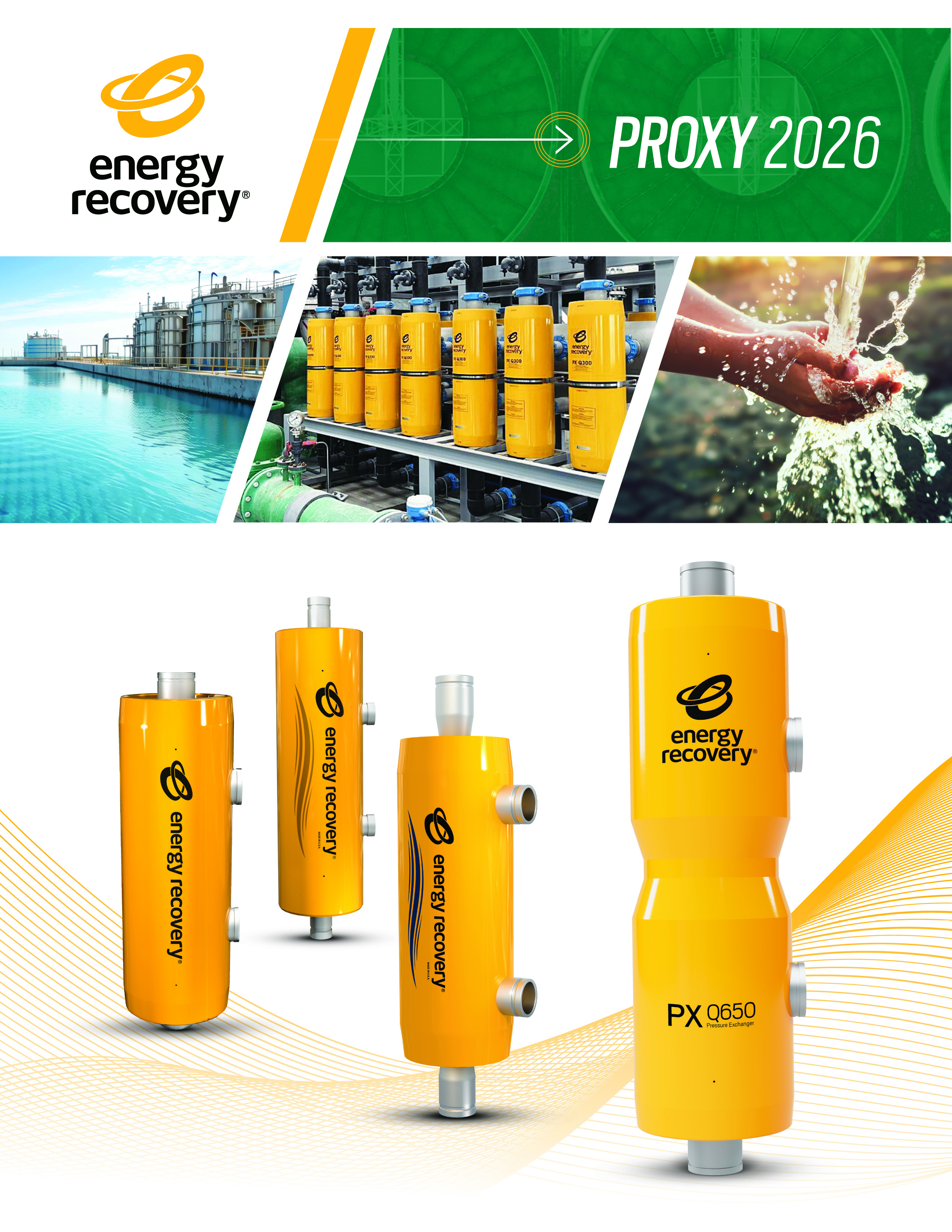
ERII-2026-Proxy-cover-front_final.jpg
UNITED STATES SECURITIES AND EXCHANGE COMMISSION
Washington, D.C. 20549
SCHEDULE 14A
Proxy Statement Pursuant to Section 14(a)
of the Securities Exchange Act of 1934
Filed by the Registrant  ☒
Filed by a party other than the Registrant  ☐
Check the appropriate box:
Preliminary Proxy Statement
Confidential, For Use of the Commission Only (as permitted by Rule 14a-6(e)(2))
Definitive Proxy Statement
Definitive additional materials
Soliciting material under Rule 14a-12
eri_logo_h_4c 1.jpg
Energy Recovery, Inc.
(Name of Registrant as Specified in Its Charter)
(Name of Person(s) Filing Proxy Statement, if Other Than the Registrant)
Payment of Filing Fee (Check the appropriate box):
No fee required.
Fee computed on table below per Exchange Act Rules 14a-6(i)(1) and 0-11.
(1)Title of each class of securities to which transaction applies:
(2)Aggregate number of securities to which transactions applies:
(3)Per unit price or other underlying value of transaction computed pursuant to Exchange Act Rule 0‑11 (set forth the
amount on which the filing fee is calculated and state how it was determined):
(4)Proposed maximum aggregate value of transaction:
(5)Total fee paid:
Fee paid previously with preliminary materials:
Check box if any part of the fee is offset as provided by Exchange Act Rule 0‑11(a)(2) and identify the filing for
which the offsetting fee was paid previously. Identify the previous filing by registration statement number, or
the form or schedule and the date of its filing.
(1)Amount previously paid:
(2)Form, Schedule or Registration Statement No.
(3)Filing Party:
(4)Date Filed:
Energy Recovery, Inc.2026 Proxy Statement | i
Table of Contents
eri_logo_h_4c.jpg
NOTICE OF 2026 ANNUAL MEETING OF STOCKHOLDERS
meeting calendar.jpg
Globe2.jpg
record date.jpg
Date:
Place:
Record Date:
Thursday, June 4, 2026
at 10:00 a.m. Pacific Time
www.virtualshareholdermeeting.
com/ERII2026
April 6, 2026
Dear Stockholders of Energy Recovery, Inc.:
You are invited to attend the Energy Recovery, Inc., 2026 Annual Meeting of Stockholders,
which will be held on Thursday, June 4, 2026, at 10:00 a.m. Pacific Time (the “2026 Annual
Meeting”).  As in past years, this year’s 2026 Annual Meeting will be conducted in a virtual
format via a live audio webcast at www.virtualshareholdermeeting.com/ERII2026.  To
participate in the 2026 Annual Meeting, you will need the 16-digit control number that appears
on your Notice Regarding the Availability of Proxy Materials, your proxy card (printed in the box
and marked by the arrow), and the instructions that accompanied your proxy materials.  If you
hold shares in the name of a broker, bank, trustee or other nominee, you may need to contact
your broker, bank, trustee or other nominee for assistance with your 16-digit control number. 
You will have the ability to submit questions during the 2026 Annual Meeting via the meeting
website.
Agenda:
1.To elect six (6) directors for a one-year term;
2.To consider and approve, on a non-binding advisory basis, executive compensation as
disclosed in the attached Proxy Statement;
3.To ratify the appointment of Deloitte & Touche LLP as the Company’s independent
registered public accounting firm for the fiscal year ending December 31, 2026;
4.To approve Amendment No. 1 to the Energy Recovery, Inc. 2020 Incentive Plan; and
5.To consider any other business that may properly come before the 2026 Annual
Meeting or any adjournment or postponement thereof.
Energy Recovery, Inc.2026 Proxy Statement | ii
Table of Contents
The Board of Directors has fixed the close of business on April 6, 2026, as the record date
for the 2026 Annual Meeting.  Stockholders of record as of April 6, 2026, may vote at the
2026 Annual Meeting or any postponements or adjournments of the meeting.  This notice of
annual meeting, notice of internet availability, proxy statement, annual report on Form 10-K
and form of proxy are being made available on or about April 20, 2026.
It is important that your shares are represented at the 2026 Annual Meeting, and
regardless of whether you plan to attend, the Company respectfully requests that you vote in
advance on the matters to be presented at the 2026 Annual Meeting as described in these
proxy materials.
You can help the Company reduce costs and the impact on the environment by electing
to receive and access future copies of the Company’s proxy statements, annual reports and
other stockholder materials electronically by email.  If your shares are registered directly in
your name with the Company’s stock registrar and transfer agent, Equiniti Trust Company, LLC,
you can make this election by going to its website (www.equiniti.com/us/) or by following the
instructions provided when voting over the Internet.  If you hold your shares in a brokerage
account or otherwise through a third party in “street name,” please refer to the information
provided by your broker, bank or other nominee for instructions on how to elect to receive and
view future annual meeting materials electronically.
By Order of the Board of Directors,
William Yeung Signature 2022-03-23.jpg
William W. Yeung
Chief Legal Officer and Corporate Secretary
San Leandro, California
April 20, 2026
Important Notice Regarding the Availability of Proxy Materials
for the Annual Stockholder Meeting
To Be Held on June 4, 2026:  This Proxy Statement, along with
the 2025 Annual Report on Form 10-K for the fiscal year ended
December 31, 2025, is available free of charge at the following
website:  www.proxyvote.com
Energy Recovery, Inc.2026 Proxy Statement | iii
Table of Contents
Page
Human Capital Resources
Board Composition
Sustainability
Page
39
Executive Compensation Framework
Energy Recovery, Inc.2026 Proxy Statement | iv
Table of Contents
Page
Page
Energy Recovery, Inc.2026 Proxy Statement | 1
Table of Contents
Proxy Statement
eri_logo_h_4c.jpg
2026 ANNUAL MEETING OF STOCKHOLDERS
To Be Held at 10:00 a.m. Pacific Time on
Thursday, June 4, 2026
This proxy statement and the enclosed form of proxy (“Proxy Statement”) are furnished in
connection with the solicitation of proxies by the Company’s Board of Directors (the “Board” or
the “Board of Directors”) for use at the 2026 Annual Meeting of Stockholders of Energy
Recovery, Inc., a Delaware corporation, and any postponements, adjournments or
continuations thereof.  The 2026 Annual Meeting will be held in a virtual format via live audio
webcast on Thursday, June 4, 2026, at 10:00 a.m. Pacific Time.  Stockholders can attend the
meeting via the internet at www.virtualshareholdermeeting.com/ERII2026 by using the 16-digit
control number which appears on the Notice Regarding the Availability of Proxy Materials, the
proxy card (printed in the box and marked by the arrow), and the instructions that
accompanied your proxy materials.  References in this Proxy Statement to “we,” “us,” “our,”
“the Company” or “Energy Recovery” refer to Energy Recovery, Inc.
The Notice of Internet Availability of Proxy Materials (the “Notice”) containing instructions
on how to access this Proxy Statement and 2025 Annual Report is first being mailed on or about
April 20, 2026, to all stockholders entitled to vote at the 2026 Annual Meeting.
THE INFORMATION PROVIDED IN THE “QUESTION AND ANSWER” FORMAT IN THE
SECTION ENTITLED “INFORMATION ABOUT THE 2026 ANNUAL MEETING”
IS FOR YOUR CONVENIENCE ONLY AND IS MERELY A SUMMARY OF
THE INFORMATION CONTAINED IN THIS PROXY STATEMENT.
YOU SHOULD READ THIS ENTIRE PROXY STATEMENT CAREFULLY.
Energy Recovery, Inc.2026 Proxy Statement | 2
Table of Contents
Proxy Summary
This summary contains highlights about the Company, information contained elsewhere in
this Proxy Statement and the upcoming 2026 Annual Meeting.  This summary does not contain
all of the information that you should consider in advance of the meeting and the Company
encourages you to read the entire Proxy Statement carefully before voting.
2026 Annual Meeting
meeting calendar.jpg
Globe2.jpg
Date and Time:
Virtual Meeting Access:
Thursday, June 4, 2026, at 10:00 a.m., Pacific Time
www.virtualshareholdermeeting.com/ERII2026
record date.jpg
file date.jpg
Record Date:
Proxy Mail Date:
April 6, 2026
On or about April 20, 2026
Computer.jpg
Computer.jpg
Vote in Advance of the Meeting
Over the internet at www.proxyvote.com; or
Over the internet – See page 104 of the Proxy —“How Do I Vote
Cellphone 2.jpg
Envelope.jpg
By telephone
at 1-800-690-6903; or
By mail — sign, date and return
the proxy card or voting instruction form mailed to you.
Energy Recovery, Inc.2026 Proxy Statement | 3
Table of Contents
Meeting Agenda and Voting Matters
Matter
Board Recommendation
Page
1.
Election of six (6) Directors for a One-Year Term
FOR each Nominee
2.
FOR
3.
FOR
4.
FOR
2026 Director Nominees
Name
Age (1)
Director
Since
Principal Occupation
Independent
Roles and Committee
Memberships (1)
Alexander J. Buehler
50
2015
Former President and
CEO of Integrated
Water Services
Yes
Audit (Chair), Compensation
Joan K. Chow
65
2021
Former Executive Vice
President and Chief
Marketing Officer of
Conagra Foods
Yes
Compensation (Chair), Audit
Arve Hanstveit
71
1995
CFO of Foldstar, Inc.
Yes
Nominating & Corporate
Governance, Audit
David W. Moon
64
2023
President and CEO of
Energy Recovery, Inc.
No
Colin R. Sabol
58
2023
Former President of
Measurement &
Control Solutions at
Xylem
Yes
Nominating & Corporate
Governance (Chair),
Compensation
Pamela L. Tondreau
66
2019
Former Executive Vice
President and Chief
Legal Officer of onsemi
Yes
Board Chair, Compensation,
Nominating & Corporate
Governance
(1)As of Record Date, April 6, 2026.
Energy Recovery, Inc.2026 Proxy Statement | 4
Table of Contents
Human Capital Resources
Our employees are key to our Company’s success. We are proud to have built a global
workforce to match our global customer base, and we work to create an inclusive, exciting,
safe, and supportive environment for all our employees worldwide. Energy Recovery is built
around innovation and is committed to creating a work environment that engages the
viewpoints and styles of its diverse teams. Our employees challenge the status quo, actively
partner to resolve challenges, and seek to continuously improve themselves and our
operations.
Our Code of Business Conduct (our “Code”) serves as a critical tool to help all of us
recognize and report unethical conduct, while preserving and nurturing our culture. Our Code is
reflected in our employee manual, which we provide to all  our employees, and in our training
programs. Both our employee manual and training programs include our policies against
harassment and bullying, and the elimination of bias in the workplace.
Board Composition
The Board considers and recognizes the distinct attributes of its directors.  The Board
currently includes two women, one racially/ethnically diverse director and one director of
diverse national origin.  In addition, the Board has two women in leadership roles, including the
Chair of the Board and the Chair of the Compensation Committee.
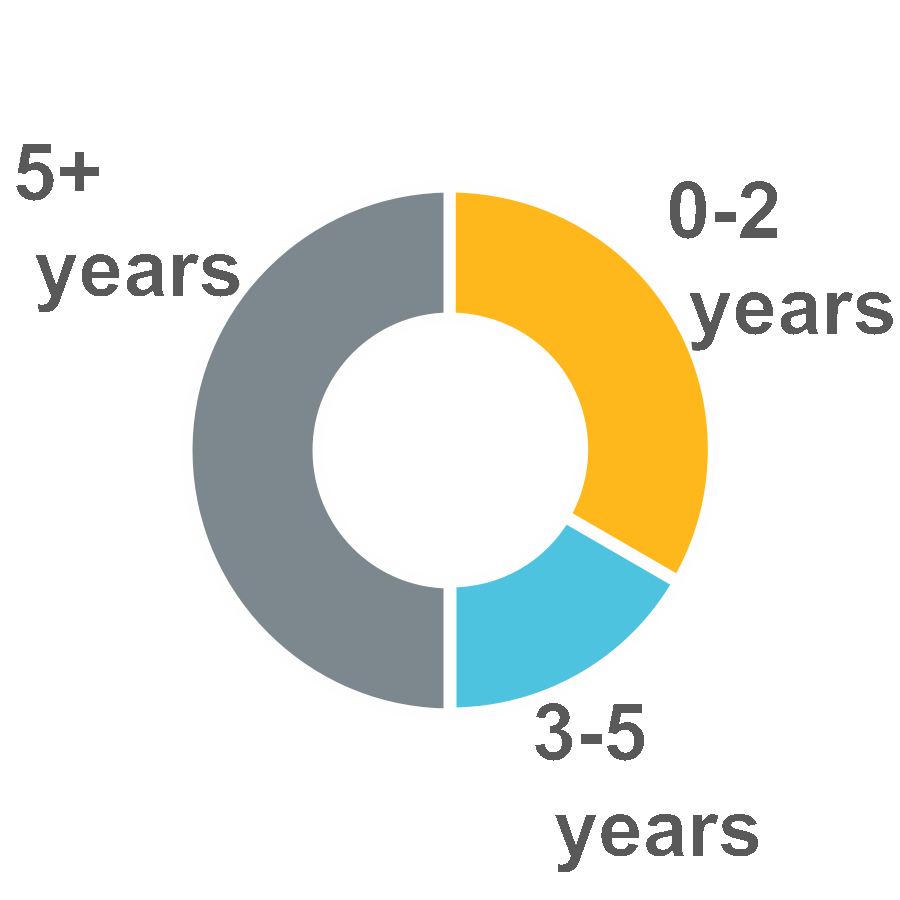
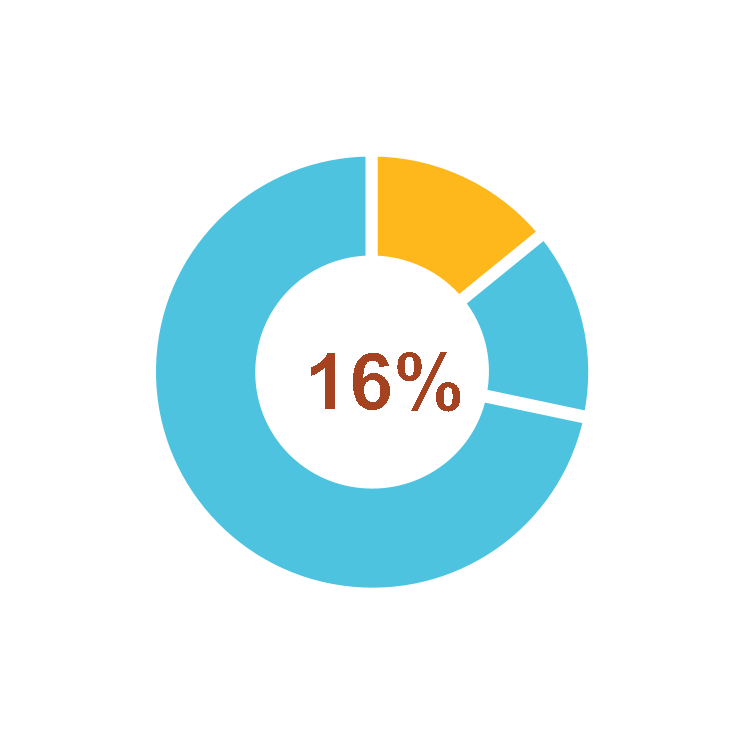
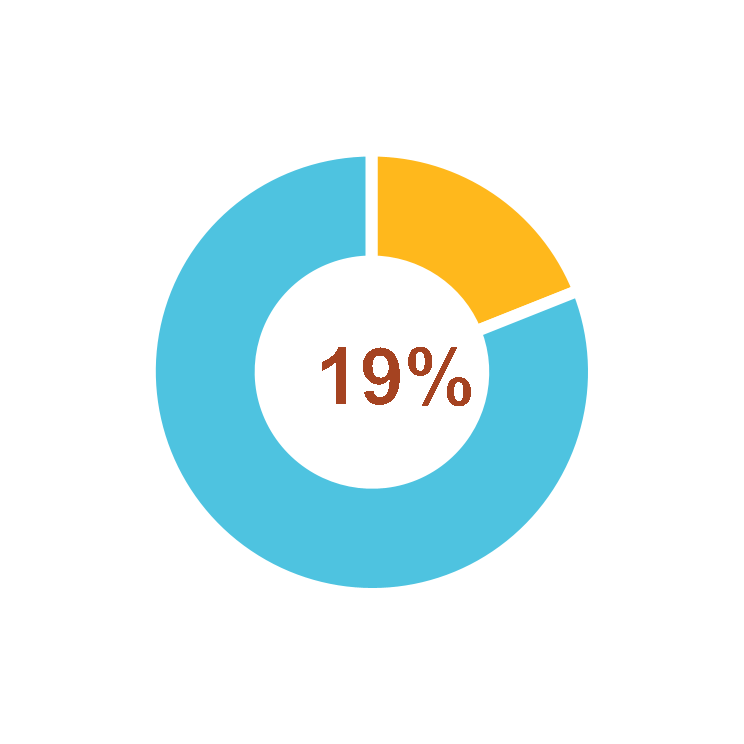
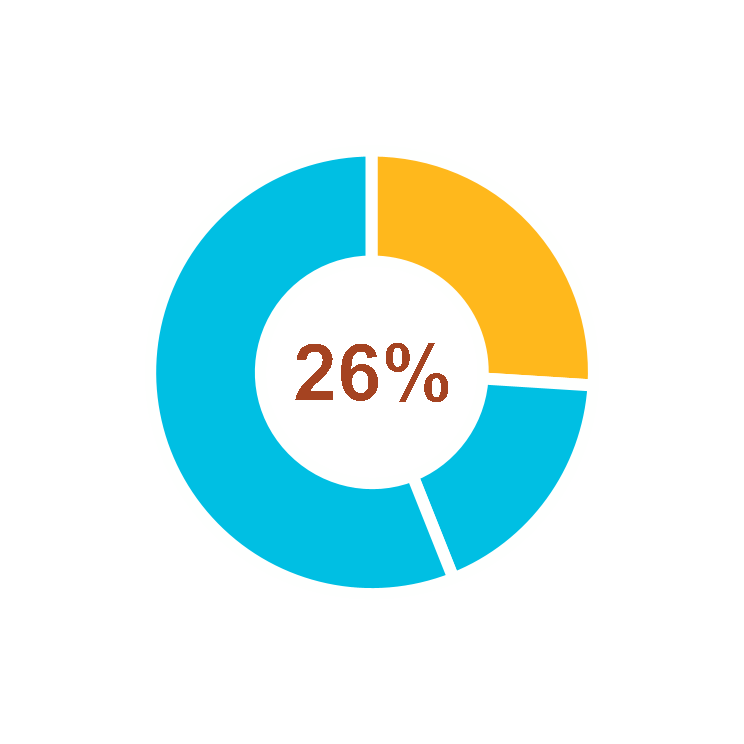
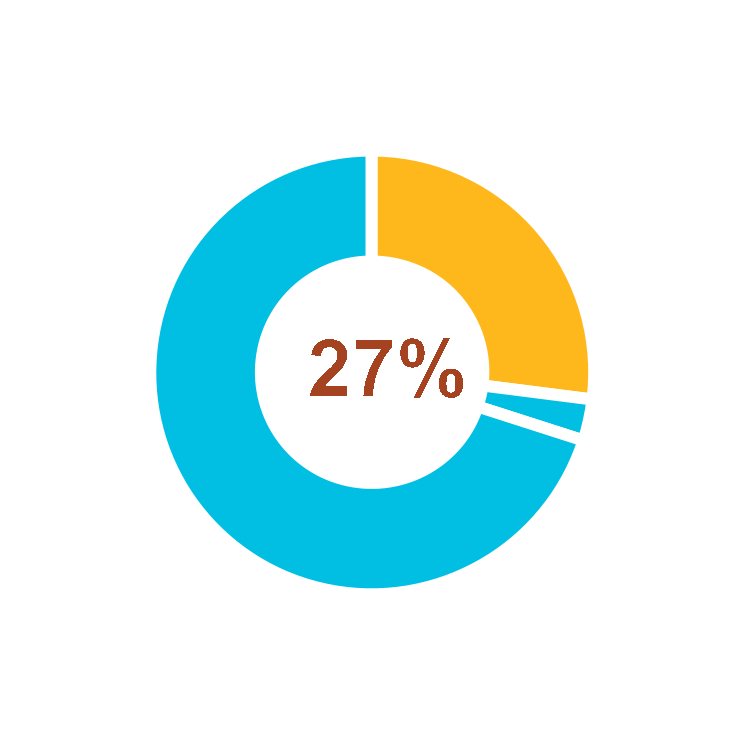
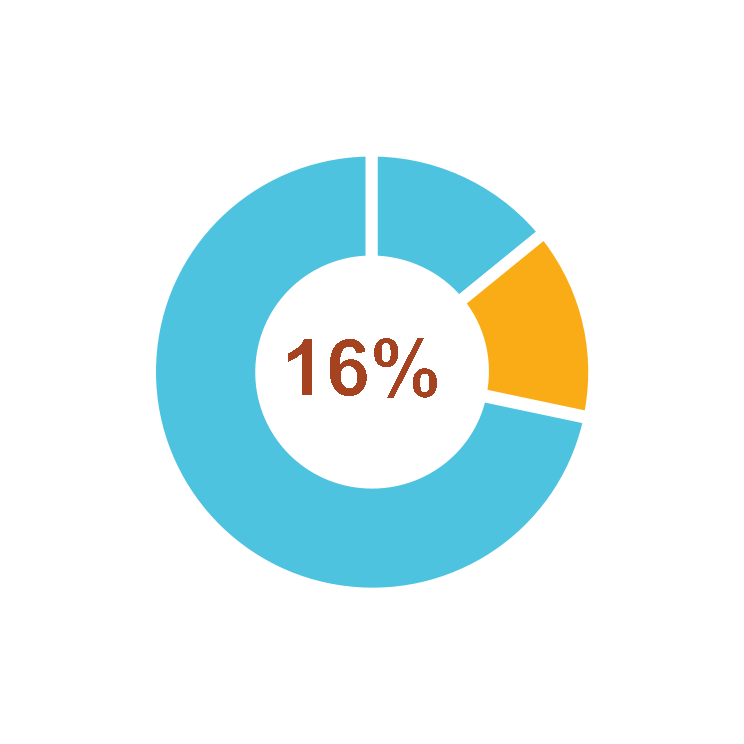
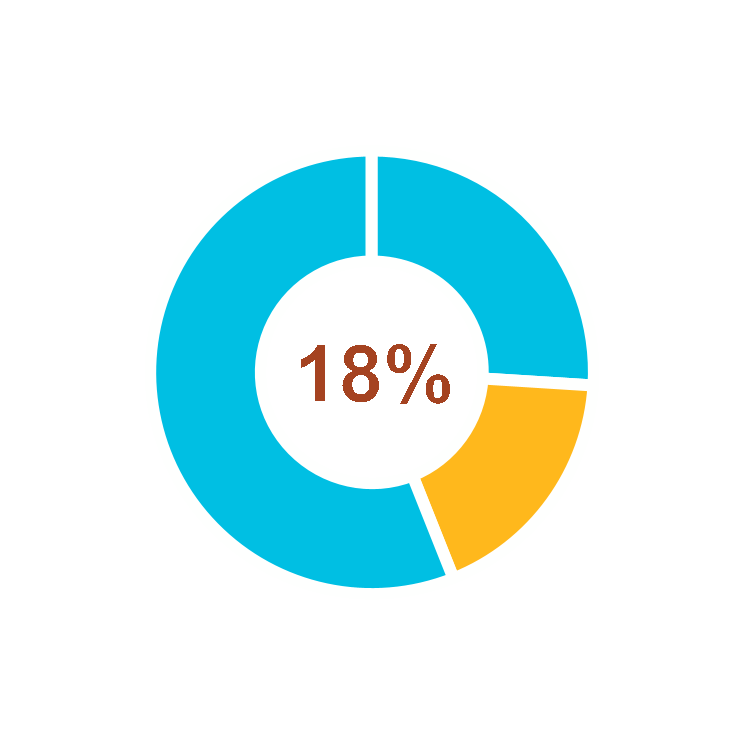
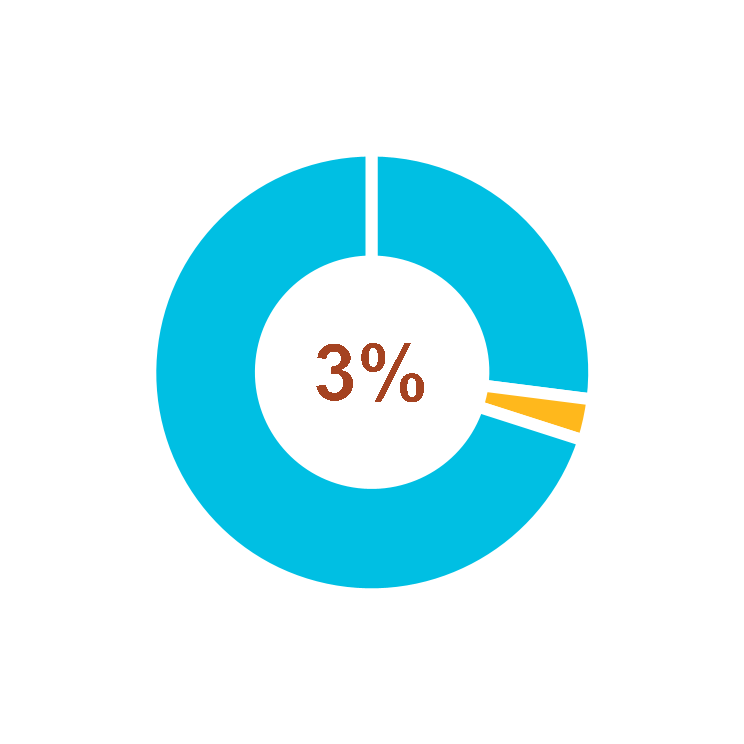
2/6 WOMEN (1)1/6 PEOPLE OF COLOR (1)5/6 INDEPENDENT (1)9.3 YRS. AVG. TENURE (1)
453
455
457
459
(1)As of the Record Date.
Energy Recovery, Inc.2026 Proxy Statement | 5
Table of Contents
Stockholder Engagement and Governance Highlights
The Company believes that strong corporate governance includes consistent engagement
with its stockholders.  The Company believes in fostering long-term relationships and year-
round, open and honest engagement with its investors, which is critical to the Company’s
success.  The Company engages with stockholders on a variety of topics throughout the year to
ensure that it is addressing questions and concerns and to seek input on policies and practices. 
The Company’s management team, including its Chief Executive Officer (“CEO”), Chief Financial
Officer (“CFO”) and Investor Relations department, regularly engages in meaningful dialogue
with the Company’s stockholders through 1-on-1 meetings, quarterly earnings calls, industry
conferences, the annual shareholder meeting and other channels of communication, which the
management team regularly shares with the Board.  Stockholders may communicate with the
Board as set forth under “Communication between Stockholders and Directors” on page 33.
During 2025, the Company engaged with a wide cross section of shareholders through
investor (non-deal) road shows,investor conferences and 1-on-1 investor meetings.  In addition,
since 2020, the Company’s annual meetings have been conducted virtually through a live
webcast and online shareholder tools.  The Company believes the virtual meeting format
enables stockholders to participate fully, and equally, from any location around the world, at
little to no cost to them.  The format of the Company’s 2026 Annual Meeting has been designed
to ensure that its stockholders who attend the Company’s 2026 Annual Meeting will be
afforded the same rights and opportunities to participate as they would at an in-person
meeting.  For more information on the meeting format, see page 104.
These interactions enable a two-way dialogue between the Company and our
shareholders and provide an important channel for the Board and management to understand
the perspectives of our shareholders and their areas of interest.  These interactions also help to
inform our decision making and commitments.
The Board regularly assesses and refines the Company’s corporate governance policies
and procedures to take into account evolving best practices and the valuable feedback of the
Company’s shareholders and other stakeholders who have provided important external
viewpoints that inform the Company’s decisions and strategy.
Energy Recovery, Inc.2026 Proxy Statement | 6
Table of Contents
Governance highlights include:
All directors elected annually for
one-year terms
Proxy access rights, allowing eligible
long-term shareholders holding 3%
or more of the Company’s
outstanding shares of common stock
to include nominations for directors
in the Company’s proxy statement
Only one class of outstanding shares
with each share entitled to one vote
Independent oversight – 5 of 6
current directors are independent
(all except the current CEO)
Independent Chair of the Board or
Lead Independent Director with
robust responsibilities
100% independent Board
Committees
Independent directors meet in
executive session at each regularly
scheduled Board meeting
Board with effective mix of skills,
experiences and perspectives
Focus on Board refreshment -
average Board tenure is
approximately 9.3 years
Active Board oversight of the
Company’s strategy, risk
management, cybersecurity, human
capital management and
sustainability matters
Annual Board and committee self-
assessments to review effectiveness
Prohibition on hedging or pledging
the Company’s common stock
Stringent clawback policy
Rigorous director and executive
stock ownership guidelines
Director resignation policy
Robust corporate governance
guidelines applicable to directors
Energy Recovery, Inc.2026 Proxy Statement | 7
Table of Contents
Executive Compensation Highlights
The Company’s compensation decisions were aligned with its financial and operational
performance in 2025 and reflected its focus on variable, at-risk compensation.  The Company’s
compensation is intended to reward performance and sustained growth over the long term.  The
Company continues to look ahead and evaluate new methods to sustain our pay for performance
philosophy, including the introduction of performance based restricted stock units in 2025.
The Company’s CEO and other executive officers have demonstrated their commitment to
fair pay and pay for performance alignment with our investor interests.  The Company is
committed to effective compensation governance, as demonstrated by the following
compensation policies and practices:
What We Do
What We Don’t Do
Substantial portion of compensation is
at-risk
Long-term vesting to promote
retention and investor alignment
Rigorous stock ownership guidelines
Double trigger change in control
severance
At-will employment of executive
officers
Independent Compensation
Committee
Independent compensation consultant
Annual executive compensation
assessment tied to practices of a
reasonable peer group of similar size/
value public companies
Risk assessment
Clawback policy
Annual incentives are based on
achievement of rigorous performance
goals
Executive compensation program does
not encourage excessive risk taking
No repricing
No excessive perquisites
No executive retirement plan
benefits
No guaranteed bonuses or
annual equity awards
No excessive severance
No excise tax gross-ups
Energy Recovery, Inc.2026 Proxy Statement | 8
Table of Contents
Proposal No. 1 – Election of Directors
The Board, upon the recommendation of the Nominating & Corporate Governance
Committee, has nominated the 6 people listed below for election at the Annual Meeting to
serve until the 2027 Annual Meeting of Shareholders and until their respective successors are
duly elected and qualified.  All of the director nominees currently serve on the Board and each
has consented, if elected as a director of the Company, to serve until their term expires.
In the event that any of the Director
Nominees is unable or declines to serve as a
director at the time of the 2026 Annual
Meeting, the proxies will be voted for any
nominee who shall be designated by the
present Board of Directors to fill the vacancy. 
In the event that additional person(s) are
nominated for election as director(s), the
proxy holders intend to vote all proxies
received by them in such a manner as will
assure the election of as many of the
nominees listed below as possible.  In such
event, the specific nominees to be voted for
will be determined by the proxy holders.  The
Board has no reason to believe that the
person named will be unable or unwilling to
serve as a director, if elected.  The nominee
for director who receives the greatest
number of votes will be elected.
A plurality of the shares voted for the
nominee at the meeting is required to elect
the nominee as a director.
Director Nominees
(Term Expiring in 2027)
Alexander J. Buehler
Joan K. Chow
Arve Hanstveit
David W. Moon
Colin R. Sabol
Pamela L. Tondreau
Energy Recovery, Inc.2026 Proxy Statement | 9
Table of Contents
Director Criteria and Qualifications
In connection with the selection and nomination process, the Nominating & Corporate
Governance Committee reviews the experience, skills, expertise, backgrounds and other
attributes of each individual candidate in the context of the Board as a whole, with the
objective of maintaining a group of directors that can further the Company’s success.  The
Nominating & Corporate Governance Committee considers a number of important factors in
determining whether to re-nominate incumbent directors and in evaluating new director
candidates, including:
satisfaction of director criteria set
forth in the Nominating & Corporate
Governance Committee Charter;
for incumbent directors, the director’s
participation in, and contributions to,
the activities of the Board, the
contents of the most recent board
assessment and attendance at
meetings;
the individual’s educational and
professional background and personal
accomplishments;
broad-based leadership, expertise and
experience relevant to the Company’s
long-term strategy, operations and
culture;
ensuring an appropriate balance
between director tenure and board
refreshment;
ability to effectively represent the
long-term interests of our
shareholders and other stakeholders;
and
compliance with Securities and
Exchange Commission (“SEC”), the
Nasdaq Stock Market (“NASDAQ”) and
other applicable legal and regulatory
standards.
The Company believes the selection of qualified directors is essential to ensuring that the
Board functions effectively.  The Board believes that each nominee listed below is highly
qualified and has the background, skills, experience and attributes that qualify each nominee to
serve as the director of the Company.  The Board’s recommendation is based on its carefully
considered judgment that the background, skills, experience and attributes of each of the
nominees make them the best candidates to serve on the Board.  The Board also believes that
the Company will be best served by directors with a wide array of talents and perspectives to
drive innovation, promote critical thinking and enhance discussions.  The matrix below indicates
the director nominees who possess each qualification, skill or expertise.
Energy Recovery, Inc.2026 Proxy Statement | 10
Table of Contents
Skill/Experience
Buehler
Chow
Hanstveit
Moon
Sabol
Tondreau
Manufacturing/Operations
Industry/Product Knowledge
International Operations/Experience
Finance/Accounting
Product Innovation/R&D
Energy
Human Capital/Culture
Strategic Transformation/M&A
Corporate Strategy/Governance
Risk Oversight
We invite you to read about our direct nominees below.
Energy Recovery, Inc.2026 Proxy Statement | 11
Table of Contents
DIRECTOR NOMINEES
Director Since
Name, Principal Occupation, and Other Information
February 2015
Alexander J. Buehler
Age 50
Alexander J. Buehler most recently served as President & CEO of
Buehler A 2022-10.jpg
Integrated Water Services, a PE-backed company focused on product
solutions, technical and digital services, and field services for water and
wastewater treatment facilities.  Beforehand, Mr. Buehler served as the
Interim CEO of LiqTech International, a publicly traded manufacturing and
technology company based in Copenhagen, Denmark that specializes in
advanced membranes and filters comprised of silicon carbide ceramics. 
Prior to LiqTech, Mr. Buehler served as the President & CEO of the Brock
Group, a leading soft craft services provider with established business
across multiple end markets.  Previously, Mr. Buehler was EVP of Global
Resources for Intertek, a publicly traded company headquartered in
London that is a market leader in quality assurances services across
multiple industries—namely energy, mining, power, infrastructure,
aerospace, and others.  Before Intertek, Mr. Buehler served at Energy
Maintenance Services (“EMS”) from July 2014 to September 2017, first with a brief stint as Chief
Financial Officer and then as President & Chief Executive Officer, during which time he steered the
company through the market downturn in oil & gas, repositioned the business as a leading integrity
maintenance company, and led the marketing and sale of the business.  Mr. Buehler became a member
of the Company’s Board of Directors in February 2015.  From 2011 to 2014, Mr. Buehler served as
Energy Recovery’s Chief Financial Officer.  From 2004 to 2011, Mr. Buehler held executive-level positions
at Insituform Technologies, Inc. (now Aegion Corporation), a global leader in water infrastructure
technology and services for municipalities and industry.
With substantial experience across industrial end markets (water, energy), including products and
services, with multiple C-level roles at publicly traded and private equity-backed companies, Mr. Buehler
is a highly impactful business executive with years of experience in leadership, strategy, commercial
excellence, financial oversight, and execution discipline.  Mr. Buehler currently serves as Chair of the
Board for LiqTech International and has previously served as a board member and Chair of the Audit
Committee for Viscount Systems.
The Board selected Mr. Buehler to serve as a director because of his substantial experience in the
global water, oil & gas and manufacturing industries, his knowledge of the Company and its products,
and his executive and financial experience.
EDUCATION
B.S. in Civil Engineering from the United States Military Academy at West Point and an M.B.A. in
Finance from the Wharton School at the University of Pennsylvania.
CURRENT BOARD COMMITTEES
Audit Committee (Chair)
Compensation Committee (Member)
Energy Recovery, Inc.2026 Proxy Statement | 12
Table of Contents
Director Since
Name, Principal Occupation, and Other Information
December 2021
Joan K. Chow
Age 65
Chow J 2022-10.jpg
Joan K. Chow has extensive leadership experience in retail and
marketing, consumer insights, and human resources matters, and
has served as senior leader at some the world’s most recognizable
companies.
Ms. Chow is the former Executive Vice President and Chief
Marketing Officer at ConAgra Foods, one of North America’s
leading packaged food companies. Prior to that, Ms. Chow spent
extensive time with Sears Holdings Corporation in various
marketing roles and ultimately served as Senior Vice President and
Chief Marketing Officer for Sears Retail. She has also held
executive positions with Information Resources Inc., Johnson &
Johnson Consumer Products, Inc. and the Greater Chicago Food
Depository.
Ms. Chow currently serves as Chair of the Compensation Committee and a member of the
Audit Committee at ERII, Inc. and is also a director at High Liner Foods. She has previously
served as a Director of Spectrum Brands, Wellbilt, Inc., The Manitowoc Company, RC2
Corporation, and Feeding America.
The Board selected Ms. Chow because of her extensive executive and marketing
experience as well as her prior public company board experience, which provides her unique
insight on key board and company issues.
EDUCATION
B.A. Cornell University and an M.B.A. from the Wharton School of the University of Pennsylvania.
CURRENT BOARD COMMITTEES
Compensation Committee (Chair)
Audit Committee (Member)
Energy Recovery, Inc.2026 Proxy Statement | 13
Table of Contents
Director Since
Name, Principal Occupation, and Other Information
January 1995
Arve Hanstveit
Age 71
Arve Hanstveit is the Chief Financial Officer at Foldstar, Inc.  Previously,
Hanstveit A 2022-10.jpg
between August 1997 and November 2010, he served as Partner and
Vice President of ABG Sundal Collier, a Scandinavian investment bank,
where he was responsible for advising U.S. institutional investors on
equity investments in Nordic companies.  Prior to joining ABG Sundal
Collier, Mr. Hanstveit worked as a securities analyst and as a portfolio
manager for TIAA-Cref, a large U.S. institutional investor.  From
February 2007 to January 2010, Mr. Hanstveit served on the Board of
Directors of Kezzler AS, a privately-held Norwegian company, which
delivers secure track and trace solutions to the industry.  Mr. Hanstveit
is also a member of the Norwegian American Chamber of Commerce
and the New York Angels, an independent consortium of individual
accredited angel investors that provide equity capital for early-stage
companies in the New York City area.
The Board selected Mr. Hanstveit to serve as a director because of his early investment in the
Company, his years of experience as a portfolio manager and securities analyst, his detailed
understanding of global financial markets and his extensive knowledge of the Company, its products,
and markets.
EDUCATION
B.A. in Business from the Norwegian School of Management and an M.B.A. from the University of
Wisconsin, Madison.
CURRENT BOARD COMMITTEES
Audit Committee (Member)
Nominating & Corporate Governance Committee (Member)
Energy Recovery, Inc.2026 Proxy Statement | 14
Table of Contents
Director Since
Name, Principal Occupation, and Other Information
July 2023
David W. Moon
Age 64
David W. Moon became the Company’s President and CEO in
Moon D 2024-03.jpg
January 2024 and served as the Company’s interim-President and CEO
from October 2023 to January 2024.  Mr. Moon first joined the
Company as a Board Member in July 2023.  Mr. Moon was previously
President of Carrier Commercial Refrigeration (“CCR”), a division of
Carrier Global Corporation, from 2020 to 2021.  Based in Paris, CCR was
a leading supplier of high-efficiency CO2 turnkey refrigeration systems
and services to the food retail, processing and storage segments and
pharma segment in Europe, the Middle East, Africa and Asia.  Prior to
that, Mr. Moon worked as an Advisor for Ares Management LLC on the
acquisition of CoolSys Inc., the U.S. market leader in commercial
refrigeration and heating, ventilation and air conditioning (“HVAC”)
services.  He joined the CoolSys Board of Directors post-acquisition. 
Mr. Moon was President & Chief Operating Officer of Heatcraft Worldwide Refrigeration (“Heatcraft”), a
division of Lennox International, Inc., from 2006 to 2017.  Heatcraft was the global OEM leader in
commercial refrigeration equipment.  Mr. Moon joined Lennox International, Inc. in 1998 holding
various management positions in the United States, Singapore and Australia.  Prior to that, Mr. Moon
held various management positions at Allied Signal, Inc., Case Corporation and Tenneco Oil Company in
the United States, Hong Kong, Taiwan and Germany.  Mr. Moon served on the Board of Directors of
American Woodmark Corporation from 2015 to 2020. 
The Board selected Mr. Moon as a director because of his 25 years of commercial/industrial
refrigeration and commercial HVAC leadership, his executive experience and leadership qualities.
EDUCATION
B.S. in Civil Engineering and an M.B.A. from Texas A&M University.
CURRENT BOARD COMMITTEES
None
Energy Recovery, Inc.2026 Proxy Statement | 15
Table of Contents
Director Since
Name, Principal Occupation, and Other Information
July 2023
Colin R. Sabol
Age 58
Colin R. Sabol joined the Board in July 2023.  Mr. Sabol is an
Sabol C 2024-03.jpg
accomplished business leader, strategist and deal maker with over
20 years of experience in the global water and energy markets.  From
2017-2022, Mr. Sabol was President of Measurement & Control
Solutions at Xylem, Inc., a global water technology provider.  Between
2013 and 2017, he led a wide range of global business at Xylem
including Analytical Instrumentation, Water Treatment and the
Dewatering Pump Rental businesses.
Mr. Sabol joined ITT, Inc. in 2006 as VP Growth for the Fluid & Motion
Control segment, where he led the transformation of a mechanical
equipment portfolio into a technology and services leader.  He was
instrumental in effecting the spin-off of Xylem from ITT in 2011. 
Mr. Sabol first entered the water industry at General Electric Company
where he served as Chief Growth Officer of GE Water from 2003 to
2006.  He served on the board of Faradyne Motors, LLC, a JV between Xylem and Pentair from 2009 to
2017 and was Board Chair of Xylem Watermark, Xylem’s corporate social responsibility program, from
2009 to 2017.
The Board selected Mr. Sabol as a director because of his extensive executive experience and his
expertise within the water industry, which provides him with unique insight on key issues involving the
Company’s water business unit.
EDUCATION
B.S. in Material Engineering from Alfred University.
CURRENT BOARD COMMITTEES
Nominating & Corporate Governance Committee (Chair)
Compensation Committee (Member)
Energy Recovery, Inc.2026 Proxy Statement | 16
Table of Contents
Director Since
Name, Principal Occupation, and Other Information
July 2019
Pamela L. Tondreau
Age 66
Pamela L. Tondreau is an experienced legal and business professional. 
Tondreau P 2021-04.jpg
She was elected as Chair of the Board in October 2023.  Ms. Tondreau
was with ON Semiconductor Corporation (now onsemi), as  Executive
Vice President and Chief Legal Officer, from October 2021 to March
2026.  Previously, Ms. Tondreau served as a consultant to Infineon
Technologies AG, which purchased Cypress Semiconductor Corporation
(“CY”) from April 16, 2020 until July 2020.  Prior to her consulting role,
Ms. Tondreau served as Chief Legal Officer, Corporate Secretary and
Executive Vice President of Human Resources of CY from 2014 through
2016.  Prior to her tenure with CY, Ms. Tondreau was an executive with
Hewlett-Packard Corporation (“HP”) from 1999 to 2012 holding various
positions including Chief Intellectual Property Counsel, Deputy General
Counsel to the Chief Technology Officer, counsel to the Technology
Committee of the Board, counsel for the networking business including
leading the acquisition of 3Com and integrating the China entity into HP.
Ms. Tondreau has extensive experience in the areas of intellectual property strategy, corporate
governance and executive compensation, enterprise risk management and domestic and international
mergers and acquisitions (“M&A”).
The Board selected Ms. Tondreau as a director because of her experience as a technology
executive and General Counsel and her knowledge and experience with corporate governance,
compliance, intellectual property, policy and M&A.
EDUCATION
B.A. in Anthropology and Economics from the University of California at Berkeley and a J.D. from
McGeorge School of Law.
CURRENT BOARD COMMITTEES
Compensation Committee (Member)
Nominating & Corporate Governance Committee (Member)
THE BOARD OF DIRECTORS UNANIMOUSLY RECOMMENDS THAT
STOCKHOLDERS VOTE “FOR” THE ELECTION OF
ALEXANDER J. BUEHLER, JOAN K. CHOW,
ARVE HANSTVEIT, DAVID W. MOON,
COLIN R. SABOL AND PAMELA L. TONDREAU.
Energy Recovery, Inc.2026 Proxy Statement | 17
Table of Contents
INFORMATION ABOUT THE BOARD OF DIRECTORS
AND CORPORATE GOVERNANCE MATTERS
Corporate Governance Overview
Director Independence
5 of 6 continuing directors are
independent (all except the CEO)
Independent Chair of the Board
100% independent Board
Committees
Regular executive sessions of
independent directors
Committees authorized to hire third
party advisors
Best Practices
Board with effective mix of skills,
experiences and perspectives
Active Board oversight of the
Company’s strategy, risk
management, cybersecurity, human
capital management and
sustainability matters
Rigorous director and executive
stock ownership guidelines
Prohibition on hedging or pledging
the Company’s common stock
Focus on Active Board refreshment -
average Board tenure is
approximately 9.3 years
Director resignation policy
Accountability
Annual Board and Committee
evaluations
✔  Robust corporate governance
guidelines applicable to directors
Stringent clawback policy
Stockholder Rights
Proxy access rights for stockholders
One class of outstanding shares with
each share entitled to one vote
Energy Recovery, Inc.2026 Proxy Statement | 18
Table of Contents
The Company is committed to maintaining superior governance practices that represent
the long-term interests of the Company’s stockholders.  The Company’s governance framework
is designed to promote governance transparency and ensure the Board has the necessary
authority to review and evaluate its business operations and make decisions that are
independent of management and in the best interests of the Company’s stockholders.  The
Company regularly assesses and refines its corporate governance policies and procedures to
take into account evolving best practices.  In 2022, the Board adopted Corporate Governance
Guidelines that provide a framework for governance as a whole and describe the principles and
practices that the Board follows in carrying out its responsibilities.  Furthermore, the Board
later amended the Company’s Corporate Governance Guidelines to include a Director
Resignation Policy.  The Corporate Governance Guidelines address the roles of the Board and
the Company’s management, the composition, structure and polices of the Board and the
Board’s committees, the responsibilities of the Chair of the Board, expectations and
responsibilities of directors, evaluation of the Board and the Board’s committee performance,
and other related matters.  The Nominating & Corporate Governance Committee is responsible
for periodically reviewing the Corporate Governance Guidelines to ensure that the guidelines
reflect the best interests of both the Company and the Company’s stockholders, and that it
complies with all applicable rules and regulations.
Key Corporate Governance Documents
The Company’s commitment to good corporate governance is reflected in the Company’s
key governance documents, listed below, which are available online at https://
ir.energyrecovery.com/corporate-governance/governance-documents.
Corporate Governance Guidelines
Amended and Restated Certificate of Incorporation (the “Charter”)
Amended and Restated Bylaws (the “Bylaws”)
Audit Committee Charter
Compensation Committee Charter
Nominating & Corporate Governance Committee Charter
Code of Business Conduct and Ethics (the “Code of Ethics”)
Leadership Structure
The Company’s governance framework provides the Board with the flexibility to select the
appropriate board leadership structure.  In making determinations regarding the leadership
structure, the Board considers the facts and circumstances at the time, including the specific
needs of the business and a structure in the best interests of the Company and the Company’s
shareholders.
Energy Recovery, Inc.2026 Proxy Statement | 19
Table of Contents
The Board is led by a Chair that is elected by the Board.  The general duty of the Chair of
the Board is to provide leadership on the Board, including setting board and corporate culture,
building consensus around the Company’s strategy, and providing direction as to how the Board
operates.  The current leadership structure is comprised of an independent Chair, the
Company’s President and CEO who serves as a director, Board committees led by independent
directors, and active engagement by all directors.  Five of the six continuing directors will be
independent, assuming that all of the director nominees are elected at the 2026 Annual
Meeting.
Ms. Tondreau is the Chair of the Board and Mr. Moon is the President and CEO.  The
Company believes that this separation of roles and allocation of distinct responsibilities to each
role facilitates communication between the Company’s senior management and the full Board
about issues such as corporate governance, management development, succession planning,
executive compensation, and the Company’s performance, and best facilitates permitting the
Company’s President and CEO to concentrate on the Company’s business.  Pursuant to the
Company’s corporate governance guidelines, the Board may in the future combine the role of
the Company’s President and CEO and the Chair of the Board.  If that were to happen, then the
Board’s independent directors would elect a Lead Independent Director.
Board Chair
CEO
Independent Committee Chairs
Pamela L. Tondreau
David W. Moon
Alexander J. Buehler
Joan K. Chow
Colin R. Sabol
Audit Committee
Chair
Compensation
Committee Chair
Nominating &
Corporate
Governance
Committee Chair
Alexander Buehler Aug 2022.jpg
Colin Sabol_Headshot_1.75x2.13.jpg
David Moon_Headshot_1.75x2.13.jpg
ER-Pam-2021-AB__WEB-.jpg
Joan-Chow-Energy-Recovery.jpg
Energy Recovery, Inc.2026 Proxy Statement | 20
Table of Contents
Board of Directors
The number of directors is fixed by the Board, subject to the terms of the Charter and the
Bylaws.
Directors
Until the 2026 Annual Meeting, the Board will continue to consist of six directors.  As of
the Record Date, the following table represents the Directors and committees served:
Board Committee Memberships
Director
Age (1)
Audit
Compensation
Nominating &
Corporate
Governance
Alexander J. Buehler
50
Chair
Member
Joan K. Chow
65
Member
Chair
Arve Hanstveit
71
Member
Member
David W. Moon (2)
64
Colin R. Sabol
58
Member
Chair
Pamela L. Tondreau (3)
66
Member
Member
(1)As of the Record Date.
(2)Mr. Moon is the Company’s CEO and therefore does not serve on any Board committees.
(3)Ms. Tondreau serves as Chair of the Board.
Board Experience and Tenure
The Board believes that a variety of skills, perspectives and experience are an important
aspect of an effective board.  The Nominating & Corporate Governance Committee seeks to
recommend individuals to the Board with, among other things, different skills, experiences,
expertise and perspectives appropriate for the Company’s business and operations.  The
Company recognizes the benefits of healthy debate that stems from these different viewpoints
that may result from different backgrounds. 
Energy Recovery, Inc.2026 Proxy Statement | 21
Table of Contents
The Company believes that fresh perspectives and new ideas are critical to a forward-
looking and strategic board.  Three out of six continuing directors have served on the Board for
five years or less.  At the same time, given the extremely complex nature of the Company’s
business, it is equally important to benefit from the valuable experience and institutional
knowledge that longer-serving directors bring to the boardroom.  The Board is focused on
maintaining a balance between longer serving directors and newer directors with
complementary skills, expertise, backgrounds and points of view, which allow for natural
turnover and a reasonable pace of board refreshment.  The Board strongly believes that the
director nominees provide the Company with an appropriate base of knowledge, experience
and capability, allowing the Company to leverage deep company experience and knowledge in
addition to new viewpoints and innovative ideas among the Company’s current directors and
those that join the Board in the future.
Director Independence
The Nominating & Corporate Governance Committee and the Board undertake an annual
review of director independence.  The Nominating & Corporate Governance Committee and the
Board evaluated all business and charitable relationships between the Company and the
Company’s non-employee directors, and all other relevant facts and circumstances.  Based on
information provided by each director concerning his background, employment and affiliations,
including family relationships, the Board has affirmatively determined that, except for
Mr. Moon who is currently serving as the Company’s President and CEO, none of the current
directors or continuing director nominees have a relationship that would interfere with the
exercise of independent judgment in carrying out the responsibilities of a director and that each
of these directors is “independent” as that term is defined under the applicable rules and
regulations of the SEC and the listing standards of NASDAQ (the “Applicable Rules”).  In making
these determinations, the Board considered the current and prior relationships that each
director has with the Company and all other facts and circumstances the Board deemed
relevant in determining their independence.
The Board also has determined that each director nominee, except for Mr. Moon, is a
non-employee director, as defined pursuant to Rule 16b-3 promulgated under the Exchange
Act, and an outside director, as defined pursuant to Internal Revenue Code (“IRC”)
Section 162(m), as amended.
The Board’s standards for determining director independence meet or exceed the
Applicable Rules of the SEC and NASDAQ listing standards.  In determining whether a director is
“independent”, the Board considers whether the individual:
is not an executive officer or employee of the Company or any other individual having a
relationship which, in the opinion of the Board, would interfere with the exercise of
independent judgment in carrying out the responsibilities of a director;
is not, and has not at any time during the past three years been, employed by the
Company;
Energy Recovery, Inc.2026 Proxy Statement | 22
Table of Contents
has not accepted, and does not have any spouse, parent, child or sibling, whether by
blood, marriage or adoption, any person residing in such individual’s home, or any
relative supported financially (each, a “Family Member”) who has accepted, any
compensation from the Company in excess of $120,000 during any period of
12 consecutive months within the three years preceding the determination of
independence, other than (a) compensation for board or committee service,
(b) compensation paid to a Family Member who is an employee (other than an
executive officer) of the Company, or (c) benefits under a tax-qualified retirement plan
or non-discretionary compensation;
is not a Family Member of an individual who is, or at any time during the past three
years was, employed by the Company as an executive officer;
is not, and does not have a Family Member who is, a partner in, or a controlling
stockholder or an executive officer of, any organization to which the Company made, or
from which the Company received, payments for property or services in the current or
any of the past three fiscal years that exceed 5% of the recipient’s consolidated gross
revenues for that year, or $200,000, whichever is more, other than (a) payments arising
solely from investments in the Company’s securities and (b) payments under non-
discretionary charitable contribution matching programs;
is not, and does not have a Family Member who is, employed as an executive officer of
another entity where at any time during the past three years any of the executive
officers of the Company served on the compensation committee of such other entity;
is not, and does not have a Family Member who is, a current partner of the Company’s
outside auditor, and was not, and does not have a Family Member who was, a partner
or employee of the Company’s outside auditor who worked on the Company’s audit at
any time during any of the past three years; and
satisfies any additional requirements for independence promulgated from time to time
by NASDAQ.
Relationships Among Directors or Executive Officers
There are no family relationships among any of the directors or executive officers of the
Company.
Board Self-Evaluation
The Nominating & Corporate Governance Committee charter provides that the
Nominating & Corporate Governance Committee must conduct a periodic assessment of the
performance of the Board, including the committees, and provide the results to the full Board
for discussion.  The purpose of the review is to increase the effectiveness of the Board as a
whole and of each of the committees.  The assessment includes an evaluation of the Board and
each committee’s contribution as a whole, of specific areas in which the Board, the applicable
committee and/or management believe better contributions could be made and of the overall
make-up and composition of the Board and its committees.
Energy Recovery, Inc.2026 Proxy Statement | 23
Table of Contents
Board Meetings
The Board conducts its business through meetings of the full Board and committees of the
Board.  The Board regularly meets in executive session with only independent directors of the
Board present.  During 2025, the Board held 7 meetings.  During 2025, no director attended
fewer than 93% of all the meetings of the Board or its committees on which he or she served
after becoming a member. The Company encourages, but does not require, the directors to
attend the annual meeting of stockholders.  All directors attended the 2025 annual meeting of
stockholders.
Committees of the Board of Directors
The Board has three standing committees: the Audit Committee, the Compensation
Committee and the Nominating & Corporate Governance Committee.  From time to time, the
Board may establish temporary special committees to address specific matters.  The primary
responsibilities, membership and meeting information for the standing committees of the
Board during 2025 are summarized below.  A copy of the charter of the Audit Committee, the
Compensation Committee and the Nominating & Corporate Governance Committee is available
on the Company’s website at www.energyrecovery.com under the links “Investor Relations” –
“Corporate Governance.”
Energy Recovery, Inc.2026 Proxy Statement | 24
Table of Contents
Audit Committee
Current Members: All Independent
Alexander J. Buehler (Chair)
Joan K. Chow
Arve Hanstveit
Meetings in 2025: 4
The Board has unanimously determined that
each member of the Audit Committee meets
NASDAQ’s “financial sophistication”
requirements and that Mr. Buehler has the
financial education and experience to qualify
as an “Audit Committee financial expert”
within the meaning of SEC regulations.
Key Responsibilities:
Oversee and report to the Board with
respect to the quality and integrity of the
Company’s financial statements,
accounting, and financial reporting
processes, and audits of the financial
statements and internal controls over
financial reporting.
Appoint, compensate, and evaluate the
qualifications, independence and
performance of the Company’s
independent auditor.
Oversee the performance of the
Company’s internal audit function.
Establish policy standards and guidelines
for the Company’s risk assessment and
risk management.
Monitor the Company’s compliance with
legal and regulatory requirements,
including the Company’s disclosure
controls and procedures, and the
Company’s anonymous whistleblower
hotline.
Review and approve related party
transactions with the Company.
Review cyber-security and other risks
relevant to the Company’s information
system controls and security.
Energy Recovery, Inc.2026 Proxy Statement | 25
Table of Contents
Compensation Committee
Current Members: All Independent
Joan K. Chow (Chair)
Alexander J. Buehler
Colin R. Sabol
Pamela L. Tondreau
Meetings in  2025: 7
The Board has determined that each member
is independent under NASDAQ rules and the
Company’s Corporate Governance Guidelines
and is a “non-employee director” as defined
by Rule 16b-3 under the Exchange Act.
Key Responsibilities:
Review and approve the Company’s
overall compensation philosophy.
Design and administer the Company’s
executive compensation programs and
policies that are aligned with business and
compensation objectives.
Evaluate the performance of the
Company’s President and CEO and
approve his compensation and other
terms of employment.
Determine and approve the annual
compensation of the Company’s executive
officers.
Administer the Company’s incentive and
stock plans, including establishing
guidelines, interpreting plan documents,
selecting participants, approving grants
and awards and making other decisions
regarding the operation of such plans.
Review and make recommendations to
the Board concerning independent
director compensation.
Retain outside advisors; directly retain
and oversee the Company’s independent
compensation consultant.
Review the compensation policies and
practices to determine areas of resulting
risk.
Plan for executive succession planning,
other than CEO.
Energy Recovery, Inc.2026 Proxy Statement | 26
Table of Contents
Nominating & Corporate Governance Committee
Current Members: All Independent
Colin R. Sabol (Chair)
Arve Hanstveit
Pamela L. Tondreau
Meetings in 2025: 4
The Board has determined that each member
is independent under NASDAQ rules.
Key Responsibilities:
Identify and recommend to the Board
nominees to serve on the Board.
Monitor the independence of directors of
the Board and Board committees.
Oversee the Board and Board committees
annual evaluation process.
Develop and oversee compliance with the
Company’s corporate governance
functions, including the procedures for
compliance with significant applicable
legal, ethical and regulatory requirements
that impact corporate governance.
Review and make recommendations to
the Board with respect to the Company’s
corporate governance practices.
Plan for CEO succession.
Oversee the Company’s sustainability
program.
The Bylaws contain provisions that address the process by which a stockholder may
nominate an individual to stand for election to the Board.  In order to nominate a candidate for
director, a stockholder must give timely notice in writing to the Company’s Corporate Secretary
and otherwise comply with the provisions of the Bylaws.  To be timely, a stockholder’s notice to
the Company’s Corporate Secretary must be delivered to or mailed and received at the
Company’s principal executive offices, in the case of an annual meeting, not later than the close
of business on the 120th day, nor earlier than the close of business on the 150th day, prior to the
anniversary date of the immediately preceding annual meeting.  If no annual meeting was held
in the previous year or the annual meeting is called for a date that is not within 25 days before
or after such anniversary date, notice by the stockholder to be timely must be so received not
later than the close of business the 10th day following the day on which such notice of the date
of the meeting was mailed or public disclosure of the date of the meeting was made, whichever
occurs first.  In the case of a special meeting of stockholders called for the purpose of electing
directors, notice must be delivered to or mailed and received not later than the close of
business on the 10th day following the day on which notice of the date of the special meeting
was mailed or public disclosure of the date of the special meeting was made, whichever occurs
first.
Energy Recovery, Inc.2026 Proxy Statement | 27
Table of Contents
Stockholder nominations must also include the information required by the Bylaws. 
Under the Bylaws, information as to each person whom the stockholder proposes to nominate
for election as a director must include (i) the name, age, business address and residence
address of the person, (ii) the principal occupation or employment of the person, (iii) the class
or series and number of shares of the Company’s capital stock that are owned beneficially or of
record by the person, (iv) whether and the extent to which any derivative instrument, swap,
option, warrant, short interest, hedge or profit interest or other transaction has been entered
into by or on behalf of the person, or any affiliates or associates of such person, with respect to
stock of the corporation, (v) whether and the extent to which any other transaction,
agreement, arrangement or understanding (including any short position or any borrowing or
lending of shares of the Company’s capital stock) has been made by or on behalf of the person,
or any affiliates or associates of such person, the effect or intent of any of the foregoing being
to mitigate loss to, or to manage risk or benefit of stock price changes for, such person, or any
affiliates or associates of such person, or to increase or decrease the voting power or pecuniary
or economic interest of such person, or any affiliates or associates of such person, with respect
to the Company’s capital stock, (vi) a description of all arrangements or understandings
between the stockholder and each nominee and any other person or persons (naming such
person or persons) pursuant to which the nominations are to be made by the stockholder,
(vii) the written consent of such person to being named as a nominee and to serving as a
director, if elected, (viii) the written representation and agreement of such person required by
Section 2.15 of the Bylaws, and (ix) any other information relating to such person that is
required to be disclosed in solicitations of proxies for elections of directors, or is otherwise
required, in each case pursuant SEC regulations.  The stockholder giving notice must also
provide certain other information required under the Bylaws.  In addition to satisfying the
foregoing requirements under the Bylaws, to comply with the universal proxy rules,
shareholders who intend to solicit proxies in support of director nominees other than the
Company’s nominees must provide notice that sets forth the information required by
Rule 14a-19 under the Exchange Act no later than 60 days before the one-year anniversary of
the 2026 Annual Meeting.
In addition, the Nominating & Corporate Governance Committee considers and makes
recommendations to the Board regarding any stockholder recommendations for candidates to
serve on the Board.  If a stockholder wishes to recommend a candidate to serve on the Board, it
must provide the same information about such recommended candidate as would be required
for a direct nomination discussed in the paragraph above.
A stockholder who wishes to nominate or recommend a candidate to serve on the Board
should carefully review the applicable provisions of the Bylaws.  Any such nomination must be
made in accordance with the procedures outlined in, and include the information required by,
the Bylaws.  The nomination must be addressed to the Company’s Corporate Secretary (at
Energy Recovery, Inc., Attn: Corporate Secretary, 1717 Doolittle Drive, San Leandro, California
94577).  You can also obtain a copy of the Bylaws by writing to the Company’s Corporate
Secretary at this address.
Energy Recovery, Inc.2026 Proxy Statement | 28
Table of Contents
In addition, the Bylaws permit certain of the Company’s stockholders who have
beneficially owned 3% or more of the Company’s outstanding common stock continuously for
at least three years to submit nominations to be included in the Company’s proxy materials for
a number not to exceed the greater of two (2) or twenty percent (20%) of the total number of
directors then serving.  Notice of proxy access director nominations for the 2027 Annual
Meeting must be delivered to the Company’s Corporate Secretary at the Company’s principal
executive offices no earlier than November 23, 2026, and no later than the close of business on
December 21, 2026.  The notice must set forth the information required by the Bylaws with
respect to each proxy access director nomination that eligible stockholder or stockholders
intend to present at the 2027 Annual Meeting and must otherwise be in compliance with the
Bylaws.
In the past, when new directors have been added to the Board, the Board or Nominating
& Corporate Governance Committee has endeavored to select director candidates who have
business, scientific or regulatory specializations; technical skills; or other backgrounds that
increased the range of experience and diversity of perspectives within the Board in ways that
pertain to the Company’s current and future business goals.  The Nominating & Corporate
Governance Committee also considers diversity in terms of gender, ethnic background, and
national origin.
There are no differences in the manner in which the Nominating & Corporate Governance
Committee evaluates nominees for director based on whether the nominee is recommended by
a stockholder or by the Nominating & Corporate Governance Committee itself.
In reviewing potential candidates for the Board, the Nominating & Corporate Governance
Committee considers numerous factors including:
whether or not the person has any
relationships that might impair his
or her independence, such as any
business, financial, or family
relationships with the Company, the
Company’s management, the
Company’s stockholders, or the
Company’s affiliates;
whether or not the person serves on
boards of, or is otherwise affiliated
with, competing companies;
whether or not the person is willing
to serve as, and willing and able to
commit the time necessary for the
performance of the duties of, a
director of the Company; and
the contribution that the person can
make to the Board and the
Company, with consideration given
to the person’s experience in the
fields of energy, technology, and
manufacturing as well as leadership
or entrepreneurial experience in
business or education.
Energy Recovery, Inc.2026 Proxy Statement | 29
Table of Contents
Of greatest importance is the individual’s integrity and ability to bring experience and
knowledge in areas related to the Company’s current and future business.  The Board intends to
continue using these criteria to evaluate candidates for election to the Board.
Board Role in Risk Management
The goal of the Company’s risk management process is to understand and manage
material risks impacting the Company’s business.  The Company’s management is responsible
for identifying and managing the risks, while the Board is highly focused on oversight of the
Company’s enterprise risks, including strategic risks and the risk management process to ensure
that it is properly designed, functioning effectively and consistent with our overall corporate
strategy and to improve long-term organizational performance to enhance stockholder value.  A
fundamental part of risk management is not only understanding the risks the Company faces
and what steps the Company’s management is taking to manage those risks, but also
understanding what level of risk is appropriate.  The Company’s management is responsible for
establishing the Company’s business strategy, identifying and assessing the related risks and
establishing appropriate risk management practices.
Board of Directors
Overall responsibility for risk
oversight, including:
Strategic
Financial
Operational
Reputational
Legal & regulatory
Technology
Succession
Audit Committee
Compensation Committee
Nominating and Corporate
Governance Committee
Accounting
Risk & compliance
Financial statements
Internal audit
Financial reporting process &
controls
Cybersecurity & information
technology
Executive compensation design
Human capital management
Board refreshment, diversity &
succession planning
Sustainability
Compliance & ethics program
Corporate responsibility
CEO succession planning
Energy Recovery, Inc.2026 Proxy Statement | 30
Table of Contents
Board of Directors
The Board, either directly or through one or more of its committees, reviews the
Company’s business strategy and the Company’s management assessment of the related risk,
and discusses with the Company’s management the appropriate level of risk.  The Board relies
on each Board committee to oversee the Company’s management of specific risks related to
that Board committee’s function.  While the Board is responsible for setting, monitoring, and
maintaining the Company’s risk management policies and practices, the Company’s executive
officers and members of the Company’s management team are responsible for implementing
and overseeing the Company’s day-to-day risk management processes.
Certain risks are reviewed and discussed with the entire board, such as (but not
limited to):
Significant commercial risks
Capital market risks
Material legal or reputational
matters
Mergers and acquisitions
Strategy
Competitive developments
Risks related to sustainability
Cybersecurity risks
Audit Committee
The Audit Committee is primarily responsible for overseeing the Company’s risk
management processes on behalf of the Board.  The Audit Committee charter provides that the
Audit Committee should discuss and consider the process by which the Company’s senior
management and the relevant departments assess and manage the Company’s exposure to risk
and discuss the Company’s major financial risk exposure and the steps management has taken
to monitor, control and report such exposures.  In addition, the Audit Committee reports to the
Board, which also considers the Company’s risk profile.  The Audit Committee and the Board
obtain input from the Company’s management regarding the Company’s most significant risks,
the Company’s risk management strategy, and that the risks undertaken are consistent with the
Board’s tolerance for risk.
Risks reviewed and discussed by the Audit Committee include (but not limited to):
Financial statements and financial
risk exposures
Tax strategy and related risks
Business ethics and anti-corruption
program
Significant commercial risks
Oversight of overall risk
management processes and policies
Accounting, controls and financial
reporting and disclosures
Cybersecurity and information
technology risks
Energy Recovery, Inc.2026 Proxy Statement | 31
Table of Contents
Compensation Committee
The Compensation Committee oversees compensation risk management by participating
in the creation of, and approving, compensation structures that create incentives that
encourage an appropriate level of risk-taking behavior consistent with the Company’s business
strategy.
Risks reviewed and discussed by the Compensation Committee include (but not limited
to):
Executive compensation philosophy
and program design
Executive development and
leadership
Human capital management
Turnover and employee risks
Nominating & Corporate Governance Committee
The Nominating & Corporate Governance Committee oversees risks related to our
corporate governance, including Board and director performance, Board and CEO succession
and the review of the Company’s Corporate Governance Guidelines and other governance
documents.
Risks reviewed and discussed by the Nominating & Corporate Governance  Committee
include (but not limited to):
Board refreshment, diversity and succession planning
Sustainability
Compliance and ethics
Corporate responsibility
Role of Independent Directors
In addition to the oversight provided by the full Board, the Audit Committee, the
Compensation Committee and the Nominating & Corporate Governance Committee, the
Company’s executive officers and the members of the Company’s management team, and the
Company’s independent directors, hold regularly scheduled executive sessions as often as they
deem appropriate, but in any event at least four times each year.  These executive sessions
provide an additional avenue through which the Company monitors its risk exposure and
policies regarding risk management.
Energy Recovery, Inc.2026 Proxy Statement | 32
Table of Contents
Cybersecurity Governance
The Board is acutely aware of the critical nature of managing risks associated with
cybersecurity threats.  The Board has established oversight mechanisms to ensure effective
governance in managing risks associated with cybersecurity threats because the Company
recognizes the significance of these threats to the Company’s operational integrity and
stakeholder confidence.
Board of Directors Oversight
The Audit Committee is central to the Board’s oversight of cybersecurity risks and bears
the primary responsibility for this domain.  The Audit Committee is composed of independent
board members with diverse expertise and experience which allows them to oversee
cybersecurity risks effectively.  The Audit Committee actively participates in strategic decisions
related to cybersecurity, offering guidance and approval for major initiatives.  This involvement
ensures that cybersecurity considerations are integrated into the Company’s broader strategic
objectives.  Through the Audit Committee, the Board receives updates on any significant
developments in the cybersecurity domain, ensuring the Board’s oversight is proactive and
responsive.
Management’s Role Managing Risk
The Company has an internal management team that provides comprehensive briefings to
the Audit Committee on a regular basis, with a minimum frequency of once per year.  These
briefings encompass a broad range of topics, including:
Current cybersecurity landscape and emerging threats;
Status of ongoing cybersecurity initiatives and strategies;
Incident reports and learnings from any cybersecurity events; and
Compliance with regulatory requirements and industry standards.
Compensation Committee Interlocks and Insider Participation
No member of the Compensation Committee, other than Mr. Buehler, was at any time
during fiscal year 2025 or at any other time, an officer or employee of the Company, or had any
relationship with the Company that required disclosure under Item 404 of Regulation S-K. 
Mr. Buehler previously served as the CFO of the Company from 2011 to 2014.  None of the
Company’s current executive officers serve on the Compensation Committee or the board of
directors of another entity whose executive officer(s) serve(s) on the Compensation Committee
or the Board.
Energy Recovery, Inc.2026 Proxy Statement | 33
Table of Contents
Communication between Stockholders and Directors
The Board currently does not have a formal process for stockholders to send
communications to the Board.  The Company, however, makes every effort to ensure that the
views of the Company’s stockholders are heard by the Board or individual directors and that the
Company responds to its stockholders on a timely basis.  The Board does not recommend that
formal communication procedures be adopted at this time because it believes that informal
communications are sufficient to convey questions, comments and observations that could be
useful to the Board.  Stockholders wishing to formally communicate with the Board may send
communications directly to the Company’s Corporate Secretary (at Energy Recovery, Inc.,
Attn: Corporate Secretary, 1717 Doolittle Drive, San Leandro, California 94577).
Codes of Business Conduct and Ethics
The Company’s employees, including the Company’s principal executive officer and
principal financial and accounting officer, and the Company’s directors are governed by the
Code of Ethics.  The Codes of Ethics require the Company’s employees and directors to conduct
the Company’s business in the highest legal and ethical manner.  The Codes of Ethics meet the
requirements of a “code of ethics” as defined by Item 406 of Regulation S-K and the
requirements of a code of business conduct and ethics under applicable NASDAQ listing
standards.  The full texts of the Codes of Ethics and further details regarding the scope of each
of the Codes of Ethics are available on the Company’s website at www.energyrecovery.com
under the links “Investor Relations”—“Corporate Governance.”  Any amendments to or waivers
from the Codes of Ethics will be posted at this location on the Company’s website as required
by applicable SEC and NASDAQ rules.
Sustainability
Just as our products help our customers operate more efficiently, Energy Recovery is
focused on continuously improving our own operations. Our sustainability approach integrates
initiatives with measurable targets for our own operational footprint, alongside delivering
customer solutions that drive profitable, sustainable growth for both our customers and our
business.
The Company's corporate governance structure is focused on effectively managing risk
and preserving long-term value for the benefit of shareholders, customers, employees, and
other stakeholders. At the Board level, responsibility for sustainability oversight is handled by
the Nominating & Corporate Governance Committee, whose review includes relevant
sustainability topics, risks, and opportunities.
Energy Recovery, Inc.2026 Proxy Statement | 34
Table of Contents
Our current sustainability goals focus on four key topics: Employees, Innovation &
Opportunity, Product Safety & Performance, and Operational Impact & Management. As we
continue to advance our sustainability program, we are focusing our commitments and
reporting on the areas that most directly support our competitive position and the needs of the
customers and industries we serve.
As a result of the Company’s sustainability efforts and reporting, MSCI ESG Research LLC
(“MSCI”) awarded the Company its highest rating of AAA as of March 2026. MSCI’s evaluation
recognizes Energy Recovery as one of the highest performing companies within the Industrial
Machinery industry in MSCI’s All Company World Index, highlighting robust corporate
governance, labor management practices, and engagement with clean technology
opportunities.
The Company’s annual sustainability performance report details our initiatives to manage
sustainability topics within our own business and drive profitable, sustainable outcomes for our
customers. Our most recent sustainability performance report is available for download on our
website at: https://energyrecovery.com/sustainability/. We have included this website address
only as an inactive textual reference and do not intend it to be an active link to our website. Our
sustainability performance report is not incorporated by reference into, and is not a part of, this
Proxy Statement.
Energy Recovery, Inc.2026 Proxy Statement | 35
Table of Contents
Director Compensation
Only our non-employee directors receive compensation for their services as directors. 
The Compensation Committee annually reviews the form and amount of compensation of non-
employee directors to validate that the Company’s non-employee directors are compensated
appropriately.  The Compensation Committee  considers the level of work and involvement the
directors have with the Company’s business and the compensation paid to directors in the
marketplace generally and at the Company’s peer group companies.  The Compensation
Committee periodically has its independent compensation consultant perform a Board
compensation assessment.  For board service period June 2025 to June 2026, the Company’s
annual non-employee director compensation was in the form of (i) a cash retainer and (ii) an
annual grant of restricted stock units as follows:
Retainer Fee
$
Board Fees
Cash Retainer
50,000
Equity Retainer (1)
150,000
200,000
Chair of the Board Fees (2)
Cash Retainer
50,000
Equity Retainer (1)
35,000
85,000
Committee and Lead Independent Director Fees (2) (3)
Lead Independent Director
15,000
Chair of the Audit Committee
15,000
Chair of the Compensation Committee
10,000
Chair of the Nominating & Corporate Governance Committee
8,500
(1)Fair value of equity awarded at grant date.  Awards granted vest on the earlier of 1-year following the date of
grant or on June 6, 2026, the date of the 2026 Annual Meeting.
(2)Fees are in addition to base Board Fees.
(3)Fees are paid in cash
As an employee, Mr. Moon was not eligible to receive any of these cash and equity
retainers for serving as a director.
Cash Compensation
Annual cash retainer fees, paid in quarterly installments, are prorated and paid based on
the date of appointment to the Board to the earlier date of the 2026 Annual Meeting or from
their effective date of resignation from the Board, and in regards to services related to Chair
positions, from the date of appointment to their Chair position to the earlier date of the
2026 Annual Meeting or from their effective date of resignation of their Chair position.
Energy Recovery, Inc.2026 Proxy Statement | 36
Table of Contents
Equity Compensation
In 2025, the equity award was granted in the form of restricted stock units (“RSUs”). 
These awarded RSUs will fully vest on the date of the 2026 Annual Meeting, provided that the
director is providing service to the Board through such date.
Director Compensation for the Year Ended December 31, 2025
The table below summarizes the compensation paid to non-employee directors for the
year ended December 31, 2025.  Directors who are also the Company’s employees receive no
additional compensation for their service as a director.
Director
Fees Earned and
Paid in Cash
Equity
Awards (1)
Total
Unvested RSU
Shares Held
December 31,
2025
($)
($)
($)
(#)
Alexander J. Buehler (2)
65,000
149,993
214,993
12,038
Joan K. Chow (3)
60,000
149,993
209,993
12,038
Arve Hanstveit (4)
54,250
149,993
204,243
12,038
David W. Moon (5)
Colin R. Sabol (6)
54,250
149,993
204,243
12,038
Pamela L. Tondreau (7)
100,000
184,994
284,994
14,847
Total
333,500
2,084,963
2,418,463
62,999
(1)The amount in the Equity Awards column sets forth the fair value on the grant date of the restricted stock unit
awards granted in 2025 as calculated in accordance with Financial Accounting Standards Board (“FASB”)
Accounting Standards Codification (“ASC”) Topic 718, Share-Based Compensation (“ASC 718”), without regard
to estimated forfeitures.  The method and assumptions used to calculate the fair value on the grant date of
the Company’s equity awards is discussed in Note 12 of the Notes to Consolidated Financial Statements
included in the 2025 Annual Report on Form 10-K for the year ending December 31, 2025.
(2)Mr. Buehler is a director and the Chair of the Audit Committee.
(3)Ms. Chow is a director and Chair of the Compensation Committee.
(4)Mr. Hanstveit is a director and was the Chair of the Nominating & Corporate Governance Committee until June
5, 2025.  The fee for the Chair of the Nominating & Corporate Governance Committee through June 5, 2025
was $4,250.
(5)Mr. Moon is an employee director and does not receive any director compensation.
(6)Mr. Sabol is a director and was made the Chair of the Nominating & Corporate Governance Committee on
June 5, 2025.  The fee for the Chair of the Nominating & Corporate Governance Committee from June 5, 2025
through December 31, 2025 was $4,250.
(7)Ms. Tondreau is a director and Chair of the Board.
Energy Recovery, Inc.2026 Proxy Statement | 37
Table of Contents
The Company’s non-employee directors are also reimbursed for travel, lodging and other
reasonable expenses incurred in connection with their attendance at the Board or Board
committee meetings.
Stock Ownership Guidelines
The Board believes that the Company’s non-employee directors and executive officers
should own and hold shares of its common stock to further align their interests with the long-
term interests of stockholders and further promote the Company’s commitment to sound
corporate governance.  Toward this end, in April 2016, the Board adopted guidelines with
respect to ownership levels of the Company’s common stock of the Company’s President and
CEO and other executive officers, and members of the Board.  These guidelines were amended
in April 2017 and February 2023.  The guidelines state that the President and CEO and other
executive officers, and each director must beneficially own the Company’s common stock
having a value equal to:
President and CEO: five times annual base salary;
Other executive officers: two times annual base salary; and
Non-employee directors: five times the amount of the annual cash retainer paid to
directors for general service on the Board.
The guidelines were established to promote a long-term perspective in managing the
Company and align the interests of the Company’s stockholders, executives and directors.
For purposes of determining ownership under these guidelines the Company includes
shares of its common stock actually owned by the covered individual or family members and
certain indirect forms of ownership, such as stock held in a grantor trust for the benefit of the
covered individual.  Vested and unvested options or unvested RSUs and the unvested portion of
any performance-based restricted stock or other equity-based award are not included. 
Directors and executive officers were given periods of three and five years, respectively, from
the most recent amendment of the original guidelines in February 2023 to meet these
ownership requirements while newly appointed directors or executive officers are given a
period of five years from their date of appointment to meet these requirements. As of the
record date, each of the Company’s covered directors and executive officers are either in
compliance with or on pace to achieve compliance with the ownership guidelines by the
required time period.
Energy Recovery, Inc.2026 Proxy Statement | 38
Table of Contents
Prohibition on Hedging and Pledging Shares
The Company’s Insider Trading Policy (the “Insider Trading Policy”) provides that the
Company’s employees and directors may not purchase financial instruments (including prepaid
variable forward contracts, equity swaps, puts, calls, straddles, collars and exchange funds) that
are designed to hedge or offset any decrease in the market value of the Company’s equity
securities and entering into other transactions with the same economic effect, including short
sales involving the Company’s securities.  The Insider Trading Policy further prohibits the
Company’s employees and directors from entering into borrowing or other arrangements
involving non-recourse pledge of the Company’s securities.  Finally, the Company does not
permit its directors or employees to sell a security future with respect to the Company’s
securities that establishes a position that increases in value as the value of the underlying
Company security decreases.  A copy of our Insider Trading Policy is filed as Exhibit 19.1 to our
Annual Report on Form 10-K for the fiscal year ended December 31, 2025.
Equity Grant Policies and Practices
Although we do not have a formal policy with respect to the timing of our equity award
grants, the compensation committee generally grants annual equity awards on a
predetermined annual schedule and we do not take material nonpublic information into
account when determining the timing and terms of such awards.  In addition, we do not grant
equity awards in anticipation of the release of material nonpublic information and we do not
time the release of material nonpublic information based on equity award grant dates or for the
purpose of affecting the value of executive compensation.
Energy Recovery, Inc.2026 Proxy Statement | 39
Table of Contents
Proposal No. 2 – Non-Binding Advisory Vote on Executive
Compensation
The Compensation Discussion and Analysis beginning on page 41 of this Proxy Statement
describes the Company’s executive compensation program and the compensation decisions
made by the Compensation Committee for the fiscal year ended December 31, 2025, with
respect to the executive officers named in the Summary Compensation Table on page 71.  The
Board is asking the Company’s stockholders to cast a non-binding advisory vote to approve the
following resolution:
“RESOLVED, that the stockholders of Energy Recovery, Inc. approve, on an advisory
basis, the compensation of the executive officers named in the Summary
Compensation Table for 2025, as disclosed in this Proxy Statement pursuant to the
compensation disclosure rules of the SEC (which disclosure includes the
Compensation Discussion and Analysis, the compensation tables (other than the pay
ratio), and the related footnotes and narratives accompanying the tables).”
The Board is asking the Company’s stockholders to vote “FOR” this proposal because it
believes that the policies and practices described in the Compensation Discussion and Analysis
section of this Proxy Statement are necessary to achieve the Company’s primary objective of
the executive compensation program, that of attracting, retaining and motivating the talent the
Company needs to meet and/or exceed its strategic, operational and financial goals. 
Additionally, the Company wants to reward superior performance and align the long-term
interests of its executives with the Company’s stockholders.
This proposal, commonly known as a “Say on Pay” proposal, gives you, as a stockholder,
the opportunity to express your views on the Company’s executive compensation programs and
policies and the compensation paid to the executive officers named in the Summary
Compensation Table.
The Company’s current policy is to hold a Say on Pay vote each year.  The Company
expects to hold another advisory vote with respect to executive compensation at the 2027
Annual Meeting.
Energy Recovery, Inc.2026 Proxy Statement | 40
Table of Contents
Although your vote on this proposal is advisory and non-binding, the Compensation
Committee values the views of the Company’s stockholders and will take into account the
outcome of the vote when considering future compensation decisions for the Company’s
named executive officers.  The Company is providing this advisory vote pursuant to Section 14A
of the Securities Exchange Act of 1934, as amended (the “Exchange Act”).
THE BOARD OF DIRECTORS UNANIMOUSLY RECOMMENDS A VOTE
“FOR” THE APPROVAL, ON AN ADVISORY BASIS, OF THE
COMPENSATION OF THE COMPANY’S NAMED EXECUTIVE OFFICERS AS
DISCLOSED IN THE COMPENSATION DISCUSSION AND ANALYSIS, THE
ACCOMPANYING COMPENSATION TABLES AND THE RELATED
NARRATIVE DISCLOSURE INCLUDED IN THIS PROXY STATEMENT.
Energy Recovery, Inc.2026 Proxy Statement | 41
Table of Contents
EXECUTIVE COMPENSATION
Compensation Discussion and Analysis
This Compensation Discussion and Analysis describes the Company’s executive
compensation philosophy and programs, compensation decisions made under those programs
and the factors considered in making those decisions for the Company’s named executive
officers (“NEOs”), who, for 2025, were:
Named Executive Officer
Title
David W. Moon (1)
President and Chief Executive Officer
Michael S. Mancini (2)
Chief Financial Officer
Rodney Clemente (3)
Senior Vice President, Water
Natarajan Ramanan (4)
Chief Technology Officer
William W. Yeung (5)
Chief Legal Officer
(1)On October 23, 2023, Mr. Moon was appointed as Interim President and CEOOn January 16, 2024, Mr. Moon
was appointed as President and CEO.
(2)Mr. Mancini became the Company’s CFO effective August 5, 2024.
(3)Mr. Clemente has been the Company’s Senior Vice President, Water since December 22, 2019.  Prior to that,
he served as the Company’s Vice President, Water since July 31, 2018 and the Vice President of Global
Desalination Operations since April 29, 2015.
(4)Mr. Ramanan was hired as the Company’s Chief Technology Officer on March 3, 2025.
(5)Mr. Yeung has been serving in his present position as the Company’s Chief Legal Officer (“CLO”) since
March 11, 2020.  Prior to that he served as the Company’s General Counsel since May 27, 2016.
For 2025, as a group, Messrs. Moon, Mancini, Clemente, Ramanan and Yeung are the
Company’s NEOs, and within the group of NEOs, Mr. Moon is the Company’s CEO and Principal
Executive Officer (“PEO”).
The Compensation Committee has principal responsibility for establishing, implementing
and monitoring adherence to the Company’s compensation philosophy and objectives.  The
Compensation Committee’s duties include evaluating the performance and recommending to
the Board for approval the compensation of the Company’s President and CEO, recommending
to the Board for approval director compensation, and setting the compensation of the
Company’s other executive officers, as well as performing oversight of the Company’s
compensation arrangements, plans, policies and programs for employees in general.
Energy Recovery, Inc.2026 Proxy Statement | 42
Table of Contents
Compensation Philosophy and Objectives
The primary objective of the Company’s executive compensation program is to attract,
retain, and motivate the talent it needs to meet and/or exceed the Company’s strategic,
operational and financial goals.  Additionally, another core principle of our compensation
philosophy is to align pay with performance in order to match the long-term interests of its
executives with the Company’s stockholders.  The guiding principles of the Company’s
compensation program involve:
Objective
How we achieve this
✔  Attract, Retain and
Motivate Executive
Talent
We maintain pay targets and a compensation
program design that align to broader market
practices that attract mission critical executive talent
✔ Pay for Performance
We reward performance, incentivizing the Company’s
key executives to exceed  strategic, operational and
financial goals
✔ Align Management and
Shareholder Interests
We provide long-term, equity-based incentives and
have robust stock ownership guidelines. In addition,
our program design aligns outcomes and rewards
with stockholder expectations.
The Compensation Committee annually reviews the Company’s executive compensation
program to ensure an appropriate alignment between the Company’s compensation policies
and programs and the Company’s business needs and the interests of the Company’s
stockholders.  The Company’s executive compensation programs are reviewed to ensure they
achieve a balance between rewarding performance and retaining key people while
accommodating a continuing effort to manage its share utilization rate to minimize the dilutive
effects of equity awards to the Company’s stockholders.
In addition, the Compensation Committee reviews the Company’s compensation policies
and practices to determine areas of resulting risk and the actions that the Company has taken,
or should take, to mitigate any such identified risk.  Based on the Compensation Committee’s
review of the Company’s compensation policies and practices with inputs from its independent
compensation consultant, the Company does not believe that any risks relating from the
Company’s compensation policies and practices for its employees are reasonably likely to have
a material adverse effect on the Company’s business.
Energy Recovery, Inc.2026 Proxy Statement | 43
Table of Contents
A significant part of the Company’s executive compensation philosophy is designed to link
executive compensation to the Company’s performance through at-risk compensation
opportunities, providing significant reward to executives based on the Company’s success.  As
such, the Compensation Committee believes that the Company’s executive officers’ total
compensation should be reflective of the Company’s short and long-term performance. 
Accordingly, a significant amount of the Company’s executive officers’ compensation is
composed of performance-based bonus opportunities and equity awards with vesting
requirements, which derive their value based on both stock-based performance and the
Company’s financial and operational performance.  As a result, a significant majority of the
Company’s executive officers’ target total direct compensation opportunity is “at risk.”  There is
no assurance that the target annual bonus opportunities or grant date fair values reported for
these equity awards will be reflective of their actual economic value or that comparable
amounts will ever be realized by the Company’s executive officers.
The Company’s executives understand the importance of meeting key performance
objectives (also known as Management by Objectives or “MBOs”).  In 2025, the Board
established four predetermined, rigorous performance measures for the Company’s President
and CEO under the Company’s Annual Incentive Plan (“AIP”), the Company’s cash-based
incentive program for eligible employees.  These objectives are summarized below:
Corporate MBOs
Weight
(%)
1 –
Financial Performance — revenue target.
35
2 –
Financial Performance — adjusted EBITDA.
35
3 –
Financial Performance – Wastewater revenue target.
15
4 –
Financial Performance – CO2 revenue target.
15
Overall
100
The MBOs of the Company’s other named executive officers mirrored those of the CEO,
with the exception of Mr. Clemente, who was assigned the following MBOs:
Clemente MBOs
Weight
(%)
1 –
Financial Performance — revenue target.
35
2 –
Financial Performance — adjusted EBITDA.
35
3 –
Financial Performance – Desalination revenue target.
30
Overall
100
Each Other NEO receives an annual performance review from the Company’s President
and CEO (with review and discussion with the Compensation Committee) to evaluate his
performance on both a qualitative and quantitative basis in connection with their individual
objectives.  The Compensation Committee, however, ultimately determines the payout of cash
incentives for all of the Company’s NEOs. 
Energy Recovery, Inc.2026 Proxy Statement | 44
Table of Contents
Our 2025 long term equity based awards for our named executive officers incorporated
both time-based awards, in the form of restricted stock units (“RSUs”), and performance-based
awards, in the form of performance restricted stock units (“PSUs”), with half of the target based
value consisting of the performance-based component.  The performance-based component is
tied to attainment of a three-year cumulative revenue target and a three-year cumulative
adjusted EBITDA target.  The performance-based component of the 2025 equity based awards
will be earned, if at all, following the completion of a three-year performance period. The
Compensation Committee believes that performance-based awards tied to rigorous,
strategically aligned and value-driving internal performance metrics helps align to the
Company’s pay-for-performance philosophy and properly aligns our named executive officers
with the interests of our shareholders.  RSUs serve as a meaningful and durable retention tool
even in periods of volatile stock price performance with realized executive pay outcomes also
tied to the Company’s long-term stock performance.  Additionally, RSUs represent a component
of our compensation program that the Compensation Committee believes is necessary in order
to retain the Company’s executive officers and be competitive with compensation packages to
executives offered by comparable companies.  In addition, the RSU awards vest over four years,
reinforcing the long-term focus and the performance dynamic of the Company’s executive
compensation program.  For a more detailed discussion of the Company’s incentive plans,
please refer to “Equity-Based Incentive Compensation.”
Executive Compensation Framework
A substantial portion of the Company’s target total direct compensation for its executives
is variable, with up to 84% of compensation at risk for the President and CEO role and up to
74% of compensation at risk on average for the Company’s other NEOs.  Base salary is the only
fixed component of direct compensation.
Energy Recovery, Inc.2026 Proxy Statement | 45
Table of Contents
2025 Actual Compensation Allocations
Component and
Rationale
Target CEO
Proportion
Actual CEO
Proportion (1)
Target NEO
Proportion
Actual NEO
Proportion (2)
Base Salary (3)
Fixed pay to
attract and retain
talent, based on
role, level of
responsibilities
and individual
performance.
Annual Incentives (4)
Variable pay to
incentivize and
recognize
performance in
areas of short-
term strategic
importance.
Long-Term Incentives (5)
Equity-based pay
to incentivize and
recognize
performance in
areas of long-term
strategic
importance,
promote retention
and stability, and
align executives
with shareholders.
46
47
1099511628609
1099511628615
51
52
3848290698077
3848290698097
56
57
3848290698110
3848290698119
(1)Proportion represents the base salary actually paid in 2025, annual incentive award earned in 2025 and paid in
2026, and grant date fair market value of actual long-term incentive awards granted in fiscal year 2025 to the
Company’s President and CEO role.  Refer to the Summary Compensation Table for further details on actual
compensation.  Percentages are rounded.
(2)Proportion represents the average of all NEOs active on December 31, 2025, other than the Company’s
President and CEO, base salary actually paid in 2025, annual incentive award earned in 2025 and paid in 2026,
and grant date fair market value of actual long-term incentive awards granted in fiscal year 2025.  Refer to the
Summary Compensation Table for further details on actual compensation.  Percentages are rounded.
(3)No applicable Performance Measures.
(4)Applicable Performance measures are (i) Annual Revenue Target, (ii) Annual Adjusted EBITDA Target and (iii)
Annual Business Unit Revenue Targets.
(5)Applicable Performance measure is variation of underlying stock price due to overall business results.
Energy Recovery, Inc.2026 Proxy Statement | 46
Table of Contents
Additional elements of the Company’s executive compensation program include change in
control compensation, post-termination compensation, standard retirement benefits and
limited perquisites as appropriate to support the Company’s executive compensation
philosophy.
Pay Best Practices
Our compensation best practices include:
Substantial Portion of Compensation is At-Risk: For 2025, up to 84% and 74% of the
pay mix for the Company’s President and CEO and Other NEOs, respectively, was
variable and/or performance-based.
Long-Term VestingThe Company’s RSU and PSU awards have multi-year vesting
periods to reward long-term performance and deter inappropriate risk taking.
Stock Ownership GuidelinesThe Company has stock ownership requirements for its
directors and executive officers.  The Company’s President and CEO and Other NEOs
must hold five-times and two-times, their base salary, respectively, and the Company’s
directors must hold five-times of their annual cash retainer.
No RepricingThe Company’s stock options cannot be repriced, reset or exchanged for
cash or other equity awards if underwater without stockholder approval.
Double Trigger Change in Control SeveranceThe Company’s Change in Control
Severance Plan requires a double trigger (i.e., change in control plus qualifying
termination) to receive severance benefits and accelerated vesting of equity awards
under a change in control.
At-Will Employment of Executive Officers: All of the Company’s executive officers,
including its President and CEO and its CFO, are employed by the Company on an “at
will” basis.  The Company does not provide guaranteed annual bonus or equity award
rights.  Compensation is reviewed and approved by the Compensation Committee in
its sole discretion each year.
Independent Compensation Committee: The Compensation Committee consists
entirely of independent directors who select and utilize an independent outside
compensation consultant.
Independent Compensation Consultant: The Compensation Committee’s independent
compensation consultant, Compensia, Inc. (“Compensia”), a national compensation
consulting firm, is retained directly by the Compensation Committee and performs no
other consulting or other services for the Company.
Annual Executive Compensation Assessment: Compensia conducts an annual executive
compensation assessment with benchmarks developed based on the review of a
reasonable set of similar-industry and size/value public companies.
Energy Recovery, Inc.2026 Proxy Statement | 47
Table of Contents
Risk Assessment: The Compensation Committee and its independent advisor perform
an annual review of the risks related to the Company’s compensation program.
No Gross-Ups or Excessive PerquisitesThe Company does not provide for tax gross-
ups in connection with any “golden parachute” excise taxes.  The Company does not
provide excessive benefits or perquisites for its executive officers outside the scope of
what the Company provides generally for all employees.
No Excessive Severance - Change in Control PolicyThe Company’s executive officers
are not entitled to change in control cash severance payments in excess of one (1)
time their annual base salary plus target bonus.
No Excessive Severance - Executive Severance Plan: Severance payments to the
Company’s executive officers under the Company’s Severance Plan are limited to
six (6) months of an executive’s salary in cases of non-voluntary termination without
cause.  The Company does not generally provide severance to executive terminations
other than in connection with involuntary terminations without cause.
Clawback Policy: In July 2023, the Company amended and restated its compensation
recovery plan (“clawback”) in compliance with the final Dodd-Frank rules.  Under the
amended and restated plan, in the event the Company is required to prepare an
accounting restatement, the Company, through the Board, will recover reasonably
promptly from any executive officer the amount of erroneously awarded
compensation received during the recovery period.
Standard Retirement Plan BenefitsThe Company does not maintain defined benefit
pension plans or defined contribution retirement plans for its executive officers other
than a 401(k) plan, which provides for broad-based employee participation in the U.S.
Energy Recovery, Inc.2026 Proxy Statement | 48
Table of Contents
Executive Compensation Process
The Compensation Committee is responsible for establishing and implementing executive
compensation policies and programs in a manner consistent with the Company’s compensation
objectives and principles.
Roles and Responsibilities in the Executive Compensation Process
✔ Compensation
Committee
The Compensation Committee oversees our executive compensation
program, approves the MBOs for the Company and our NEOs and
evaluates the results against those targets annually, determines the
compensation of our CEO, our Other NEOs, and other executives, and
reviews the design and implementation of our annual incentive and
equity-based plans.
The Compensation Committee makes its determinations regarding
executive compensation based on a variety of factors including the
NEO’s individual performance, peer group data, recommendations
from the independent compensation consultant and management.  In
determining the compensation package for each of our Other NEOs,
the Compensation Committee receives input and recommendations
from our CEO and Chief Human Resources Officer.  Executives do not
have a role in determining their own compensation. The CEO does not
have a role in determining his own compensation.   
✔ Independent
Compensation
Consultant
The Compensation Committee retains Compensia as its independent
compensation consultant to assist in the execution of the
Compensation Committee’s duties. Compensia provides the
Compensation Committee data analysis, guidance and
recommendations on executive compensation levels relative to our
peers, market trends in incentive plan design, risk and reward analysis 
of executive compensation plans and other compensation practices
and policies.
✔ CEO
Our CEO makes compensation recommendations to the
Compensation Committee for all executive officers, including our
Other NEOs.  Our CEO evaluates the performance of the executive
officers and considers their responsibilities as well as the
compensation analysis provided by Compensia.
✔ Other Members of
Management
The Chief Human Resources Officer provides analysis regarding
competitive practices and pay ranges, compensation programs, equity
awards and benefit plans.  The Chief Human Resources Officer and
Chief Legal Officer attend non-executive sessions of the Compensation
Committee to provide additional perspective and expertise.
Compensation Committee and Board of Directors
Historically, the Compensation Committee has determined annual compensation and
granted annual equity awards at one or more meetings held during the first quarter of the year. 
In addition, at various meetings throughout the year, the Compensation Committee also
considers matters related to individual compensation, such as compensation for new executive
hires, as well as high-level strategic issues, such as the efficacy of the Company’s compensation
strategy, potential modifications to that strategy and new market and regulatory trends, plans
or approaches to compensation in the industries relevant to the Company business and labor
market.
Energy Recovery, Inc.2026 Proxy Statement | 49
Table of Contents
Role of Executive Officers
The Compensation Committee meets regularly in executive meetings.  The Company’s
President and CEO and Chief Human Resources Officer work together to design and develop
compensation programs for the Compensation Committee’s consideration, and ultimate
approval, recommend changes to existing compensation programs, recommend performance
targets to be achieved under those programs and implement the decisions of the
Compensation Committee.  These individuals also provide information to the Company’s
independent compensation consultant so that it can perform its duties for the Compensation
Committee.
At the beginning of each year, the Company’s President and CEO provides
recommendations to the Compensation Committee on the compensation levels of the
Company’s Other NEOs, as well as his review of each Other NEO’s performance and
contributions during the previous year.  The Company’s President and CEO does not make any
recommendations to the Compensation Committee with respect to his compensation levels. 
When appropriate, members of the Company’s management team, including the Company’s
President and CEO and Chief Human Resources Officer, attend portions of the Compensation
Committee meetings to provide information and answer questions.  No NEO voted in the final
determinations regarding the structure or amount of any component of their compensation
package.
The Compensation Committee is responsible for making final decisions on compensation
for the Company’s executive officers.  For all executive officers, as part of its deliberations, the
Compensation Committee may review and consider, as appropriate, one or more of the
following: (i) analysis of the Company’s historical executive compensation levels and current
company-wide compensation levels, (ii) trends in compensation paid to similarly situated
executives at the Company’s peer companies developed by its compensation consultant, (iii) an
executive officer’s tenure, past performance and expected contribution to future results,
(iv) criticality of the executive position (both on an absolute basis and relative to other roles
within the organization) and (v) the Company’s President and CEO’s recommendations based
on his direct knowledge of each executive officer’s performance and contributions during the
previous year as well as expected contributions in the coming year.
Energy Recovery, Inc.2026 Proxy Statement | 50
Table of Contents
The Compensation Committee has not established any formal policies or guidelines for
allocating compensation between current and long-term incentive compensation, or between
cash and non-cash compensation.  The Compensation Committee considers relevant market
data, such as the compensation practices of the Company’s peer group discussed below under
“Competitive Positioning,” as well as key qualitative factors when determining each executive’s
recommended pay level.  In general, however, the Compensation Committee emphasizes
equity compensation over cash compensation to promote long-term thinking, strategy and
growth.  In determining the amount and mix of compensation elements and whether each
element provides the correct incentives and rewards for performance consistent with the
Company’s short and long-term goals and objectives, the Compensation Committee relies on its
judgment about each individual rather than adopting a formulaic approach to compensatory
decisions.
Independent Compensation Consultant for Compensation Committee
The Compensation Committee has the authority under its charter to engage the services
of outside advisors, experts and others to assist it.  Accordingly, the Compensation Committee
retained Compensia to advise on matters related to the compensation of its executive officers,
including the Company’s President and CEO, and the Board.  For 2025, Compensia advised the
Compensation Committee on best practices to attract, retain and incentivize the Company’s
executives, assisted in the design of the Company’s compensation plan, and derived the peer
group and resulting compensation benchmark data against which the Company’s overall
compensation structure and levels are compared.
Based on the consideration of the various factors as set forth in the rules of the SEC and
the listing standards of NASDAQ, the Compensation Committee has determined that its
relationship with Compensia and the work of Compensia on behalf of the Compensation
Committee have not raised any conflict of interest.
Consideration of “Say on Pay” Results
The Company conducted an advisory vote on executive compensation at the 2025 Annual
Meeting.  Although this vote was not binding on the Board or the Company, the Company
believes that it is important for its stockholders to have an opportunity to express their views
regarding the Company’s executive compensation as disclosed in the Proxy Statement.  The
Board and the Compensation Committee value stockholders’ opinions, and, to the extent there
is any significant vote against the compensation of the Company’s NEOs, the Compensation
Committee will evaluate whether any additional actions including potential changes to pay
levels or structures are warranted.
Energy Recovery, Inc.2026 Proxy Statement | 51
Table of Contents
At the 2025 Annual Meeting, the Company received strong stockholder support for its
“say on pay” proposal as 86.1% of the votes cast voted in favor of the “say on pay” proposal. 
The Company believes these results continue to demonstrate that its stockholders are aligned
with the Company’s approach to executive compensation.  However, the Company continues to
engage with key large stockholders to discuss in detail its overall compensation philosophy
among other matters, through 1-on-1 investor meetings, participation in investor (non-deal)
road shows, investor conferences, quarterly earnings calls and other channels of
communication.  These meaningful dialogues with the Company’s stockholders are regularly
shared with the Board.  As in past years, the Company’s stockholders continue to be largely
supportive of the Company’s effort of rewarding and retaining its key personnel.  As a result, for
2025, the Compensation Committee decided to retain the core components of the Company’s
executive compensation program and apply the same general principles and philosophy as in
the prior fiscal year with respect to its executive compensation decisions, with the addition of
performance-based equity awards. The Company continues to evaluate and strengthen the
governance of its compensation programs.  The Company will continue to evolve its
compensation process and look for ways to enhance the Company’s ability to attract, retain,
and motivate the talent it needs to achieve or exceed the Company’s corporate objectives for
2026 and beyond.
The Company intends to continue to monitor stockholder feedback and expand its efforts
to obtain feedback from the Company’s stockholders.  The Company’s goal in soliciting
feedback is to (1) better understand the Company’s stockholders’ views on executive
compensation, (2) be responsive to the Company’s stockholders’ views expressed in a say on
pay vote and (3) understand whether potential changes to the Company’s compensation
programs and governance policies would address concerns expressed by the Company’s
stockholders.  The Company intends to hold a “say on pay” advisory vote at each annual
meeting.
Competitive Positioning
In 2025, the Compensation Committee formally reviewed competitive market
compensation data and directed Compensia to develop a peer group of companies against
which the Company’s overall compensation may be compared.  While the Company has
historically believed that it has a unique footprint that makes such comparisons extremely
difficult, based on the advice of the Company’s advisors, the Company attempts to find
meaningful comparisons and periodically test and adjust such peers to better reflect its relative
position.  The Company updated its list of peers that were used for the Company’s 2025
compensation decisions utilizing a process similar to past years.  The Company’s peer group
consists of companies in industrial machinery, clean technology, energy, and broader
technology and health care equipment industries that are comparable to the Company in terms
of revenue, market capitalization, headcount and location, where possible. The Company’s
peers were relatively similar to the Company in terms of revenue and market cap and had
median revenue of approximately $193 million and a median market cap of approximately $840
million at the time of the Company’s fiscal 2025 executive officer compensation assessment.
Energy Recovery, Inc.2026 Proxy Statement | 52
Table of Contents
As part of this process, the following peer group companies were identified and used by
Compensia in its 2025 compensation assessment that was relied upon by the Compensation
Committee for its 2025 executive pay decision-making:
ACM Research, Inc.
Aspen Aerogels, Inc.
Middlesex Water Company
Aehr Test Systems
Ballard Power System, Inc.
nLIGHT, Inc.
Alphatec Holdings, Inc.
CEVA, Inc.
Omega Flex, Inc.
Altus Power, Inc.
Graham
PROCEPT BioRobotics Corp.
Ambarella
Helios Technologies, Inc.
Thermon Group Holdings
American Superconductor
Mesa Laboratories, Inc.
TransMedics Group
Base Salaries of Named Executive Officers
Base salaries are designed to provide the Company’s executives with a stable source of
income commensurate with their responsibility, experience and performance.  The
Compensation Committee begins with an analysis of base pay relative to the market and the
Company’s peer group.  The Compensation Committee makes adjustments based on variables
such as pay parity relative to other executive officers, experience and internal accountability
and does not target any particular percentile or pay ranking.  The Compensation Committee
reviews base salaries annually and solicits input from the Company’s President and CEO for
non-CEO base salaries.  The President and CEO does not provide any input or recommendations
with respect to his own base salary.  The following table describes the annualized base salary as
of December 31, 2025 and the percentage increase from the prior year.  Increases for the NEOs’
base salaries were largely to reward performance and address gaps to the market median,
reflecting increased tenure in their respective roles.
Named Executive Officer
2024 Base
Salary
2025 Base
Salary (1)
Percent
Increase from
2024 (2)
($)
(%)
David W. Moon
570,000
620,000
9
Michael S. Mancini
400,000
400,000
Rodney Clemente
390,000
400,000
3
Natarajan Ramanan (3)
N/A
350,000
William W. Yeung
374,000
394,000
5
(1)Annualized salary as of December 31, 2025.
(2)Increase relative to salary as of December 31, 2024.
(3)Mr. Ramanan was hired as the Company’s Chief Technology Officer on March 3, 2025 and Mr. Ramanan’s 2025
actual salary was prorated for the service period from March 3, 2025 through December 31, 2025.
Energy Recovery, Inc.2026 Proxy Statement | 53
Table of Contents
Annual Cash Incentive Compensation
The Company’s Annual Incentive Plan (“AIP”), is a cash incentive plan designed to
encourage the performance and retention of eligible employees in recognition of individual
achievement that contributes to the Company’s strategic and financial success.
The AIP is intended to incentivize short-term performance consistent with the Company’s
strategy and the achievement of key financial metrics.  Payments under the AIP to the
Company’s NEOs are based on a formula that takes into account both the level of achievement
of the Company’s performance goals for the year and the level of achievement of individual
performance objectives.  For 2025, each NEO’s bonus determination under the AIP was
determined based on the following formula:
Base Salary
x
NEO Target Bonus
Percentage
CEO and Corporate MBOs
For 2025, the Board enumerated four key objectives (“MBOs”) for the Company’s
President and CEO, which are set forth in the table below.  In addition, the Board approved a
sliding scale to measure all four financial performance MBOs.  The Financial Performance MBO
– revenue target – was measured on a sliding scale from 0% for less than 95% achievement of
the target to up to 150% for 105% or greater achievement of the target.  The Financial
Performance MBO – adjusted EBITDA – was measured on a sliding scale from 0% for less than
85% achievement of the target to up to 150% for 115% or greater achievement of the target. 
The Financial Performance MBO – Wastewater revenue target – was measured on a sliding
scale from 0% for less than 90% achievement of the target to up to 150% for 110% or greater
achievement of the target. The Financial Performance MBO – CO2 revenue target – was
measured on a sliding scale from 0% for less than 80% achievement of the target to up to 150%
for 120% or greater achievement of the target.  Adjusted EBITDA is a non-GAAP financial
measure that the Company defines as net income (loss) which excludes i) depreciation and
amortization; ii) stock-based compensation; iii) executive transition costs; iv) restructuring
charges; v) impairment of long-lived assets; vi) other income, net, such as interest income and
other nonoperating income (expense), net; and vii) provision for (benefit from) income taxes.
Minimum
Threshold
Target
Maximum
Threshold and
Above
(%)
(%)
(%)
1 –
Financial Performance — revenue target.
95
100
105
2 –
Financial Performance — adjusted EBITDA.
85
100
115
3 –
Financial Performance – Wastewater revenue target.
90
100
110
4 –
Financial Performance – CO2 revenue target.
80
100
120
Energy Recovery, Inc.2026 Proxy Statement | 54
Table of Contents
Other NEO MBOs
The MBOs of the Company’s other executives largely mirrored those of the CEO, with the
exception of Mr. Clemente.  Mr. Clemente was assigned Financial Performance objectives 1 and
2 and a third financial performance objective,  Financial Performance MBO – Desalination
revenue target.  This third MBO was measured on a sliding scale from 0% for less than 96%
achievement of the target to up to 150% for 104% or greater achievement of the target.  This
exception was a result of the CEO’s determination of the activities that were most critical to the
Company’s future growth. 
Minimum
Threshold
Target
Maximum
Threshold and
Above
(%)
(%)
(%)
1 –
Financial Performance — revenue target.
95
100
105
2 –
Financial Performance — adjusted EBITDA.
85
100
115
3 -
Financial Performance – Desalination
revenue target.
96
100
104
Energy Recovery, Inc.2026 Proxy Statement | 55
Table of Contents
Approved Annual Incentive Plan Levels
The Compensation Committee met in February 2026 to consider the 2025 performance of
each NEO as compared to their respective MBOs and approved the AIP allocation levels for
each NEO, as set forth in the table below.  The attainment percentage for each MBO was below
the minimum threshold for such MBO, resulting in zero AIP for each of the NEOs.  Importantly,
the Compensation Committee did not apply any upward discretion with respect to Annual
Incentive Plan bonus payouts to any NEO.
Financial Performance
Target
Total Waste
Water
Revenue
Total Attainment
Total
Revenue
Adjusted
EBITDA
Total CO2
Revenue
Total
Desalination
Revenue (1)
(%)
(%)
(%)
(%)
(%)
(%)
Weighting
35
35
15
15
N/A
100
Achievement
David W. Moon
85
70
53
6
N/A
63
Michael S. Mancini
85
70
53
6
N/A
63
Natarajan Ramanan
85
70
53
6
N/A
63
William W. Yeung
85
70
53
6
N/A
63
Weighting
35
35
N/A
N/A
30
100
Achievement
Rodney Clemente
85
70
N/A
N/A
91
82
(1)Total Desalination Revenue MBO only applies to Mr. Clemente.
2025 AIP
Named Executive Officer
AIP Target in
Percent
AIP Target in $
(1)
MBO
Achievement
2025 AIP Paid
in 2026
(%)
($)
(%)
($)
David W. Moon
100
615,833
63
0
Michael S. Mancini
70
280,000
63
0
Rodney Clemente
70
279,417
82
0
Natarajan Ramanan
60
192,500
63
0
William W. Yeung
60
235,400
63
0
(1)Target amount is the 2025 weighted average base salary multiplied by the target percentage.
Energy Recovery, Inc.2026 Proxy Statement | 56
Table of Contents
Key Contributor Bonus
In 2026, the Compensation Committee granted one-time, non-recurring Key Contributor
bonuses to certain executives  in recognition of their respective contributions to the Company
in 2025 that were not reflected in the four Company MBOs.  These awards were approved in 
February 2026 and are payable in equal installments over a 10 month period.
Named Executive Officer
Key Contributor
Bonus
($)
David W. Moon
0
Michael S. Mancini
70,000
Rodney Clemente
70,000
Natarajan Ramanan
0
William W. Yeung
0
The Compensation Committee approved a limited number of these non‑recurring awards
to acknowledge specific, measurable actions taken by executives to protect core business
operations and reduce the Company’s cost structure during a period of external disruption. The
awards were modest in amount, did not alter the design or outcomes of the Company’s annual
incentive program, and were not made broadly across the executive team. The Committee
believes this targeted and discretionary use of awards was appropriate and aligned with
long‑term shareholder interests.
Equity-Based Incentive Compensation
Historically, the Company granted equity-based awards, including stock options and RSUs,
to eligible NEOs and other employees pursuant to its 2020 Incentive Plan.  As with other
elements, the grant date fair value received through various annual stock-based awards is
included in the Company’s annual compensation review process.  The Company periodically
collects and reviews competitive data from the peer group that includes data with respect to
the annual grant value of these equity incentives for executives comparable to our NEOs at our
peer companies.  Individual equity awards are made based on the Company’s assessment of
this market data along with several other factors, including such individual's prior performance,
overall company contributions, future potential as well as the retentive impact of such
individual's unvested equity.
In 2025, the Company granted PSUs and RSUs to executives and other key employees to
provide long-term incentives to align management with long-term stockholder interest
intended to increase stockholder value.  Further, the Company uses stock options, RSUs and
other equity based incentive awards to remain competitive in its efforts to retain and recruit
key talent.  The Compensation Committee believes that with management having a stake in the
Company’s long-term success, the likelihood of enhancing stockholder value increases.
Energy Recovery, Inc.2026 Proxy Statement | 57
Table of Contents
2025 Equity-Based Incentive Awards
Our 2025 long term equity based awards for our named executive officers incorporated
both time-based (RSUs) and performance-based (PSUs) awards, with half of the target based
value consisting of PSUs and half consisting of RSUs. 
2025 RSU Grant
In 2025, RSU grants comprised 50% of the target long-term equity incentive award value
granted to NEOs.  The Compensation Committee believes RSUs align executives’ interests with
those of stockholders via actual share ownership, and vesting requirements promote retention
and continuity in our senior leadership team even in periods of volatile stock price
performance.  Additionally, RSUs represent a component of its compensation program that the
Compensation Committee believes is necessary in order to retain the Company’s executive
officers and be competitive with compensation packages to executives offered by comparable
companies.  In addition, the Company’s 2025 RSU awards vest over four years, reinforcing the
long-term focus and the performance dynamic of the Company’s executive compensation
program.
Named Executive Officer
RSUs
Value
(#)
($)
David W. Moon (1)
88,980
1,299,998
Michael S. Mancini (1)
34,223
499,998
Rodney Clemente (1)
34,223
499,998
Natarajan Ramanan (1)
26,455
400,000
William W. Yeung (1)
23,956
349,997
(1)The vesting schedule for the RSU awards granted in January 2025 as part of the Company’s annual equity grant
program provides that 25% of the RSU awards vest on the first four anniversaries of the vesting
commencement date.
Energy Recovery, Inc.2026 Proxy Statement | 58
Table of Contents
2025 PSU Grant
In 2025, PSUs comprised 50% of the target long-term incentive award value.  To the
extent they are earned based on achievement of performance goals, award will be settled in
the Company’s stock.  The PSUs are tied 50% to attainment of a three-year cumulative revenue
target and 50% to attainment of a three-year cumulative adjusted EBITDA target.  The
performance-based component of the 2025 PSUs will be earned, if at all, following the
completion of a three-year performance period ending December 31, 2027. The Compensation
Committee believes that performance-based awards tied to rigorous, strategically aligned and
value-driving internal performance metrics helps align to the Company’s pay-for-performance
philosophy and properly aligns our named executive officers with the interests of our
shareholders.
Named Executive Officer
Target Three Year
Revenue
Value
Target Three Year
EBITDA
Value
(#)
($)
(#)
($)
David W. Moon
44,490
649,999
44,490
649,999
Michael S. Mancini
17,112
250,006
17,111
249,992
Rodney Clemente
17,112
250,006
17,111
249,992
Natarajan Ramanan
6,614
100,004
6,613
99,989
William W. Yeung
11,978
174,999
11,978
174,999
The Compensation Committee believes that growth in the Company’s total revenue will
drive stockholder value.  Total cumulative revenue will be measured from January 1, 2025 to
December 31, 2027 (the “Performance Period”) and will be the cumulative sum of the
Company’s publicly reported total revenue for each fiscal year in the Performance Period.  At
the end of the Performance Period, the Compensation Committee will determine the number
of PSUs that will be earned by the NEOs ranging from 0% for performance below the 90% of the
target and up to 200% upon achievement of 110% or more of the target. 
The Company’s management team is focused on deploying capital efficiently and
effectively to drive long-term returns for stockholders.  The cumulative adjusted EBITDA metric
is designed to reflect this principle.  Total cumulative adjusted EBITDA will be measured during
the Performance period and will be the cumulative sum of the Company’s publicly reported
Non-GAAP Adjusted EBITDA metric for each fiscal year in the Performance Period.  At the end of
the Performance Period, the Compensation Committee will determine the number of PSUs that
will be earned by the NEOs ranging from 0% for performance below the 80% of the target and
up to 200% upon achievement of 120% or more of the target.
Energy Recovery, Inc.2026 Proxy Statement | 59
Table of Contents
The Compensation Committee determined these grants primarily based on an assessment
of: (i) with respect to the President and CEO, the Compensation Committee’s annual review and
assessment of the President and CEO’s performance and contributions during the previous year
as well as expected contributions in fiscal year 2026, (ii) with respect to the Other NEOs, the
President and CEO’s recommendations tied to his review of each Other NEO’s performance and
contributions during the previous year as well as expected contributions in fiscal year 2025,
(iii) the Compensation Committee’s review of each executive officer’s historical equity
compensation levels and retention hold at the Company and (iv) the Compensation
Committee’s review of applicable competitive market compensation data (including the
Company’s peer practices) and company-wide compensation levels, including the aggregate
equity budget and available share pool for fiscal year 2025.
Benefits
In 2025, the Company’s NEOs were eligible to participate in the Company’s standard
benefits programs on the same basis provided to all of the Company’s other U.S. employees,
including medical, dental and vision insurance; short- and long-term disability insurance; and
health and dependent care flexible spending accounts. 
The Company also maintains a tax-qualified 401(k) plan, which provides for broad-based
employee participation in the U.S.  The Company does not provide defined benefit pension
plans or defined contribution retirement plans to its NEOs other than the 401(k) plan.
Change in Control Severance Plan
The Energy Recovery, Inc. Change in Control Severance Plan (the “CIC Plan”) is
summarized below under the caption “Change in Control Plan” and the potential payments are
summarized below under the caption “Potential Payments under the Change in Control Plan.” 
Designed as a retention tool, the CIC Plan protects participating executives from economic
harm in the event that their employment is actually or constructively terminated after a change
in control of the Company.  Under this “double trigger” approach, participating executives are
eligible for severance and other benefits under the CIC Plan if they are terminated without
“Cause” or leave for “Good Reason,” as those terms are defined below, within 18 months after
a change in control of the Company.
The Company believes these change of control severance benefits are an essential
element of its executive compensation program and assist the Company in recruiting and
retaining talented individuals.  By establishing these change in control severance benefits, the
Company believes it can mitigate the distraction and loss of executive officers that may occur in
connection with a rumored or actual change in control and protect stockholder interests while a
transaction is under consideration or pending.
Energy Recovery, Inc.2026 Proxy Statement | 60
Table of Contents
Change in Control Plan
Pursuant to the terms of the CIC Plan, on each December 31, the CIC Plan is extended
automatically for an additional year unless the Compensation Committee delivers written
notice, at least six months prior to the end of each such term, to each participant that the
CIC Plan will not be extended.  As a result, on December 31, 2025, the CIC Plan was
automatically extended through December 31, 2026.
The Compensation Committee is authorized by the CIC Plan to designate any full-time
employee of the Company as a participant.  The participants include the Company’s executive
officers and other designated key employees.
A participant is entitled to severance benefits under the CIC Plan if a change of control
occurs and the acquiring company terminates the participant’s employment without cause, or
the participant terminates his or her employment with good reason, in either case within
18 months after a change in control (including, but not limited to, an acquisition of a controlling
interest in the Company by a third party).  The CIC Plan sets forth definitions of cause, good
reason and change in control, which are described in full at the end of this summary.
The severance benefits, conditioned on the participant’s signing a release in favor of the
Company and complying with certain other covenants under the CIC Plan, include the following
(in addition to then earned and unpaid amounts owed less deductions required or permitted by
law):
Cash Compensation
Additional 12 months of base salary upon termination
100% of participant’s target annual bonus in the year of the
occurrence of the change of control
COBRA Benefits
Company paid coverage following first eligibility limited to the
lower of 12 months or re-employment eligibility of a comparable
plan with another employer
Equity Compensation
Immediate vesting of 100% of unvested equity awards upon
termination
Other Compensation
Maximum of $10,000 of reasonable outplacement costs
The CIC Plan also provides that if a change in control occurs and a participant’s equity
compensation is not converted, assumed or replaced by a successor entity with an equivalent
award, then immediately prior to the change in control, the participant’s equity compensation
shall become fully exercisable and vested and all forfeiture restrictions on such equity
compensation shall immediately lapse.  In the case of equity compensation, the amount of
which is based on the satisfaction of performance criteria, all performance criteria will be
deemed satisfied at target.  The conversion, assumption or replacement of an equity award for
another equity award of stock that is not publicly traded shall not be considered an equivalent
award for purposes of the CIC Plan.
Energy Recovery, Inc.2026 Proxy Statement | 61
Table of Contents
In no event is the Company obligated to gross up any payment or benefit to a participant
to avoid the effects of the “parachute rules” of IRC Sections 280G and 4999.  Benefits to a
participant, however, may be reduced if the reduction would result in the participant receiving
a greater payment on an after-tax basis due to the application of those sections of the tax law
(such provision, a “better after-tax” provision).  Additionally, payments may be conditioned or
delayed as needed to be exempt from or comply with IRC Section 409A relating to “non-
qualified deferred compensation.”
The CIC Plan also obligates the Company to make all payments to a Participant required by
applicable law upon employment termination such as earned but unpaid salary and bonus
(without regard to a release or other covenants of the participant in the CIC Plan and subject to
deductions required or permitted by applicable law).
Key Defined Terms of the Change in Control Plan
“Cause” means in the context of employment termination:
(i)any act by participant in the course of employment or participant’s performance of
any act which, if participant were prosecuted, would constitute a felony;
(ii)participant’s failure to carry out his or her material duties, after not less than
thirty (30) days prior written notice of such failure, and which failure is unrelated to an
illness or disability of not greater than twelve (12) work weeks;
(iii)participant’s dishonesty towards or fraud upon the Company which is injurious to the
Company;
(iv)participant’s violation of confidentiality obligations to the Company or
misappropriation of Company assets; or
(v)participant’s death or disability, as defined in the Company long-term disability plan in
which the participant participates, or if the participant does not participate in such a
plan, the principal long-term disability plan that covers the Company’s senior-level
executives.
“Change in Control” means:
(i)an acquisition of 50% or more of the Company’s outstanding common stock or voting
securities of the Company by any person or entity, other than the Company, a
Company employee benefit plan, or a corporation controlled by the Company’s
stockholders;
Energy Recovery, Inc.2026 Proxy Statement | 62
Table of Contents
(ii)changes in the composition of the Board over a rolling twelve-month period, which
changes result in less than a majority of the directors consisting of Incumbent
Directors.  “Incumbent Directors” include directors who are or were either
(x) members of the Board as of the effective date, as defined in the CIC Plan or
(y) elected, or nominated for election, to the Board with the affirmative votes of at
least a majority of the Incumbent Directors at the time of such election or nomination. 
Incumbent Directors do not include any individual not otherwise an Incumbent
Director whose election or nomination resulted from an actual or threatened proxy
contest (relating to the election of directors to the Board); or
(iii)consummation of a complete liquidation or dissolution of the Company, or a merger,
consolidation, or sale of all or substantially all of the Company’s then existing assets
(collectively, a “Business Combination”) other than a Business Combination: (x) in
which the stockholders of the Company immediately prior to the Business
Combination receive 50% or more of the voting stock resulting from the Business
Combination, (y) through which at least a majority of the members of the Board are
Incumbent Directors, and (z) after which no individual, entity, or group (excluding any
corporation resulting from the Business Combination or any employee benefit plan of
such corporation or of the Company) owns 50% or more of the stock of the
corporation resulting from the Business Combination who did not own such stock
immediately before the Business Combination.
Good Reason” means the occurrence of any one or more of the following without the
participant’s express written consent:
(i)the termination or material breach of this CIC Plan by the Company;
(ii)the failure by the Company to have any successor, or any assignee of all or
substantially all of the Company’s assets, assume this CIC Plan;
(iii)any material diminishment in participant’s title, position, duties, responsibilities, or
status other than those in effect immediately prior to the Change in Control (including,
in the case of a participant who is the CEO who reports directly to the Board or a
participant who is the CFO or General Counsel who reports directly to the CEO
immediately prior to the change, if, after such Change in Control, the CEO no longer
reports directly to the Board of a public company and the CFO and/or General Counsel
no longer report directly to the CEO of a public company), it being understood that in
the case of a participant other than the CEO, CFO, or General Counsel, a participant’s
reporting to a business unit head instead of to the CEO will not constitute a material
diminishment if the participant’s duties and responsibilities otherwise remain
substantially the same;
(iv)any material reduction in, limitation of, or failure to pay or provide any compensation
provided to the participant under any agreement or understanding between the
participant and the Company, pursuant to the Company’s policies and past practices,
as of the date immediately prior to the Change in Control;
Energy Recovery, Inc.2026 Proxy Statement | 63
Table of Contents
(v)any material reduction in the participant’s annual base salary or target bonus
opportunity from the amounts in effect immediately prior to the Change in Control; or
(vi)any change in the participant’s place of employment that increases participant’s
commuting distance by more than thirty (30) miles over his or her commuting distance
immediately prior to the Change in Control.
Good Reason will only be deemed to exist if the participant provides notice of the
condition(s) constituting Good Reason within thirty (30) days of the existence of the condition
and gives the Company thirty (30) days from its receipt of such notice to remedy the condition. 
If the condition is remedied, Good Reason will not be deemed to exist.
The benefits provided in the CIC Plan are summarized in the table below, and the amounts
shown assume hypothetically that each applicable termination or event was effective as of
December 31, 2025.  The actual amounts that will be paid can only be determined at the time
of the termination or other applicable event.
The table below does not include payments that are generally required by applicable law
for all salaried employees (notwithstanding that these requirements are referred to in the
applicable arrangement) such as payment of accrued but unpaid wages and unused vacation or
rights to previously incurred business expense reimbursement.  The amounts set forth below do
not take into account the “better after-tax” provision or reflect taxes, tax withholding, or other
deductions required by law and may be subject to reduction or delay in payment in accordance
with the specific provisions of the applicable arrangement or law.
Energy Recovery, Inc.2026 Proxy Statement | 64
Table of Contents
Potential Payments under the Change in Control Plan
The payments summarized below are triggered if a change of control, as defined in the
CIC Plan, occurs on December 31, 2025, and the acquiring company terminates the participant’s
employment without cause, or the participant terminates his/her employment with good
reason, in either case within 18 months after a change in control (including, but not limited to,
an acquisition of a controlling interest in the Company by a third party).  The amounts described
below do not take into account the “better after-tax” provision or applicable taxes.
Named Executive Officer
Lump-Sum
Payment (1)
Vesting of all
Unvested Equity
Compensation
Awards (2)
COBRA Benefits for
up to 12 Months
(Medical, Dental
and Vision
Benefits) (3)
Maximum
Outplacement
Services
Reimbursement
($)
($)
($)
($)
David W. Moon
1,240,000
3,214,586
10,000
Michael S. Mancini
680,000
923,337
48,918
10,000
Rodney Clemente
680,000
1,820,978
34,600
10,000
Natarajan Ramanan (5)
560,000
535,310
26,006
10,000
William W. Yeung
630,400
1,196,499
48,918
10,000
(1)These amounts consist of twelve months’ base pay and 100% of the target annual bonus.
(2)The CIC Plan further provides that all unvested equity compensation, including time and performance vesting
awards, held by a participant will vest and become exercisable immediately prior to a Change in Control
(whether or not the participant’s employment is terminated) if a Change of Control occurs and (i) the
Company’s shares are no longer publicly traded or (ii) if a publicly-traded company acquires the Company, but
does not replace unvested Company awards with defined equivalent equity compensation applicable to the
acquiring company’s stock.  For this purpose, all performance criteria, if any, underlying unvested awards are
deemed to be satisfied at 100% of target.  The amount in this column for vesting of equity compensation
awards assumes hypothetically that each applicable trigger under the CIC Plan occurred on December 31,
2025, and in the case of vesting RSUs is based on the closing price of the Company’s common stock of $13.49
on December 31, 2025 and in the case of vesting option awards is based on $13.49 minus the exercise price of
the applicable option.
(3)COBRA amounts are based on NEO participation at December 31, 2025, and are estimated based on medical,
dental and vision amounts paid by Company on behalf of the Named Executive and amounts paid by the
Named Executive.
Energy Recovery, Inc.2026 Proxy Statement | 65
Table of Contents
Severance and Termination Plan
The Energy Recovery, Inc. Severance Plan (the “Severance Plan”) was approved and
adopted by the Board in February 2021 for the benefit of certain key members of management
and other senior employees, including each of the NEOs.
Designed as a retention tool, the Severance Plan is designed to protect participating
executives from economic harm in the event of a Qualifying Termination (as defined in the
Severance Plan).  The Company believes these severance benefits are an essential element of
its executive compensation program and assist the Company in recruiting and retaining
talented individuals.  The Severance Plan is summarized below under the caption “Severance
Benefits” and the potential payments are summarized below under the caption “Potential
Payments under the Severance Plan.”
Severance Benefits
The Severance Plan sets forth severance benefits in the event of a Qualifying Termination,
which includes all payments required by applicable law, including all earned and unpaid salary,
all earned but unpaid and undeferred bonus attributable to the year that ends immediately
before the year in which the termination occurs and other benefits under applicable benefit
plans to which the employee was entitled upon such termination.  In addition, the Severance
Plan includes the following benefits.
Cash Compensation
Additional 6 months of base salary upon termination
COBRA Benefits
Company paid coverage following first eligibility limited to the
lower of 6 months or re-employment eligibility of a comparable
plan with another employer
Equity Compensation
Immediate vesting of 25% of unvested equity awards upon
termination
Extension of post-termination exercise period of vested stock
options from 3 months to 6 months
In the case of unvested equity compensation where the amount payable is based on the
satisfaction of performance criteria, the amount of unvested equity will be determined by
deeming all performance criteria satisfied at 100% target; to the extent the equity
compensation is subject to the IRC Section 409A, the vesting acceleration of the equity
compensation shall not cause any distribution or payment under the equity compensation to be
made before the earliest date it may be made without violating the IRC Section 409A.
Energy Recovery, Inc.2026 Proxy Statement | 66
Table of Contents
The severance benefits are contingent upon the employee meeting certain eligibility
requirements, including delivering to the Company a general release.  Because it may be
difficult for the Company’s executive officers to find comparable employment following a
termination without cause, these severance benefits are intended to ease the consequences to
an executive officer of an unexpected termination of employment.  The Company also believes
that having such arrangements in place can help the Company attract and retain key employees
in a marketplace where these types of arrangements are commonly offered by its peer
companies.
Key Defined Terms of the Severance Plan
“Qualifying Termination” means an (i) involuntary termination without “Cause” as defined
in the CIC Plan, as amended and in effect at the time of the Eligible Employee’s termination and
(ii) Eligible Employee is not terminated for a “Non-Qualifying Reason,” each as determined by
the Plan Administrator in its sole discretion.  For clarity, a “Qualifying Termination” shall include
the situation where the Eligible Employee is notified of an involuntary termination without
“Cause” as defined in the CIC Plan, as amended and in effect at the time of their termination,
and which is not for a “Non-Qualifying Reason,” followed by an agreement between the Eligible
Employee and the Employer to have the employee voluntarily resign their employment with
Employer.  In order for an involuntary termination to qualify, the termination of employment
must occur with respect to employment with all entities in the Plan Sponsor’s controlled group
as determined under the rules of IRC Section 414, as modified by IRC Section 409A.
“Non-Qualifying Reason” means either (i) the Eligible Employee voluntarily terminates
their employment for whatever reason (except when such voluntary termination of
employment is based on an agreement with Employer following notice by Employer to the
Eligible Employee of a “Qualifying Termination”); or (ii) the Eligible Employee separates from
Employer for whatever reason, and (a) Eligible Employee accepts any position with Employer
that begins prior to the effective date of their employment termination with Employer, or (b) a
comparable position with Employer is offered to the Eligible Employee prior to the effective
date of their employment termination with Employer.  For comparison of internal positions, a
comparable position is a position determined by the Plan Administrator as having the same or
higher base salary or which is paid no more than 15% lower in base salary than the employee’s
terminated position.
Energy Recovery, Inc.2026 Proxy Statement | 67
Table of Contents
Potential Payments under the Severance Plan
The payments summarized below are triggered if a termination, as defined in the
Severance Plan, occurs on December 31, 2025.  The amounts described below do not take into
account the “better after-tax” provision or applicable taxes.
Named Executive Officer
Lump-Sum
Payment (1)
Vesting of 25% of
all Unvested Equity
Compensation
Awards (2)
COBRA Benefits for
up to 6 Months
(Medical, Dental
and Vision
Benefits) (3)
($)
($)
($)
David W. Moon
310,000
803,647
Michael S. Mancini
200,000
230,834
24,459
Rodney Clemente
200,000
455,245
17,300
Natarajan Ramanan (5)
175,000
133,828
13,003
William W. Yeung
197,000
299,125
24,459
(1)These amounts consist of six months’ base pay.
(2)The Severance Plan further provides that 25% of all unvested equity compensation, including time and
performance vesting awards, held by a participant will vest and become exercisable immediately prior to
termination.  The amount in this column for vesting of equity compensation awards assumes hypothetically
that each applicable trigger under the Severance Plan occurred on December 31, 2025, and in the case of
vesting RSUs is based on the closing price of the Company’s common stock of $13.49 on December 31, 2025
and in the case of vesting option awards is based on $13.49 minus the exercise price of the applicable option.
(3)COBRA amounts are based on each NEO’s participation at December 31, 2025, and are estimated based on
medical, dental and vision amounts paid by the Company on behalf of the NEO and amounts paid by the NEO.
Compensation Policies and Practices as They Relate to Risk
Management
The Compensation Committee has reviewed the Company’s compensation programs for
its employees and believes that the Company’s compensation programs are structured in a
manner that does not create risks that are reasonably likely to have a material adverse effect
on the Company.  The Compensation Committee considered, among other factors, the
allocation of compensation among annual base salary, AIP and long-term equity awards.
Energy Recovery, Inc.2026 Proxy Statement | 68
Table of Contents
REPORT OF THE COMPENSATION COMMITTEE
This report is not deemed to be soliciting material filed with the SEC or subject to the
liabilities of Section 18 of the Exchange Act, except to the extent that the Company specifically
incorporates it by reference into a document filed with the SEC.
The Compensation Committee reviewed and discussed the Compensation Discussion and
Analysis (“CD&A”) set forth above with the Company’s management.  Based on the review and
discussions, the Compensation Committee recommended to the Company’s Board of Directors
that the CD&A be included in this Proxy Statement.
MEMBERS OF THE COMPENSATION COMMITTEE
Chair of the
Compensation
Committee
Committee Members
Joan K. Chow
Alexander J. Buehler
Colin R. Sabol
Pamela L. Tondreau
Alexander Buehler Aug 2022.jpg
ER-Pam-2021-AB__WEB-.jpg
Colin Sabol_notie.jpg
Joan-Chow-Energy-Recovery.jpg
Energy Recovery, Inc.2026 Proxy Statement | 69
Table of Contents
SECURITY OWNERSHIP OF CERTAIN BENEFICIAL OWNERS
AND MANAGEMENT
The following table sets forth certain information with respect to the beneficial ownership
of the Company’s common stock as of April 6, 2026 for (i) each person or group of affiliated
persons who is known by the Company to beneficially own more than 5% of the Company’s
common stock, (ii) each of the Company’s directors, (iii) each of the Company’s officers
appearing in the “Summary Compensation Table” on Page 71 and (iv) all directors and executive
officers as a group.
The Company has determined beneficial ownership in accordance with the rules of the
SEC and the information is not necessarily indicative of beneficial ownership for any other
purpose.  Unless otherwise indicated below, to the Company’s knowledge, the persons and
entities named in the table have sole voting and sole investment power with respect to all
shares that they beneficially own, subject to community property laws where applicable.  To
the Company’s knowledge, no person or entity except as set forth below, is the beneficial
owner of more than 5% of the voting power of the Company’s common stock as of the close of
business on April 6, 2026.  The address of each executive officer and director is c/o Energy
Recovery, Inc., 1717 Doolittle Drive, San Leandro, CA 94577.
Stockholders Holding more than 5%  of Common Stock
Shares Beneficially
Owned (1)
Percent of
Class (2)
(#)
(%)
Ameriprise Financial, Inc. (3)
5,258,831
10.1
145 Ameriprise Financial Center
Minneapolis, MN 55474
Amundi (4)
2,852,138
5.5
91-93 Boulevard Pasteur 75015 Paris, France
BlackRock, Inc. (5)
4,875,598
9.4
50 Hudson Yards
New York, NY 10001
Directors, Named Executive Officers, and
Current Group
Number of Shares
Owned Directly and
Indirectly
Number of Shares
Exercisable or
Vested within 60
days after April 6,
2026
Total Shares
Beneficially
Owned (1)
Percent of
Class (2)
(#)
(#)
(#)
(%)
Arve Hanstveit (6)
530,471
64,687
595,158
1.1
William W. Yeung (7)
24,818
130,298
155,116
0.3
David W. Moon (8)
38,893
105,508
144,401
0.3
Alexander J. Buehler
54,290
80,014
134,304
0.3
Rodney Clemente
70,911
70,911
0.1
Energy Recovery, Inc.2026 Proxy Statement | 70
Table of Contents
Directors, Named Executive Officers, and
Current Group
Number of Shares
Owned Directly and
Indirectly
Number of Shares
Exercisable or
Vested within 60
days after April 6,
2026
Total Shares
Beneficially
Owned (1)
Percent of
Class (2)
Pamela L. Tondreau
41,043
28,964
70,007
0.1
Michael S. Mancini
95,550
95,550
0.2
Joan K. Chow (9)
23,484
23,484
*
Colin R. Sabol
17,359
17,359
*
Natarajan Ramanan
17,611
17,611
*
All named executive officers and
directors as a group (10 persons)
730,358
593,543
1,323,901
2.5
*Less than 0.1%
(1)Beneficial ownership is determined in accordance with the rules of the SEC.  In computing the number of
shares beneficially owned by a person and the percentage ownership of that person, shares of Common Stock
subject to options and warrants held by that person that are currently exercisable, or exercisable within
60 days after April 6, 2026, are deemed outstanding.  Such shares, however, are not deemed outstanding for
the purpose of computing the percentage ownership of each other person.
(2)Percent of class is based on the number of shares of the Company’s common stock outstanding as of April 6,
2026, the Record Date, which were 52,001,859 shares.
(3)Based on a Schedule 13G filed by Ameriprise Financial, Inc. with the SEC on April 8, 2026, which reported
5,258,831 shares beneficially owned.  The stockholder has shared voting power over 5,258,831 shares and
shared investment power over 5,258,831 shares.
(4)Based on a Schedule 13G filed by Amundi with the SEC on February 24, 2026, which reported 2,852,138 shares
beneficially owned.  The stockholder has shared voting power over 1,868,087 shares and shared investment
power over 2,852,138 shares.
(5)Based on a Schedule 13G filed by BlackRock, Inc. with the SEC on January 25, 2024, which reported 4,875,598
shares beneficially owned.
(6)Includes 60,000 shares of common stock held in the Natasha Hanstveit Irrevocable Trust and 60,000 shares of
common stock held in the Sophie Hanstveit Irrevocable Trust. Mr. Hanstveit, under each trust, is the sole
trustee and exercises sole voting and investment power.  Of the shares beneficially owned by Mr. Hanstveit,
384,928 shares are held in brokerage accounts pursuant to which they may serve as security for margin loans.
(7)Includes 5,568 shares of the Company’s common stock held by Mr. Yeung’s spouse.
(8)Includes 36,950 shares of the Company’s common stock held in joint with Mr. Moon’s spouse.
(9)Includes 1,500 shares of the Company’s common stock held in joint with Ms. Chow’s spouse.
Energy Recovery, Inc.2026 Proxy Statement | 71
Table of Contents
Summary Compensation Table
The table below summarizes certain compensation information with respect to the
Company’s NEOs for the applicable fiscal years ending December 31, 2025, 2024 and 2023.
Named Executive
Officer
Year
Salary
Stock
Award (1)
Option
Award (2)
Non-Equity
Incentive
Compensation (3)
All Other
Compensation (4)
Total
($)
($)
($)
($)
($)
($)
David W. Moon
(5)
2025
614,231
2,599,996
7,920
3,222,147
President and Chief
Executive Officer
(5)
2024
568,385
1,299,991
1,299,995
338,542
238,725
3,745,638
Michael S. Mancini
(6)
2025
400,000
999,996
70,000
60,912
1,530,908
Chief Financial
Officer
2024
146,154
1,499,995
86,681
17,578
1,750,408
Rodney Clemente
2025
398,846
999,996
70,000
51,040
1,519,882
Senior Vice
President, Water
2024
372,739
1,129,988
201,886
19,065
1,723,678
(7)
2023
352,608
1,281,286
192,173
19,067
1,845,133
Natarajan Ramanan
2025
275,962
599,992
434,010
38,511
1,348,475
Chief Technology
Officer
William W. Yeung
2025
391,692
699,994
68,029
1,159,715
Chief Legal Officer
2024
352,577
638,999
188,550
26,863
1,206,989
2023
332,732
659,389
177,135
26,413
1,195,669
(1)The amounts in the “Stock Award” column set forth the grant date fair value of RSU awards as calculated in
accordance with ASC 718 without regard to estimated forfeitures.  The grant date fair value of each award is
measured based on the closing price of the Company’s common stock on the date of grant, unless there is no
closing price on the date of grant, in which case it is based on the closing price on the trading day last
preceding the date of grant.  Stock awards unless noted below, generally represent annual restricted stock
units awarded under the Company’s long-term incentive program.
(2)The amounts in the “Option Award” column set forth the grant date fair value of stock options granted in the
years indicated as calculated in accordance with ASC 718 without regard to estimated forfeitures.  The
methodology and assumptions used to calculate the grant date fair value are discussed in Note 12 of the Notes
to Consolidated Financial Statements included in the Company’s 2025 Annual Report on Form 10-K filed on
February 26, 2026.  Option awards unless noted below, generally represent annual stock options awarded
under the Company’s long-term incentive program.
(3)Non-Equity Incentive Plan Compensation is also referred to as cash incentive bonuses.  The amounts for each
year shown were paid to the employee in the following year (e.g., 2025 non-equity incentives were earned in
2025 and paid to the employee in 2026).
Energy Recovery, Inc.2026 Proxy Statement | 72
Table of Contents
(4)“All Other Compensation” includes the following components:
Named Executive Officer
Year
Insurance
Premiums
401(k) Match
Other (a)
Total
($)
($)
($)
($)
David W. Moon
2025
7,920
7,920
2024
8,230
5,237
225,258
238,725
2023
442
176
618
Michael S. Mancini
2025
53,612
7,300
60,912
2024
367
1,385
673
2,425
Rodney Clemente
2025
40,540
10,500
51,040
2024
8,715
10,350
19,065
2023
8,565
9,900
601
19,067
Natarajan Ramanan
2025
30,232
8,279
38,511
2024
2023
William W. Yeung
2025
57,529
10,500
68,029
2024
16,513
10,350
26,863
2023
16,513
9,900
26,413
(a)Other than noted below, Other Compensation in fiscal year 2025, 2024 and 2023 includes cash value of
certain gifts awarded.
(5)On October 23, 2023, Mr. Moon was appointed as Interim President and CEO.  The annual base salary for
Mr. Moon represents the number of months of service for the period beginning on October 23, 2023 through
December 31, 2023.  In addition to the annual base salary, Mr. Moon was granted RSUs valued at $1,299,998
in October 2023.  In January 2024, Mr. Moon was appointed as President and CEO.
(6)Mr. Mancini became the Company’s CFO effective August 5, 2024Mr. Mancini’s salary for 2024 represents
the amount paid from August 5, 2024 through December 31, 2024.  In addition to his annual base salary,
Mr. Mancini was granted option awards valued at $1,499,995 in August 2024.
(7)In addition to the 2023 annual equity incentive award of $881,300, Mr. Clemente was granted additional RSUs
valued at $399,986 in October 2023.  In addition to the 2022 annual equity incentive award of $349,991,
Mr. Clemente was granted additional RSUs valued at $149,993 in March 2022.
Energy Recovery, Inc.2026 Proxy Statement | 73
Table of Contents
Pay Versus Performance
The follow table provides a description of (a) the relationship between executive
compensation actually paid (“CAP”) to the Company’s NEOs including the Company’s principal
executive officer (“PEO”) and the Company’s cumulative total shareholder return (“TSR”) and
(b) the TSR relationship between the Company and the peer group and (c) the Company’s net
income and operating income over each of the five most recently completed fiscal years.  The
Compensation Committee makes executive compensation decisions independent of SEC
disclosure requirements.  For a discussion of the Company’s decision making process, please
see “Compensation Discussion and Analysis” above.
Year
Principal Executive Officer (1)
Other Named Executive
Officers (2)
Value of Initial Fixed $100
Investment Based On:
Net
Income
Operating
Income
Summary
Compensation
Table
Compensation
Actually Paid (3)
Summary
Compensation
Table
Compensation
Actually Paid (4)
Total
Shareholder
Return (5)
Peer Group
Total
Shareholder
Return (6)
($)
($)
($)
($)
($)
($)
($)
($)
(In thousands, except value of initial fixed investment which are presented in whole dollars)
2025
3,222
2,833
1,390
1,200
98.90
164.80
22,962
23,889
2024
3,746
3,152
1,295
955
150.15
215.97
23,050
19,724
2023
2,159
1,886
1,519
1,289
192.44
177.93
21,504
19,050
2022
2,033
2,123
1,008
1,004
209.30
136.03
24,049
24,829
2021
2,007
4,671
859
1,736
219.51
161.44
14,269
13,831
(1)Includes the compensation actually paid (“CAP”) of all PEOs (current and previous).  For fiscal year 2023, the
Company’s PEOs were Messrs. Moon and MaoMr. Moon was Interim President and CEO for October 23,
2023 through December 31, 2023 and Mr. Mao was President and CEO from January 1, 2023 through
October 23, 2023; salary compensation and equity awards granted related to their Board memberships have
been excluded from the above table.  For fiscal years 2021 through 2022, Mr. Mao was the Company’s only
PEO.
(2)Includes average CAP of all NEOs (current and previous) excluding the Company’s PEO.  The following table
details the individual NEOs that were included in the respective annual calculation.
NEOs
2025
2024
2023
2022
2021
Joshua Ballard (a)
ü
ü
ü
ü
Rodney Clemente
ü
ü
ü
ü
ü
Farshad Ghasripoor (b)
ü
ü
ü
ü
Michael Mancini (c)
ü
ü
Natarajan Ramanan (d)
ü
William Yeung
ü
ü
ü
ü
ü
(a)Mr. Ballard left the Company on June 30, 2024.
(b)Dr. Ghasripoor left the Company on March 14, 2025.
Energy Recovery, Inc.2026 Proxy Statement | 74
Table of Contents
(c)Mr. Mancini became the Company’s CFO effective August 5, 2024.
(d)Mr. Ramanan became the Company’s CTO effective March 3, 2025.
(3)In accordance with SEC rules, the following adjustments were made to determine the CAP on the Company’s
PEOs during fiscal years 2021 through 2025, which consist solely of adjustments to the PEOs’ equity awards.  In
2023, since Mr. Mao remained on the Board through the 2024 Annual Meeting and continued to provide
service to the Company, the change in fair value of his outstanding awards are based on the Company’s share
value as of December 31, 2023.
Energy Recovery, Inc.2026 Proxy Statement | 75
Table of Contents
Deductions
Adjustments
Year
Summary
Compensation
Table
Stock Awards
Granted in the
Year
Fair Value of
Equity Awards
Granted in the
Year and
Unvested at
Year End
Year over Year
Change in Fair
Value of
Outstanding
and Unvested
Equity Awards
Year over Year
Change in Fair
Value of
Equity Awards
Granted in
Prior Years
that Vested in
the Year
Total
Adjustments
from Amounts
Presented in
the Summary
Compensation
Table *
Total
Compensation *
($)
($)
($)
($)
($)
($)
($)
(In thousands)
2025
3,222
(2,600)
2,401
(210)
21
(389)
2,833
2024
3,746
(2,600)
2,030
(24)
(594)
3,152
2023
2,159
(1,579)
1,167
(251)
390
(273)
1,886
2022
2,033
(1,000)
1,218
(101)
(28)
89
2,123
2021
2,007
(1,001)
2,161
978
525
2,664
4,671
*Amounts may not total due to rounding.
(4)In accordance with SEC rules, the following adjustments were made to determine the CAP on average to the
Company’s non-PEO NEOs during fiscal years 2021 through 2025, which consist solely of adjustments to the
non-PEO NEOs’ equity awards.
Deductions
Adjustments
Year
Summary
Compensation
Table
Stock
Awards
Granted in
the Year
Fair Value
of Equity
Awards
Granted in
the Year
and
Unvested
at Year
End
Year over
Year
Change in
Fair Value
of
Outstanding
and
Unvested
Equity
Awards
Year over
Year Change
in Fair Value
of Equity
Awards
Granted in
Prior Years
that Vested
in the Year
Fair Value
at the End
of the Prior
Year of
Equity
Awards
that Failed
to Meet
Vesting
Conditions
in the Year
Total
Adjustments
from Amounts
Presented in
the Summary
Compensation
Table *
Total
Compensation *
($)
($)
($)
($)
($)
($)
($)
($)
(In thousands)
2025
1,390
(933)
838
(85)
(9)
(189)
1,200
2024
1,295
(791)
759
(98)
(67)
(142)
(339)
955
2023
1,519
(979)
729
(70)
90
(230)
1,289
2022
1,008
(444)
508
(31)
(37)
(4)
1,004
2021
859
(331)
629
388
191
877
1,736
*Amounts may not total due to rounding.
(5)Cumulative total shareholder return of the Company’s common stock for each fiscal year from 2022 through
2025, respectively.  Assumes the investment of $100 in the Company’s common stock on December 31, 2021
and the reinvestment of dividends, if any, although dividends have never been declared on the Company’s
common stock.
(6)Cumulative total shareholder return of the Company’s peer group used in 2025, as discussed above under
“Compensation Discussion and Analysis,” for each fiscal year from 2022 through 2025, respectively.  Assumes
the investment of $100 on December 31, 2021 and the reinvestment of dividends.  In addition, the weighting
of the market value of companies denominated in foreign current are revalued using the current foreign
exchange rate.
Energy Recovery, Inc.2026 Proxy Statement | 76
Table of Contents
Pay Versus Total Shareholder Return (TSR)
The following graph presents the relationship between CAP to the Company’s PEOs and
the average of all of the Company’s NEOs, excluding the PEOs (current and prior), and to the
cumulative TSRs of the Company and the Company’s peer group.
283
Energy Recovery, Inc.2026 Proxy Statement | 77
Table of Contents
Pay Versus Operating and Net Income
The following graph presents the relationship between CAP to the Company’s PEOs and
the average of all of the Company’s NEOs, excluding the PEOs (current and prior), and to the
Company’s operating and net income.
252
Financial Performance Measures
As described in greater detail in “Compensation Discussion and Analysis” above, the
Company’s executive compensation program reflects a variable pay-for-performance
philosophy.  The metrics that the Company uses for both of the long-term and short-term
incentive awards are selected based on an objective of incentivizing the Company’s executive
officers to increase the value of the Company’s enterprise for the Company’s stockholders. 
While the Company uses numerous financial and non-financial performance measures for the
purpose of evaluating performance for its compensation programs, the following is an
unranked list of financial performance measures the Company considers the most important in
linking the compensation actually paid to the Company’s NEOs for 2025 with the Company’s
performance:
Revenue
Gross margin
Operating expenses
Operating income
Earnings per share
Energy Recovery, Inc.2026 Proxy Statement | 78
Table of Contents
Additional Information Regarding Executive Compensation
Grants of Plan-Based Awards in 2025
The following table sets forth information concerning non-equity and equity incentive
plan awards to the Company’s NEOs during 2025.  The non-equity incentive plan consists of the
2025 cash incentive plan described in the “Compensation Discussion and Analysis” section
above.  The actual amounts realized in accordance with the non-equity incentive plan are
reported in the “Summary Compensation Table” under the column entitled “Non-Equity
Incentive Plan Compensation.”  During 2025, the Company did not grant any stock option
awards.
Estimated future payouts under
non-equity incentive plan awards
All other
stock
awards:
Number of
shares of
stock or
units
All other
option
awards:
Number of
securities
underlying
options
Base price
of stock
awards or
fair value
of option
awards
Grant date
fair value of
stock and
option
awards (1)(2)
Named Executive Officer
Grant Date
Threshold
Target
Maximum
($)
($)
($)
(#)
(#)
($/Sh)
($)
David W. Moon (3)
1/23/25
615,833
88,980
14.61
1,299,998
Michael S. Mancini (3)
1/23/25
280,000
34,223
14.61
499,998
Rodney Clemente (3)
1/23/25
279,417
34,223
14.61
499,998
Natarajan Ramanan (3)
3/3/25
192,500
65,030
6.15
434,010
William W. Yeung (3)
1/23/25
235,400
23,956
14.61
349,997
(1)Amounts reflect the aggregate grant date fair value of option awards granted in 2025, calculated in
accordance with ASC 718 without regard to estimated forfeitures.  See Note 12 of the Notes to Consolidated
Financial Statements included in the Company’s 2025 Annual Report on Form 10-K for the year ended
December 31, 2025, filed with the SEC on February 26, 2026, for a discussion of assumptions made in
determining the grant date fair value of these option awards.  See the “Outstanding Equity Awards as of
December 31, 2025” table for information regarding the vesting schedule of such option awards.
(2)Amounts reflect the aggregate grant date fair value of RSU awards calculated in accordance with ASC 718
without regard to estimated forfeitures.  The grant date fair value of each award is measured based on the
closing price of the Company’s common stock on the date of grant, unless there is no closing price on the date
of grant, in which case it is based on the closing price on the trading day last preceding the date of grant.  See
the “Outstanding Equity Awards as of December 31, 2025” table for information regarding the vesting
schedule of such RSU awards.
(3)In 2025, under the Company’s non-equity incentive plan, Mr. Moon was eligible to earn a cash award in an
amount not to exceed 100% of his annual salary; Messrs. Mancini, Clemente, Ramanan and Yeung each were
eligible to earn a cash award in an amount not to exceed 60% of their annual salary.  See the section entitled
“Annual Cash Incentive Compensation” table for more information regarding 2025 cash awards.
Energy Recovery, Inc.2026 Proxy Statement | 79
Table of Contents
Outstanding Equity Awards as of December 31, 2025
The following table presents certain information concerning equity awards held by the
Company’s NEOs as of December 31, 2025. 
Option Awards (1)
Stock Awards (1)
Named Executive Officer
Date of
Grant
Number of
Securities
Underlying
Unexercised
Options
Exercisable
Number of
Securities
Underlying
Unexercised
Options
Unexercisable
Option
Exercise Price
Option
Expiration
Date
Number of
shares or
units of stock
that have not
vested
Market value
of shares or
units of stock
that have not
vested (2)
(#)
(#)
($)
(#)
($)
David W. Moon
(3)
1/25/24
93,334
101,451
16.16
1/25/34
(4)
1/25/24
60,334
813,906
(6)
1/23/25
177,960
2,400,680
93,334
101,451
238,294
3,214,586
Michael S. Mancini
(3)
8/5/24
76,440
152,882
16.03
8/5/34
(6)
1/23/25
68,446
923,337
76,440
152,882
68,446
923,337
Rodney Clemente
(3)
1/31/20
13,718
10.21
1/31/30
(3)
2/1/21
33,519
13.96
2/1/31
(3)
1/28/22
23,180
494
18.99
1/28/32
(4)
1/28/22
2,304
31,081
(4)
1/30/23
4,087
55,134
(4)
7/25/23
7,707
103,957
(5)
1/25/24
52,444
707,470
(6)
1/23/25
68,446
923,337
70,417
494
134,988
1,820,978
Natarajan Ramanan
(7)
3/3/25
65,030
15.12
3/3/35
(7)
3/3/25
0
39,682
535,310
65,030
39,682
535,310
William W. Yeung
(3)
2/1/21
26,336
13.96
2/1/31
(3)
1/28/22
19,870
423
18.99
1/28/32
(4)
1/28/22
1,975
26,643
(4)
1/30/23
3,503
47,255
(5)
7/25/23
5,558
74,977
(4)
1/25/24
29,657
400,073
(6)
1/23/25
47,912
646,333
46,206
423
88,605
1,195,281
(1)Includes unvested options awards and stock awards for shares, subject to time vesting, granted under the
2008 Equity Incentive Plan, the 2016 Incentive Plan and the 2020 Incentive Plan.
(2)The market values of the RSU awards that have not vested are calculated by multiplying the number of shares
underlying the RSU awards shown in the table by $13.49, the closing price of the Company’s common stock on
December 31, 2025, the last trading day of fiscal 2025.
(3)These stock options were granted under the 2008 Equity Incentive Plan, 2016 Equity Incentive Plan, or the
2020 Incentive Plan with 25% vesting on the first anniversary following the date of grant, and 1/48th of the
total award each month thereafter.  These stock options are fully vested 4-years following the date of grant
and unexercised vested stock options expire 10-years from date of grant.
Energy Recovery, Inc.2026 Proxy Statement | 80
Table of Contents
(4)These RSUs were granted under the 2016 Equity Incentive Plan or the 2020 Incentive Plan with 25% vesting on
each of the first four anniversaries following the date of grant.
(5)These RSUs were granted under the 2020 Incentive Plan with 33⅓% vesting on each of the first three
anniversaries following the date of grant.
(6)These RSUs were granted under the 2025 Incentive Plan with 25% vesting on each of the first four
anniversaries following the date of grant.
(7)These RSUs were granted under Mr. Ramanan’s Offer Letter with 25% vesting on each of the first four
anniversaries following the date of grant.
Option Exercises and Stock Vested in 2025
The table below provides supplemental information regarding option exercises and stock
award vested by the Company’s NEOs during fiscal year 2025.
Option Awards
Stock Awards
Named Executive Officer
Number of shares
acquired on
exercise
Value realized on
exercise
Number of shares
acquired on
vesting
Valued realized on
vesting (1)
(#)
($)
(#)
($)
David W. Moon
20,111
289,598
Michael S. Mancini
x
x
x
Rodney Clemente
35,306
509,571
Natarajan Ramanan
x
x
x
William W. Yeung
69,656
478,755
24,269
351,773
(1)Represents the number of shares acquired on vesting multiplied by the fair market value of the Company’s
common stock as reported by the NASDAQ on the applicable date of vesting.
CEO Pay Ratio
For fiscal year 2025, the ratio of the median of the annual total compensation of all of the
Company’s employees other than the Company’s President and CEO (“Median Annual
Compensation”) to the combined annual total compensation of Mr. Moon, the Company’s 
President and CEO (“CEO Compensation”) was 18.14 to 1.  This ratio is a reasonable estimate
calculated in a manner consistent with Item 402(u) of Regulation S‑K using the data and
assumptions summarized below.  In this summary, the Company refers to the employee who
received such Median Annual Compensation, who was selected in a manner consistent with
Item 402(u) of Regulation S-K, as the “Median Employee.”  For purposes of this disclosure, the
date used to identify the Median Employee was December 31, 2025 (the “Determination
Date”) and the 2025 Median Annual Compensation was $105,831, which was calculated by
totaling all applicable elements of compensation of the Company’s Median Employees in
accordance with Item 402(c)(2)(x) of Regulation S‑K for fiscal year 2025.
Energy Recovery, Inc.2026 Proxy Statement | 81
Table of Contents
When calculating the Median Annual Compensation, the Company first determined its
U.S. and non-U.S. employee population as of the Determination Date.  The Company then
measured the compensation of these 190 employees, which represented all full-time
employees using the employee’s 1) annualized base wage; 2) value of equity compensation
awarded; and 3) non-equity compensation earned in 2025.
The CEO Compensation for purposes of this disclosure represents the annualized base
salary for Mr. Moon under the “Base Salaries of Named Executive Officers Table” and the sum
of the value of equity awards and non-equity compensation earned, reported under the
Summary Compensation Table” for fiscal year 2025.
Energy Recovery, Inc.2026 Proxy Statement | 82
Table of Contents
Executive Officers
Moon D 2.jpg
David W. Moon, age 64, became the Company’s President and CEO in
January 2024 and served as the Company’s interim-President and CEO from
October 2023 to January 2024.  Mr. Moon first joined the Company as a
Board Member in July 2023.  Mr. Moon was previously President of Carrier
Commercial Refrigeration (“CCR”), a division of Carrier Global Corporation,
from 2020 to 2021.  Based in Paris, CCR was a leading supplier of high-
efficiency CO2 turnkey refrigeration systems and services to the food retail,
processing and storage segments and pharma segment in Europe, the
Middle East, Africa and Asia.  Prior to that, Mr. Moon worked as an Advisor
for Ares Management LLC on the acquisition of CoolSys Inc., the U.S.
market leader in commercial refrigeration and heating, ventilation and air conditioning
(“HVAC”) services.  He joined the CoolSys Board of Directors post-acquisition.  Mr. Moon was
President & Chief Operating Officer of Heatcraft Worldwide Refrigeration (“Heatcraft”), a
division of Lennox International, Inc., from 2006 to 2017.  Heatcraft was the global OEM leader
in commercial refrigeration equipment.  Mr. Moon joined Lennox International, Inc. in 1998
holding various management positions in the United States, Singapore and Australia.  Prior to
that, Mr. Moon held various management positions at Allied Signal, Inc., Case Corporation and
Tenneco Oil Company in the United States, Hong Kong, Taiwan and Germany.  Mr. Moon served
on the Board of Directors of American Woodmark Corporation from 2015 to 2020.  Mr. Moon
holds a B.S. in Civil Engineering and an M.B.A. from Texas A&M University.
Mancini M 2.jpg
Michael S. Mancini, age 45, joined the Company in August 2024 as Chief
Financial Officer.  Prior to joining the Company, Mr. Mancini served as CFO
of Astranis Space Technologies Corp., a San Francisco-based next-gen
satellite company, where he was instrumental in bringing this revolutionary
satellite technology to market.  Mr. Mancini was previously CFO and
Executive Vice President of Strategy for Aerion Supersonic, a supersonic
aircraft startup, where he built the finance and accounting organization
from the ground up, led partnership efforts with leading global aerospace
companies, and crafted the company’s multibillion-dollar financing
strategy.  Prior to his CFO roles, Mr. Mancini was a private equity and
hedge fund investor, deploying capital in both growth-stage and value-based investing
strategies.  Mr. Mancini has a bachelor’s degree in finance and economics from Boston College.
Energy Recovery, Inc.2026 Proxy Statement | 83
Table of Contents
Clemente R 2.jpg
Rodney Clemente, age 46, is the Senior Vice President of Water at Energy
Recovery, where he leads the company’s Desalination Water Business Unit
with full P&L responsibility. The functions under his leadership include sales
growth, strategy, business development, product development, technical
services, and aftermarket.  A 25+ year veteran of Energy Recovery,
Mr. Clemente merges deep international business experience with intimate
knowledge of global water treatment markets, resulting in the company’s
global market leadership position. Rodney’s expertise spans several
corporate disciplines, including operations, corporate development,
marketing, and finance. He is an active member of many leading industry
organizations, such as the International Desalination and Reuse
Association, the European Desalination Society, and the American Membrane Technology
Association.  Mr. Clemente has a B.S. in Engineering from California State University, East Bay
and an Executive M.B.A. from the University of Virginia’s Darden School of Business.  He also
completed an executive education program at Columbia Business School and currently serves
on the Darden School Foundation Board.
Ram Headshot 2.0.jpg
Natarajan Ramanan, age 65, is the Chief Technology Officer at
Energy Recovery, overseeing all product engineering and research
and development. He is responsible for pushing the frontier of the
company’s pressure exchanger technology while ensuring long-term
strategic plans are translated into near-term initiatives with
measurable commercial outcomes.  Mr. Ramanan has over 30 years
of experience in clean technology, semiconductor, and software
industries, as well as an established track record of creating
innovative, disruptive products and driving business growth from
startups to IPOs. Prior to joining Energy Recovery in 2025, he served
as Executive Vice President of Engineering for Rondo Energy, where he built and scaled the
engineering team to be the leader for the rapidly growing electrical thermal storage market.
Previously, at Bloom Energy, he held multiple leadership roles, reducing operational costs,
fostering a high-performance culture, and implementing key design innovations that drove
revenue growth.  Mr. Ramanan received a doctorate in mechanical engineering from The Ohio
State University, completed his postdoctoral fellowship at Stanford University, and holds over
50 patents.
Energy Recovery, Inc.2026 Proxy Statement | 84
Table of Contents
Young W 2.jpg
William W. Yeung, age 53, joined the Company in June 2016 and is the
Chief Legal Officer and Corporate Secretary to the Board.  Mr. Yeung brings
over 20 years of legal experience, with extensive experience in securities
law, corporate governance and compliance, corporate strategy, SEC
reporting and regulatory compliance, mergers and acquisitions and general
contracts.  His clients have included Goldman Sachs, JP Morgan, Credit
Suisse, Citigroup Global Markets, Lehman Brothers, UBS, Salomon Smith
Barney, BNP Paribas, Del Monte, Sony Capital Corporation, McDonald’s
Corporation, KBC Bank, The Interpublic Group of Companies, The Bank of
New York, United Technologies Corporation and Nortel Networks.  Prior to
joining the Company, Mr. Yeung was the General Counsel of SharesPost, Inc. and served as a
senior legal executive for Thomas Weisel Partners Group Inc. and Socialutions Inc.  Mr. Yeung
began practicing law at Cleary, Gottlieb, Steen & Hamilton LLP in New York and practiced at
Morrison & Foerster LLP in San Francisco.  Mr. Yeung holds a J.D. from New York University
School of Law and a B.A. from Boston College.
Energy Recovery, Inc.2026 Proxy Statement | 85
Table of Contents
Proposal No. 3 – Ratification of Appointment of Independent
Registered Public Accounting Firm
The Audit Committee has appointed Deloitte & Touche LLP as the Company’s independent
registered public accounting firm for the fiscal year ending December 31, 2026.  Deloitte &
Touche LLP has served as the Company’s auditors since 2018.  A representative of Deloitte &
Touche LLP is expected to be present at the virtual 2026 Annual Meeting.  The representative
will have an opportunity to make a statement and to respond to any questions.
The Audit Committee recognizes the importance of maintaining the independence of the
Company’s independent auditor, both in fact and appearance.  Each year, the Audit Committee
evaluates the qualifications, performance and independence of the Company’s independent
auditor and determines whether to re-engage the current independent auditor.  In doing so,
the Audit Committee considers the quality and efficiency of the services provided by the
auditors, the auditors’ (global) capabilities and the auditors’ technical expertise and knowledge
of the Company’s operations and industry.  Based on this evaluation, the Audit Committee has
retained Deloitte & Touche LLP as the Company’s Independent Auditor for fiscal year 2026.  The
members of the Audit Committee and the Board believe that, due to Deloitte & Touche LLP’s
knowledge of the Company and of the industries in which the Company operate, it is in the
Company and the Company’s stockholder’s best interest to retain Deloitte & Touche LLP to
serve as its independent auditor during fiscal year 2026.
Principal Accountant Fees and Services
The following table sets forth all fees accrued or paid to Deloitte & Touche LLP, the
Company’s independent registered public accountants for fiscal years ended December 31,
2025 and 2024.
2025
2024
($)
($)
Audit Fees (1)
1,160,000
1,103,105
Tax Fees (2)
83,896
56,746
All Other Fees (3)
1,895
1,895
Total
1,245,791
1,161,746
(1)Audit Fees consist of fees for professional services rendered in connection with the audit of the Company’s
annual consolidated financial statements on Form 10-K, review of the financial statements included in the
Company’s quarterly reports on Form 10-Q and services that are normally provided by the independent
registered public accountants in connection with statutory and regulatory filings or engagements for those
fiscal years.
(2)Tax Fees consist of fees for professional services rendered for tax compliance, tax advice and tax planning.
(3)All Other Fees consist of accounting guidance software in 2025 and 2024.
Energy Recovery, Inc.2026 Proxy Statement | 86
Table of Contents
Audit Committee Pre-Approval of Audit and Permissible Non-Audit
Services of Independent Registered Public Accounting Firm
The Audit Committee pre-approves audit, audit-related, tax and all other services
provided by the Company’s independent registered public accountants, Deloitte & Touche LLP,
and will not approve services that are impermissible under applicable laws and regulations.  The
pre-approval of services may be delegated to one or more of the Audit Committee’s members,
but the decision of that member to pre-approve specific services must be reported to the full
Audit Committee at its next scheduled meeting.  In the fiscal years ended December 31, 2025
and 2024, all fees identified above under the caption “Audit Fees” that were billed by Deloitte &
Touche LLP for 2025 and 2024 were approved by the Audit Committee in accordance with SEC
requirements.
In the fiscal years ended December 31, 2025 and 2024, there were no other professional
services provided by Deloitte & Touche LLP, other than those listed above, that would have
required the Audit Committee to consider their compatibility with maintaining the
independence of Deloitte & Touche LLP.
Ratification of Deloitte & Touche LLP
Although ratification is not required, the appointment of Deloitte & Touche LLP as the
Company’s independent auditors for fiscal year 2026 is being submitted for ratification at the
2026 Annual Meeting because the Board believes doing so is a good corporate governance
practice.  Furthermore, the Audit Committee will take stockholders’ opinions regarding the
appointment of Deloitte & Touche LLP into consideration in future deliberations.  If Deloitte &
Touche LLP’s appointment is not ratified at the 2026 Annual Meeting, the Audit Committee will
consider the engagement of other independent auditors.  The Audit Committee may terminate
Deloitte & Touche LLP’s engagement as the Company’s independent accountants without the
approval of the Company’s stockholders whenever the Audit Committee deems appropriate.
THE BOARD OF DIRECTORS UNANIMOUSLY RECOMMENDS THAT
STOCKHOLDERS VOTE “FOR” RATIFICATION OF THE APPOINTMENT OF
DELOITTE & TOUCHE LLP AS THE COMPANY’S INDEPENDENT
REGISTERED PUBLIC ACCOUNTING FIRM FOR THE YEAR ENDING
DECEMBER 31, 2026
Energy Recovery, Inc.2026 Proxy Statement | 87
Table of Contents
REPORT OF THE AUDIT COMMITTEE
This report is not deemed to be soliciting material filed with the SEC or subject to the
liabilities of Section 18 of the Exchange Act, except to the extent that the Company specifically
incorporates it by reference into a document filed with the SEC.
The Audit Committee oversees the Company’s financial reporting process on behalf of the
Board of Directors.  The Company’s management has the primary responsibility for the financial
statements, for maintaining effective internal control over financial reporting and for assessing
the effectiveness of internal control over financial reporting.  In fulfilling its oversight
responsibilities, the Audit Committee reviewed and discussed the consolidated audited financial
statements and the related schedules in the 2025 Annual Report with Company management,
including a discussion of the quality, not just the acceptability, of the accounting principles, the
reasonableness of significant judgments and the clarity of disclosures in the financial
statements.
The Audit Committee is governed by a charter.  A copy of the charter is available on the
Company’s website at www.energyrecovery.com.  The charter was last amended effective April,
2020.  The Audit Committee held four meetings during fiscal year 2025.  The Audit Committee is
comprised solely of independent directors as defined by the NASDAQ listing standards and
Rule 10A-3 of the Exchange Act.
The meetings of the Audit Committee are designed to facilitate and encourage
communication among the committee, the Company, the Company’s internal audit function
and the Company’s independent auditor.  The Audit Committee discussed with the Company’s
internal auditors and independent auditor the overall scope and plans for their respective
audits.  The Audit Committee meets with the internal auditors and the independent auditor,
with and without management present, to discuss the results of their examinations; their
evaluations of the Company’s internal control, including internal control over financial
reporting; and the overall quality of the Company’s financial reporting.
Energy Recovery, Inc.2026 Proxy Statement | 88
Table of Contents
The Audit Committee reviewed and discussed with Deloitte & Touche LLP, which was
responsible for expressing an opinion on the conformity of those consolidated audited financial
statements and related schedules with United States (“U.S.”) Generally Accepted Accounting
Principles, its judgments as to the quality, not just the acceptability, of the Company’s
accounting principles and such other matters as are required to be discussed with the Audit
Committee by the standards of the Public Company Accounting Oversight Board (United States)
(“PCAOB”), including PCAOB Auditing Standard No. 1301, Communications With Audit
Committees, the rules of the SEC and other applicable regulations.  In addition, the Audit
Committee has received the written disclosures and the letter from Deloitte & Touche LLP
required by applicable PCAOB requirements regarding Deloitte & Touche LLP’s communications
with the Audit Committee concerning independence.  Additionally, the Audit Committee has
discussed with Deloitte & Touche LLP, Deloitte & Touche LLP’s independence from Company
management and the Company, including the matters in such letter, and has considered the
compatibility of non-audit services with Deloitte & Touche LLP’s independence.
In reliance on the reviews and discussions referred to above, the Audit Committee
recommended to the Board of Directors, and the Board has approved, that the consolidated
audited financial statements and related schedules be included in the 2025 Annual Report on
Form 10-K for the year ended December 31, 2025 and filed by the Company with the SEC.
MEMBERS OF THE AUDIT COMMITTEE
Chair of the Audit
Committee
Committee Members
Alexander J. Buehler
Joan K. Chow
Arve Hanstveit
Alexander Buehler Aug 2022.jpg
Arve Hanstveit Aug 2022.jpg
Joan-Chow-Energy-Recovery.jpg
Energy Recovery, Inc.2026 Proxy Statement | 89
Table of Contents
Proposal No. 4 – Approval of Amendment No. 1 to the Energy
Recovery, Inc. 2020 Incentive Plan
The Board is asking our stockholders to approve the amendment and restatement of the
Energy Recovery, Inc. 2020 Incentive Plan (the “2020 Plan”) to increase the number of shares of
the Company’s common stock authorized for issuance under the 2020 Plan by 5,000,000 shares.
When our stockholders previously approved the 2020 Plan at our 2020 Annual Meeting, they
authorized the issuance of 5,894,727 shares, of which 1,648,665 remained available for
issuance as of April 6, 2026.
BACKGROUND AND REASONS FOR THE PROPOSAL
The Board of Directors believes that equity awards under the 2020 Plan have contributed
to strengthening the incentive of participating employees to achieve the objectives of the
Company and its stockholders by encouraging employees to acquire a greater proprietary
interest in the Company. The Board believes that the number of shares of common stock
currently available under the 2020 Plan is insufficient to meet our current and future equity
compensation needs. Stockholder approval of the amendment and restatement of the 2020
Plan is intended to ensure that we have sufficient shares available to attract and retain
employees and to further our growth and development.
Accordingly, the Board on April 15, 2026, upon the recommendation of the Compensation
Committee, approved the amendment and restatement of the 2020 Plan, subject to
stockholder approval, to increase the 2020 Plan share pool by 5,000,000 shares. The
amendment and restatement of the 2020 Plan will become effective upon receipt of
stockholder approval at the Annual Meeting. If the amendment and restatement of the 2020
Plan is not approved by our stockholders, awards may continue to be made from the remaining
shares under the 2020 Plan. Our executive officers and directors have a financial interest in this
proposal because they are eligible to receive awards under the 2020 Plan.
For a discussion of equity awards as components of our executive compensation program,
please refer to the “Compensation Discussion and Analysis” section below.
HIGHLIGHTS OF THE 2020 PLAN AND KEY GOVERNANCE PROVISIONS
The 2020 Plan includes several features that are consistent with the interests of our
stockholders and sound corporate governance practices, including the following:
Independent Compensation Committee.  Awards under the 2020 Plan will be
administered by our Compensation Committee, which is composed entirely of independent
directors who meet Nasdaq independence standards.
Annual limit on employee awards.  The 2020 Plan establishes a maximum number of
shares subject to awards that may be granted to any individual employee in any calendar year.
Energy Recovery, Inc.2026 Proxy Statement | 90
Table of Contents
Annual Limit on nonemployee director awards.  The value of shares and cash awards to
an individual non-employee director during any calendar year may not exceed $500,000.
No recycling of shares or “liberal share counting” practices. Shares tendered to us or
retained by us in the exercise or settlement of an award or for tax withholding may not become
available again for issuance under the 2020 Plan. In addition, the gross shares subject to a stock
appreciation right (SAR) award and not the net number of shares actually issued upon exercise
counts against our plan reserve.
No repricing or cash buyout without stockholder approval.  Repricing or other exchanges
or cash buyouts of stock options and SARs are prohibited without prior stockholder approval.
No dividends on stock options or SARs. No dividends or dividend equivalents accrue on
stock options or SARs.
No dividends on unvested stock awards.  No dividends or dividend equivalents may be
paid on stock awards before they are vested or payable.
No discounted stock options or SARs.  All stock options and SARs must be issued with an
exercise or grant price at fair market value.
Ten-year term for stock options and SARs. Stock options and SARs have a maximum term
of ten years.
No tax gross-ups.  The 2020 Plan does not provide for the gross-up of any excise tax
liability on 2020 Plan awards.
Double-trigger change in control vesting.  Awards assumed by a successor company in
connection with a change in control will not automatically vest and pay out solely as a result of
the change in control.
No liberal change in control definition.  Change in control benefits are triggered only by
the occurrence, rather than stockholder approval, of a merger or other change in control event.
No automatic share replenishment or “evergreen” provision. There is no evergreen
feature pursuant to which the shares authorized for issuance under the 2020 Plan can be
automatically replenished.
Minimum vesting. The aggregate number of shares that may be issued pursuant to
Awards that contain no restrictions or restrictions based solely on continuous employment or
service over less than one year may not exceed 5% of the aggregate maximum number of
shares authorized for issuance under the 2020 Plan, except in limited circumstances after the
time of grant.
BACKGROUND FOR REQUESTED SHARE AUTHORIZATION
Energy Recovery, Inc.2026 Proxy Statement | 91
Table of Contents
The amendment and restatement of the 2020 Plan authorizes the issuance of an
additional 5,000,000 shares. If the 2020 Plan is approved, the number of shares of our common
stock authorized for grant under the 2020 Plan will be equal to the sum of up to (i) 10,894,727
shares authorized under the 2020 Plan plus (ii) up to 4,954,723 shares subject to awards
granted under the 2016 Incentive Plan (the “2016 Plan”) and the Amended and Restated 2008
Equity Incentive Plan (the “2008 Plan”) that were outstanding as of July 16, 2020, the date of
initial stockholder approval of the 2020 Plan, and subsequently expire, terminate or are
otherwise surrendered, cancelled or forfeited. As of April 6, 2026, we had the following awards
outstanding under our equity compensation plans:
Total shares underlying outstanding options
1,376,267
Weighted-average exercise price of outstanding options
$13.83
Weighted-average remaining contractual life of outstanding options
1.57 years
Total shares underlying outstanding unvested restricted stock units
1,302,870
Total shares of common stock outstanding
52,001,859
Total shares available for grant under our equity compensation plans1
1,648,665
(1) Our equity compensation plans consist of the 2020 Plan, the 2016 Plan and the 2008
Plan. Shares are available for grant only under the 2020 Plan.
In setting the additional number of shares authorized for issuance under the 2020 Plan as
amended and restated, the Compensation Committee and the Board of Directors considered a
number of factors, including the number of outstanding equity awards, the number of shares
available for grant under the 2020 Plan, our historical granting practices and burn rate, and the
level of potential dilution that will result from approval of the amendment and restatement of
the 2020 Plan.
In 2023, 2024 and 2025, we granted equity awards representing a total of approximately
552,657, 1,471,463 and 1,155,039 shares, respectively, as follows:
2023
2024
2025
Stock options granted
14,341
720,793
144,185
Restricted stock unit awards granted
538,316
750,670
1,010,854
Total equity awards granted
552,657
1,471,463
1,155,039
Weighted-average (basic) common
stock outstanding
56,444
57,213
53,802
Annual equity plan utilization rate
(“burn rate”)
0.98%
2.57%
1.96%
Energy Recovery, Inc.2026 Proxy Statement | 92
Table of Contents
Our three-year average annual burn rate for the period from January 1, 2023 through
December 31, 2025 was 1.84%. We calculated our burn rate by (i) counting the number of
shares subject to awards granted during each year and (ii) dividing the resulting number by the
average number of shares of our common stock outstanding as reported in our Form 10-K for
each respective year. As of April 6, 2026, the number of shares subject to outstanding equity
awards under our equity compensation plans plus the number of the shares available for grant
under the 2020 Plan and the new shares to be authorized under the 2020 Plan as amended and
restated (an aggregate of 6,648,655 shares), represented 12.7% of our outstanding common
stock. We believe our three-year average annual burn rate and level of potential dilution
assuming the amendment and restatement of the 2020 Plan is approved by stockholders
compare favorably to industry standards.
Our future burn rate will depend on a number of factors, including the number of
participants in the 2020 Plan, the price per share of our common stock, any changes to our
compensation strategy, changes in business practices or industry standards, changes in the
compensation practices of our competitors or changes in compensation practices in the market
generally, and the methodology used to establish the equity award mix. Based on the factors
above, the Board believes that the share reserve under the 2020 Plan as amended and restated
is reasonable and appropriate at this time.
The closing sale price of a share of our common stock on the Nasdaq Market on April 6,
2026 was $10.42 per share.
SUMMARY OF THE 2020 PLAN
The following description is a summary of some of the key provisions of the 2020 Plan,
and it is qualified in its entirety by reference to the full text of the 2020 Plan as amended and
restated, which is attached to this proxy statement as Appendix A.
Purposes of the 2020 Plan
The 2020 Plan is intended to promote our long-term success and the creation of
stockholder value by encouraging employees, officers, directors, consultants, agents, advisors,
and independent contractors to focus on critical long-range objectives; encouraging the
attraction and retention of employees, officers, directors, consultants, agents, advisors, and
independent contractors with exceptional qualifications; and linking employees, officers,
directors, consultants, agents, advisors, and independent contractors directly to stockholder
interests through increased stock ownership.
Administration
Energy Recovery, Inc.2026 Proxy Statement | 93
Table of Contents
The 2020 Plan is administered by the Board of Directors or the Board’s Compensation
Committee, which must be composed of directors who meet the independence requirements
of Nasdaq and at least two or more of whom are “non-employee directors” within the meaning
of Rule 16b-3(b)(3) under the Exchange Act. The Board may delegate concurrent administration
of the 2020 Plan to different committees consisting of one or more members of the Board in
accordance with the 2020 Plan’s terms. In addition, the Board or the Compensation Committee
may delegate granting authority to one or more officers of the Company in accordance with the
2020 Plan’s terms. References to the “Committee” in this summary description are, as
applicable, to the Board or the Compensation Committee, or other committees or officers
authorized to administer the 2020 Plan.
The Committee is authorized to select the individuals to be granted awards, the types of
awards to be granted, the number of shares to be subject to awards, and the other terms,
conditions, and provisions of such awards, as well as to interpret and administer the 2020 Plan
and any award or agreement entered into under the 2020 Plan.
Eligibility
Awards may be granted under the 2020 Plan to employees, officers, directors,
consultants, agents, advisors, and independent contractors of the Company and its related
companies selected by the Committee. As of April 6, 2026, approximately 175 employees, 29
consultants and 5 non-employee directors were eligible to receive grants under the 2020 Plan.
Number of Shares Authorized
Subject to adjustment as provided in the 2020 Plan, the number of shares of common
stock authorized for issuance under the 2020 Plan as amended and restated is:
5,000,000 shares, plus
Up to 4,954,723 shares subject to outstanding awards under the 2016 Plan and the 2008
Plan as of July 16, 2020, the date of initial stockholder approval of the 2020 Plan, that
subsequently cease to be subject to such awards (other than by reason of exercise or
settlement of the awards in shares) will automatically become available for issuance under the
2020 Plan.
The number of shares of common stock that may be issued upon the exercise of incentive
stock options, subject to adjustment as provided in the 2020 Plan, is limited to 15,849,450 
shares.
Annual Limit on Employee Awards.
Subject to certain adjustment as provided in the 2020 Plan, participants may not be
granted awards for more than 750,000 shares of common stock in any calendar year. However,
additional one-time grants of such awards may be granted for up to 300,000 additional shares
to newly hired or newly promoted individuals. The maximum dollar value payable to any
participant with respect to performance units or any other awards denominated in cash cannot
exceed $7,500,000 in any calendar year.
Energy Recovery, Inc.2026 Proxy Statement | 94
Table of Contents
Annual Limit on Nonemployee Director Awards
The aggregate amount of compensation granted during any fiscal year of the Company to
any director who is not an employee of the Company, including any equity awards and any cash
retainers or fees, may not exceed $500,000.
Share Counting
If any award lapses, expires, terminates, or is canceled prior to the issuance of shares or if
shares are issued under the 2020 Plan and thereafter are forfeited to the Company, the shares
subject to such awards and the forfeited shares shall again be available for issuance under the
2020 Plan. The following shares will not become available for issuance under the 2020 Plan:
shares tendered by a participant as full or partial payment upon exercise of a stock
option;
the gross number of shares subject to any grant of SARs; and
shares withheld by, or otherwise tendered to, the Company to satisfy a participant’s tax
withholding obligations with respect to the grant, vesting, or exercise of an award.
Awards granted in assumption of or in substitution for awards previously granted by an
acquired company will not reduce the number of shares authorized for issuance under the 2020
Plan.
Types of Awards
The 2020 Plan permits the granting of any or all of the following types of awards:
Stock Options. Stock options entitle the holder to purchase a specified number of shares
of common stock at a specified price, which is called the exercise price, subject to the terms and
conditions of the stock option grant. The Committee may grant either incentive stock options,
which must comply with Section 422 of the Code, or nonqualified stock options. The Committee
sets exercise prices and terms, except that stock options must be granted with an exercise price
not less than 100% of the fair market value of our common stock on the date of grant
(excluding stock options granted in connection with assuming or substituting stock options in
acquisition transactions). Unless the Committee determines otherwise, fair market value
means, as of a given date, the closing price of our common stock. At the time of grant, the
Committee determines when stock options are exercisable and what the term of the stock
options will be, except that the term cannot exceed ten years.
In the event of termination of service with the Company or a related company, a
participant will be able to exercise his or her stock option for the period of time and on the
terms and conditions determined by the Committee and stated in the stock option agreement.
Energy Recovery, Inc.2026 Proxy Statement | 95
Table of Contents
Stock Appreciation Rights (SARs). The Committee may grant SARs as a right in tandem with
the number of shares underlying stock options granted under the 2020 Plan or as a
freestanding award. Upon exercise, SARs entitle the holder to receive payment per share in
stock or cash, or in a combination of stock and cash, equal to the excess of the share’s fair
market value on the date of exercise over the grant price of the SAR. The grant price of a
tandem SAR is equal to the exercise price of the related stock option, and the grant price for a
freestanding SAR is determined by the Committee in accordance with the procedures described
above for stock options. Exercise of an SAR issued in tandem with a stock option will reduce the
number of shares underlying the related stock option to the extent of the SAR exercised. The
term of a freestanding SAR cannot be more than ten years, and the term of a tandem SAR
cannot exceed the term of the related stock option.
No Repricing or Cash Buyouts Without Shareholder Approval. Without stockholder
approval, the Committee is not authorized to (a) lower the exercise or grant price of an option
or SAR after it is granted, except in connection with certain adjustments to our corporate or
capital structure permitted by the 2020 Plan, such as stock splits, (b) cancel a stock option or
SAR at a time when its exercise or grant price exceeds the fair market value of the underlying
stock, in exchange for cash, another stock option or SAR, restricted stock or other equity award,
unless the cancellation and exchange occur in connection with a merger, acquisition, spin-off or
similar corporate transaction, or (c) take any other action that is treated as a repricing under
generally accepted accounting principles.
Stock Awards, Restricted Stock, and Stock Units. The Committee may grant awards of
shares of common stock or awards designated in units of common stock. These awards may be
made subject to repurchase or forfeiture restrictions at the Committee’s discretion. The
restrictions may be based on continuous service with the Company or the achievement of
specified performance criteria, as determined by the Committee. Stock units may be paid in
stock or cash or a combination of stock and cash, as determined by the Committee.
Performance Awards. The Committee may grant performance awards in the form of
performance shares or performance units. Performance shares are units valued by reference to
a designated number of shares of common stock. Performance units are units valued by
reference to a designated amount of property other than shares of common stock.
Performance shares and performance units may be payable upon the attainment of
performance criteria and other terms and conditions as established by the Committee.
Performance awards may be payable in stock, cash or other property, or a combination thereof.
Other Stock- or Cash-Based Awards. The Committee may grant other incentives
denominated in shares of common stock or in cash, which may be payable in shares of common
stock or cash or a combination of both, subject to the terms of the 2020 Plan and any other
terms and conditions determined by the Committee.
Energy Recovery, Inc.2026 Proxy Statement | 96
Table of Contents
Performance Measures. The performance measures for any award of performance-based
compensation must be set by the Compensation Committee at the start of each performance
period and may, without limitation, be based on one or a combination of two or more of the
following performance criteria as reported or calculated by the Company: cash flows (including,
but not limited to, operating cash flow, free cash flow or cash flow return on capital); working
capital; earnings per share; book value per share; operating income (including or excluding
depreciation, amortization, items that are unusual in nature or infrequently occurring or both,
restructuring charges, or other expenses); revenues; operating margins; return on assets; return
on equity; debt; debt plus equity; market or economic value added; stock price appreciation;
total stockholder return; cost control; strategic initiatives; market share; net income; return on
invested capital; improvements in capital structure; or customer satisfaction, employee
satisfaction, services performance, subscriber, cash management, or asset management
metrics. The performance goals also may be based on the achievement of specified levels of
performance for the Company as a whole (or of any affiliate or business unit) under one or
more of the performance criteria described above relative to the performance of other
corporations.
The Compensation Committee may provide in any award of performance-based
compensation that any evaluation of performance may, without limitation, include or exclude
any of the following events that occur during a performance period: asset write-downs;
litigation or claim judgments or settlements; the effect of changes in tax law or rate on deferred
tax liabilities, accounting principles, or other laws or provisions affecting reported results; any
reorganization and restructuring programs; items that are unusual in nature or infrequently
occurring or both that the Company identifies in its audited financial statements, including
notes to the financial statements, or the Management’s Discussion and Analysis section of our
periodic reports; acquisitions or divestitures; foreign exchange gains and losses; gains and
losses on asset sales; and impairments.
Change in Control
Effect of Change in Control. Under the 2020 Plan, the Committee may provide for the
vesting acceleration of an award upon a change in control of the Company, whether or not the
award is assumed by the successor corporation, or upon a termination of a participant’s
employment following a change in control. A change in control includes:
A merger, consolidation, or other reorganization of our company after which our
stockholders own 50% or less of the surviving corporation or its parent company;
a sale of all or substantially all of our assets;
a change in the composition of the Board of Directors, as a result of which less than 50%
of the incumbent directors either had been directors 12 months before the change in
composition of the Board or were appointed or nominated by the Board by a majority of the
directors who had been directors 12 months before or had been selected in this manner; or
an acquisition of 50% or more of our outstanding stock by any person or group other
than a person related to our company, such as a holding company owned by our stockholders.
Energy Recovery, Inc.2026 Proxy Statement | 97
Table of Contents
Unless the Committee determines otherwise in the instrument evidencing an award or in
a written employment, services or other agreement between a participant and the Company or
a related company, in the event that we are a party to a merger or consolidation in which
options or awards are not continued or assumed or substituted with comparable awards by the
surviving corporation, all outstanding options or awards will be subject to the agreement of
merger or consolidation, which shall provide for one or more of the following:
The acceleration of vesting of 100% of the then unvested portion of the common stock
subject to any outstanding options and stock appreciation rights.
The cancellation of all outstanding options and stock appreciation rights in exchange for a
payment to the holders thereof equal to the excess of (i) the fair market value of the common
shares subject to such options and stock appreciation rights over (ii) their exercise price. Such
payment shall be made in the form of cash, cash equivalents, or securities of the surviving
corporation or its parent.
The cancellation of all outstanding stock units and a payment to the holders thereof equal
to the fair market value of the common stock subject to such stock units. Such payment shall be
made in the form of cash, cash equivalents, or securities of the surviving corporation or its
parent.
Adjustments
If any change is made in the stock subject to the 2020 Plan, or subject to any award,
without the receipt of consideration by us (through stock dividend, stock split, spin-off,
combination or exchange of shares, recapitalization, merger, consolidation, distribution to
stockholders other than a normal cash dividend or other change in our corporate or capital
structure not involving the receipt of consideration by us), or in the event of an extraordinary
cash dividend, then the Committee shall make proportional adjustments to (a) the maximum
number and kind of securities available for issuance under the 2020 Plan, (b) the maximum
number and kind of securities issuable as incentive stock options, (c) the maximum number and
kind of securities subject to individual annual award limits and (d) the number and kind of
securities subject to any outstanding awards and/or the per share price of such securities.
Acceleration of Awards, Lapse of Restrictions
Consistent with the terms of the 2020 Plan, the Compensation Committee may accelerate
vesting requirements, performance periods, and the expiration of the applicable term or
restrictions, and adjust performance targets and payments, upon such terms and conditions as
are set forth in the participant’s award agreement, or otherwise in the Compensation
Committee’s discretion, which may include, without limitation, acceleration resulting from the
participant’s death, disability, or retirement.
Effective Date, Term, Termination, and Amendment
Energy Recovery, Inc.2026 Proxy Statement | 98
Table of Contents
Unless earlier amended or terminated by the Board of Directors or the Compensation
Committee, the 2020 Plan as amended and restated will terminate, and no further awards may
be granted, ten years after the date on which the 2020 Plan was initially approved by
stockholders at the 2020 Annual Meeting. The Board or the Compensation Committee may
amend, suspend, or terminate the 2020 Plan at any time, except that, if required by applicable
law, regulation, or stock exchange rule, stockholder approval will be required for any
amendment, and only the Board may amend the 2020 Plan if stockholder approval of the
amendment is required. The amendment, suspension or termination of the 2020 Plan or the
amendment of an outstanding award generally may not, without a participant’s consent,
materially adversely affect any rights under an outstanding award.
Recoupment of Awards
Awards made under the 2020 Plan are subject to the Company’s Compensation Recovery
(“Clawback”) Policy (the “Policy”) adopted by the Company in compliance with the final rules
under the Dodd-Frank Wall Street Reform and Consumer Protection Act, and any other
compensation recoupment or clawback policies we may have in place from time to time. Under
the Policy, in the event the Company is required to prepare an accounting restatement, the
Company, through the Board, will recover reasonably promptly from any executive officer the
amount of erroneously awarded compensation received during the recovery period.
U.S. FEDERAL INCOME TAX CONSIDERATIONS
The following is a general summary of the U.S. federal income tax consequences of
awards under the 2020 Plan to us and to participants in the 2020 Plan who are citizens or
residents of the United States for U.S. federal tax purposes. The summary is based on the
Internal Revenue Code (the “Code”), applicable Treasury Regulations and administrative and
judicial interpretations thereof, each as in effect on the date of this proxy statement and is,
therefore, subject to future changes in the law, possibly with retroactive effect. The summary is
general in nature and does not purport to be legal or tax advice. Furthermore, the summary
does not address issues relating to any U.S. gift or estate tax consequences or the
consequences of any state, local, or foreign tax laws.
Nonqualified Stock Options.    A participant generally will not recognize taxable income
upon the grant or vesting of a nonqualified stock option with an exercise price at least equal to
the fair market value of our common stock on the date of grant and no additional deferral
feature. Upon the exercise of a nonqualified stock option, a participant generally will recognize
compensation taxable as ordinary income in an amount equal to the difference between the
fair market value of the shares underlying the option on the date of exercise and the option
exercise price. When a participant sells the shares acquired upon exercise, the participant will
have short-term or long-term capital gain or loss, as the case may be, equal to the difference
between the amount the participant received from the sale and the tax basis of the shares sold.
The tax basis of the shares generally will be equal to the greater of the fair market value of the
shares on the exercise date or the option exercise price.
Energy Recovery, Inc.2026 Proxy Statement | 99
Table of Contents
Incentive Stock Options.    A participant generally will not recognize taxable income upon
the grant of an incentive stock option. If a participant exercises an incentive stock option during
employment as an employee or within three months after his or her employment ends (12
months in the case of permanent and total disability), the participant will not recognize taxable
income at the time of exercise for regular U.S. federal income tax purposes (although the
participant generally will have taxable income for alternative minimum tax purposes at that
time as if the option were a nonqualified stock option). If a participant sells or otherwise
disposes of the shares acquired upon exercise of an incentive stock option after the later of (a)
one year from the date the participant exercised the option and (b) two years from the grant
date of the option, the participant generally will recognize long-term capital gain or loss equal
to the difference between the amount the participant received in the disposition and the
option exercise price. If a participant sells or otherwise disposes of shares acquired upon
exercise of an incentive stock option before these holding period requirements are satisfied,
the disposition will constitute a “disqualifying disposition,” and the participant generally will
recognize taxable ordinary income in the year of disposition equal to the excess of the fair
market value of the shares on the date of exercise over the option exercise price (or, if less, the
excess of the amount realized on the disposition of the shares over the option exercise price).
The balance of the participant’s gain on a disqualifying disposition, if any, will be taxed as short-
term or long-term capital gain, as the case may be.
With respect to both nonqualified stock options and incentive stock options, special rules
apply if a participant uses shares of our common stock already held by the participant to pay
the exercise price or if the shares received upon exercise of the option are subject to a
substantial risk of forfeiture by the participant.
Stock Appreciation Rights.    A participant generally will not recognize taxable income
upon the grant or vesting of an SAR with a specified grant price at least equal to the fair market
value of our common stock on the date of grant and no additional deferral feature. Upon the
exercise of an SAR, a participant generally will recognize compensation taxable as ordinary
income in an amount equal to the difference between the fair market value of the shares
underlying the SAR on the date of exercise and the specified grant price of the SAR. When a
participant sells any shares acquired upon exercise, the participant generally will have short-
term or long-term capital gain or loss, as the case may be, equal to the difference between the
amount the participant received from the sale and the tax basis of the shares sold. The tax basis
of the shares generally will be equal to the greater of the fair market value of the shares on the
exercise date or the total base value.
Restricted Stock Awards.    A recipient of a restricted stock award generally will recognize
compensation taxable as ordinary income when the shares cease to be subject to restrictions in
an amount equal to the excess of the fair market value of the shares on the date the restrictions
lapse over the amount, if any, paid by the participant with respect to the shares.
Energy Recovery, Inc.2026 Proxy Statement | 100
Table of Contents
Instead of postponing the federal income tax consequences of a restricted stock award
until the restrictions lapse, the participant may elect to recognize compensation taxable as
ordinary income in the year of the award in an amount equal to the fair market value of the
shares at the time of receipt. This election is made under Section 83(b) of the Code. A Section
83(b) election is made by filing a written notice with the Internal Revenue Service office with
which the participant files his or her federal income tax return. The notice must be filed within
30 days of the date of grant of the restricted stock award for which the election is made and
must meet certain technical requirements.
The tax treatment of a subsequent disposition of restricted stock will depend upon
whether the participant has made a timely and proper Section 83(b) election. If the participant
makes a timely and proper Section 83(b) election, when the participant sells the restricted
shares, the participant will have short-term or long-term capital gain or loss, as the case may
be, equal to the difference between the amount the participant received from the sale and the
tax basis of the shares sold. If no Section 83(b) election is made, any disposition after the
restrictions lapse generally will result in short-term or long-term capital gain or loss, as the case
may be, equal to the difference between the amount the participant received from the sale and
the tax basis of the shares sold. The tax basis of the shares generally will be equal to the
amount, if any, paid by the participant with respect to the shares, plus the amount of taxable
ordinary income recognized by the participant either at the time the restrictions lapsed or at
the time of the Section 83(b) election, as the case may be. If the participant forfeits the shares
to the Company (e.g., upon the participant’s termination prior to expiration of the restriction
period), the participant may not claim a deduction with respect to the income recognized as a
result of making a Section 83(b) election.
Restricted Stock Units.    A participant generally will not recognize income at the time a
restricted stock unit is granted. When any part of a restricted stock unit is issued or paid, the
participant generally will recognize compensation taxable as ordinary income at the time of
such issuance or payment in an amount equal to the cash and then fair market value of any
shares the participant receives.
Performance Share or Performance Unit Awards.    A participant generally will not
recognize income at the time a performance share or performance unit award is granted. When
any part of a performance share or performance unit award is issued or paid, the participant
generally will recognize compensation taxable as ordinary income at the time of such issuance
or payment in an amount equal to the cash and then fair market value of any shares the
participant receives.
Other Awards.    The U.S. federal income tax consequences of other awards under the
2016 Plan will depend upon the specific terms of each award.
Tax Consequences to Us.    In the foregoing cases, we generally will be entitled to a
deduction at the same time, and in the same amount, as a participant recognizes ordinary
income, subject to certain limitations imposed under the Code.
Energy Recovery, Inc.2026 Proxy Statement | 101
Table of Contents
Section 409A of the Code.    We intend that awards granted under the 2016 Plan comply
with, or otherwise be exempt from, Section 409A of the Code, but make no representation or
warranty to that effect.
Tax Withholding.    We are authorized to deduct or withhold from any award granted or
payment due under the 2020 Plan, or require a participant to remit to us, the amount of any
withholding taxes due in respect of the award or payment and to take such other action as may
be necessary to satisfy all obligations for the payment of applicable withholding taxes. We are
not required to issue any shares of our common stock or otherwise settle an award under the
2020 Plan until all tax withholding obligations are satisfied.
PLAN BENEFITS
All awards to employees, officers, and consultants under the 2020 Plan are made at the
discretion of the Compensation Committee. Therefore, the benefits and amounts that will be
received or allocated to such individuals under the 2020 Plan are not determinable at this time.
However, please refer to the description of grants made to our named executive officers in the
last fiscal year described in the “Grants of Plan-Based Awards in 2019” table below. Grants
made to our non-employee directors in the last fiscal year are described under “Director
Compensation” below.
AGGREGATE PAST GRANTS UNDER THE 2020 PLAN
The following table sets forth information with respect to stock options and other awards
granted under the 2020 Plan since its initial approval in 2020 through April 6, 2026 to the
individuals and groups described in the table (including 8,040 shares that have been cancelled):
Name and Position/Group
Number of Shares
Covered by Awards
David W. Moon
554,348
Michael S. Mancini
380,466
Rodney Clemente
266,769
Natarajan Ramanan
156,312
William W. Yeung
251,220
All executive officers as a group
1,609,115
All non-employee directors as a group
236,664
All employees, including all executive officers and non-
employee directors, as a group
2,268,521
THE BOARD OF DIRECTORS UNANIMOUSLY RECOMMENDS THAT
STOCKHOLDERS VOTE “FOR” THE APPROVAL OF THE AMENDMENT AND
RESTATEMENT OF THE ENERGY RECOVERY, INC. 2020 INCENTIVE PLAN.
EQUITY COMPENSATION PLAN INFORMATION
The following table sets forth equity compensation plan information as of December 31, 2025.
Energy Recovery, Inc.2026 Proxy Statement | 102
Table of Contents
Plan Category
Number of
Securities to Be
Issued Upon
Exercise of
Outstanding
Options,
Warrants, and
Rights (# of
Shares)(1)
Weighted-
Average Exercise
Price of
Outstanding
Options,
Warrants, and
Rights ($ per
Share)
Number of
Securities
Remaining
Available for
Future Issuance
Under Equity
Compensation
Plans (# of Shares)
Equity
compensation
plans approved by
security holders
2,740,758
$13.91
2,449,603
Equity
compensation
plans not
approved by
security holders
None
Not Applicable
Not Applicable
(1) Represents shares of the Company’s common stock issuable upon exercise of options
outstanding under the following equity compensation plans: the 2020 Incentive Plan, the 2016
Plan and the 2008 Plan. Does not include the 5,000,000 additional shares authorized for
issuance under the 2020 Plan as amended and restated. An additional 1,306,335 shares of the
Company’s common stock were subject to outstanding full value awards.
THE BOARD OF DIRECTORS UNANIMOUSLY RECOMMENDS THAT
STOCKHOLDERS VOTE “FOR” THE APPROVAL OF THE ENERGY
RECOVERY, INC.’S 2020 INCENTIVE PLAN
Energy Recovery, Inc.2026 Proxy Statement | 103
Table of Contents
OTHER MATTERS
Information About The Annual Meeting
Q:What is the purpose of the Annual Meeting?
A:Stockholders of record at the close of business on April 6, 2026 (the “Record Date”) will
vote on the following items at the 2026 Annual Meeting:
the election of six (6) directors to serve until the 2027 Annual Meeting (and until his/her
respective successor has been elected and qualified, or until the director’s earlier
removal or resignation);
to hold a non-binding advisory vote on executive compensation;
to ratify the appointment of Deloitte & Touche LLP as the Company’s independent
registered public accounting firm for the fiscal year ending December 31, 2026;
to approve Amendment No. 1 to the Energy Recovery, Inc. 2020 Incentive Plan; and
to transact such other business that may properly come before the 2026 Annual
Meeting or at any adjournment or postponement thereof.
Q:Why are you conducting a Virtual Stockholder Meeting?
A:The Company believes the virtual meeting format enables stockholders to participate fully,
and equally, from any location around the world, at little to no cost to them.  The Company
designed the format of the 2026 Annual Meeting to ensure that the Company’s
stockholders who attend the 2026 Annual Meeting will be afforded the same rights and
opportunities to participate as they would at an in-person meeting.  The directors will also
attend the meeting virtually.
Q:What Happens If There Are Technical Difficulties During the Annual Meeting?
A:The Company will have technicians ready to assist you with any technical difficulties you
may have accessing the virtual annual meeting, voting at the annual meeting or submitting
questions at the annual meeting.  If you encounter any difficulties accessing the virtual
meeting during the check-in or meeting time, please call the technical support number that
will be posted on the Virtual Shareholder Meeting on the log in page.
Energy Recovery, Inc.2026 Proxy Statement | 104
Table of Contents
Q:How do I access the Audio Webcast of the Annual Meeting?
A:The live audio webcast of the 2026 Annual Meeting will begin promptly at 10:00 a.m. Pacific
Daylight Time.  Online access to the audio webcast will open approximately
fifteen (15) minutes prior to the start of the 2026 Annual Meeting to allow time for you to
log in and test the computer audio system.  The Company encourages its stockholders to
access the meeting prior to the start time.  To attend the virtual 2026 Annual Meeting, log
in at www.virtualshareholdermeeting.com/ERII2026.
Stockholders will need their unique 16-digit control number which appears on the Notice
Regarding the Availability of Proxy Materials, the proxy card (printed in the box and marked
by the arrow) and the instructions that accompanied the proxy materials.  In the event that
you do not have a control number, please contact your broker, bank or other nominee as
soon as possible and no later than Wednesday, June 3, 2026, so that you can be provided
with a control number and gain access to the meeting.
Q:How do I vote?
A:If you are a stockholder of record as of the Record Date, there are four ways to vote:
Via the Internet.  You may vote by proxy via the Internet by following the instructions
found on the proxy card or the Notice.
By Telephone.  You may vote by proxy by calling the toll-free number found on the proxy
card or the Notice.
By Mail.  You may vote by proxy by filling out the proxy card and returning it in the
envelope provided.  If you vote by mail, your proxy card must be received by June 3,
2026.
At the Virtual 2026 Annual Meeting.  You may vote live at the 2026 Annual Meeting at
www.virtualshareholdermeeting.com/ERII2026.
Please note that the Internet and telephone voting facilities will close at 11:59 p.m. Eastern
Daylight Time (8:59 p.m. Pacific Daylight Time) on June 3, 2026.
If you are a beneficial owner of shares held in street name as of the Record Date, you
should have received from your broker, bank, trustee or other nominee instructions on how
to vote or instruct the broker to vote your shares, which are generally contained in a “vote
instruction form” sent by the broker, bank, trustee or other nominee.  Please follow their
instructions carefully.  Street name stockholders generally may vote by one of the following
methods:
Via the Internet.  You may vote by proxy via the Internet by following the instruction
form provided to you by your broker, bank, trustee or other nominee.
By Telephone.  You may vote by proxy by calling the toll-free number found on the vote
instruction form provided to you by your broker, bank, trustee or other nominee.
By Mail.  You may vote by proxy by filling out the vote instruction form and returning it
in the envelope provided to you by your broker, bank, trustee or other nominee.
Energy Recovery, Inc.2026 Proxy Statement | 105
Table of Contents
At the Virtual 2026 Annual Meeting.  You may vote live at the virtual 2026 Annual
Meeting at www.virtualshareholdermeeting.com/ERII2026 using your unique 16-digit
control number which appears on the Notice Regarding the Availability of Proxy
Materials, the proxy card (printed in the box and marked by the arrow) and the
instructions that accompanied the proxy materials.
Q:How does the Board of Directors recommend I vote on these proposals?
A:The Board recommends a vote:
FOR the election of Alexander J. Buehler, Joan K. Chow, Arve Hanstveit, David W. Moon,
Colin R. Sabol and Pamela L. Tondreau;
FOR the approval of the Company’s executive compensation;
FOR the ratification of the appointment of Deloitte & Touche LLP as the Company’s
independent registered public accounting firm for the fiscal year ending December 31,
2026; and
FOR the approval of Amendment No. 1 to the Energy Recovery, Inc. 2020 Incentive Plan.
Q:What is included in the proxy materials?
A:The proxy materials include this Proxy Statement and the Company’s 2025 Annual Report
on Form 10-K for the year ended December 31, 2025, as filed with the SEC on February 26,
2026 (the “2025 Annual Report”).  These materials were first made available to you via the
Internet on or about April 20, 2026.  The Company’s principal executive offices are located
at 1717 Doolittle Drive, San Leandro, CA 94577, and the Company’s telephone number is
(510) 483-7370.  The Company maintains a website at www.energyrecovery.com.  The
information on the website is not a part of this Proxy Statement.
Q:Why did I receive a Notice of Internet Availability of Proxy Materials instead of a full set of
proxy materials?
A:In accordance with the rules of the SEC, the Company has elected to furnish its proxy
materials, including this Proxy Statement and the 2025 Annual Report, primarily via the
Internet.  The Notice containing instructions on how to access the Company’s proxy
materials is first being mailed on or about April 20, 2026 to all stockholders entitled to vote
at the virtual 2026 Annual Meeting.  Stockholders may request to receive all future proxy
materials in printed form by mail or electronically by e-mail by following the instructions
contained in the Notice.  The Company encourages stockholders to take advantage of the
availability of its proxy materials via the Internet to help reduce the environmental impact
of the 2026 Annual Meeting.
Q:How many votes do I have?
A:On each matter to be voted upon, you have one vote for each share of common stock you
own as of the Record Date.
Energy Recovery, Inc.2026 Proxy Statement | 106
Table of Contents
Q:Can I change my vote or revoke my proxy after submitting my proxy?
A:You may change your vote or revoke your proxy at any time prior to the taking of the vote
at the 2026 Annual Meeting.
If you are the stockholder of record, you may change your vote by (1) granting a new proxy
bearing a later date (which automatically revokes the earlier proxy) using any of the
methods described on pages 104-105 of this Proxy Statement (and until the applicable
deadline for each method); (2) providing a written notice of revocation to the Company’s
Secretary at Energy Recovery, Inc., 1717 Doolittle Drive, San Leandro, CA 94577 prior to
your shares being voted; or (3) attending the 2026 Annual Meeting and voting at the
2026 Annual Meeting.  Attendance at the 2026 Annual Meeting will not cause your
previously granted proxy to be revoked unless you specifically so request or vote at the
virtual 2026 Annual Meeting.
For shares you hold beneficially in street name, you generally may change your vote by
submitting new voting instructions to your broker, bank, trustee or nominee following the
instructions they provided, or, if you have obtained a legal proxy from your broker, bank,
trustee or nominee giving you the right to vote your shares, by attending the virtual
2026 Annual Meeting and voting in person.
Q:What if I return a proxy card but do not make specific choices?
A:When proxies are properly dated, executed and returned, the shares represented by such
proxies will be voted at the 2026 Annual Meeting in accordance with the instructions of the
stockholder.  If no specific instructions are given, the shares will be voted in accordance
with the recommendations of the Board as described on page 105 of this Proxy Statement. 
If any matters not described in this Proxy Statement are properly presented at the
2026 Annual Meeting, the proxy holders will use their own judgment to determine how to
vote your shares.  If the 2026 Annual Meeting is postponed or adjourned, the proxy holders
can vote your shares on the new meeting date as well, unless you have revoked your proxy
instructions, as described above under “Can I change my vote or revoke my proxy after
submitting my proxy?”
Energy Recovery, Inc.2026 Proxy Statement | 107
Table of Contents
Q:Who pays for the expenses related to the preparation and mailing of the Proxy
Statement?
A:The Company will bear the costs of soliciting proxies, including the costs for the
preparation, assembly, printing and mailing of the Proxy Statement and related proxy
materials.  In addition, the Company will reimburse brokerage firms and other nominees
representing beneficial owners of shares for their expenses in forwarding solicitation
materials to beneficial owners of those shares.  The Company has retained Alliance Advisors
as its proxy solicitors, and proxies may be solicited by a representative of that firm.  For its
services, the Company will pay Alliance Advisors a fee of $10,500 plus reasonable expenses. 
Proxies may also be solicited by certain of the Company’s directors, officers and regular
employees, without additional compensation, either personally, by telephone, facsimile or
mail.
Q:Who can vote at the Annual Meeting?
A:Only stockholders of record at the close of business on April 6, 2026, the Record Date, will
be entitled to notice of, and to vote at, the 2026 Annual Meeting.  Each stockholder of
record will be entitled to one vote on each matter for each share of common stock held on
the Record Date.  On the Record Date, the Company had 52,001,859 shares of common
stock outstanding, held by 15 holders of record, one of which is Cede & Co., a nominee for
Depository Trust Company (“DTC”).
Q:Will there be any other items of business on the agenda?
A:The Company does not know of any business to be considered at the 2026 Annual Meeting
other than the proposals described in this Proxy Statement; however, the proxy holders
(who are the management representatives named on the proxy card) may vote using their
discretion with respect to any other matters properly presented for a vote at the meeting.
Q:How many votes are required for the approval of each item?
A:Proposal No. 1 (election of director): The candidates who receive the greatest number of
votes cast (also known as a “plurality” of the votes cast) at the 2026 Annual Meeting will be
elected, provided that a quorum is present.  The Board recommends a vote “FOR” the
nominees.
Proposal No. 2 (advisory approval of the Company’s executive compensation), Proposal
No. 3 (ratification of Deloitte & Touche LLP as the Company’s independent registered public
accountants), and Proposal No. 4 (approval of Amendment No. 1 to incentive plan): An
affirmative vote of a majority of the shares of the Company’s common stock present and
entitled to vote is required to approve Proposals No. 2, No. 3, and No. 4 , provided that a
quorum is present.  The Board recommends a vote “FOR” each of the Proposals No. 2, No. 3
and No. 4.
Energy Recovery, Inc.2026 Proxy Statement | 108
Table of Contents
Q:What is the quorum requirement?
A:A “quorum” of stockholders must be present for us to hold a valid meeting of stockholders. 
Stockholders representing a majority (more than 50%) of the voting power of the
Company’s outstanding common stock as of the Record Date, present in person or
represented by proxy, constitute a quorum for the transaction of business at the
2026 Annual Meeting.
Your shares will be counted towards the quorum only if you submit a valid proxy or if you
vote in person at the meeting.  Stockholders who submit signed and dated proxies without
specifying their votes and broker “non-votes” described below will be counted towards the
quorum requirement.  If there is no quorum, the chair of the meeting or a majority of the
votes present at the meeting may adjourn the meeting to another date.
Q:What is a record holder?
A:If your shares are registered directly in your name with the Company’s transfer agent,
Equiniti Trust Company, LLC, you are considered a “record holder” of those shares.  If you
are a record holder, you will receive a Notice on how you may access and review the proxy
materials on the Internet.
Q:What is a beneficial owner?
A:If your shares are held in a stock brokerage account, by a bank or by another nominee,
those shares are registered with Equiniti Trust Company, LLC in the “street name” of the
brokerage account, bank or other nominee, you are considered the “beneficial owner” of
those shares.  If you are a beneficial owner, your broker or other nominee will send you a
form of voting instructions along with instructions on how to access proxy materials.
As a beneficial owner, you have the right to direct your broker, bank or other nominee on
how to vote your shares by using the voting instruction form included in the mailing or by
following the instructions on the voting instruction card for voting via the Internet or
telephone.
If there are multiple beneficial owners in the same household, your broker or other
nominee may send only one set of voting instructions or copy of the proxy materials to your
household.  If you are receiving multiple copies of these materials and would like to receive
a single copy in the future, please contact your broker, bank or other nominee to request a
single copy in the future.
Energy Recovery, Inc.2026 Proxy Statement | 109
Table of Contents
Q:How are votes counted?
A:All shares of common stock represented by valid proxies will be voted in accordance with
their instructions.  In the absence of instructions, proxies will be voted “FOR” Proposals
Nos. 1, 2, 3 and 4.
Brokers, banks and other nominees may submit a proxy card for shares of common stock
that they hold for a beneficial owner but may decline to vote on certain items because they
have not received instructions from the beneficial owner.  These are called “Broker Non-
Votes” and are not included in the tabulation of the voting results for the election of
directors or for purposes of determining the number of votes cast with respect to a
particular proposal.  Consequently, Broker Non‑Votes will not count as votes cast for
purposes of Proposals Nos. 1, 2, 3 and 4.
Brokers have the discretion to vote such shares for which they have not received voting
instructions from the beneficial owners on routine matters but not on non-routine matters. 
The only routine matter up for vote this year is the ratification of the independent
registered public accounting firm (Proposal No. 3).
A broker is prohibited from voting on a non-routine matter unless the broker receives
specific voting instructions from the beneficial owner of the shares.  The election of
directors (Proposal No. 1),  the advisory vote on executive compensation (Proposal No. 2)
and the approval of Amendment No. 1 to incentive plan (Proposal No. 4) are non-routine
matters, and your broker cannot vote your shares on these proposals unless you have
timely returned applicable voting instructions to your broker.
Abstentions have no effect on the outcome of voting for Proposal No. 1, election of
directors.  Abstentions are treated as shares present or represented and voting regarding
Proposals Nos. 2, 3 and 4, so abstentions have the same effect as negative votes on those
proposals.
A summary of the voting provisions, provided a valid quorum is present or represented at
the 2026 Annual Meeting, for the matters described in “What is the purpose of the Annual
Meeting?” is as follows:
Energy Recovery, Inc.2026 Proxy Statement | 110
Table of Contents
Proposal
No.
Vote
Board Voting
Recommendation
Routine or
Non-
Routine (1)
Discretionary
Voting by
Broker
Permitted?
Vote Required
for Approval
Impact of
Abstention
Impact of Broker
Non-votes
(Uninstructed
Shares)
1
Election of the
director
nominees
FOR
Non-
routine
No
Plurality (2)
No impact
No impact
2
Advisory, non-
binding
approval of
executive
compensation
FOR
Non-
routine
No
Majority of
shares present
or represented
by proxy and
entitled to
vote
Has the
same
effect as a
vote
against
No impact
3
Ratification of
independent
public
accountants
FOR
Routine
Yes
Majority of
shares present
or represented
by proxy and
entitled to
vote
Has the
same
effect as a
vote
against
Broker has the
discretion to
vote
4
Approval of
amendment to
incentive plan
FOR
Non-
routine
No
Majority of
shares present
or represented
by proxy and
entitled to
vote
Has the
same
effect as a
vote
against
No impact
(1)“Routine” means if you hold your shares in street name, your broker may vote your shares for you absent
any other instructions from you.  “Non-routine” means if you hold your shares in street name, your broker
may not vote your shares for you.
(2)“Plurality” means that the nominees who receive the largest number of votes cast “for” are elected as
directors.  Accordingly, the six nominees receiving the highest number of affirmative votes will be elected
as the directors to serve until the 2027 Annual Meeting.  Abstentions and broker non‑votes will have no
effect on the outcome of the vote.
Q:Who counts or tabulates the votes?
A:The votes of stockholders attending the 2026 Annual Meeting and voting in person will be
counted or tabulated by an independent inspector of election.  For the 2026 Annual
Meeting, a representative of Broadridge Investor Communications Solutions, Inc. will
tabulate votes cast by proxy and in person.
Q:How do I access the proxy materials and annual report via the Internet?
A:A Notice will be mailed or emailed with instructions on how to access proxy materials via
the Internet.  This Proxy Statement, the 2025 Annual Report, and related proxy materials for
the 2026 Annual Meeting to be held on June 4, 2026 will also be available electronically at
http://ir.energyrecovery.com.
Energy Recovery, Inc.2026 Proxy Statement | 111
Table of Contents
If you have previously chosen to receive the proxy materials via the Internet, you will be
receiving an e-mail on or about April 20, 2026 with information on how to access
stockholder information and instructions for voting over the Internet.  Stockholders of
record may vote via the Internet until 11:59 p.m. Eastern Daylight Time (8:59 p.m. Pacific
Daylight Time) on June 3, 2026.
If your shares are registered in the name of a brokerage firm and you have not elected to
receive proxy materials over the Internet, you may still be eligible to vote shares
electronically over the Internet.  Many brokerage firms participate in programs that provide
eligible stockholders who receive a paper copy of this Proxy Statement and 2025 Annual
Report the opportunity to vote via the Internet.  If your brokerage firm participates in such a
program, a form from the broker will provide voting instructions.
Stockholders can elect to view future proxy statements and annual reports over the Internet
instead of receiving paper copies.  Stockholders of record wishing to receive future
stockholder materials electronically can elect this option by following the instructions
provided when voting over the Internet at www.proxyvote.com.
Upon electing to view future proxy statements and annual reports over the Internet, you
will receive an e-mail notification next year with instructions containing the Internet
address of those materials.  The choice to view future proxy statements and annual reports
over the Internet will remain in effect until you contact your broker or the Company to
rescind the instructions.  Internet access does not have to be elected each year.
Stockholders who elected to receive this Proxy Statement electronically over the Internet
and who would now like to receive a paper copy of this Proxy Statement so that they may
submit a paper proxy in lieu of an electronic proxy should contact either their broker or the
Company.
Q:What should I do if I get more than one proxy or voting instruction card?
A:Stockholders may receive more than one set of voting materials, including multiple copies
of the proxy materials and multiple Notices, proxy cards or voting instruction cards.  For
example, stockholders who hold shares in more than one brokerage account may receive
separate sets of proxy materials for each brokerage account in which shares are held. 
Stockholders of record whose shares are registered in more than one name will receive
more than one set of proxy materials or one Notice.  You should vote in accordance with all
of the proxy cards and voting instruction cards you receive relating to the 2026 Annual
Meeting to ensure that all of your shares are counted.
Q:I share an address with another stockholder, and we received only one paper copy of the
proxy materials.  How may I obtain an additional copy of the proxy materials?
A:The SEC has adopted rules that permit companies and intermediaries (e.g., brokers) to
satisfy the delivery requirements for proxy statements and annual reports with respect to
two or more stockholders sharing the same address by delivering a single Proxy Statement
addressed to those stockholders.  This process is commonly referred to as “house-holding.”
Energy Recovery, Inc.2026 Proxy Statement | 112
Table of Contents
Brokers with account holders who are the Company’s stockholders may be house-holding
the Company’s proxy materials.  A single set of proxy materials may be delivered to multiple
stockholders sharing an address unless contrary instructions have been received from the
affected stockholders.  Once you have received notice from your broker that it will be
house-holding communications to your address, house-holding will continue until you are
notified otherwise or until you notify your broker or the Company that you no longer wish
to participate in house-holding.
If, at any time, you no longer wish to participate in house-holding and would prefer to
receive a separate proxy statement and annual report, you may (1) notify your broker,
(2) direct your written request to: Energy Recovery, Inc., Attn: Investor Relations,
1717 Doolittle Drive, San Leandro, CA 94577 or (3) contact the Company’s Investor Relations
department by email at IR@energyrecover.com or by telephone at (281) 962-8105. 
Stockholders who receive multiple copies of the proxy statement or annual report at their
address and would like to request house-holding of their communications should contact
their broker.  In addition, the Company will promptly deliver, upon written or oral request
to the address or telephone number above, a separate copy of the proxy statement and
annual report to a stockholder at a shared address to which a single copy of the documents
was delivered.
Q:What if I have questions about my Energy Recovery shares or need to change my mailing
address?
A:You may contact the Company’s transfer agent, Equiniti Trust Company, LLC, by telephone
at (800) 937-5449 (U.S.) or (718) 921-8124 (outside the U.S.), by email to
helpast@equiniti.com or by website at https://equiniti.com/us/ast-access, if you have
questions about your Energy Recovery shares or need to change your mailing address.
Q:Where can I find the voting results of the Annual Meeting?
A:The Company will announce preliminary voting results at the 2026 Annual Meeting.  The
Company will also disclose voting results on a Current Report on Form 8-K that the
Company will file with the SEC within four business days after the 2026 Annual Meeting.  If
final voting results are not available to the Company in time to file a Current Report on
Form 8‑K within four business days after the 2026 Annual Meeting, the Company will file a
Current Report on Form 8‑K to publish preliminary results and will provide the final results
in an amendment to this Current Report on Form 8-K as soon as they become available.
Energy Recovery, Inc.2026 Proxy Statement | 113
Table of Contents
RELATED PERSON POLICIES AND TRANSACTIONS
The NASDAQ listing rules require that the Company, on an ongoing basis, conduct
appropriate reviews of all related-person transactions for potential conflict-of-interest
situations.  The Audit Committee charter provides that the committee’s responsibilities include
the review of all related party transactions required to be disclosed pursuant to Item 404 of
Regulation S-K promulgated under the Securities Act of 1933, as amended, and to determine
whether to approve the transactions.  In determining whether a related party transaction will
be approved, the Audit Committee will consider several factors, including without limitation:
(a) the benefits to the Company; (b) the impact on a director’s independence in the event the
related party is a director, an immediate family member of a director or an entity in which a
director is a partner, stockholder or executive officer; (c) the availability of other sources for
comparable products or services; (d) the terms of the transaction; and (e) the terms available to
unrelated third parties or to employees generally.
Related party transactions are, subject to certain limited exceptions, any transaction,
arrangement or relationship in which the Company is a participant and the amount involved
exceeds $120,000, and the related party had, has or will have a direct or indirect material
interest.  Related party includes: (a) any person who is or was (at any time during the last fiscal
year) an executive officer, director or nominee for election as a director; (b) any person or
group who is a beneficial owner of 5% or more of the Company’s voting securities; (c) any
immediate family member of a person described in clauses (a) or (b) of this sentence; or (d) any
entity in which any of the foregoing persons is employed, is a director, executive officer or
partner, or is in a similar position, or in which such person, together with all other “related
parties,” have in the aggregate 5% or greater beneficial ownership interest.
The Board’s Nominating & Corporate Governance Committee charter also provides that
the Nominating & Corporate Governance Committee will review potential conflicts of interest. 
In addition, the Code of Business Conduct and Ethics provides that each employee and non-
employee director is expected to disclose potential conflicts of interest involving that individual
or the individual’s family members to a supervisor, executive officer or member of the Audit
Committee as described in the Code of Business Conduct and Ethics.
Notwithstanding the foregoing, all compensation-related matters must be approved by
the Compensation Committee of the Board of Directors or recommended by the Compensation
Committee to the Board of Directors for its approval.
During fiscal 2025, the Company did not enter into any transactions with related parties
that required review, approval or ratification by the Board of Directors as described above.
Energy Recovery, Inc.2026 Proxy Statement | 114
Table of Contents
REQUIREMENTS FOR STOCKHOLDER PROPOSALS
Requirements for Stockholder Proposals to be Brought Before an
Annual Meeting
For stockholder proposals to be considered properly brought before an annual meeting,
the stockholder must have given timely notice in writing to the Corporate Secretary of the
Company and otherwise comply with the provisions of the Bylaws regarding the requirements
for stockholder proposals to be brought before an annual meeting.  Under the Bylaws, to be
timely for the annual meeting of stockholders to be held in 2027, a stockholder’s notice must
generally be delivered to or mailed and received by the Secretary of the Company at the
principal executive offices of the Company between November 23, 2026 and December 21,
2026.  Also under the Bylaws, a stockholder’s notice to the Secretary must set forth as to each
matter the stockholder proposes to bring before the annual meeting: (a) the name and record
address of the stockholder who intends to propose the business and the class or series and
number of shares of the Company’s capital stock that are owned beneficially or of record by
such stockholder; (b) whether and the extent to which any derivative instrument, swap, option,
warrant, short interest, hedge or profit interest or other transaction has been entered into by
or on behalf of the stockholder, or any affiliates or associates of such stockholder, with respect
to stock of the Company; (c) whether and the extent to which any other transaction,
agreement, arrangement or understanding (including any short position or any borrowing or
lending of shares of stock of the Company) has been made by or on behalf of the stockholder,
or any affiliates or associates of such stockholder, the effect or intent of any of the foregoing
being to mitigate loss to, or to manage risk or benefit of stock price changes for, such
stockholder, or any affiliates or associates of such stockholder, or to increase or decrease the
voting power or pecuniary or economic interest of such stockholder, or any affiliates or
associates of such stockholder, with respect to stock of the Company; (d) a representation that
the stockholder is a holder of record of Energy Recovery stock entitled to vote at such meeting
and intends to appear in person or by proxy at the meeting to introduce the business specified
in the notice; (e) a brief description of the business desired to be brought before the annual
meeting and the reasons for conducting such business at the annual meeting; (f) any material
interest of the stockholder in such business; and (g) any other information that is required to be
provided by the stockholder under applicable SEC regulations.  Information with respect to the
requirements for stockholder nominations for candidates to serve as a director of the Company
is set forth above under “Committees of the Board of Directors – The Nominating & Corporate
Governance Committee.”
Energy Recovery, Inc.2026 Proxy Statement | 115
Table of Contents
Requirements for Stockholder Proposals to be Considered for
Inclusion in the Company’s Proxy Materials
Stockholder proposals submitted pursuant to Rule 14a-8 under the Exchange Act, and
intended to be presented at the 2027 Annual Meeting, must be received by the Corporate
Secretary of the Company (at Energy Recovery, Inc., Attn: Corporate Secretary, 1717 Doolittle
Drive, San Leandro, California 94577) no later than December 21, 2026 in order to be
considered for inclusion in the Company’s proxy materials for that meeting.
Requirements for Proxy Access
In addition, the Bylaws permit certain of the Company’s stockholders who have
beneficially owned 3% or more of the Company outstanding common stock continuously for at
least three years to submit nominations to be included in the Company’s proxy materials for a
number not to exceed the greater of two (2) or twenty percent (20%) of the total number of
directors then serving.  Notice of proxy access director nominations for the 2027 Annual
Meeting must be delivered to the Company’s Corporate Secretary at the Company (at Energy
Recovery, Inc., Attn: Corporate Secretary, 1717 Doolittle Drive, San Leandro, California 94577)
no earlier than November 23, 2026 and no later than the close of business on December 21,
2026.  The notice must set forth the information required by the Bylaws with respect to each
proxy access director nomination that eligible stockholder or stockholders intend to present at
the 2027 Annual Meeting and must otherwise be in compliance with the Bylaws.
Delinquent Section 16(a) Reports
Section 16(a) of the Exchange Act requires the Company’s directors, executive officers and
persons who own more than 10% of the Company’s common stock (collectively “Reporting
Persons”) to file reports of ownership and changes in ownership of the Company’s common
stock.  Reporting Persons are required by SEC regulations to furnish the Company with copies of
all Section 16(a) reports that they file.
Based solely on the Company’s review of copies of the reports the Company has’ received
and written representations provided to the Company from the individuals required to file the
reports, the Company believes that each of its executive officers and directors has complied
with applicable reporting requirements for transactions in the Company’s common stock during
the year ended December 31, 2025, except for Mr. Ramanan who filed a late report due to an
administrative error on March 12, 2025.
Energy Recovery, Inc.2026 Proxy Statement | 116
Table of Contents
Other
The Board does not know of any other matters to be presented at the 2026 Annual
Meeting.  If any additional matters are properly presented or otherwise allowed to be
considered at the 2026 Annual Meeting, the persons named in the enclosed proxy will have
discretion to vote shares they represent in accordance with their own judgment on such
matters.
It is important that your shares be represented at the meeting, regardless of the number
of shares that you hold.  You are, therefore, urged to submit your proxy or voting instructions at
your earliest convenience.
Forward-Looking Statements
This Proxy Statement contains forward-looking statements within the “safe harbor”
provisions of the Private Securities Litigation Reform Act of 1995.  Forward-looking statements
in this report include, but are not limited to, statements about the Company’s expectations,
objectives, anticipations, plans, hopes, beliefs, intentions or strategies regarding the future.
Forward-looking statements represent the Company’s current expectations about future
events, are based on assumptions, and involve risks and uncertainties.  If the risks or
uncertainties occur or the assumptions prove incorrect, then the Company’s results may differ
materially from those set forth or implied by the forward-looking statements.  The Company’s
forward-looking statements are not guarantees of future performance or events and it is
important to note that the Company’s actual results could differ materially from the results set
forth or implied by its forward-looking statements.
Words such as “expects,” “anticipates,” “aims,” “projects,” “intends,” “plans,” “believes,”
“estimates,” “seeks,” “continue,” “could,” “may,” “potential,” “should,” “will,” “would,”
variations of such words and similar expressions are also intended to identify such forward-
looking statements.  These forward-looking statements are subject to risks, uncertainties and
assumptions that are difficult to predict.  Readers are directed to risks and uncertainties
identified under the heading Item 1A, “Risk Factors,” in the Company’s 2025 Annual Reports on
Form 10-K, filed with the SEC on February 26, 2026, for factors that may cause actual results to
be different from those expressed in these forward-looking statements.  Except as required by
law, the Company undertakes no obligation to revise or update publicly any forward-looking
statements for any reason.
Energy Recovery, Inc.2026 Proxy Statement | 117
Table of Contents
ANNUAL REPORT
The 2025 Annual Report on Form 10-K for the fiscal year ended December 31, 2025 (the
2025 Annual Report”) as filed with the SEC is being furnished to stockholders concurrently
herewith, is being mailed with this Proxy Statement to those stockholders that request to
receive a copy of the proxy materials in the mail.  Stockholders that received the Notice of
Internet Availability of Proxy Materials can access this Proxy Statement and the 2025 Annual
Report at www.proxyvote.com, which does not have “cookies” that identify visitors to the site. 
Requests for copies of the 2025 Annual Report may also be directed to the Corporate Secretary
(at Energy Recovery, Inc., Attn: Corporate Secretary, 1717 Doolittle Drive, San Leandro, CA
94577).
The Company filed the 2025 Annual Report filed with the SEC on February 26, 2026. It is
available free of charge at the SEC’s web site at www.sec.gov.  Upon written request by an
Energy Recovery stockholder, the Company will mail without charge a copy of the 2025 Annual
Report, including the financial statements and financial statement schedules, but excluding
exhibits to the 2025 Annual Report.  Exhibits to the 2025 Annual Report are available upon
payment of a reasonable fee, which is limited to the Company’s expenses in furnishing the
requested exhibit(s).  All requests should be directed to the Corporate Secretary (at Energy
Recovery, Inc., Attn: Corporate Secretary, 1717 Doolittle Drive, San Leandro, CA 94577).
Energy Recovery, Inc.2026 Proxy Statement | 118
Table of Contents
APPENDIX A
ENERGY RECOVERY, INC.
2020 INCENTIVE PLAN
(As Amended and Restated Effective April 15, 2026)
SECTION 1. PURPOSE
The purpose of the Energy Recovery, Inc. 2020 Incentive Plan is to promote the long-term
success of the Company and the creation of stockholder value by (a) encouraging employees,
officers, directors, consultants, agents, advisors and independent contractors of the Company
and its Related Companies to focus on critical long-range objectives, (b) encouraging the
attraction and retention of such persons with exceptional qualifications, and (c) linking such
persons directly to stockholder interests through increased stock ownership.
SECTION 2. DEFINITIONS
Certain capitalized terms used in the Plan have the meanings set forth in Appendix A.
SECTION 3. ADMINISTRATION
3.1Administration of the Plan
(a)The Plan shall be administered by the Board or the Compensation Committee. The
Board will cause the Compensation Committee to be composed of two or more directors and to
satisfy the applicable requirements of any stock exchange on which the Common Stock may
then be listed. For purposes of Awards to Participants who are subject to Section 16 of the
Exchange Act, Compensation Committee means all of the members of the Compensation
Committee who are “non-employee directors” within the meaning of Rule 16b-3(b)(3)
promulgated under the Exchange Act or any successor definition adopted by the Securities and
Exchange Commission. Awards to Nonemployee Directors shall be made by the Board upon
recommendation of the Compensation Committee.
Energy Recovery, Inc.2026 Proxy Statement | 119
Table of Contents
(b)Notwithstanding the foregoing, the Board may delegate concurrent responsibility
for administering the Plan, including with respect to designated classes of Eligible Persons, to
different committees consisting of one or more members of the Board, subject to such
limitations as the Board deems appropriate, except with respect to Awards granted to
Participants who are subject to Section 16 of the Exchange Act. Members of any committee
shall serve for such term as the Board may determine, subject to removal by the Board at any
time. To the extent consistent with applicable law, the Board or the Compensation Committee
may authorize one or more officers of the Company to grant or amend Awards to designated
classes of Eligible Persons, within limits specifically prescribed by the Board or the
Compensation Committee; provided, however, that no such officer shall have or obtain
authority to grant Awards to himself or herself or to any Participants who are subject to Section
16 of the Exchange Act. For the avoidance of doubt, provided it meets the limitation in the
preceding sentence, this delegation shall include the right to modify Awards as necessary to
accommodate changes in laws or regulations, including in jurisdictions outside the United
States. Any delegation hereunder shall be subject to the restrictions and limits that the Board or
the Committee specifies at the time of such delegation, and the Board may at any time rescind
the authority so delegated or appoint a new delegate. At all times, any delegate appointed
under this Section 3.1(b) shall serve in such capacity at the pleasure of the Board or the
Committee.
(c)All references in the Plan to the “Committee” shall be, as applicable, to the Board,
the Compensation Committee or any other committee or any officer to whom authority has
been delegated to administer the Plan.
3.2Administration and Interpretation by the Committee
(a)Except for the terms and conditions explicitly set forth in the Plan and to the
extent permitted by applicable law, the Committee shall have full power and exclusive
authority, subject to such orders or resolutions not inconsistent with the provisions of the Plan
as may from time to time be adopted by the Board or a Committee composed of members of
the Board, to (i) select the Eligible Persons to whom Awards may from time to time be granted
under the Plan; (ii) determine the type or types of Awards to be granted to each Participant
under the Plan; (iii) determine the number of shares of Common Stock to be covered by each
Award granted under the Plan; (iv) determine the terms and conditions of any Award granted
under the Plan; (v) approve the forms of notice or agreement for use under the Plan; (vi)
amend, modify, suspend, discontinue or terminate the Plan, waive any restrictions or
conditions applicable to any Award or amend or modify the terms and conditions of any
outstanding Award; (vii) determine whether, to what extent and under what circumstances
Awards may be settled in cash, shares of Common Stock or other property or canceled or
suspended; (viii) interpret and administer the Plan and any instrument evidencing an Award,
notice or agreement executed or entered into under the Plan; (ix) establish such rules and
regulations as it shall deem appropriate for the proper administration and operation of the
Plan; (x) delegate ministerial duties to such of the Company’s employees as it so determines;
and (xi) make any other determination and take any other action that the Committee deems
necessary or desirable for administration of the Plan.
Energy Recovery, Inc.2026 Proxy Statement | 120
Table of Contents
(b)In no event, however, shall the Committee have the right, without stockholder
approval, to (i) lower the exercise or grant price of an Option or SAR after it is granted, except in
connection with adjustments provided in Section 15.1 of the Plan; (ii) take any other action that
is treated as a repricing under generally accepted accounting principles; or (iii) cancel an Option
or SAR at a time when its exercise or grant price exceeds the Fair Market Value of the
underlying stock in exchange for cash, another option, stock appreciation right, restricted stock,
restricted stock unit or other equity, unless the cancellation and exchange occurs in connection
with a merger, acquisition, spin-off or other similar corporate transaction.
(c)The effect on the vesting of an Award of a Company-approved leave of absence or
a Participant’s reduction in hours of employment or service shall be determined by the
Company’s General Counsel or, with respect to directors or executive officers, by the
Compensation Committee, whose determination shall be final.
(d)Decisions of the Committee shall be final, conclusive and binding on all persons,
including the Company, any Participant, any stockholder and any Eligible Person. A majority of
the members of the Committee may determine its actions.
SECTION 4. SHARES SUBJECT TO THE PLAN
4.1Authorized Number of Shares
Subject to adjustment from time to time as provided in Section 15.1 of the Plan, the
number of shares of Common Stock available for issuance under the Plan shall be:
(a)9,500,000 shares; plus
(b)(i) up to 1,394,727 authorized shares available for issuance and not issued or
subject to outstanding awards under the Company’s 2016 Incentive Plan as of the Effective
Date, which shares shall cease to be set aside or reserved for issuance pursuant to the 2016
Incentive Plan effective on the Effective Date and shall instead be set aside and reserved for
issuance pursuant to the Plan, and (ii) up to 4,954,723 shares subject to outstanding awards
under the 2016 Incentive Plan and the 2008 Equity Incentive Plan (the “Prior Plans”) as of the
Effective Date that cease to be subject to such awards following the Effective Date (other than
by reason of exercise or settlement of the awards to the extent they are exercised for or settled
in vested or nonforfeitable shares), which shares shall cease to be set aside or reserved for
issuance pursuant to the Prior Plans effective on the date upon which they cease to be so
subject to such awards and shall instead be set aside and reserved for issuance pursuant to the
Plan.
No awards may be granted under the 2016 Incentive Plan after the Effective Date.
Shares issued under the Plan shall be drawn from authorized and unissued shares or
shares now held or subsequently acquired by the Company as treasury shares.
Energy Recovery, Inc.2026 Proxy Statement | 121
Table of Contents
4.2Share Usage
(a)If any Award lapses, expires, terminates or is canceled prior to the issuance of
shares thereunder or if shares of Common Stock are issued under the Plan to a Participant and
thereafter are forfeited to the Company, the shares subject to such Awards and the forfeited
shares shall again be available for issuance under the Plan. The following shares shall not again
become available for issuance under the Plan: (i) shares of Common Stock tendered by a
Participant or retained by the Company as full or partial payment to the Company upon
exercise of an Option, (ii) shares of Common Stock reserved for issuance upon grant of SARs, to
the extent the number of reserved shares exceeds the number of shares actually issued upon
exercise of the SARs, and (iii) shares of Common Stock withheld by, or otherwise tendered to,
the Company to satisfy a Participant’s tax withholding obligations in connection with an Award.
The number of shares of Common Stock available for issuance under the Plan shall not be
reduced to reflect any dividends or dividend equivalents that are reinvested into additional
shares of Common Stock or credited as additional shares of Common Stock subject to or paid
with respect to an Award.
(b)The Committee shall also, without limitation, have the authority to grant Awards
as an alternative to or as the form of payment for grants or rights earned or due under other
compensation plans or arrangements of the Company.
(c)Notwithstanding any other provision of the Plan to the contrary, the Committee
may grant Substitute Awards under the Plan. Substitute Awards shall not reduce the number of
shares authorized for issuance under the Plan. In the event that an Acquired Entity has shares
available for awards or grants under one or more preexisting plans not adopted in
contemplation of such acquisition or combination, then, to the extent determined by the Board
or the Compensation Committee, the shares available for grant pursuant to the terms of such
preexisting plan (as adjusted, to the extent appropriate, using the exchange ratio or other
adjustment or valuation ratio or formula used in such acquisition or combination to determine
the consideration payable to holders of common stock of the entities that are parties to such
acquisition or combination) may be used for Awards under the Plan and shall not reduce the
number of shares of Common Stock authorized for issuance under the Plan; provided, however,
that Awards using such available shares shall not be made after the date awards or grants could
have been made under the terms of such preexisting plans, absent the acquisition or
combination, and shall be made only to individuals who were not employees or directors of the
Company or a Related Company prior to such acquisition or combination. In the event that a
written agreement between the Company and an Acquired Entity pursuant to which a merger
or consolidation is completed is approved by the Board and that agreement sets forth the terms
and conditions of the substitution for or assumption of outstanding awards of the Acquired
Entity, those terms and conditions shall be deemed to be the action of the Committee without
any further action by the Committee, except as may be required for compliance with Rule 16b-3
under the Exchange Act, and the persons holding such awards shall be deemed to be
Participants.
Energy Recovery, Inc.2026 Proxy Statement | 122
Table of Contents
4.3Maximum Awards
The maximum Common Stock amounts in this Section 4.3 are subject to adjustment under
Section 15.1 of the Plan and are subject to the Plan maximum set forth in Section 4.1 of the
Plan.
(a)Limit on Awards to Participants
(i)No Participant may be granted Options or Stock Appreciation Rights in any
calendar year period with respect to more than an aggregate of 500,000 shares of Common
Stock for such Awards, except that the Company may make additional one-time grants of such
Awards for up to an aggregate of 300,000 shares to newly hired or newly promoted individuals.
(ii)No Participant may be granted Awards other than Options, Stock
Appreciation Rights, Performance Units or other Awards denominated in cash or other property
in any calendar year period with respect to more than an aggregate of 500,000 shares of
Common Stock for such Awards, except that the Company may make additional one-time
grants of such Awards for up to 300,000 shares to newly hired or newly promoted individuals.
(iii)The maximum dollar value payable with respect to Performance Units or
other Awards denominated in cash or other property subject to Section 16 of the Plan granted
to any Participant in any one calendar year is $7,500,000.
(b)Limit on Awards to Nonemployee Directors. Notwithstanding any provision in the
Plan to the contrary, the aggregate amount of all compensation granted or paid, as applicable,
to any individual for service as a Nonemployee Director during any fiscal year of the Company,
including any Awards granted (based on grant date fair value computed as of the date of grant
in accordance with applicable financial accounting rules) and any cash retainer or fees paid or
provided for service on the Board or any committee thereof, or any Award granted in lieu of
any such cash retainer or meeting fee, shall not exceed $500,000. The Board may make an
exception to the limit in this Section 4.3(a) for any Nonemployee Director in extraordinary
circumstances, as the Board may determine in its discretion, provided that any Nonemployee
Director who is granted or paid such additional compensation may not participate in the
decision to grant or pay such additional compensation.
(c)Incentive Stock Options. The maximum number of shares of Common Stock that
may be issued upon the exercise of Incentive Stock Options shall be 4,500,000 shares.
Energy Recovery, Inc.2026 Proxy Statement | 123
Table of Contents
SECTION5. ELIGIBILITY
5.1General
An Award may be granted to any employee, officer or director of the Company or a
Related Company whom the Committee from time to time selects. An Award may also be
granted to any consultant, agent, advisor or independent contractor for bona fide services
rendered to the Company or any Related Company that (a) are not in connection with the offer
and sale of the Company’s securities in a capital-raising transaction and (b) do not directly or
indirectly promote or maintain a market for the Company’s securities.
5.2Non-U.S. Participants
Notwithstanding any provision of the Plan to the contrary, in order to comply with the
laws in countries outside the United States in which the Company and its Related Companies
operate or have Eligible Persons, the Committee, in its sole discretion, shall have the power and
authority to (i) determine which Related Companies shall be covered by the Plan; (ii) determine
which Eligible Persons outside the United States are eligible to participate in the Plan; (iii)
modify the terms and conditions of any Award granted to Eligible Persons outside the United
States to comply with applicable laws of jurisdictions outside of the United States; (iv) establish
subplans and modify exercise procedures and other terms and procedures and rules, to the
extent such actions may be necessary or advisable, including adoption of rules, procedures or
subplans applicable to particular Related Companies or Eligible Persons residing in particular
locations; provided, however, that no such subplans and/or modifications shall increase the
share limitations contained in Section 4 of the Plan; and (v) take any action, before or after an
Award is made, that it deems advisable to obtain approval or comply with any necessary local
governmental regulatory exemptions or approvals. Without limiting the generality of the
foregoing, the Committee is specifically authorized to adopt rules, procedures and subplans
with provisions that limit or modify rights on death, disability or termination of employment,
available methods of exercise or settlement of an Award, payment of income, social insurance
contributions and payroll taxes, the shifting of employer tax liability to the Participant,
withholding procedures, the conversion of local currency and handling of any stock certificates
or other indicia of ownership which may vary with local requirements. Notwithstanding the
foregoing, the Committee may not take any actions hereunder, and no Awards shall be granted,
that would violate the Exchange Act, the Code, any securities law or governing statute or any
other applicable law.
SECTION 6. AWARDS
6.1Form, Grant and Settlement of Awards
The Committee shall have the authority, in its sole discretion, to determine the type or
types of Awards to be granted under the Plan. Such Awards may be granted either alone or in
addition to or in tandem with any other type of Award. Any Award settlement may be subject
to such conditions, restrictions and contingencies as the Committee shall determine.
Energy Recovery, Inc.2026 Proxy Statement | 124
Table of Contents
6.2Evidence of Awards
Awards granted under the Plan shall be evidenced by a written, including an electronic,
instrument that shall contain such terms, conditions, limitations and restrictions as the
Committee shall deem advisable and that are not inconsistent with the Plan.
6.3Minimum Vesting
The Committee may provide for such vesting conditions for an Award as it may determine,
except that, subject to adjustment as provided in Section 15.1, the aggregate number of shares
that may be issued pursuant to Awards granted under the Plan that contain no restrictions or
restrictions based solely on continuous employment or services over less than one year shall
not exceed 5% of the aggregate maximum number of shares specified in Section 4.1 This
limitation will not, however, apply in the following situations: (i) upon a Change in Control; (ii)
termination of employment due to death or Disability; and (iii) a Substitute Award.
6.4Dividends and Distributions
Participants may, if the Committee so determines other than with respect to Options or
Stock Appreciation Rights, be credited with dividends or dividend equivalents for dividends paid
with respect to shares of Common Stock underlying an Award in a manner determined by the
Committee in its sole discretion; provided, however, that any such credited dividends or
dividend equivalents shall accrue and be paid only to the extent the Award becomes vested or
payable. The Committee may apply any restrictions to the dividends or dividend equivalents
that the Committee deems appropriate. The Committee, in its sole discretion, may determine
the form of payment of dividends or dividend equivalents, including cash, shares of Common
Stock, Restricted Stock or Stock Units. Notwithstanding the foregoing, the right to any dividends
or dividend equivalents declared and paid on Restricted Stock must comply with or qualify for
an exemption under Section 409A.
SECTION 7. OPTIONS
7.1Grant of Options
The Committee may grant Options designated as Incentive Stock Options or Nonqualified
Stock Options.
7.2Option Exercise Price
Options shall be granted with an exercise price per share not less than 100% of the Fair
Market Value of the Common Stock on the Grant Date (and such exercise price shall not be less
than the minimum exercise price required by Code Section 422 with respect to Incentive Stock
Options), except in the case of Substitute Awards.
Energy Recovery, Inc.2026 Proxy Statement | 125
Table of Contents
7.3Term of Options
Subject to earlier termination in accordance with the terms of the Plan and the instrument
evidencing the Option, the maximum term of an Option shall be ten years from the Grant Date.
7.4Exercise of Options
The Committee shall establish and set forth in each instrument that evidences an Option
the time at which, or the installments in which, the Option shall vest and become exercisable.
To the extent an Option has vested and become exercisable, the Option may be exercised
in whole or from time to time in part by delivery, as directed by the Company, to the Company
or a brokerage firm designated or approved by the Company of a properly executed stock
option exercise agreement or notice, in a form and in accordance with procedures established
by the Committee, setting forth the number of shares with respect to which the Option is being
exercised, the restrictions imposed on the shares purchased under such exercise agreement or
notice, if any, and such representations and agreements as may be required by the Committee,
accompanied by payment in full as described in Section 7.5 of the Plan. An Option may be
exercised only for whole shares and may not be exercised for less than a reasonable number of
shares at any one time, as determined by the Committee.
7.5Payment of Exercise Price
The exercise price for shares purchased under an Option shall be paid in full to the
Company by delivery of consideration equal to the product of the Option exercise price and the
number of shares purchased. Such consideration must be paid before the Company will issue
the shares being purchased and must be in a form or a combination of forms acceptable to the
Committee for that purchase, which forms may include:
(a)cash;
(b)check or wire transfer;
(c)having the Company withhold shares of Common Stock that would otherwise be
issued on exercise of the Option that have an aggregate Fair Market Value equal to the
aggregate exercise price of the shares being purchased under the Option;
(d)tendering (either actually or, so long as the Common Stock is registered under
Section 12(b) or 12(g) of the Exchange Act, by attestation) shares of Common Stock owned by
the Participant that have an aggregate Fair Market Value equal to the aggregate exercise price
of the shares being purchased under the Option;
Energy Recovery, Inc.2026 Proxy Statement | 126
Table of Contents
(e)so long as the Common Stock is registered under Section 12(b) or 12(g) of the
Exchange Act, and to the extent permitted by law, delivery of a properly executed exercise
agreement or notice, together with irrevocable instructions to a brokerage firm designated or
approved by the Company to deliver promptly to the Company the aggregate amount of
proceeds to pay the Option exercise price and any withholding tax obligations that may arise in
connection with the exercise, all in accordance with the regulations of the Federal Reserve
Board; or
(f)such other consideration as the Committee may permit.
7.6Effect of Termination of Service
(a)The Committee shall establish and set forth in each instrument that evidences an
Option whether the Option shall continue to be exercisable, and the terms and conditions of
such exercise, after a Termination of Service, any of which provisions may be waived or
modified by the Committee at any time.
(b)If the exercise of the Option following a Participant’s Termination of Service, but
while the Option is otherwise exercisable, would be prohibited solely because the issuance of
Common Stock would violate the registration requirements under the Securities Act or similar
requirements under the laws of any state or foreign jurisdiction, then the Option shall remain
exercisable until the earlier of (i) the Option Expiration Date and (ii) the expiration of a period of
three months (or such longer period of time as determined by the Committee in its sole
discretion) after the Participant’s Termination of Service during which the exercise of the
Option would not be in violation of such Securities Act or other requirements.
SECTION 8. INCENTIVE STOCK OPTION LIMITATIONS
Notwithstanding any other provision of the Plan to the contrary, the terms and conditions
of any Incentive Stock Options shall in addition comply in all respects with Code Section 422, or
any successor provision, and any applicable regulations thereunder. If the stockholders of the
Company do not approve the Plan within 12 months after the Board’s adoption of the Plan (or
the Board’s adoption of any amendment to the Plan that constitutes the adoption of a new plan
for purposes of Code Section 422), Incentive Stock Options granted under the Plan after the
date of the Board’s adoption (or approval) will be treated as Nonqualified Stock Options. No
Incentive Stock Options may be granted more than ten years after the earlier of the approval by
the Board or the stockholders of the Plan (or any amendment to the Plan that constitutes the
adoption of a new plan for purposes of Code Section 422). In interpreting and applying the
provisions of the Plan, any Option granted as an Incentive Stock Option pursuant to the Plan
shall, to the extent permitted by law, be construed as an “incentive stock option” within the
meaning of Code Section 422.
Energy Recovery, Inc.2026 Proxy Statement | 127
Table of Contents
SECTION 9. STOCK APPRECIATION RIGHTS
9.1Grant of Stock Appreciation Rights
The Committee may grant Stock Appreciation Rights to Participants at any time on such
terms and conditions as the Committee shall determine in its sole discretion. An SAR may be
granted in tandem with an Option or alone (“freestanding”). The grant price of a tandem SAR
shall be equal to the exercise price of the related Option. The grant price of a freestanding SAR
shall be established in accordance with the procedures for Options set forth in Section 7.2 of
the Plan. An SAR may be exercised upon such terms and conditions and for such term as the
Committee determines in its sole discretion; provided, however, that, subject to earlier
termination in accordance with the terms of the Plan and the instrument evidencing the SAR,
the maximum term of a freestanding SAR shall be ten years, and in the case of a tandem SAR,
(a) the term shall not exceed the term of the related Option and (b) the tandem SAR may be
exercised for all or part of the shares subject to the related Option upon the surrender of the
right to exercise the equivalent portion of the related Option, except that the tandem SAR may
be exercised only with respect to the shares for which its related Option is then exercisable. An
SAR agreement may provide for an automatic exercise of the SAR subject to any applicable
requirements.
9.2Payment of SAR Amount
Upon the exercise of an SAR, a Participant shall be entitled to receive payment in an
amount determined by multiplying (a) the difference between the Fair Market Value of the
Common Stock on the date of exercise over the grant price of the SAR by (b) the number of
shares with respect to which the SAR is exercised. At the discretion of the Committee as set
forth in the instrument evidencing the Award, the payment upon exercise of an SAR may be in
cash, in shares, in some combination thereof or in any other manner approved by the
Committee in its sole discretion.
Energy Recovery, Inc.2026 Proxy Statement | 128
Table of Contents
SECTION 10. STOCK AWARDS, RESTRICTED STOCK AND STOCK UNITS
10.1Grant of Stock Awards, Restricted Stock and Stock Units
The Committee may grant Stock Awards, Restricted Stock and Stock Units on such terms
and conditions and subject to such repurchase or forfeiture restrictions, if any, which may be
based on continuous employment or service with the Company or a Related Company or the
achievement of any performance goals, as the Committee shall determine in its sole discretion,
which terms, conditions and restrictions shall be set forth in the instrument evidencing the
Award.
10.2Vesting of Restricted Stock and Stock Units
Upon the satisfaction of any terms, conditions and restrictions prescribed with respect to
Restricted Stock or Stock Units, or upon a Participant’s release from any terms, conditions and
restrictions on Restricted Stock or Stock Units, as determined by the Committee (a) the shares
of Restricted Stock covered by each Award of Restricted Stock shall become freely transferable
by the Participant, and (b) Stock Units shall be paid in shares of Common Stock or, if set forth in
the instrument evidencing the Awards, in cash or a combination of cash and shares of Common
Stock. Any fractional shares subject to such Awards shall be paid to the Participant in cash.
Energy Recovery, Inc.2026 Proxy Statement | 129
Table of Contents
SECTION 11. PERFORMANCE AWARDS
11.1Performance Shares
The Committee may grant Awards of Performance Shares, designate the Participants to
whom Performance Shares are to be awarded and determine the number of Performance
Shares and the terms and conditions of each such Award. Performance Shares shall consist of a
unit valued by reference to a designated number of shares of Common Stock, the value of
which may be paid to the Participant by delivery of shares of Common Stock or, if set forth in
the instrument evidencing the Award, of such property as the Committee shall determine,
including, without limitation, cash, shares of Common Stock, other property, or any
combination thereof, upon the attainment of Performance Measures, as established by the
Committee, and other terms and conditions specified by the Committee. The amount to be paid
under an Award of Performance Shares may be adjusted on the basis of such further
consideration as the Committee shall determine in its sole discretion.
11.2Performance Units
The Committee may grant Awards of Performance Units, designate the Participants to
whom Performance Units are to be awarded and determine the number of Performance Units
and the terms and conditions of each such Award. Performance Units shall consist of a unit
valued by reference to a designated amount of property other than shares of Common Stock,
which value may be paid to the Participant by delivery of such property as the Committee shall
determine, including, without limitation, cash, shares of Common Stock, other property, or any
combination thereof, upon the attainment of Performance Measures, as established by the
Committee, and other terms and conditions specified by the Committee. The amount to be paid
under an Award of Performance Units may be adjusted on the basis of such further
consideration as the Committee shall determine in its sole discretion.
SECTION 12. OTHER STOCK- OR CASH-BASED AWARDS
Subject to the terms of the Plan and such other terms and conditions as the Committee
deems appropriate, the Committee may grant other incentives denominated in cash, shares of
Common Stock or other property under the Plan, which incentives may be paid to the
Participant by delivery of such property as the Committee shall determine, including, without
limitation, cash, shares of Common Stock, other property, or any combination thereof, subject
to the terms and conditions specified by the Committee.
SECTION 13. WITHHOLDING
(a)The Company or any Related Company may require the Participant to pay to the
Company or any Related Company, as applicable, the amount of (i) any taxes that the Company
or any Related Company is required by applicable federal, state, local or foreign law to withhold
with respect to the grant, vesting or exercise of an Award (“tax withholding obligations”) and
(ii) any amounts due from the Participant to the Company or to any Related Company (“other
obligations”). Notwithstanding any other provision of the Plan to the contrary, the Company
shall not be required to issue any shares of Common Stock or otherwise settle an Award under
the Plan until such tax withholding obligations and other obligations are satisfied.
Energy Recovery, Inc.2026 Proxy Statement | 130
Table of Contents
(b)The Committee may permit or require a Participant to satisfy all or part of the
Participant’s tax withholding obligations and other obligations by (i) paying cash to the
Company or a Related Company, as applicable, (ii) having the Company or a Related Company,
as applicable, withhold an amount from any cash amounts otherwise due or to become due
from the Company or a Related Company, as applicable, to the Participant, (iii) having the
Company withhold a number of shares of Common Stock that would otherwise be issued to the
Participant (or become vested, in the case of Restricted Stock) having a Fair Market Value equal
to the tax withholding obligations and other obligations, or (iv) surrendering a number of shares
of Common Stock the Participant already owns having a value equal to the tax withholding
obligations and other obligations. The value of the shares so withheld or tendered may not
exceed the employer’s minimum required tax withholding rate or such other applicable rate as
may be approved by the Committee so long as such withholding does not result in adverse
treatment for financial accounting purposes.
SECTION 14. ASSIGNABILITY
No Award or interest in an Award may be sold, assigned, pledged (as collateral for a loan
or as security for the performance of an obligation or for any other purpose) or transferred by a
Participant or made subject to attachment or similar proceedings otherwise than by will or by
the applicable laws of descent and distribution, except to the extent the Participant designates
one or more beneficiaries on a Company-approved form who may exercise the Award or
receive payment under the Award after the Participant’s death. During a Participant’s lifetime,
an Award may be exercised only by the Participant. Notwithstanding the foregoing and to the
extent permitted by Code Section 422, the Committee, in its sole discretion, may permit a
Participant to assign or transfer an Award subject to such terms and conditions as the
Committee shall specify.
SECTION 15. ADJUSTMENTS
15.1Adjustment of Shares
In the event that, at any time or from time to time, a stock dividend, stock split, spin-off,
combination or exchange of shares, recapitalization, merger, consolidation, distribution to
stockholders other than a normal cash dividend, or other change in the Company’s corporate or
capital structure results in (i) the outstanding shares of Common Stock, or any securities
exchanged therefor or received in their place, being exchanged for a different number or kind
of securities of the Company or (ii) new, different or additional securities of the Company or
any other company being received by the holders of shares of Common Stock, or in the event of
an extraordinary cash dividend, then the Committee shall make proportional adjustments in (1)
the maximum number and kind of securities available for issuance under the Plan; (2) the
maximum number and kind of securities set forth in Section 4.3 of the Plan; and (3) the number
and kind of securities that are subject to any outstanding Award and/or the per share price of
such securities. The determination by the Committee, as to the terms of any of the foregoing
adjustments shall be conclusive and binding.
Energy Recovery, Inc.2026 Proxy Statement | 131
Table of Contents
Notwithstanding the foregoing provisions of this Section 15.1, the issuance by the
Company of shares of stock of any class, or securities convertible into shares of stock of any
class, for cash or property, or for labor or services rendered, either upon direct sale or upon the
exercise of rights or warrants to subscribe therefor, or upon conversion of shares or obligations
of the Company convertible into such shares or other securities, shall not affect, and no
adjustment by reason thereof shall be made with respect to, outstanding Awards. Also
notwithstanding the foregoing, a dissolution or liquidation of the Company, a reorganization or
a Change in Control shall not be governed by this Section 15.1 but shall be governed by Sections
15.2, 15.3 and 15.4, respectively.
15.2Dissolution or Liquidation
To the extent not previously exercised or settled, and unless otherwise determined by the
Committee in its sole discretion, Awards shall terminate immediately prior to the dissolution or
liquidation of the Company. To the extent a vesting condition, forfeiture provision or
repurchase right applicable to an Award has not been waived by the Committee, the Award
shall be forfeited immediately prior to the consummation of the dissolution or liquidation.
15.3Reorganization
Notwithstanding any other provision of the Plan to the contrary, unless the Committee
shall determine otherwise in the instrument evidencing the Award or in a written employment,
services or other agreement between the Participant and the Company or a Related Company,
in the event that the Company is a party to a merger or consolidation, all outstanding Awards
shall be subject to the agreement of merger or consolidation approved by the Board, provided
that such agreement shall provide for one or more of the following:
(a)The continuation of such outstanding Awards by the Company (if the Company is
the surviving corporation).
(b)The assumption of such outstanding Awards by the surviving company or its
parent, provided that the assumption of Options or SARs shall comply with Code Section 424(a)
if the Options are Incentive Stock Options, and shall comply with Treasury Regulation Section
1.409A-1(b)(5)(v)(D) if the Options are Nonqualified Stock Options.
(c)The substitution by the surviving company or its parent of new awards for such
outstanding Awards, provided that the substitution of Options or SARs shall comply with Code
Section 424(a) if the Options are Incentive Stock Options, and shall comply with Treasury
Regulation Section 1.409A-1(b)(5)(v)(D) if the Options are Nonqualified Stock Options.
Energy Recovery, Inc.2026 Proxy Statement | 132
Table of Contents
(d)The acceleration of the exercisability of 100% of the then unexercisable portion of
such Options and SARs and acceleration of vesting of 100% of the then unvested portion of the
Common Stock subject to such Options and SARs. The acceleration of exercisability of such
Options and SARs and vesting of such Common Stock shall be contingent on the closing of such
merger or consolidation. The Optionee shall be able to exercise such Options and SARs during a
period of not less than five full business days preceding the closing date of such merger or
consolidation, unless (i) a shorter period is required to permit a timely closing of such merger or
consolidation and (ii) such shorter period still offers the Optionees a reasonable opportunity to
exercise such Options and SARs. Any exercise of such Options and SARs during such period may
be contingent on the closing of such merger or consolidation.
(e)The cancellation of outstanding Options and SARs and a payment to the Optionees
equal to the excess of (i) the fair market value of the Common Stock subject to such Options
and SARs (whether or not such Options and SARs are then exercisable or such Common Stock is
then vested) as of the closing date of such merger or consolidation over (ii) their exercise price.
Such payment shall be made in the form of cash, cash equivalents, or securities of the surviving
company or its parent with a fair market value equal to the required amount. Such payment
may be subject to vesting based on the Optionee’s continuing employment or service, provided
that the vesting schedule shall not be less favorable to the Optionee than the schedule under
which such Options and SARs would have become exercisable or such Common Stock would
have vested. If the exercise price of the Common Stock subject to such Options and SARs
exceeds the fair market value of such Common Stock, then such Options and SARs may be
cancelled without making a payment to the Optionees. For purposes of this Section 15.3(e), the
fair market value of any security shall be determined without regard to any vesting conditions
that may apply to such security.
(f)The cancellation of outstanding Stock Units and a payment to the Participants
equal to the fair market value of the Common Stock subject to such Stock Units (whether or not
such Stock Units are then vested) as of the closing date of such merger or consolidation. Such
payment shall be made in the form of cash, cash equivalents, or securities of the surviving
company or its parent with a fair market value equal to the required amount. Such payment
may be subject to vesting based on the Participant’s continuing employment or service,
provided that the vesting schedule shall not be less favorable to the Participant than the
schedule under which such Stock Units would have vested. For purposes of this Section 15.3(f),
the fair market value of any security shall be determined without regard to any vesting
conditions that may apply to such security.
15.4Acceleration
The Committee shall have the discretion, exercisable either at the time the Award is
granted or at any time while the Award remains outstanding, to provide for the automatic
acceleration of vesting upon the occurrence of a Change in Control, whether or not the Award
is to be assumed or replaced in the Change in Control, or in connection with a termination of a
Participant’s service following a Change in Control.
Energy Recovery, Inc.2026 Proxy Statement | 133
Table of Contents
15.5Further Adjustment of Awards
Subject to Sections 15.2, 15.3 and 15.4 of the Plan, the Committee shall have the
discretion, exercisable at any time before a sale, merger, consolidation, reorganization,
liquidation, dissolution or change in control of the Company, as defined by the Committee, to
take such further action as it determines to be necessary or advisable with respect to Awards.
Such authorized action may include (but shall not be limited to) establishing, amending or
waiving the type, terms, conditions or duration of, or restrictions on, Awards so as to provide
for earlier, later, extended or additional time for exercise, lifting restrictions and other
modifications, and the Committee may take such actions with respect to all Participants, to
certain categories of Participants or only to individual Participants. The Committee may take
such action before or after granting Awards to which the action relates and before or after any
public announcement with respect to such sale, merger, consolidation, reorganization,
liquidation, dissolution or change in control that is the reason for such action.
15.6No Limitations
The grant of Awards shall in no way affect the Company’s right to adjust, reclassify,
reorganize or otherwise change its capital or business structure or to merge, consolidate,
dissolve, liquidate or sell or transfer all or any part of its business or assets.
15.7No Fractional Shares
In the event of any adjustment in the number of shares covered by any Award, each such
Award shall cover only the number of full shares resulting from such adjustment, and any
fractional shares resulting from such adjustment shall be disregarded.
15.8Section 409A
Notwithstanding any other provision of the Plan to the contrary, (a) any adjustments
made pursuant to this Section 15 to Awards that are considered “deferred compensation”
within the meaning of Section 409A shall be made in compliance with the requirements of
Section 409A, and (b) any adjustments made pursuant to this Section 15 to Awards that are not
considered “deferred compensation” subject to Section 409A shall be made in such a manner
as to ensure that after such adjustment the Awards either (i) continue not to be subject to
Section 409A or (ii) comply with the requirements of Section 409A.
Energy Recovery, Inc.2026 Proxy Statement | 134
Table of Contents
SECTION 16. AMENDMENT AND TERMINATION
16.1Amendment, Suspension or Termination
The Board or the Compensation Committee may amend, suspend or terminate the Plan or
any portion of the Plan at any time and in such respects as it shall deem advisable; provided,
however, that, to the extent required by applicable law, regulation or stock exchange rule,
stockholder approval shall be required for any amendment to the Plan; and provided, further,
that any amendment that requires stockholder approval may be made only by the Board.
Subject to Section 16.3 of the Plan, the Committee may amend the terms of any outstanding
Award, prospectively or retroactively.
16.2Term of the Plan
Unless sooner terminated as provided herein, the Plan shall terminate ten years from the
Effective Date. After the Plan is terminated, no future Awards may be granted, but Awards
previously granted shall remain outstanding in accordance with their applicable terms and
conditions and the Plan’s terms and conditions.
16.3Consent of Participant
The amendment, suspension or termination of the Plan or a portion thereof or the
amendment of an outstanding Award shall not, without the Participant’s consent, materially
adversely affect any rights under any Award theretofore granted to the Participant under the
Plan. Any change or adjustment to an outstanding Incentive Stock Option shall not, without the
consent of the Participant, be made in a manner so as to constitute a “modification” that would
cause such Incentive Stock Option to fail to continue to qualify as an Incentive Stock Option.
Notwithstanding the foregoing, any adjustments made pursuant to Section 15.1 of the Plan
shall not be subject to these restrictions.
SECTION 17. GENERAL
17.1No Individual Rights
No individual or Participant shall have any claim to be granted any Award under the Plan,
and the Company has no obligation for uniformity of treatment of Participants under the Plan.
Furthermore, nothing in the Plan or any Award granted under the Plan shall be deemed to
constitute an employment contract or confer or be deemed to confer on any Participant any
right to continue in the employ of, or to continue any other relationship with, the Company or
any Related Company or limit in any way the right of the Company or any Related Company to
terminate a Participant’s employment or other relationship at any time, with or without cause.
17.2Issuance of Shares
Energy Recovery, Inc.2026 Proxy Statement | 135
Table of Contents
(a)Notwithstanding any other provision of the Plan, the Company shall have no
obligation to issue or deliver any shares of Common Stock under the Plan or make any other
distribution of benefits under the Plan unless, in the opinion of the Company’s counsel, such
issuance, delivery or distribution would comply with all applicable laws (including, without
limitation, the requirements of the Securities Act or the laws of any state or foreign jurisdiction)
and the applicable requirements of any securities exchange or similar entity.
(b)The Company shall be under no obligation to any Participant to register for
offering or resale or to qualify for exemption under the Securities Act, or to register or qualify
under the laws of any state or foreign jurisdiction, any shares of Common Stock, security or
interest in a security paid or issued under, or created by, the Plan, or to continue in effect any
such registrations or qualifications if made.
(c)As a condition to the exercise of an Option or any other receipt of Common Stock
pursuant to an Award under the Plan, the Company may require (i) the Participant to represent
and warrant at the time of any such exercise or receipt that such shares are being purchased or
received only for the Participant’s own account and without any present intention to sell or
distribute such shares and (ii) such other action or agreement by the Participant as may from
time to time be necessary to comply with the federal, state and foreign securities laws. At the
option of the Company, a stop-transfer order against any such shares may be placed on the
official stock books and records of the Company, and a legend indicating that such shares may
not be pledged, sold or otherwise transferred, unless an opinion of counsel is provided
(concurred in by counsel for the Company) stating that such transfer is not in violation of any
applicable law or regulation, may be stamped on stock certificates to ensure exemption from
registration. The Committee may also require the Participant to execute and deliver to the
Company a purchase agreement or such other agreement as may be in use by the Company at
such time that describes certain terms and conditions applicable to the shares.
(d)To the extent the Plan or any instrument evidencing an Award provides for
issuance of stock certificates to reflect the issuance of shares of Common Stock, the issuance
may be effected on a noncertificated basis, to the extent not prohibited by applicable law or
the applicable rules of any stock exchange.
17.3Indemnification
Each person who is or shall have been a member of the Board, or a member of a
committee appointed by the Board or an officer of the Company to whom authority was
delegated in accordance with Section 3.1 of the Plan, shall be indemnified and held harmless by
the Company against and from any loss, cost, liability or expense that may be imposed upon or
reasonably incurred by such person in connection with or resulting from any claim, action, suit
or proceeding to which such person may be a party or in which such person may be involved by
reason of any action taken or failure to act under the Plan and against and from any and all
amounts paid by such person in settlement thereof, with the Company’s approval, or paid by
such person in satisfaction of any judgment in any such claim, action, suit or proceeding against
such person; provided, however, that such person shall give the Company an opportunity, at its
own expense, to handle and defend the same before such person undertakes to handle and
defend it on such person’s own behalf, unless such loss, cost, liability or expense is a result of
such person’s own willful misconduct or except as expressly provided by statute.
Energy Recovery, Inc.2026 Proxy Statement | 136
Table of Contents
The foregoing right of indemnification shall not be exclusive of any other rights of
indemnification to which such person may be entitled under the Company’s certificate of
incorporation or bylaws, as a matter of law, or otherwise, or of any power that the Company
may have to indemnify or hold harmless.
17.4No Rights as a Stockholder
Unless otherwise provided by the Committee or in the instrument evidencing the Award
or in a written employment, services or other agreement, no Award, other than a Stock Award
or Restricted Stock, shall entitle the Participant to any cash dividend, voting or other right of a
stockholder unless and until the date of issuance under the Plan of the shares that are the
subject of such Award.
17.5Section 409A
(a)General. The Plan and Awards granted under the Plan are intended to be exempt
from the requirements of Section 409A to the maximum extent possible, whether pursuant to
the short-term deferral exception described in Treasury Regulation Section 1.409A-1(b)(4), the
exclusion applicable to stock options and certain other equity-based compensation under
Treasury Regulation Section 1.409A-1(b)(5), or otherwise. To the extent Section 409A is
applicable to the Plan or any Award granted under the Plan, it is intended that the Plan and any
Awards granted under the Plan comply with the deferral, payout and other limitations and
restrictions imposed under Section 409A. Notwithstanding any other provision of the Plan or
any Award granted under the Plan to the contrary, the Plan and any Award granted under the
Plan shall be interpreted, operated and administered in a manner consistent with such
intentions.
(b)Separation from Service; Six-Month Delay. Without limiting the generality of the
foregoing, and notwithstanding any other provision of the Plan or any Award granted under the
Plan to the contrary, with respect to any payments and benefits under the Plan or any Award
granted under the Plan to which Section 409A applies, all references in the Plan or any Award
granted under the Plan to the termination of the Participant’s employment or service are
intended to mean the Participant’s “separation from service,” within the meaning of Section
409A(a)(2)(A)(i). In addition, if the Participant is a “specified employee,” within the meaning of
Section 409A, then to the extent necessary to avoid subjecting the Participant to the imposition
of any additional tax under Section 409A, amounts that would otherwise be payable under the
Plan or any Award granted under the Plan during the six-month period immediately following
the Participant’s “separation from service,” within the meaning of Section 409A(a)(2)(A)(i), shall
not be paid to the Participant during such period, but shall instead be accumulated and paid to
the Participant (or, in the event of the Participant’s death, the Participant’s estate) in a lump
sum on the first business day after the earlier of the date that is six months following the
Participant’s separation from service or the Participant’s death.
Energy Recovery, Inc.2026 Proxy Statement | 137
Table of Contents
(c)Unilateral Amendment. Notwithstanding any other provision of the Plan to the
contrary, the Committee, to the extent it deems necessary or advisable in its sole discretion,
reserves the right, but shall not be required, to unilaterally amend or modify the Plan and any
Award granted under the Plan so that the Award qualifies for exemption from or complies with
Section 409A; provided that the Committee makes no undertaking to preclude Section 409A
from applying to Awards granted under the Plan.
(d)No Guarantee of Tax Treatment. Notwithstanding any provision of the Plan to the
contrary, the Company does not guarantee to any Participant or any other person(s) with an
interest in an Award that (i) any Award intended to be exempt from Section 409A shall be so
exempt, (ii) any Award intended to comply with Section 409A shall so comply, or (iii) any Award
shall otherwise receive a specific tax treatment under any other applicable tax law, nor in any
such case will the Company or any affiliate be required to indemnify, defend or hold harmless
any individual with respect to the tax consequences of any Award.
17.6No Trust or Fund
The Plan is intended to constitute an “unfunded” plan. Nothing contained herein shall
require the Company to segregate any monies or other property, or shares of Common Stock,
or to create any trusts, or to make any special deposits for any immediate or deferred amounts
payable to any Participant, and no Participant shall have any rights that are greater than those
of a general unsecured creditor of the Company.
17.7Successors
All obligations of the Company under the Plan with respect to Awards shall be binding on
any successor to the Company, whether the existence of such successor is the result of a direct
or indirect purchase, merger, consolidation, or otherwise, of all or substantially all the business
and/or assets of the Company.
17.8Severability
If any provision of the Plan or any Award is determined to be invalid, illegal or
unenforceable in any jurisdiction, or as to any person, or would disqualify the Plan or any Award
under any law deemed applicable by the Committee, such provision shall be construed or
deemed amended to conform to applicable laws, or, if it cannot be so construed or deemed
amended without, in the Committee’s determination, materially altering the intent of the Plan
or the Award, such provision shall be stricken as to such jurisdiction, person or Award, and the
remainder of the Plan and any such Award shall remain in full force and effect.
17.9Choice of Law and Venue
The Plan, all Awards granted thereunder and all determinations made and actions taken
pursuant hereto, to the extent not otherwise governed by the laws of the United States, shall
be governed by the laws of the State of Delaware without giving effect to principles of conflicts
of law. Participants irrevocably consent to the nonexclusive jurisdiction and venue of the state
and federal courts located in the State of Delaware.
Energy Recovery, Inc.2026 Proxy Statement | 138
Table of Contents
17.10Legal Requirements
The granting of Awards and the issuance of shares of Common Stock under the Plan are
subject to all applicable laws, rules and regulations and to such approvals by any governmental
agencies or national securities exchanges as may be required.
17.11Recoupment
Awards shall be subject to any policy adopted by the Company pursuant to the
requirements of (i) Section 954 of the Dodd-Frank Wall Street Reform and Consumer Protection
Act (regarding recovery of erroneously awarded compensation) and any implementing rules
and regulations thereunder, (ii) similar rules under the laws of any other jurisdiction, (iii) any
compensation recovery or clawback policies adopted by the Company to implement any such
requirements, or (iv) any other compensation recovery or clawback policies as may be adopted
from time to time by the Company, all to the extent determined by the Committee in its
discretion to be applicable to a Participant.
SECTION18. EFFECTIVE DATE
The effective date (the “Effective Date”) is the date on which the Plan is approved by the
stockholders of the Company. If the stockholders of the Company do not approve the Plan
within 12 months after the Board’s adoption of the Plan, any Incentive Stock Options granted
under the Plan will be treated as Nonqualified Stock Options.
PLAN ADOPTION AND AMENDMENTS/ADJUSTMENTS
SUMMARY PAGE
Date of Board Action
May 5, 2020
Action
Initial Plan Adoption
Section/Effect of
Amendment
Date of Shareholder
Approval
July 16, 2020
April 15, 2026
Amendment No.1
4.1
Energy Recovery, Inc.2026 Proxy Statement | 139
Table of Contents
APPENDIX A
DEFINITIONS
As used in the Plan,
Acquired Entity” means any entity acquired by the Company or a Related Company or
with which the Company or a Related Company merges or combines.
Award” means any Option, Stock Appreciation Right, Stock Award, Restricted Stock,
Stock Unit, Performance Share, Performance Unit, cash-based award or other incentive payable
in cash or in shares of Common Stock as may be designated by the Committee from time to
time.
Board” means the Board of Directors of the Company.
Change in Control,” unless the Committee determines otherwise with respect to an
Award at the time the Award is granted or unless otherwise defined for purposes of an Award
in a written employment, services or other agreement between the Participant and the
Company or a Related Company, means the occurrence of any of the following events:
(a)The consummation of a merger or consolidation of the Company with or into
another entity or any other corporate reorganization, if persons who were not stockholders of
the Company immediately prior to such merger, consolidation or other reorganization own
immediately after such merger, consolidation or other reorganization 50% or more of the
voting power of the outstanding securities of each of (i) the continuing or surviving entity and
(ii) any direct or indirect parent corporation of such continuing or surviving entity;
(b)The sale, transfer or other disposition of all or substantially all of the Company’s
assets;
(c)A change in the composition of the Board, as a result of which fewer than 50% of
the incumbent directors are directors who either:
(i)Had been directors of the Company on the date 12 months prior to the
date of such change in the composition of the Board (the “Original Directors”); or
(ii)Were appointed to the Board, or nominated for election to the Board, with
the affirmative votes of at least a majority of the aggregate of (A) the Original Directors who
were in office at the time of their appointment or nomination and (B) the directors whose
appointment or nomination was previously approved in a manner consistent with this
Subsection (ii); or
Energy Recovery, Inc.2026 Proxy Statement | 140
Table of Contents
(d)Any transaction as a result of which any person is the “beneficial owner” (as
defined in Rule 13d-3 under the Exchange Act), directly or indirectly, of securities of the
Company representing at least 50% of the total voting power represented by the Company’s
then outstanding voting securities. For purposes of this Subsection (d), the term “person” shall
have the same meaning as when used in Sections 13(d) and 14(d) of the Exchange Act but shall
exclude (i) a trustee or other fiduciary holding securities under an employee benefit plan of the
Company or of a Parent or Subsidiary and (ii) a corporation owned directly or indirectly by the
stockholders of the Company in substantially the same proportions as their ownership of the
Common Stock of the Company.
A transaction shall not constitute a Change in Control if its sole purpose is to change the
state of the Company’s incorporation or to create a holding company that will be owned in
substantially the same proportions by the persons who held the Company’s securities
immediately before such transaction.
Code” means the Internal Revenue Code of 1986, as amended from time to time.
Committee” has the meaning set forth in Section 3.1 of the Plan.
Common Stock” means the common stock, par value $0.001 per share, of the Company.
Company” means Energy Recovery, Inc., a Delaware corporation.
Compensation Committee” means the Compensation Committee of the Board.
Disability,” unless otherwise defined by the Committee for purposes of the Plan in the
instrument evidencing an Award or in a written employment, services or other agreement
between the Participant and the Company or a Related Company, means a mental or physical
impairment of the Participant that is expected to result in death or that has lasted or is
expected to last for a continuous period of 12 months or more and that causes the Participant
to be unable to perform his or her material duties for the Company or a Related Company and
to be engaged in any substantial gainful activity, in each case as determined by the Company’s
General Counsel or, in the case of directors and executive officers, the Compensation
Committee, whose determination shall be conclusive and binding.
Effective Date” has the meaning set forth in Section 18 of the Plan.
Eligible Person” means any person eligible to receive an Award as set forth in Section 5.1
of the Plan.
Exchange Act” means the Securities Exchange Act of 1934, as amended from time to
time.
Energy Recovery, Inc.2026 Proxy Statement | 141
Table of Contents
Fair Market Value” means the closing price for the Common Stock on any given date
during regular trading, or if not trading on that date, such price on the last preceding date on
which the Common Stock was traded, unless determined otherwise by the Committee using
such methods or procedures as it may establish. The Committee may vary its determination of
the Fair Market Value as provided in this paragraph depending on whether Fair Market Value is
in reference to the grant, exercise, vesting, settlement or payout of an Award and, for Awards
subject to Section 409A, as provided in Section 409A.
Grant Date” means the later of (a) the date on which the Committee completes the
corporate action authorizing the grant of an Award or such later date specified by the
Committee and (b) the date on which all conditions precedent to an Award have been satisfied,
provided that conditions to the exercisability or vesting of Awards shall not defer the Grant
Date.
Incentive Stock Option” means an Option granted with the intention that it qualify as an
“incentive stock option” as that term is defined for purposes of Code Section 422 or any
successor provision.
Nonemployee Director” means any member of the Board who is not an employee of the
Company.
Nonqualified Stock Option” means an Option other than an Incentive Stock Option.
Option” means a right to purchase Common Stock granted under Section 7 of the Plan.
Option Expiration Date” means the last day of the maximum term of an Option.
Optionee” means the holder of an Option.
Parent” means any corporation (other than the Company) in an unbroken chain of
corporations ending with the Company, if each of the corporations other than the Company
owns stock possessing 50% or more of the total combined voting power of all classes of stock in
one of the other corporations in such chain. A corporation that attains the status of a Parent on
a date after the adoption of the Plan shall be considered a Parent commencing as of such date.
Participant” means any Eligible Person to whom an Award is granted.
Performance Award” means an Award of Performance Shares or Performance Units
granted under Section 11 of the Plan.
Energy Recovery, Inc.2026 Proxy Statement | 142
Table of Contents
Performance Measures” means any measures of performance established by the
Committee in connection with the grant of an Award. performance measures may include, but
are not limited to, one of or any combination of the following performance measures for the
Company as a whole or any business unit of the Company, as reported or calculated by the
Company: cash flows (including, but not limited to, operating cash flow, free cash flow or cash
flow return on capital); working capital; earnings per share; book value per share; operating
income (including or excluding depreciation, amortization, items that are unusual in nature or
infrequently occurring or both, restructuring charges or other expenses); revenues; operating
margins; return on assets; return on equity; debt; debt plus equity; market or economic value
added; stock price appreciation; total stockholder return; cost control; strategic initiatives;
market share; net income; return on invested capital; improvements in capital structure; or
customer satisfaction, employee satisfaction, services performance, subscriber, cash
management or asset management metrics (together, the “Performance Measures”). Such
performance measures also may be based on the achievement of specified levels of Company
performance (or performance of an applicable affiliate or business unit of the Company) under
one or more of the Performance Measures described above relative to the performance of
other corporations.
The Committee may provide in any such Award that any evaluation of performance may
include or exclude any of the following events that occur during a performance period: (i) asset
write‑downs, (ii) litigation or claim judgments or settlements, (iii) the effect of changes in tax
law or rate on deferred tax liabilities, accounting principles, or other laws or provisions affecting
reported results, (iv) any reorganization and restructuring programs, (v) items that are unusual
in nature or infrequently occurring or both, that the Company identifies in its audited financial
statements, including notes to the financial statements, or the Management’s Discussion and
Analysis section of the Company’s periodic reports, (vi) acquisitions or divestitures, (vii) foreign
exchange gains and losses, (viii) gains and losses on asset sales or dispositions, (ix) accruals for
historic environmental obligations, (x) uninsured catastrophic property losses, and (xi)
impairments.
Performance Share” means an Award of units denominated in shares of Common Stock
granted under Section 11.1 of the Plan.
Performance Unit” means an Award of units denominated in cash or property other than
shares of Common Stock granted under Section 11.2 of the Plan.
Plan” means the Energy Recovery, Inc. 2020 Incentive Plan.
Prior Plans” has the meaning set forth in Section 4.1(b) of the Plan.
Related Company” means any entity that is directly or indirectly controlled by, in control
of or under common control with the Company.
Restricted Stock” means an Award of shares of Common Stock granted under Section 10
of the Plan, the rights of ownership of which are subject to restrictions prescribed by the
Committee.
Energy Recovery, Inc.2026 Proxy Statement | 143
Table of Contents
Restricted Stock Unit” means a Stock Unit subject to restrictions prescribed by the
Committee.
Retirement,” unless otherwise defined in the instrument evidencing the Award or in a
written employment, services or other agreement between the Participant and the Company or
a Related Company, means “Retirement” as defined for purposes of the Plan by the Committee
or the Company’s General Counsel or, if not so defined, means Termination of Service on or
after the date the Participant reaches “normal retirement age,” as that term is defined in Code
Section 411(a)(8).
Securities Act” means the Securities Act of 1933, as amended from time to time.
Section 409A” means Code Section 409A.
Stock Appreciation Right” or “SAR” means a right granted under Section 9.1 of the Plan
to receive the excess of the Fair Market Value of a specified number of shares of Common Stock
over the grant price.
Stock Award” means an Award of shares of Common Stock granted under Section 10 of
the Plan, the rights of ownership of which are not subject to restrictions prescribed by the
Committee.
Stock Unit” means an Award denominated in units of Common Stock granted under
Section 10 of the Plan.
Subsidiary” means any corporation (other than the Company) in an unbroken chain of
corporations beginning with the Company, if each of the corporations other than the last
corporation in the unbroken chain owns stock possessing 50% or more of the total combined
voting power of all classes of stock in one of the other corporations in such chain. A corporation
that attains the status of a Subsidiary on a date after the adoption of the Plan shall be
considered a Subsidiary commencing as of such date.
Substitute Awards” means Awards granted or shares of Common Stock issued by the
Company in substitution or exchange for awards previously granted by an Acquired Entity.
Energy Recovery, Inc.2026 Proxy Statement | 144
Table of Contents
Termination of Service,” unless the Committee shall determine otherwise in the
instrument evidencing the Award or in a written employment, services or other agreement
between the Participant and the Company or a Related Company, means a termination of
employment or service relationship with the Company or a Related Company for any reason,
whether voluntary or involuntary, including by reason of death, Disability or Retirement. Any
question as to whether and when there has been a Termination of Service for the purposes of
an Award and the cause of such Termination of Service shall be determined by the Company’s
General Counsel or, with respect to directors and executive officers, by the Compensation
Committee, whose determination shall be conclusive and binding. Transfer of a Participant’s
employment or service relationship between the Company and any Related Company shall not
be considered a Termination of Service for purposes of an Award. Unless the Committee
determines otherwise, a Termination of Service shall be deemed to occur if the Participant’s
employment or service relationship is with an entity that has ceased to be a Related Company.
A Participant’s change in status from an employee of the Company or a Related Company to a
Nonemployee Director, consultant, advisor, or independent contractor of the Company or a
Related Company or a change in status from a nonemployee director, consultant, advisor or
independent contractor of the Company or a Related Company to an employee of the Company
or a Related Company shall not be considered a Termination of Service.
Vesting Commencement Date” means the Grant Date or such other date selected by the
Committee as the date from which an Award begins to vest.
ENERGY RECOVERY_V_PRXY_P49311_26(#95533) - C2_Page_1.jpg
ENERGY RECOVERY_V_PRXY_P49311_26(#95533) - C2_Page_2.jpg
ENERGY RECOVERY_V_N&A_P49311_P48466_26(#95534) - C2_Page_1.jpg
ENERGY RECOVERY_V_N&A_P49311_P48466_26(#95534) - C2_Page_2.jpg
ERII-2026-Proxy-cover-back_final.jpg